2025 Pricing to Hire an Angular Consultant: Hourly Rates, Fixed‑Price Projects, and Retainers Explained
A practical pricing guide from the Angular front lines—what you’ll actually pay in 2025 to hire a senior Angular engineer, why rates vary, and how to structure a predictable engagement.
“Predictability wins budgets. Price the risk, wire the metrics, and let the CI tell you when you’re done.”Back to all posts
The 2025 Budget Question: What Does an Angular Consultant Cost?
As companies plan 2025 Angular roadmaps, it’s not just “how much per hour?” It’s which model fits your risk, how to bound scope, and what outcomes you’ll measure. Below I break down hourly, fixed‑price, and retainers—with real ranges and case studies from enterprise work.
The scene I keep seeing in Q1 planning
Your CFO wants a number. Your roadmap says “Angular 20+ upgrade, Signals migration, dashboard refresh, and CI hardening.” Recruiters are asking for rate guidance. I’ve been on both sides—shipping for a major airline, a leading telecom provider, a broadcast media network, and a global entertainment company. Here’s the honest 2025 pricing guide to hire an Angular consultant or senior Angular engineer without guesswork.
TL;DR ranges you can take to finance
- Senior Angular consultant (US/Canada): $120–$220/hr; principal/architect $180–$300/hr.
- Senior Angular consultant (UK/EU): $100–$190/hr; principal/architect $150–$260/hr.
- Senior Angular consultant (LatAm/Eastern Europe/India/APAC): $70–$140/hr; principal $120–$200/hr.
- Fixed‑price Angular 10–15 → 20 upgrades: $25k–$120k+ depending on tests, libs, and risk.
- Retainers (stabilize and ship): $8k–$40k/mo for 20–80 hours with SLAs and roadmap outcomes.
Why rates vary
Consultants who can move legacy to modern Signals + SignalStore, set up Nx CI gates, and ship telemetry‑heavy dashboards do command more. But they also de‑risk delivery and shorten timelines.
Angular 20+ Signals + SignalStore expertise
Zero‑downtime upgrade history
Real‑time analytics/NgRx/WebSocket experience
Accessibility and design systems (PrimeNG/Material)
CI/CD with Nx, Lighthouse CI, Cypress
Industry domain risk (airline kiosks vs simple CMS)
Hourly Rates in 2025 by Region, Seniority, and Risk
| Role & Risk Profile | US/Canada | UK/EU | LatAm/E. Europe/India/APAC | Notes |
|---|---|---|---|---|
| Senior Angular Engineer (Angular 20+, Signals, PrimeNG/Material) | $120–$180/hr | $100–$160/hr | $70–$120/hr | Solid for dashboards, CRUD, table virtualization |
| Principal/Architect (Zero‑downtime upgrades, multi‑tenant RBAC, NgRx/SignalStore) | $180–$260/hr | $150–$220/hr | $120–$180/hr | Complex upgrades, telemetry, SSR, threat modeling |
| High‑risk Domains (kiosks, hardware integration, offline‑first, PII/PHI) | $200–$300/hr | $170–$260/hr | $140–$200/hr | Includes Docker device sims, on‑site pilots, audits |
Tip: blend rates across tasks. Principal time for architecture + senior time for implementation can reduce cost without losing quality.
Market ranges I’m seeing on actual deals
The table below summarizes typical 2025 hourly ranges. These reflect senior/principal contractors with production Angular 20+, Signals/SignalStore, Nx, real‑time analytics, and CI experience.
When hourly fits best
Hourly works when scope is uncertain or you need targeted intervention. Lock in a weekly cap and deliverables to keep spend predictable.
Exploratory discovery (1–2 weeks)
Spikes for Signals adoption or SSR hydration issues
Short‑term rescue of flaky CI or perf regressions
Ad‑hoc mentoring, code reviews, and architecture advisory
Fixed‑Price Angular Engagements: What They Cost and When to Use
| Package | Typical Scope | Timeline | Price Range (USD) | Deliverables |
|---|---|---|---|---|
| Angular 10–15 → 20 Upgrade | CLI update, typed forms, Vite builder, Signals adoption plan, PrimeNG/Material upgrade, SSR audit, CI gates | 4–8 weeks | $25k–$75k | PRs, upgrade report, roll‑back plan, demo, test coverage |
| Zero‑Downtime Enterprise Upgrade | Multi‑app Nx migration, feature flags, canaries, Lighthouse budgets, Cypress, Firebase Hosting previews | 6–12 weeks | $60k–$120k+ | Release train, blue/green, on‑call playbook, dashboards |
| Real‑Time Telemetry Dashboard | WebSockets/GA4/Firebase, typed event schemas, virtualized tables/charts, caching/retry | 6–10 weeks | $45k–$95k | D3/Highcharts components, selectors, alerting, observability |
| Kiosk/Hardware Pilot | Docker device simulators, offline‑tolerant flows, card/printer/scanner APIs | 4–8 weeks | $40k–$90k | Emulators, CI harness, kiosk UI, defect reproduction scripts |
| Design System Seed (NG Wave) | Tokens, theming, components, accessibility audits, tokens & docs | 3–6 weeks | $30k–$70k | Themed library, Storybook, tokens, usage docs |
Fixed‑price assumes clean SOW and access to environments. Unknowns (unstable APIs, missing test data) are managed via change requests.
Best fits for fixed‑price
Fixed‑price wins when requirements are clear and integration risk is bounded. Add a change‑request process to protect both sides.
Version upgrades with known deltas
Well‑scoped dashboards, reports, and admin modules
Component libraries/design systems with a defined token set
Common 2025 fixed‑price packages
These are real‑world patterns from engagements I’ve led—telecom analytics, airline kiosks, insurance telematics, device portals, and accounting dashboards.
Retainers That Actually Provide Leverage
| Tier | Monthly Hours | Typical Rate | What You Get |
|---|---|---|---|
| Stabilize | 20–30 | $8k–$14k | CI gates, bug triage, performance budgets, PR reviews, release playbooks |
| Ship | 40–60 | $16k–$28k | New features + stabilization, a11y audits, dashboards, telemetry tuning |
| Scale | 60–80+ | $26k–$40k | Multi‑tenant features, SSR, Signals migrations, cross‑team coaching |
Tie retainers to quarterly OKRs: e.g., “Angular 20 Signals migration to 60% of routes; INP < 200ms; error budget < 1% per SLI.”
When a retainer beats project pricing
Retainers give predictable cost and guaranteed availability. Tie each month to outcomes: performance targets, deprecations closed, modules shipped.
You need ongoing roadmap throughput with guardrails
You’re running a release train (weekly/bi‑weekly)
Post‑upgrade stabilization, metrics, and mentoring
Example 2025 retainer tiers
Adjust hours and SLAs to your risk profile; include PR review windows and on‑call expectations explicitly.
How I Scope and Price Angular Work Without Surprises
Strong discovery plus CI metrics makes pricing transparent. I’d rather commit to outcomes than guess at hours.
1) Fast discovery (timeboxed)
We converge on a written scope, then choose hourly vs fixed vs retainer. Discovery is usually 16–40 hours.
Repo + CI review, Angular DevTools flame charts, Core Web Vitals, bundle budgets
Dependency audit: Angular/PrimeNG/Material versions, RxJS/NgRx, zone.js usage
Risk register: SSR/hydration, data volume, multi‑tenant roles/permissions
2) Evidence‑based estimates
I use Nx affected graphs, test coverage, and typed inventories to size work. This gives finance a defensible number.
Code: quick hours estimator (illustrative)
// Simple estimator to frame conversations; discovery refines the weights
export interface Scope {
  modules: number;         // feature modules
  upgradeFrom?: number;    // major version you're on now
  integrations: number;    // APIs/services
  hasSSR: boolean;
  hasNgRx: boolean;
  signalsAdoption: 'none'|'partial'|'full';
  a11yAudit: boolean;
  ciHardening: boolean;
}

export function estimateHours(s: Scope) {
  const base = s.modules * 18 + s.integrations * 10; // avg complexity
  const upgrade = s.upgradeFrom && s.upgradeFrom < 16 ? 24 : 8;
  const ssr = s.hasSSR ? 12 : 0;
  const ngrx = s.hasNgRx ? 10 : 0;
  const signals = s.signalsAdoption === 'none' ? 20 : s.signalsAdoption === 'partial' ? 12 : 6;
  const a11y = s.a11yAudit ? 12 : 0;
  const ci = s.ciHardening ? 16 : 0;
  return Math.round(base + upgrade + ssr + ngrx + signals + a11y + ci);
}
YAML: CI/Lighthouse budget gate wired into pricing risk
# github/workflows/quality-gates.yml
name: quality-gates
on: [pull_request]
jobs:
  lighthouse:
    runs-on: ubuntu-latest
    steps:
      - uses: actions/checkout@v4
      - uses: actions/setup-node@v4
        with: { node-version: 20 }
      - run: npm ci
      - run: npm run build -- --configuration=production
      - run: npx @lhci/cli autorun --upload.target=temporary-public-storage
        env:
          LHCI_ASSERTIONS__PRESET: lighthouse:recommended
          LHCI_ASSERTIONS__ASSERTIONS__interactive__numericValue: 'error: [optimize, 200]'
          LHCI_ASSERTIONS__ASSERTIONS__mainthread-work-breakdown__numericValue: 'error: [optimize, 2000]'
These gates turn performance into a measurable deliverable—and take risk out of fixed price.
Case Studies: Challenge → Intervention → Result (With Real Budgets)
These are representative ranges—not price quotes—but they show why model selection matters as much as the hourly number.
Telecom analytics upgrade (Angular 11 → 20, zero‑downtime)
Pricing: Fixed‑price at $82k over 9 weeks. We blended principal architecture (Signals strategy, SSR audit) with senior implementation.
Challenge: Legacy Angular 11 with NgRx, heavy charts, slow INP, no PR previews.
Intervention: Nx monorepo, Angular CLI updates, PrimeNG upgrade, typed forms, feature flags, canary deploys, Lighthouse CI, Cypress.
Result: 38% faster INP, 0 downtime across 3 releases, error rate −52%.
Major airline kiosk pilot (Dockerized hardware simulation)
Pricing: $58k fixed for 6 weeks, then a 40‑hour/mo stabilization retainer at $18k/quarter tied to field metrics.
Challenge: Reproducibility and offline flows (card readers, printers, scanners).
Intervention: Docker device emulators, service abstractions, offline‑tolerant state, exponential retry, telemetry and defect scripts.
Result: 10x faster defect reproduction, 30% fewer field bugs in pilot.
Insurance telematics dashboard (real‑time NgRx + typed events)
Pricing: Hourly (principal + senior blend) capped weekly, total $46k over 7 weeks due to uncertain data volume early on.
Challenge: Bursty WebSocket data, memory pressure, and flaky backpressure.
Intervention: Typed event schemas, selective normalization, virtualized tables, backoff retries, alerting, and GA4 funnels.
Result: 60fps scrolling at 50k rows, 0.3% error budget maintained.
Global entertainment employee tracking + payments (multi‑tenant)
Pricing: Ongoing retainer—60 hours/mo at $28k with quarterly hardening sprints.
Challenge: Role‑based isolation across studios/regions, strict audits.
Intervention: Permission‑driven selectors with SignalStore, audit trails, and Highcharts payroll views.
Result: Clean SOC audit, predictable releases, faster admin workflows.
Hidden Costs and How to Budget for Them
Write these as explicit line items in the SOW to avoid “surprise” spend.
Licenses and tools
Budget for annual licenses up front. They’re often dwarfed by people cost but vital for velocity and compliance.
PrimeNG/Material Enterprise themes
Highcharts/D3 plugins
Feature flagging/experimentation
Lighthouse CI, Sentry/DataDog/New Relic
Cloud + environments
Previews on Firebase Hosting or similar cut review time and reduce rework—cheap relative to engineering effort.
Firebase Hosting/Functions/Firestore/Logs
AWS/Azure/GCP (CDN, WAF, KMS)
Preview environments (PR)”
Quality and compliance
Allocate 10–15% buffer for the unknowns that inevitably crop up.
Accessibility audits
Security reviews and threat modeling
Performance test runs (device lab)
SOW Template and Payment Structure That Avoid Scope Creep
Tie payments to demos and measurable gates (e.g., INP and error budget).
SOW essentials
Clear language keeps everyone aligned and speeds procurement.
Scope by module and acceptance criteria
Change‑request process with impact assessment
Environments, data, and access requirements
Deliverables and demos per milestone
Example SOW snippet
### Scope
- Upgrade Angular 12 → 20; adopt Vite builder; migrate forms to typed; PrimeNG 17 upgrade.
- Introduce Signals + SignalStore for two feature modules; interop with existing NgRx.
- CI/CD: Nx affected, Cypress smoke, Lighthouse CI budgets, Firebase PR previews.

### Milestones
1. Discovery + architecture plan (week 1–2)
2. Upgrade + build pipeline (week 3–5)
3. Signals migration for Modules A/B (week 6–7)
4. Stabilization + performance targets met (week 8)

### Payments
- 30% on milestone 1 delivery
- 40% on milestone 3 delivery
- 30% on acceptance tests and production cutover
Negotiation Levers to Reduce Cost Without Sacrificing Quality
Predictability is the currency that buys better pricing. The more deterministic the scope, the better the deal.
Levers that actually move price/time
I’ll often lower price when you commit to decisive product ownership and fast PR reviews—it reduces cycle time and risk.
Consolidate meetings, async design reviews
Define PR review windows and SLAs
Limit scope to measurable outcomes (not “nice to haves”)
Leverage component libraries (e.g., NG Wave) and design tokens
Code you can reuse instead of re‑inventing
- NG Wave component library: https://ngwave.angularux.com — reusable, animated, Signals‑ready components.
- Dashboard templates and RBAC patterns—reduce custom build time by weeks.
When to Hire an Angular Developer for Legacy Rescue
Related: stabilize your Angular codebase and rescue chaotic code with gitPlumbers (https://gitplumbers.com) — a systematized path from vibe‑coded to production‑ready.
Signs you need a rescue
If this is you, check my modernization playbook at gitPlumbers—built to stabilize chaotic code and get you shipping again.
AngularJS/Angular 9–14 code in production
zone.js quirks and hard‑to‑reproduce bugs
CI is red more than it’s green
Vibe‑coded features from AI tools without tests
Pricing for rescue work
Start with a 1–2 week hourly discovery capped weekly. Move to fixed price for the highest‑ROI slices, then a short retainer to hold the gains. This structure keeps cost in check while addressing the riskiest parts first.
How an Angular Consultant Approaches Signals Migration: Cost, Scope, and Risk
Pricing: $30k–$90k for a two‑to‑four module migration with CI hardening is common in 2025. Larger platforms move to a retainer with monthly adoption goals.
Phased approach that keeps SSR and tests deterministic
We migrate leaf components first, measure, then move up to containers. SignalStore isolates domain state with role‑based selectors.
Inventory inputs/outputs per component
Typed adapters for RxJS ↔ Signals
Feature flags + canary routes
Zoneless or reduced zone scopes where safe
Estimate the effort with simple heuristics
# Quick upgrade baseline for planning (refined post‑discovery)
ng update @angular/cli @angular/core --from 12 --to 20 --force
npx nx graph # visualize affected apps/libs- 1–2 days per complex feature module to refactor to Signals if NgRx interop is needed.
- Add 1–3 days to shore up tests and CI gates per module.
Typed event schemas for real‑time UX
// Example typed telemetry event schema
export interface VehiclePing {
  ts: number; id: string; lat: number; lon: number; speed?: number;
}
export type ServerMsg = { type: 'ping'; data: VehiclePing } | { type: 'error'; message: string };

const socket = new WebSocket(url);
socket.addEventListener('message', (e) => {
  const msg = JSON.parse(e.data) as ServerMsg;
  // route to SignalStore actions/effects
});
Typed events reduce defects and rework—good for both outcomes and budget.
ROI: How We Measure Success, Not Just Cost
Measurable outcomes justify the rate—and guide the next investment.
Metrics that matter to finance and engineering
We wire these into dashboards from day one. Finance sees the effect of budget decisions in numbers, not adjectives.
Core Web Vitals (INP/LCP/CLS) improvements
Error budgets and SLO adherence
Deployment frequency and mean time to restore
Adoption metrics and time‑to‑value for new features
Hooking up analytics quickly
// Firebase/GA4 event for feature usage
logEvent(analytics, 'feature_used', { feature: 'scheduler', tenant: 'acme', role: 'admin' });
# Simple GA4/Firebase logs shipping alongside frontend deploys
- name: Upload source map and logs
run: npm run upload-telemetrySample Budgets and Starter Packages You Can Copy
Call out risks up front (third‑party API instability, compliance reviews) and ring‑fence them in the SOW.
Three realistic starting points
| Package | Model | Budget | What You Get |
|---|---|---|---|
| Upgrade Sprint | Fixed | $45k | Angular 14 → 20, Signals plan, PrimeNG upgrade, Lighthouse/Cypress, Firebase PR previews |
| Dashboard Module | Fixed | $60k | Real‑time charts/tables, virtualized lists, role‑based views, telemetry |
| Stabilize + Ship | Retainer | $18k/mo | 40 hours: CI gates, bug burn‑down, 1 feature/month, a11y/perf targets |
Where savings come from
These can shave 10–30% off timeline without cutting quality.
Nx caching and affected builds
Prebuilt UI from NG Wave
Clear PR windows and fast decisions
Quick Buyer’s Checklist for Hiring Angular in 2025
- See NG Wave components and animations: https://ngwave.angularux.com
- Review an AI-powered verification system built on Angular: https://getintegritylens.com (enterprise authentication platform)
- Explore an AI interview platform: https://sagestepper.com (adaptive learning system)
What to verify before you sign
You’re buying outcomes and risk reduction, not just hours.
Recent Angular 20+ upgrades with Signals + SignalStore
Nx/Cypress/Lighthouse CI in real projects
Experience with your domain risks (kiosks, telematics, multi‑tenant)
References or live demos (NG Wave, IntegrityLens, SageStepper)
Clear SOW, SLAs, and change‑request process
Conclusion: What to Instrument Next and How to Engage
I’ll bring the playbooks from telecom telemetry, airline kiosks, media schedulers, IoT portals, and accounting dashboards—plus the CI gates to keep us honest.
Takeaways
If you need a remote Angular developer or Angular consultant with Fortune 100 experience, I’m currently accepting 1–2 projects per quarter. We can review your repo, define scope, and give finance a defensible plan within a week.
Pick the pricing model that matches risk and clarity of scope.
Budget for licenses, a11y, security, and observability.
Instrument Core Web Vitals and error budgets from day one.
Use Nx, Firebase previews, and NG Wave to reduce both time and cost.
Next steps
Let’s discuss your Angular roadmap: https://angularux.com/pages/contact — hire an Angular developer who’s shipped airlines, telecom, media, and insurance dashboards with real metrics.
Request a repo/CI review and pricing options in 48 hours.
Schedule a Signals adoption or upgrade readiness assessment.
Start with a 1–2 week discovery before committing to fixed‑price.
Key takeaways
- Senior Angular consultants in 2025 bill $120–$220/hr in US/Canada and $70–$140/hr globally; principal/architect ranges are higher.
- Fixed‑price Angular 10–15 → 20 upgrades typically run $25k–$120k depending on scope, tests, and CI maturity.
- Retainers (stabilization/roadmap) are the most predictable: $8k–$40k/mo for 20–80 hours with defined SLAs and quarterly goals.
- Discovery + scoped SOW reduces surprises: define modules, integrations, test coverage, and UX/a11y requirements before pricing.
- Costs drop with Nx monorepos, Firebase Hosting previews, NG Wave components, and CI quality gates (Lighthouse, Cypress).
- Hidden costs: PrimeNG/Highcharts licenses, telemetry, cloud infra, a11y audits, and security reviews—budget 10–15% buffer.
- Measurable ROI beats sticker shock: faster INP, lower error rates, and zero‑downtime deploys protect revenue and velocity.
Implementation checklist
- Define business outcomes and metrics (e.g., INP < 200ms, error rate < 0.5%).
- Inventory scope: modules, API integrations, roles/tenants, data volume, offline needs.
- Assess current state: Angular version, test coverage, CI/CD, lint/type strictness, performance budgets.
- Choose pricing model per risk: hourly for discovery, fixed for well‑scoped upgrades, retainer for ongoing roadmap.
- Negotiate SLAs (response times, PR review windows), timezone overlap, and knowledge‑transfer plan.
- Plan licenses and infra: PrimeNG/Highcharts, Firebase tiers, observability, device labs.
- Set up budget guardrails: feature flags, canaries, and rollback plans with CI gates.
Questions we hear from teams
- How much does it cost to hire an Angular developer or consultant in 2025?
- Senior rates are typically $120–$220/hr in US/Canada, $100–$190/hr in UK/EU, and $70–$140/hr in LatAm/Eastern Europe/India/APAC. Principal/architect work is higher. Fixed‑price upgrades run $25k–$120k+, and retainers range $8k–$40k/mo depending on hours and SLAs.
- When should I choose hourly vs fixed‑price vs retainer for Angular work?
- Use hourly for discovery or uncertain scope, fixed‑price for well‑defined upgrades or modules, and retainers for ongoing roadmap and stabilization. Blending models—hourly discovery then fixed—keeps cost predictable and risk low.
- How long does an Angular upgrade to version 20 take?
- A typical Angular 10–15 → 20 upgrade takes 4–8 weeks. Complex multi‑app Nx migrations with canaries, SSR, and CI gates can run 6–12 weeks. Discovery clarifies scope, deprecations, and test gaps before you lock price.
- What hidden costs should we plan for beyond consultant rates?
- Plan for licenses (PrimeNG, Highcharts), cloud/preview environments (Firebase Hosting), accessibility and security audits, and observability tools. Add a 10–15% buffer for unknowns like flaky third‑party APIs or compliance reviews.
- What’s involved in a typical Angular consulting engagement with AngularUX?
- Discovery (repo/CI/perf review), a written scope, pricing model selection, and measurable gates (Lighthouse budgets, Cypress). We ship via Nx, feature flags, PR previews, and SignalStore where appropriate. A report and demo accompany each milestone.
Ready to level up your Angular experience?
Let AngularUX review your Signals roadmap, design system, or SSR deployment plan.
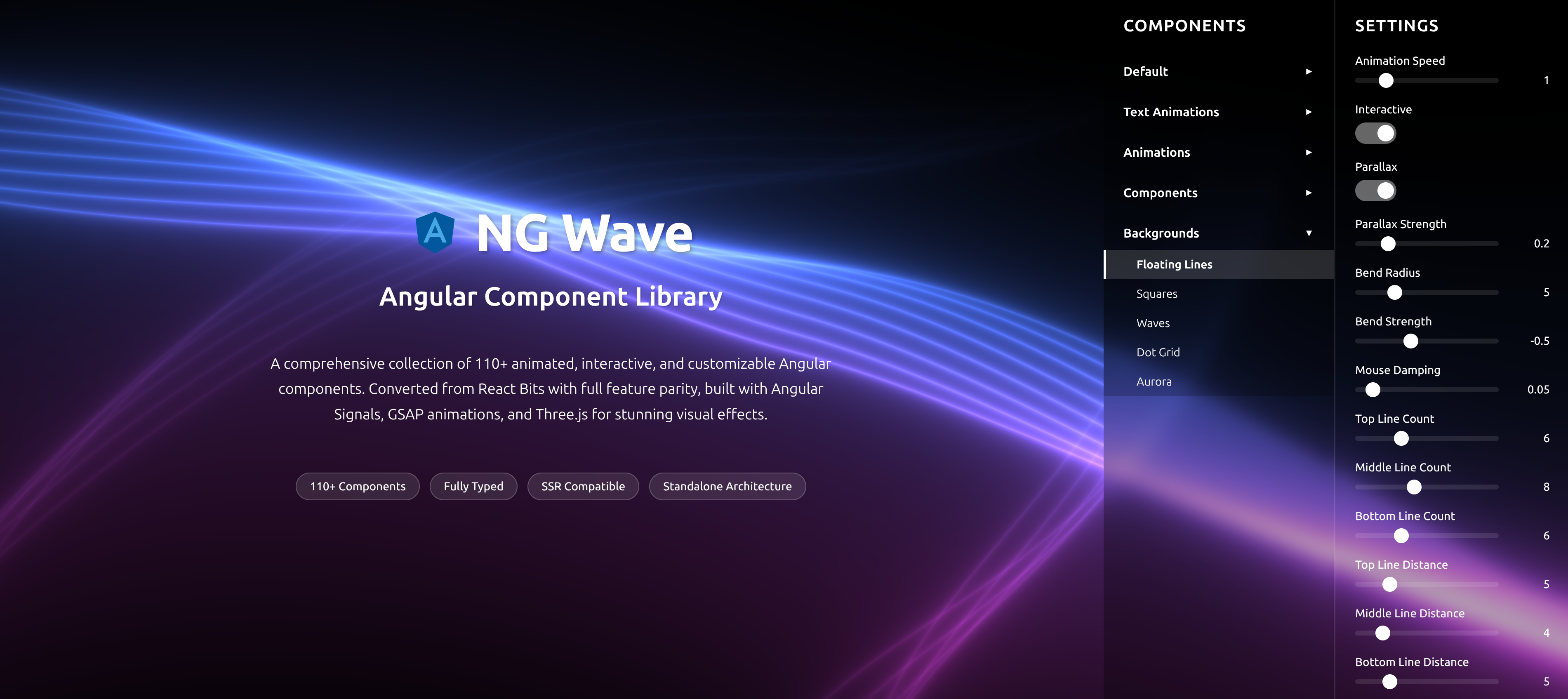
NG Wave
Angular Component Library
A comprehensive collection of 110+ animated, interactive, and customizable Angular components. Converted from React Bits with full feature parity, built with Angular Signals, GSAP animations, and Three.js for stunning visual effects.
Explore Components