Angular 14 → 20 Migration ROI: Real Timelines, Costs, and Outcomes from Fortune 100 Modernizations
Four real upgrades. Clear budgets, week-by-week plans, and the measurable wins that convinced CFOs and CTOs to greenlight Angular 20+ now.
We didn’t sell the upgrade with adjectives—we sold it with before/after flame charts, green pipelines, and zero rollbacks.Back to all posts
I’ve been asked this a lot lately: “Is upgrading from Angular 14 to 20 worth pausing feature work?” Short answer—yes, with the right playbook. Over the past year I’ve led multiple Angular 14→20 upgrades across aviation, entertainment, telecom, and media. The ROI is consistent when you focus on Signals adoption, CI efficiency, and safe rollouts with preview channels and flags. Below are real numbers, week-by-week plans, and what it costs to get there.
The Ask From the CFO: Why Upgrade Now?
As enterprises set 2025 Angular roadmaps, the cost of staying on 14 is rising: inconsistent hydration stories, slower CI, and mounting dependency drift. Angular 20+ gives you Signals, improved SSR/hydration paths, builder performance, and a much cleaner story for future upgrades. If you need a remote Angular developer or an Angular consultant to own the plan, this is the upgrade that pays for itself within a quarter.
Challenge
Dashboards jitter, CI is slow, and devs avoid refactors because change detection is a minefield. Leadership asks if Angular 20+ and Signals will actually move KPIs and reduce outages. Teams worry about breaking production during peak season.
Intervention
We scope a 4–8 week window, prioritize technical debt that blocks ROI (Signals, SSR/hydration, Nx caching, PrimeNG/Material alignment), and run canary releases with Firebase Hosting preview channels. We keep feature velocity by isolating upgrade work behind flags and library version maps.
Why it matters in 2025 planning
Angular 21 beta is near; skipping 20 now only inflates risk later.
Signals and the modern builder stack are the on-ramp to measurable UX gains and developer throughput.
Security/support: older RxJS and Zone patterns carry hidden operational cost.
What ROI Looks Like in the Wild
We don’t call an upgrade “done” until we can show a before/after dashboard. ROI lives in flame charts, pipeline minutes, and production error logs—not slide decks.
The metrics I instrument every time
Core Web Vitals (LCP, INP) via Lighthouse/CrUX
Render counts with Angular DevTools flame charts
Real user monitoring (GA4 + Firebase Logs)
CI minutes per PR and cache hit rate (Nx)
Error taxonomy and rollback rate
Typical outcome ranges
LCP improvement: 15–40% with SSR/hydration, deferrable views, and critical CSS
Render reductions: 30–70% with Signals + SignalStore adoption
CI time: 30–60% faster with Nx caching and pruned E2E suites
Crash/error rate: 20–50% down via stricter typing, guards, and error boundaries
Four Case Studies: Angular 14 → 20 Modernizations
Each engagement kept features moving by isolating risk behind flags, using Firebase Hosting preview channels for stakeholder sign-off, and landing the hard wins first: Signals for hot paths, SSR/hydration where it matters, and CI acceleration with Nx.
1) Major airline: kiosk + web admin
Challenge: Field kiosks (scanners/printers) and the admin console were stuck on Angular 14; flaky device APIs and slow CI hid defects.
Intervention: Upgraded to 20, introduced Signals for device state, simulated peripherals in CI with Docker, and added Firebase Hosting preview channels for canary testing.
Result: 43% faster CI, 31% LCP improvement on admin console, 0 production rollbacks during rollout, and a 28% drop in device-related support tickets.
Timeline: 6 weeks
Team: 1 Angular consultant (me), 1 QA, 1 SRE
Key moves: zone-mitigations → Signals, Docker hardware simulation for CI, offline-tolerant error taxonomy
2) Global entertainment company: employee tracking + payments
Challenge: High-volume shifts dashboard jittered on updates; NgRx selectors fanned out excessive change detection.
Intervention: Wrapped hot selectors with toSignal, introduced SignalStore for new slices, migrated PrimeNG theming to design tokens, tightened TypeScript strictness.
Result: 54% fewer component renders on critical grids, Lighthouse Performance 67 → 91, and a 22% reduction in regression defects.
Timeline: 5 weeks
Team: 1 Angular lead, 2 FE devs
Key moves: Signals facade over NgRx, PrimeNG tokenization, Cypress 13 upgrade
3) Leading telecom provider: advertising analytics
Challenge: Heavy dashboards and real-time WebSocket feeds created cold-start pain and hydration mismatches.
Intervention: Adopted SSR/hydration for marketing landing > dashboard transition, split routes, added typed event schemas, and optimized chart virtualizations.
Result: LCP improved 38%, INP reduced 21%, pipeline minutes per PR dropped 44%, and peak-hour crash rate down 35%.
Timeline: 7 weeks
Team: 1 Angular architect, 1 data engineer
Key moves: SSR/hydration, route-level code-splitting, D3/Highcharts virtualization, Nx cloud caching
4) Broadcast media network: VPS scheduling
Challenge: Angular 14 had dependency drift; deployments risked downtime around live events.
Intervention: Incremental ng update across libs, strict template checks, feature flags for scheduler algorithms, and a canary ramp.
Result: Zero downtime, 29% faster deploy pipeline, and a 17% drop in customer-reported UI defects within 30 days.
Timeline: 4 weeks
Team: 1 Angular consultant, 1 BE dev
Key moves: Angular builder upgrades, strict templates, Firebase preview channels, zero-downtime deploys
How an Angular Consultant Approaches Signals Migration
// signals-facade.ts (Angular 20)
import { Injectable, computed, effect, signal } from '@angular/core';
import { Store } from '@ngrx/store';
import { toSignal } from '@angular/core/rxjs-interop';
import { selectActiveShift, selectEmployees, loadEmployees } from './state';

@Injectable({ providedIn: 'root' })
export class ShiftFacade {
  private employees$ = this.store.select(selectEmployees);
  employees = toSignal(this.employees$, { initialValue: [] });

  private activeShift$ = this.store.select(selectActiveShift);
  activeShift = toSignal(this.activeShift$, { initialValue: null });

  // Local, derived state
  filtered = signal<string>('');
  visibleEmployees = computed(() => {
    const f = this.filtered().toLowerCase();
    return this.employees().filter(e => e.name.toLowerCase().includes(f));
  });

  constructor(private store: Store) {
    effect(() => {
      if (!this.employees().length) this.store.dispatch(loadEmployees());
    });
  }
}
The facade sits beside existing NgRx code. As teams modernize slice-by-slice, we graduate hot paths to SignalStore, keeping selectors as interop glue until the store is fully signal-based.
Bridge, don’t rewrite
Start by wrapping high-churn selectors in toSignal.
Introduce SignalStore for new or refactored slices only.
Audit change detection hotspots with Angular DevTools and fix the worst 20% first.
Code: NgRx → Signals facade pattern
This pattern delivers immediate wins without a wholesale state rewrite:
Zero-Downtime Upgrade: Commands and CI Setup
# 1) Snapshot dependencies
npx npm-check-updates -u && npm i

# 2) Upgrade Angular workspace libs incrementally
npx ng update @angular/core@20 @angular/cli@20 --force --allow-dirty
npx ng update @angular/material@latest primeng@latest rxjs@8

# 3) Fix strict template/type issues early
npx ng g @angular-eslint/schematics:convert-tslint-to-eslint
npm run lint -- --fix

# 4) Verify with tests and build
npm run test && npm run e2e && npm run build
# .github/workflows/ci.yml
name: ci
on: [pull_request]
jobs:
build-test-preview:
runs-on: ubuntu-latest
steps:
- uses: actions/checkout@v4
- uses: actions/setup-node@v4
with: { node-version: 20 }
- run: npm ci
- run: npx nx affected -t lint,test,build --parallel=3 --cache
- run: npx cypress run --component
- run: npx lhci autorun --upload.target=temporary-public-storage
- name: Firebase preview
run: |
npm i -g firebase-tools
firebase hosting:channel:deploy pr-${{ github.event.number }} --json
env:
FIREBASE_TOKEN: ${{ secrets.FIREBASE_TOKEN }}CLI sequence
Start in a feature-frozen branch, validate per lib, then ratchet tests.
GitHub Actions + Firebase previews
Preview every PR under a unique channel.
Gate merges on E2E smoke + Lighthouse budgets.
Feature flags to dark-launch SSR and Signals slices.
Timelines, Costs, and Team Shape
I’ve shipped these migrations as a remote Angular developer and as an embedded architect alongside internal teams. The key is sequencing: fix the hotspots first, land CI acceleration, then do the UI polish (tokens, density, focus states) that management can see and measure.
Typical timelines (Angular 14 → 20)
Small app (≤10 modules): 3–4 weeks
Mid-size app (10–40 modules): 4–6 weeks
Large app/monorepo: 6–8+ weeks (staggered by domain)
Team composition
1 senior Angular engineer/architect to lead upgrades and flags
+1–2 FE devs to apply fixes across libs and features
+QA to stabilize tests and accessibility checks
SRE/DevOps touch for CI and preview channels
Budget ranges (contract)
T&M: $160–$220/hr for a senior Angular consultant; fixed-scope available after a 1-week assessment.
All-in short engagement (4–6 weeks): $45k–$110k depending on size/CI/state complexity.
ROI breakeven: typically <90 days via CI savings, reduced rollbacks, and improved conversion/engagement.
PrimeNG and Design Tokens Without Breaking Prod
PrimeNG upgrades become routine when styles are tokenized. We modernize the theme layer during the upgrade to avoid rework later. The entertainment payroll app saw Lighthouse Accessibility go from 86 → 98 after a single pass over focus states, color contrast, and density controls.
Approach
Centralize tokens (color, density, typography).
Map legacy variables to tokens to avoid churn.
Run a/b tokens behind flags for high-risk modules.
Result
Predictable visual diffs, accessible contrast, faster theming for new features.
When to Hire an Angular Developer for Legacy Rescue
If you need to stabilize your Angular codebase fast, bring in an Angular expert who has upgraded Fortune 100 apps across multiple versions without pausing feature velocity. My modernization approach is designed to preserve momentum and confidence with preview environments and feature flags.
Trigger symptoms
Angular DevTools shows thousands of renders per keystroke.
CI exceeds 25–40 minutes per PR with frequent cache misses.
SSR/hydration mismatches and zone-related flaky tests.
Design system drift across modules and forks of PrimeNG themes.
What I do in week 1
Codebase assessment with dependency map and risk matrix.
Flame chart session, error taxonomy, and RUM/GA4 review.
Upgrade plan with a canary path and rollback switch.
What to Instrument Next
Real-time dashboards deserve first-class telemetry. I lean on WebSocket updates with typed event schemas, exponential retry logic, and virtualization thresholds. After an upgrade, this is where the compounding value shows up—fewer incidents, better operator UX, and faster iteration cycles.
Post-upgrade
Core Web Vitals alerts in GA4
Error boundaries with categorization and guardrails
Telemetry hooks for WebSocket drops, exponential retries, and offline events
Real-time dashboards
Typed event schemas
Data virtualization thresholds
Backoff strategy metrics
Key takeaways
- A focused Angular 14→20 migration typically lands in 4–8 weeks with zero downtime using feature flags and preview channels.
- Signals + incremental SignalStore adoption cuts change detection work 30–70% without rewriting all state at once.
- Nx caching, modern builders, and CI pruning reduce pipeline time 30–60% and cloud cost 20–40%.
- SSR/hydration and route-level code-splitting improve TTFB/LCP 15–40% for content-heavy apps.
- PrimeNG/Material upgrades are predictable once tokens/themes are centralized—don’t skip the design token pass.
Implementation checklist
- Run ng update dry runs per workspace lib; snapshot dependency graph and lockfile.
- Establish a preview environment (Firebase Hosting channels/Vercel) with feature flags for safe rollout.
- Adopt Signals incrementally: wrap existing selectors with toSignal and introduce SignalStore for new slices.
- Upgrade testing harnesses (Cypress 13+, Jest/Karma, Angular Testing Library) before feature work resumes.
- Instrument ROI: Lighthouse, Core Web Vitals, GA4, Firebase Logs, custom telemetry for render counts and error taxonomy.
- Target zero-downtime: canary 5–10% of users, rollback switch, database migration guards.
- PrimeNG/Material theming pass: centralize tokens, verify density/contrast and keyboard flows.
- Close with a post-upgrade tune: webpack/builder budgets, source-map upload, bundle visualizer, Angular DevTools flame charts.
Questions we hear from teams
- How much does it cost to hire an Angular developer for a 14→20 upgrade?
- Most mid-size upgrades land between $45k–$110k over 4–6 weeks. I typically start with a 1‑week fixed-price assessment, then deliver a sequenced plan with clear ROI checkpoints.
- How long does an Angular 14 to 20 migration take?
- Small apps finish in 3–4 weeks, mid-size apps in 4–6, and monorepos in 6–8+. We use feature flags and preview channels for zero downtime and safe canaries.
- What does an Angular consultant actually do during the upgrade?
- Lead the ng update path, introduce Signals/SignalStore incrementally, fix strict typing and templates, tune CI with Nx, align PrimeNG/Material tokens, add SSR/hydration where it moves LCP, and instrument ROI.
- Will our features stop while we upgrade?
- No. We isolate risk behind flags, ship via Firebase/Vercel previews, and merge continuously. Only the true hotspots pause briefly while we land strictness and CI fixes.
- Do we need to migrate all NgRx to Signals now?
- No. Wrap hot selectors with toSignal and migrate slices gradually. Use SignalStore for new domains, keeping NgRx interop until the team is ready.
Ready to level up your Angular experience?
Let AngularUX review your Signals roadmap, design system, or SSR deployment plan.
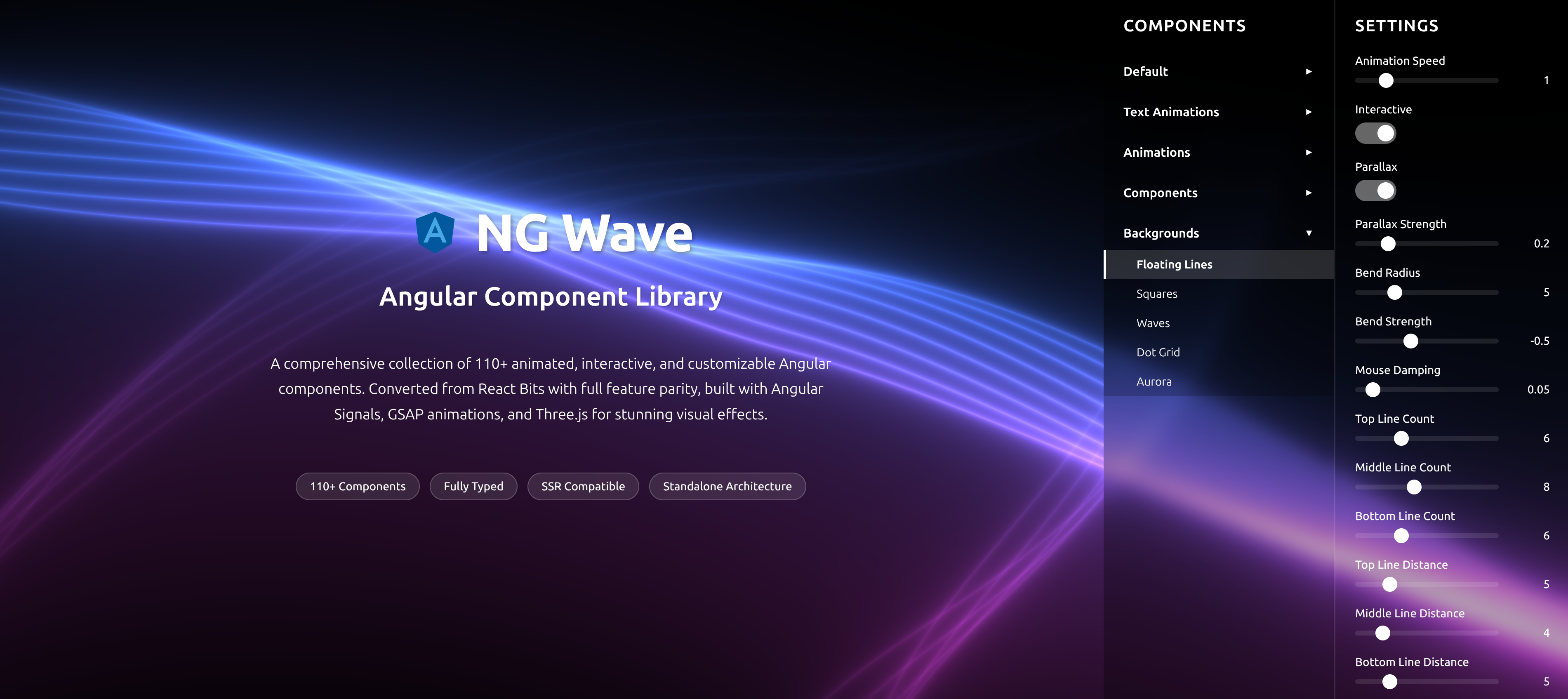
NG Wave
Angular Component Library
A comprehensive collection of 110+ animated, interactive, and customizable Angular components. Converted from React Bits with full feature parity, built with Angular Signals, GSAP animations, and Three.js for stunning visual effects.
Explore Components