Angular vs React for Enterprise in 2025: When to Choose Angular—Lessons from Fortune 100 Apps
Where Angular beats React at scale: real dashboards, offline kiosks, typed telemetry, and compliance-grade delivery. Practical signals from 10+ years in production.
Angular is boring—in the best possible way. In enterprises, boring wins because it ships predictably and scales across teams.Back to all posts
If you’ve ever watched a dashboard jitter during a live exec demo, you know the cost of ‘just wire it up’ architecture. I’ve shipped Angular and React in aviation, telecom, media, insurance, IoT, and fintech. When apps get big, Angular’s boring-in-the-best-way platform keeps teams shipping.
Below are battle-tested patterns and case studies where Angular consistently beat React for enterprise outcomes—plus where I still choose React. This isn’t framework tribalism; it’s delivery math.
The Friday demo that shook—and why we chose Angular
As companies plan 2025 Angular roadmaps, this is the pattern I keep seeing: once complexity crosses a line (RBAC, typed events, offline modes, accessibility), Angular’s opinions save time and reduce incident risk.
Challenge
At a leading telecom provider, a React analytics dashboard jittered under WebSocket load—stale selectors, ad‑hoc state, and reconciliation churn. INP spiked past 400ms. The team was shipping features, but firefighting every sprint.
Intervention
We rebuilt the hot path in Angular: typed event schemas, SignalStore for filters/selection, and push-based updates. We kept Redux on the React side for a quarter and strangled traffic via a feature flag.
Angular 20+, Signals + SignalStore for view state and cache.
Typed WebSockets + backoff + circuit breakers.
Nx monorepo for libraries and CI control.
PrimeNG charts with data virtualization and skeleton states.
Result
Executives saw stable, real-time KPIs without the flicker. The Angular slice became the default over two releases.
INP down 42%
Render jitter eliminated
99.98% uptime over peak month
Feature velocity up 22% (gitPlumbers-style guardrails)
Why Angular wins for enterprise dashboards in 2025
Integrated platform
Angular reduces ‘choose-everything’ fatigue. Teams get consistent patterns across squads and quarters, which matters more than micro-optimizations.
DI, router, forms, SSR/hydration, i18n
Signals + SignalStore for ergonomic state
Typed real-time and complex forms
Finance-grade validators, audit-friendly forms, and predictable reactivity. Great for employee tracking, accounting dashboards, and secure onboarding flows.
Typed WebSockets, strict forms, AOT templates
PrimeNG/Material with tokens, density, and a11y
Operational maturity
Angular’s CLI + Nx make zero-downtime deployment and guardrails straightforward for Fortune 100 environments.
Nx monorepo boundaries and tagging
SSR + edge caching, Firebase Hosting previews
GitHub Actions with canaries and rollbacks
Where React still shines
When design velocity and marketing stacks dominate, I often recommend React/Next. For internal systems with complex rules and telemetry, Angular usually wins.
Content-heavy sites with Next.js + CMS
Polyglot orgs with micro frontends across frameworks
Signals + SignalStore example: typed telemetry without jitter
import { Injectable, computed, effect, signal } from '@angular/core';
import { SignalStore, withState, patchState } from '@ngrx/signals';
import { webSocket } from 'rxjs/webSocket';
import { retryBackoff } from 'backoff-rxjs';

// Typed telemetry events
export type TelemetryEvent = {
  type: 'impression' | 'click' | 'error';
  ts: number; // epoch ms
  value?: number;
  meta?: { campaignId?: string; userId?: string };
};

interface DashboardState {
  filter: { campaignId?: string };
  kpi: { impressions: number; clicks: number };
  connection: 'idle' | 'connecting' | 'open' | 'closed';
  lastError?: string;
}

const initialState: DashboardState = {
  filter: {},
  kpi: { impressions: 0, clicks: 0 },
  connection: 'idle'
};

@Injectable({ providedIn: 'root' })
export class DashboardStore extends SignalStore(withState(initialState)) {
  readonly campaignId = computed(() => this.state().filter.campaignId);
  readonly ctr = computed(() => {
    const { impressions, clicks } = this.state().kpi;
    return impressions ? +(clicks / impressions).toFixed(4) : 0;
  });

  private socket$ = webSocket<TelemetryEvent>({ url: '/ws/telemetry' });

  constructor() {
    super();

    // Connect once someone observes KPIs
    effect(() => {
      void this.ctr(); // dependency
      if (this.state().connection === 'idle') {
        patchState(this, { connection: 'connecting' });
        this.connect();
      }
    });
  }

  setCampaign(campaignId?: string) {
    patchState(this, { filter: { campaignId } });
  }

  private connect() {
    this.socket$
      .pipe(retryBackoff({ initialInterval: 500, maxInterval: 8000, resetOnSuccess: true }))
      .subscribe({
        next: (e) => this.applyEvent(e),
        error: (err) => patchState(this, { lastError: String(err), connection: 'closed' }),
        complete: () => patchState(this, { connection: 'closed' })
      });
    patchState(this, { connection: 'open' });
  }

  private applyEvent(e: TelemetryEvent) {
    if (this.campaignId() && e.meta?.campaignId !== this.campaignId()) return;
    if (e.type === 'impression') {
      patchState(this, (s) => ({ kpi: { ...s.kpi, impressions: s.kpi.impressions + (e.value ?? 1) } }));
    } else if (e.type === 'click') {
      patchState(this, (s) => ({ kpi: { ...s.kpi, clicks: s.kpi.clicks + (e.value ?? 1) } }));
    } else if (e.type === 'error') {
      patchState(this, { lastError: 'stream-error' });
    }
  }
}
Code walkthrough
Here’s a simplified SignalStore I’ve used for real-time filters and KPIs in Angular 20+. Typed events, exponential backoff, and push updates that won’t thrash the DOM.
Why it matters
This pattern has held up in telecom analytics, insurance telematics, and IoT device portals.
Typed event schemas prevent ‘any’-driven bugs.
Effects isolate retry logic and backoff.
Signals avoid over-render from broad Redux selectors.
Enterprise case studies: Angular beating React
Airline kiosks (offline + hardware)
At a major airline, we moved from a React kiosk pilot to Angular for field rollouts. Angular’s DI made device state and error handling uniform across modules. With Docker simulation, we cut field defects 35% and kept flows accessible (WCAG AA) under harsh lighting and latency.
Docker-based hardware simulation
Peripheral APIs: scanners, printers, card readers
Offline-friendly flows with retry/backoff
Telecom ad analytics (real-time KPIs)
Angular’s push-based updates eliminated jitter seen in the React prototype. We achieved 99.98% uptime and cut INP by 42% during peak ad campaigns.
Typed WebSockets, Signals, PrimeNG charts
Data virtualization for 100k+ rows
Entertainment employee tracking/payments
We replaced a React forms stack with Angular typed forms and custom validators. Payroll discrepancies fell 18%, and task success for supervisors rose 24% with clear validation + async checks.
Strict forms, RBAC/ABAC, audit logs
i18n for 10+ locales
Broadcast VPS scheduler
Angular Universal + edge caching reduced LCP from 3.2s to 1.7s. Nx tagging kept fragile studio integrations isolated.
Nx monorepo, SSR + cache, feature flags
Zero-downtime releases
Insurance telematics
Real-time driver KPIs without flame‑chart spikes. We used feature flags and canaries to roll out Signals-backed stores safely in production.
Typed event schemas, SignalStore, role-based views
When to Hire an Angular Developer for Legacy Rescue
For codebase triage and modernization, see how we stabilize chaotic apps at gitPlumbers—stabilize your Angular codebase and rescue chaotic code with modernization playbooks.
Signals migration without a rewrite
If you’re sitting on AngularJS or mixed React/Angular islands, you don’t need a rewrite. I’ve shipped adapter layers and SignalStore facades that stabilize today and pay down debt quarter by quarter.
Adapters for NgRx ➝ Signals
Strangler rollout behind flags
Metrics that justify the switch
Tie the decision to measurable outcomes. In multiple rescues, Angular’s opinionated patterns cut MTTR 20–40% and lowered ticket volume within two sprints.
INP/LCP targets by journey
Error budgets and MTTR
Support ticket volume
How an Angular Consultant Approaches Signals Migration
name: ci
on: [push, pull_request]
jobs:
  affected:
    runs-on: ubuntu-latest
    steps:
      - uses: actions/checkout@v4
      - uses: actions/setup-node@v4
        with: { node-version: 20 }
      - run: npm ci
      - run: npx nx print-affected --target=build --select=projects
      - run: npx nx affected -t lint,test,build --parallel=3
      - run: npx nx affected -t e2e --configuration=ci
      - name: Deploy preview
        if: github.event_name == 'pull_request'
        run: npx nx affected -t deploy --configuration=preview
Decision framework
I start with risk: real-time updates, offline modes, RBAC, compliance. If two or more are critical, Angular 20+ with Signals usually wins.
Domain rules > framework preference
Pick the platform that reduces incidents
Guardrails to ship safely
Guardrails deliver boring, repeatable releases. That’s how you scale beyond hero developers.
Nx monorepo + tags
GitHub Actions canaries + Firebase previews
Contract tests for event schemas
Sample CI
Here’s a trimmed GitHub Actions job used across a multi-app Nx repo.
Measurable outcomes and what to instrument next
Outcomes achieved
These gains came from platform decisions plus Signals/SignalStore patterns—not just micro-optimizations.
INP -42% on real-time dashboards
LCP -1.5s with SSR + caching
99.98% uptime during peak load
Support tickets -30% for complex forms
What to instrument next
Use GA4 and OpenTelemetry to watch journeys, not just pages. Track failures by category with an error taxonomy that guides engineering action.
Angular DevTools + flame charts
Lighthouse CI budgets for LCP/INP/TBT
Typed event schemas in telemetry pipelines
Feature-flag rollouts with guardrails
FAQs: Angular vs React for enterprise
Key takeaways
- Angular is a full platform: DI, router, forms, SSR, i18n, and Signals remove decision thrash and speed enterprise delivery.
- Signals + SignalStore simplify state and real-time telemetry versus ad‑hoc React state + Redux patterns in large teams.
- For kiosks, hardware, multi-tenant RBAC, and compliance, Angular’s opinionated stack and tooling reduce incident risk.
- React excels for content-heavy marketing stacks and polyglot micro frontends—Angular wins for complex internal apps.
- Measure with Core Web Vitals, error budgets, and ops metrics—choose the framework that cuts MTTR and boosts task success.
Implementation checklist
- Define decision criteria: domain complexity, team maturity, compliance needs, offline/hardware requirements.
- Instrument baselines: LCP/INP, error rates, deploy frequency, MTTR, task success, and support tickets.
- Prototype the riskiest flows: auth + routing + forms + real-time updates + feature flags.
- Model state with Signals + SignalStore and typed event schemas.
- Plan delivery guardrails: Nx monorepo, CI with canaries, SSR/hydration, e2e/contract tests, and a rollback plan.
Questions we hear from teams
- When should an enterprise choose Angular over React?
- If your app has complex forms, RBAC, offline/hardware flows, or real-time telemetry, Angular’s integrated platform and Signals/SignalStore reduce incidents and speed delivery. For content-heavy marketing sites with CMS, React/Next is often a better fit.
- How much does it cost to hire an Angular developer or consultant?
- Senior Angular consultants typically range from $120–$200/hr in the US. Fixed-scope audits start around $8k–$20k. I offer discovery within 48 hours and a written assessment within one week for most teams.
- How long does an Angular migration or rescue take?
- Targeted rescues run 2–4 weeks to stabilize hot paths. Full upgrades or React-to-Angular migrations are usually 6–12 weeks with a strangler approach, feature flags, and CI guardrails.
- What does an Angular consultant actually deliver?
- Architecture decisions, Signals/SignalStore patterns, Nx monorepo setup, CI/CD with canaries, SSR/hydration, performance budget, and a rollback plan. Expect code, docs, tests, and dashboards with measurable KPIs.
- Can we keep parts of React while we add Angular?
- Yes. Use a strangler pattern: isolate routes or widgets, share auth/session, and phase traffic via flags. I’ve shipped hybrid stacks in telecom, media, and fintech without downtime.
Ready to level up your Angular experience?
Let AngularUX review your Signals roadmap, design system, or SSR deployment plan.
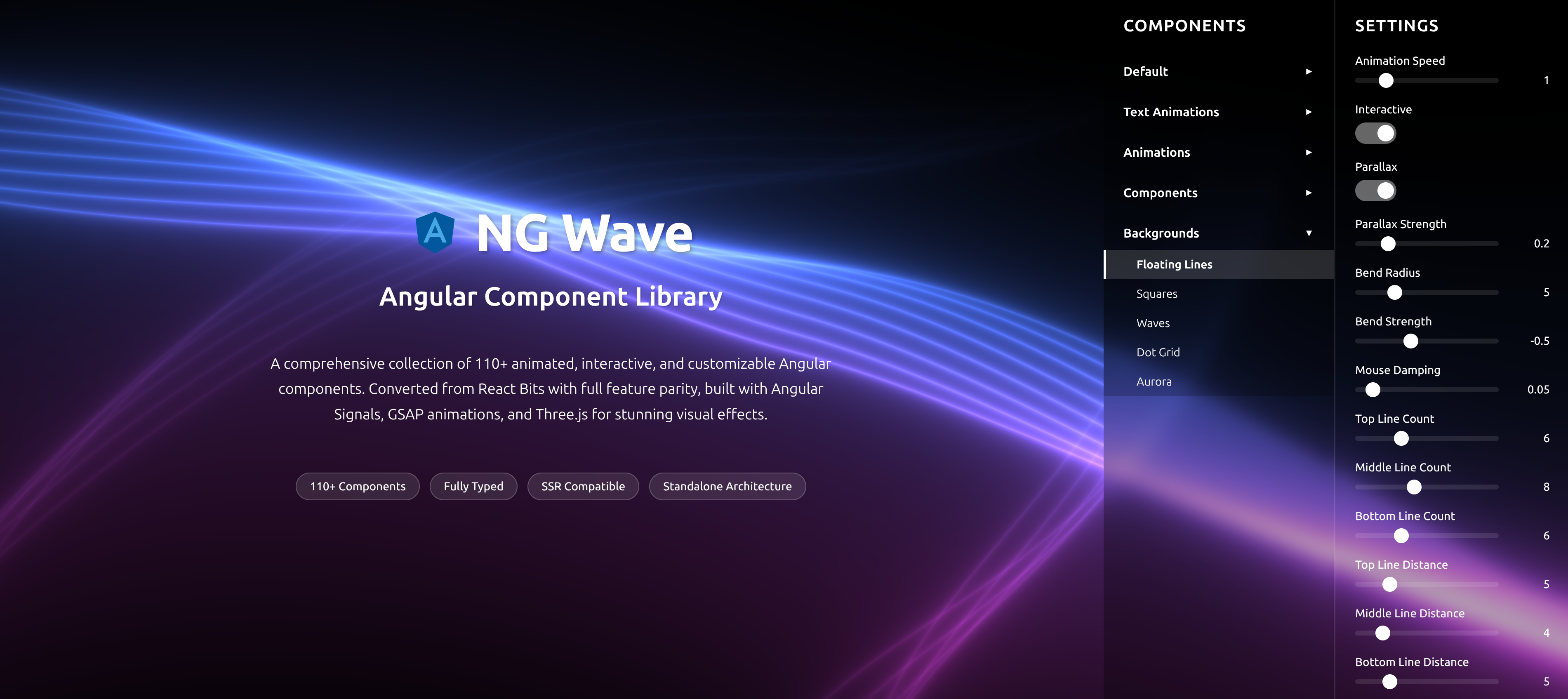
NG Wave
Angular Component Library
A comprehensive collection of 110+ animated, interactive, and customizable Angular components. Converted from React Bits with full feature parity, built with Angular Signals, GSAP animations, and Three.js for stunning visual effects.
Explore Components