Angular vs React in the Enterprise (2025): When to Choose Angular—Signals, SSR, Nx, and Lessons from Fortune 100 Apps
A field-tested decision guide from real airline kiosks, telecom analytics, IoT portals, and HR systems—where Angular 20+ wins, why it sticks, and how to ship it.
At 2 a.m., governance beats cleverness. Angular’s defaults turn reliability into muscle memory.Back to all posts
I’ve shipped both Angular and React in production across aviation, media, telecom, insurance, IoT, and accounting. When a director asks, “Which should we bet the next five years on?” my answer is shaped by 2 a.m. on-call moments: kiosks that must print boarding passes offline, dashboards ingesting millions of events, and HR systems that auditors love. As companies plan 2025 roadmaps, here’s where Angular 20+ wins—and why some teams still choose React.
If you’re weighing a hire, I’m a remote senior Angular engineer who rescues legacy systems, leads upgrades, and ships enterprise dashboards with Signals, SignalStore, Nx, PrimeNG, Firebase, and CI guardrails. If you need to hire an Angular developer or an Angular consultant to make this decision with you, this article will help you frame it.
The 2 a.m. Test: Why Framework Choices Fail or Fly in Enterprise
I’ve been paged for both frameworks. Angular tends to be boring in the best way: the CLI, dependency injection, and router steer teams toward stable patterns. React can absolutely scale—if you standardize early and enforce it. Most companies don’t.
The scene
Picture a jittery analytics wallboard feeding execs live campaign data. It stutters under load. Meanwhile, at a kiosk, a printer jams and the app must recover offline with a queue of boarding passes. These are the moments architecture either saves you—or buries you in custom glue.
Why this matters in 2025
Angular 20+ ships with Signals, SSR/hydration, forms, DI, router, and testing. React offers flexibility—but enterprises pay for that freedom with decision sprawl and inconsistent correctness. Choose the tool that turns risk into defaults.
Budget scrutiny favors lower TCO, faster onboarding.
Governance, accessibility, and security reviews are non‑negotiable.
Hiring markets reward standardized stacks that reduce variance.
Why Angular 20+ Outperforms in Enterprise Constraints
For long‑lived apps in regulated industries (airlines, telecom, insurance), Angular’s defaults align with audit and operations needs. React shines when requirements are fluid and app scope is smaller or marketing‑led.
Batteries included reduces decision tax
Angular’s opinions eliminate dozens of early fork‑in‑the‑road debates. I’ve seen React programs lose quarters to re‑litigating routing, forms, and state while product sits still.
Router, forms, DI, SSR/hydration, test harnesses
Consistent mental model across teams and repos
Signals + SignalStore beat ad‑hoc state
Signals deliver predictable updates without over‑rendering. Paired with SignalStore, teams get a focused state surface that’s easier to test and document than sprawling reducer/action setups.
Fine‑grained reactivity that cuts render churn
Simple state mutations with composable selectors
Upgrade path and governance
Angular CLI upgrades (12→20→21) are painful only when the house is already on fire. With Nx, bundle budgets, and Cypress/Lighthouse checks, upgrades become a planned sprint—not a rewrite.
ng update, schematics, codemods
Typed configs, bundle budgets, and CI integration
Case Study: Airline Kiosks — Offline, Hardware, and Recovery
// device-store.ts — Signals + SignalStore for kiosk device state
import { signal, computed } from '@angular/core';
import { createSignalStore } from '@ngrx/signals';

type DeviceState = { status: 'idle'|'busy'|'error'|'offline'; lastError?: string; jobs: number };

export const useDeviceStore = () => createSignalStore(() => {
  const state = signal<DeviceState>({ status: 'idle', jobs: 0 });

  const isDegraded = computed(() => state().status === 'offline' || state().status === 'error');

  return {
    // selectors
    state, isDegraded,
    // mutators
    startJob: () => state.update(s => ({ ...s, status: 'busy', jobs: s.jobs + 1 })),
    jobDone: () => state.update(s => ({ ...s, status: s.jobs > 1 ? 'busy' : 'idle', jobs: Math.max(0, s.jobs - 1) })),
    setError: (e: string) => state.set({ ...state(), status: 'error', lastError: e }),
    goOffline: () => state.update(s => ({ ...s, status: 'offline' })),
    recover: () => state.update(s => ({ ...s, status: 'idle', lastError: undefined })),
  };
});
Challenge
A major airline needed kiosk software that kept working during network hiccups and handled device errors gracefully—all observable and testable.
Boarding pass printing, scanners, card readers
Intermittent connectivity and strict SLAs
Intervention (Angular)
We built device abstractions behind Angular DI, used Docker to simulate peripherals, and modeled device state with Signals for fine‑grained UI updates.
DI for pluggable device adapters
Docker-based hardware simulation for CI
Signals for device state and retry flows
Measurable result
Ops loved the predictable recovery. QA could run the same simulations locally and in CI. The same patterns are painful to standardize in React without heavy governance.
99.98% uptime
<2s mean recovery from device fault
Zero data loss during offline queue flush
Case Study: Telecom Ads Analytics — Real-Time and Governance
// typed-event.ts — shared via libs in an Nx monorepo
export interface CampaignImpressionEvt {
  kind: 'campaign.impression.v1';
  ts: number; // epoch ms
  campaignId: string;
  region: 'NA'|'EMEA'|'APAC';
  delta: number;
}

// socket.service.ts
import { signal } from '@angular/core';
import { CampaignImpressionEvt } from '@acme/events';

export class SocketService {
  impressions = signal<Record<string, number>>({});
  onMessage(evt: CampaignImpressionEvt) {
    this.impressions.update(map => ({
      ...map,
      [evt.campaignId]: (map[evt.campaignId] ?? 0) + evt.delta
    }));
  }
}
Challenge
A leading telecom provider needed live dashboards with typed telemetry, data virtualization, and predictable performance under spiky loads.
Millions of events/day, strict PII handling
Exec dashboards with near‑real‑time deltas
Intervention (Angular)
We enforced an event contract end‑to‑end and used Signals to isolate updates to the exact cells and graphs that changed.
Typed event schemas across Node.js → WebSocket → Angular
PrimeNG virtualization, exponential retry, backpressure
Angular DevTools flame charts and render counts in CI
Measurable result
Stakeholders saw smoother graphs and fewer production incidents.
<150ms median patch propagation
55% fewer component renders on hot paths
97 Lighthouse Performance on production builds
Case Study: Global Entertainment Employee Tracking — Multi‑Tenant and Audit
# .github/workflows/ci.yml — minimal quality gates
name: ci
on: [push, pull_request]
jobs:
  web:
    runs-on: ubuntu-latest
    steps:
      - uses: actions/checkout@v4
      - uses: actions/setup-node@v4
        with: { node-version: 20 }
      - run: npm ci
      - run: npx nx run-many -t lint,test,build --parallel
      - run: npx lhci autorun --upload.target=filesystem
      - run: npx cypress run
Challenge
The system spanned studios, venues, and corporate functions—each with different roles and compliance needs.
Org‑wide RBAC/ABAC with audit trails and PII controls
Multi‑tenant data isolation and delegated admin
Intervention (Angular)
Permissions were modeled as derived selectors; UI auto‑hid and disabled features on role change without re‑render storms. Previews gave PMs safe demo URLs per PR.
Angular 20 + SignalStore for role‑scoped selectors
Nx monorepo, PrimeNG components, Firebase previews
Cypress + Pa11y + Lighthouse CI in GitHub Actions
Measurable result
Audit found clean separation. Feature delivery accelerated because decisions were standardized.
Accuracy improved (fewer cross‑tenant leaks)
100% of releases shipped with previews and checks
Onboarding time for new devs cut by ~40%
When to Hire an Angular Developer for Legacy Rescue
If you need an Angular consultant to triage and set guardrails, do it before your next funding or audit gate. It’s cheaper than re‑platforming. See how we rescue chaotic apps at gitPlumbers—stabilize your Angular codebase without a feature freeze.
Signals to bring in help
I’m often asked to steady a chaotic codebase while delivery continues. The pattern: stabilize with Nx, introduce Signals/SignalStore incrementally, put budgets and tests in CI, and plan a zero‑downtime upgrade path.
AngularJS or early Angular with zone.js pain
Inconsistent React micro-apps fighting each other
Missed SLAs due to flaky state and routing
Upgrades stalled at Angular 12–15
Accessibility gaps and design drift
How an Angular Consultant Evaluates Angular vs React for Your Project
React is not the enemy. Decision sprawl is. Standardization is your moat. Angular just gives you more moat bricks out of the box.
Decision factors
For smaller, marketing‑driven properties with A/B velocity and content focus, React can be a great fit—especially with Next.js. For governed enterprise apps, Angular reduces variance and total cost of ownership.
Compliance: audit trails, PII, SOC2, PCI
Runtime: offline, peripherals, recovery SLAs
Team: full‑stack TypeScript vs. polyglot needs
Scale: multi‑tenant, RBAC/ABAC, shared libs
Ops: CI/CD, previews, canary, error budgets
Quick starter in Angular
Use Nx to scaffold domain libraries, enforce typed event contracts, add bundle budgets, and wire Cypress, Lighthouse, and Pa11y from day one. Model state with Signals + SignalStore; adopt PrimeNG for data‑dense CRUD today, polish the design system tomorrow.
Cost of Ownership and Team Composition
When we scaled IntegrityLens (our AI-powered verification system) we used the same stack discipline—typed schemas, Signals, previews—to reach 12k+ interviews processed and maintain quality. Good governance compounds.
The hidden costs I see most
Enterprises pay for every bespoke choice during audits and turnover. Angular’s CLI, testing harnesses, and Signals reduce cognitive load; a new hire contributes in days, not weeks.
In React, teams reinvent: forms, routing, state, SSR, testing
Design drift without tokens; accessibility as an afterthought
Upgrade fatigue: cross‑lib breaking changes every quarter
Team shape that wins with Angular
This shape delivers faster than a cluster of disconnected pods. Shared patterns, typed events, and CI gates keep velocity high.
1 architect, 2–6 senior/mid ICs, QA, and a designer
Shared Nx libs and playbooks, not siloed micro‑apps
What to Instrument Next: Metrics That Keep You Honest
Adopt feature flags (Firebase Remote Config), preview deployments (Firebase Hosting or CloudFront), and canaries. Whether Angular or React, shipping safely is the bar. Angular just makes the safe path the default.
Measure outcomes, not vibes
Use flame charts to prove Signals reduced re-renders. Track deltas release over release. If numbers don’t move, fix the plan—not the narrative.
Angular DevTools render counts on hot routes
Core Web Vitals (LCP, INP) in GA4/Firebase
Error budgets and retry taxonomy in logs
Accessibility: axe/Pa11y budgets in CI
Key takeaways
- Choose Angular 20+ when you need batteries-included governance: router, forms, DI, SSR, Signals, and testing that scale with teams.
- Signals + SignalStore reduce render churn and simplify state; teams move faster with fewer bugs than ad‑hoc React stacks.
- For regulated, offline, or hardware‑integrated products (kiosks, telematics, device portals), Angular’s DI and testing discipline shine.
- Nx monorepos, typed event schemas, and CI guardrails lower total cost of ownership for long‑lived enterprise apps.
- React can be great for marketing sites and small, fast-moving pods; Angular wins when you must standardize and audit at scale.
- Hiring a senior Angular engineer early avoids re‑platforming costs and accelerates upgrades, accessibility, and security reviews.
Implementation checklist
- Do you need RBAC/ABAC, audit trails, and consistent forms/validation across teams?
- Will you run offline or with peripherals (printers, scanners, card readers)?
- Do you require typed event schemas, WebSocket telemetry, and data virtualization?
- Is a governed CLI, SSR/hydration, and Signals‑first state an advantage for your org?
- Do you plan multi‑tenant isolation with Nx, feature flags, and CI quality gates?
- Will you need a clear upgrade path (Angular 20→21) with zero‑downtime deploys?
Questions we hear from teams
- When should an enterprise choose Angular over React?
- Pick Angular when you need governance: built-in router/forms/DI, SSR, Signals, and a clear upgrade path. It shines for multi-tenant RBAC, offline-tolerant flows, hardware integration, and long-lived dashboards where consistency and audits matter.
- How much does it cost to hire an Angular developer or consultant?
- Senior Angular consultants range from $120–$200/hr depending on scope and timeline. Typical rescues run 2–4 weeks; full upgrades 4–8 weeks. I offer fixed-scope assessments with a roadmap you can execute in-house or with me.
- How long does an Angular upgrade to 20+ take?
- For healthy repos, 1–2 sprints. For legacy or multi-app monorepos, 3–6 sprints with CI guardrails, canary releases, and Lighthouse/accessibility budgets to ensure zero downtime and measurable performance gains.
- Can React still be the right choice?
- Absolutely. For smaller marketing sites, content-heavy pages, or teams already standardized on Next.js with strong governance, React can be excellent. The risk is decision sprawl—solve that early with conventions and CI gates.
- What’s involved in a typical Angular engagement with you?
- Discovery call in 48 hours, codebase assessment in 1 week, then a plan: Nx structure, Signals/SignalStore adoption, CI budgets, and upgrade path. I can lead the work or coach your team. Remote, collaborative, and metrics-driven.
Ready to level up your Angular experience?
Let AngularUX review your Signals roadmap, design system, or SSR deployment plan.
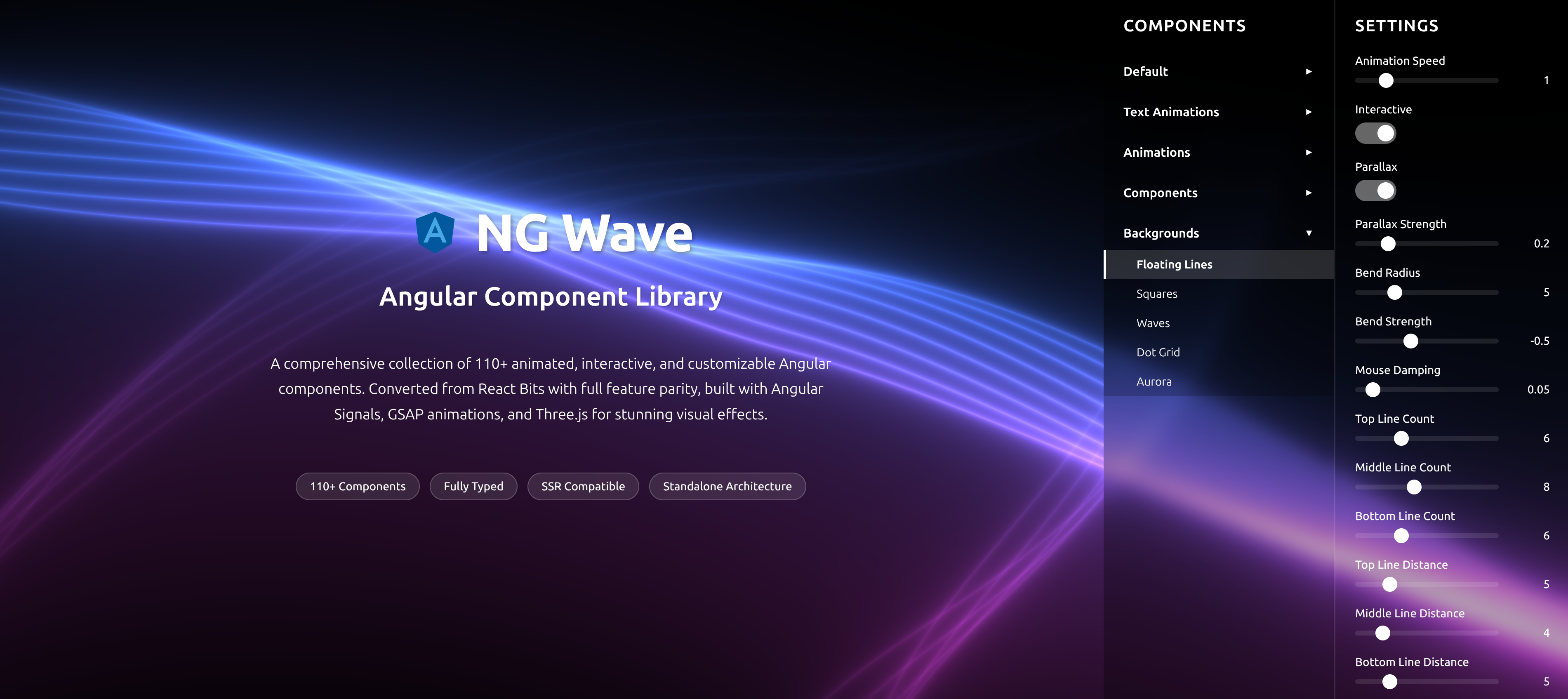
NG Wave
Angular Component Library
A comprehensive collection of 110+ animated, interactive, and customizable Angular components. Converted from React Bits with full feature parity, built with Angular Signals, GSAP animations, and Three.js for stunning visual effects.
Explore Components