Before/After: Rescuing a Chaotic Angular Codebase into a Maintainable, Fast Angular 20 System (Signals + Nx, Real Numbers)
A real rescue: from vibe-coded chaos and jittery dashboards to Angular 20 calm—Signals, SignalStore, Nx, CI guardrails, and telemetry that prove the win.
We cut renders by 73%, dropped p95 TTI by 59%, and shipped behind flags—no outages, no drama.Back to all posts
I’ve stepped into more than a few chaotic Angular codebases—jittery dashboards, failing tests, blockers everywhere—usually right before a demo or QBR. The pattern is consistent: vibe-coded state, brittle async, no guardrails, and lots of rendering waste.
This case study walks through a recent rescue that mirrors work I’ve led at a global entertainment company (employee/payments tracking), Charter (ads analytics), a broadcast media network (VPS scheduling), and United (kiosk hardware simulation). The stack: Angular 20, Signals + SignalStore, Nx, PrimeNG, Firebase, and CI that refuses regressions.
We’ll go challenge → intervention → measurable result. You’ll see the precise tools I use—Angular DevTools flame charts, SignalStore patterns, Nx boundaries—and the CI telemetry that proves we didn’t just shuffle code; we made the product measurably better.
If you need to hire an Angular developer or bring in an Angular consultant to stabilize a legacy app without breaking production, this is how I do it—remotely, predictably, and quickly.
The Dashboard That Jittered in Front of Execs (Hook)
As companies plan 2025 Angular roadmaps, execs want proof, not promises. We anchor the plan to hard numbers and keep the changes shippable behind feature flags so nothing breaks in production.
What I walked into
The first demo I saw looked like a pinball machine—charts repainted on every websocket tick, tables re-sorted on every keystroke, and a memory footprint that climbed until Chrome begged for mercy. Leadership asked if we could stabilize in weeks, not months. That’s the job.
Angular 14 app, partial NgRx, lots of ad-hoc BehaviorSubjects
Jittery PrimeNG tables and charts, renders spiking 30–60/sec
Circular deps across features, flaky CI, failing unit tests
No TypeScript strictness, inconsistent null handling, zone.js everywhere
Immediate baselines
I never refactor blind. We captured render counts with Angular DevTools, profiled flame charts, and turned on Firebase Performance and GA4 for p95 TTI and route transitions. These became our scoreboard.
p95 TTI 5.2s (core route)
Avg. renders per detail view: 180 during a 30s session
Bundle 2.4MB (gz), vendor bloated
Error rate 3.1% (unhandled promise rejections, null derefs)
Why This Matters for Angular 20 Teams
Angular 20+ gives us Signals, SSR improvements, and better build ergonomics. But without structure, teams recreate old problems. We pair modern APIs with architecture, CI, and telemetry so the gains stick.
Cost of chaos
In aviation, media, and telecom, real-time is table stakes. I’ve seen this at a major airline (kiosk reliability), Charter (ads telemetry), and a broadcast media network (scheduling). If your dashboard jitters, your business decisions jitter.
Engineers spend cycles firefighting instead of shipping features
Jitter and lag destroy trust and NPS
Hiring suffers when candidates see a tangled repo
The modernization lever
For stakeholders evaluating an Angular consultant, the question is ROI and time-to-stability. The lever is disciplined modernization with guardrails and measurable outcomes.
Signals + SignalStore cut accidental renders
Nx boundaries prevent code rot
Telemetry turns subjective UX into objective KPIs
The 4-Week Rescue Playbook (Challenge → Intervention → Result)
Here’s one representative SignalStore slice that replaced three BehaviorSubjects, two services, and several leaky subscriptions:
Week 0–1: Stabilize the foundation
We didn’t forklift to a new app. We created safety rails first. Nx split the repo into domain libs (analytics, users, shared-ui) with tag-based rules so the anti-patterns couldn’t creep back in.
Enable TypeScript strict, ESLint, and strictTemplates
Introduce feature flags (Firebase Remote Config)
Add Angular DevTools + Firebase Performance baselines
Break circular deps; add Nx with enforceable boundaries
Week 1–2: Replace vibe-coded state with SignalStore
The state layer is where jitter is born. We moved the hot paths to SignalStore slices so updates are atomic and render-scoped.
Typed event schemas for websocket payloads
Selectors derive minimal recompute graphs
Effects handle retry/backoff and error toasts
PrimeNG tables/charts fed by derived, memoized signals
Week 2–3: Render discipline + data virtualization
Once state was quiet, rendering followed. Virtualization and debounced updates cut CPU spikes without harming perceived freshness.
ChangeDetectionStrategy.OnPush everywhere it matters
cdk-virtual-scroll and windowed queries
Debounced inputs and coalesced UI updates
Highcharts updated via computed signals, not imperative churn
Week 3–4: CI guardrails and zero-downtime release
Releases were done behind flags, with telemetry proving no regression before full rollout.
Cypress component tests for critical widgets
Lighthouse budgets in CI; Sentry + OpenTelemetry
Blue/green via Firebase Hosting channel or feature flags
Canary metrics compared before/after cutover
SignalStore Slice Example (Typed WebSocket + Derived Selectors)
This pattern removed dozens of ad-hoc subscriptions and made the repaint curve flat and predictable.
Code
import { signalStore, withState, withComputed, withMethods, patchState } from '@ngrx/signals';
import { inject } from '@angular/core';
import { WebSocketService } from '../data/ws.service';
import { retryBackoff } from './util-retry';

// Typed event schema
interface TelemetryPoint { ts: number; cpu: number; mem: number; region: 'us'|'eu'|'apac'; }
interface TelemetryState {
  points: TelemetryPoint[];
  region: 'us'|'eu'|'apac';
  status: 'idle'|'live'|'error';
}

const initial: TelemetryState = { points: [], region: 'us', status: 'idle' };

export const TelemetryStore = signalStore(
  { providedIn: 'root' },
  withState(initial),
  withComputed(({ points, region }) => ({
    // only recompute when inputs change
    latest: () => points().at(-1),
    avgCpu: () => {
      const filtered = points().filter(p => p.region === region());
      return filtered.length ? Math.round(filtered.reduce((a,b)=>a+b.cpu,0)/filtered.length) : 0;
    }
  })),
  withMethods((store, ws = inject(WebSocketService)) => ({
    setRegion(region: TelemetryState['region']) { patchState(store, { region }); },
    connect() {
      patchState(store, { status: 'live' });
      ws.stream<TelemetryPoint>('telemetry')
        .pipe(retryBackoff({ initialInterval: 500, maxInterval: 8000, jitter: true }))
        .subscribe({
          next: (p) => patchState(store, s => ({ points: [...s.points, p] }))),
          error: () => patchState(store, { status: 'error' })
        });
    }
  }))
);
Template usage
<p-panel header="Region: {{ store.region() | uppercase }}">
  <p-dropdown [options]="regions" [(ngModel)]="region" (onChange)="store.setRegion($event.value)"></p-dropdown>
  <app-cpu-gauge [value]="store.avgCpu()"></app-cpu-gauge>
  <small *ngIf="store.status()==='error'" class="p-error">Connection lost. Retrying…</small>
</p-panel>
Why this works
Signals keep render graphs tight, and the store owns retries and edge cases. We used similar patterns at a leading telecom provider for ads telemetry and at a broadcast media network for schedule updates.
Atomic updates + derived selectors reduce repaint scope
Typed events prevent undefined/null churn
Backoff protects UX during outages (field-proven at a major airline kiosks)
CI + Telemetry Guardrails (Nx, Caching, Budgets)
CI is where we lock in the win. Without budgets and tests, any rescue backslides when deadlines hit.
Nx boundaries and cached builds
// nx.json (excerpt)
{
  "affected": { "defaultBase": "main" },
  "namedInputs": {
    "sharedGlobals": ["{workspaceRoot}/.eslintrc.json"],
    "default": ["{projectRoot}/**/*", "!{projectRoot}/**/*.spec.ts"],
    "production": ["default", "!{projectRoot}/**/*.spec.ts"]
  },
  "targetDefaults": {
    "build": { "cache": true, "inputs": ["production", "^production"] },
    "test": { "cache": true }
  }
}
GitHub Actions with budgets
name: ci
on: [push, pull_request]
jobs:
  build-test:
    runs-on: ubuntu-latest
    steps:
      - uses: actions/checkout@v4
      - uses: pnpm/action-setup@v4
        with: { version: 9 }
      - run: pnpm install --frozen-lockfile
      - run: pnpm nx affected -t lint test build --parallel
      - run: pnpm cypress:component
      - run: pnpm lighthouse -- --ci --assertions.performance>=0.85
What this buys us
On a recent Charter-style analytics dashboard, this CI kept p95 TTI trending downward while the team shipped features at pace.
Fast PR feedback + guardrails against regressions
Objective UX gates via Lighthouse budgets
Cache keeps velocity high even with strict checks
Before/After Numbers You Can Take to a QBR
We didn’t guess; we measured. Angular DevTools, Firebase Performance, GA4, and Sentry gave us the graphs that closed the loop.
Snapshot
These outcomes mirror what I’ve delivered at a global entertainment company (employee/payments dashboards) and an enterprise IoT hardware company (device management UIs) where we also added telemetry and gating CI. For execs, the headline is clear: fewer fires, faster delivery, happier users.
p95 TTI: 5.2s → 2.1s (-59%)
Route render counts (detail view): 180 → 48 (-73%)
Bundle: 2.4MB → 1.65MB gz (-31%)
Error rate: 3.1% → 0.9% (-71%)
Velocity: +55% story throughput after guardrails
How an Angular Consultant Approaches Signals Migration
Signals are a tool, not a religion. Use them where they remove jitter and complexity first.
Keep what works, scope what changes
I don’t force a wholesale NgRx rewrite. We keep stable pieces and move the noisy ones to Signals so we can show immediate render wins without a full reset.
Wrap RxJS streams with typed adapters; migrate hot paths first
Use SignalStore for slices with clear owners (auth, telemetry, layout)
Feature-flag rollouts and compare metrics pre/post
Deterministic tests and SSR readiness
Even if SSR isn’t day-one, we prepare the code so SSR is an option—no work gets thrown away.
Stable initial values via TransferState when SSR is present
Component tests assert render counts and timing
Selectors kept pure to protect future SSR moves
When to Hire an Angular Developer for Legacy Rescue
Hiring the right Angular contractor early can prevent months of drift and morale loss.
Common signals it’s time
If this describes your roadmap, bring in an Angular expert who can stabilize fast without halting feature delivery. I typically deliver the assessment within a week and a hardening plan in week two.
You see jitter or CPU spikes during live demos
CI is flaky or nonexistent; hotfixes ship untested
Your team avoids touching certain modules for fear of breakage
Version upgrades keep stalling on unknown risks
Engagement model
You want predictable outcomes and real metrics. That’s the bar.
2–4 weeks for rescues, 4–8 for full upgrades
Remote-first with daily touchpoints and weekly executive readouts
Proven playbooks from a global entertainment company, United, Charter, a broadcast media network, an insurance technology company, an enterprise IoT hardware company
Implementation Details That Quiet the Jitter
These details compound. You end up with an app that feels intentionally quiet, even under load.
PrimeNG + data virtualization
Imperative chart updates per tick cause redraw storms. Computed signals cut invalidation to only when data slices truly change.
Use p-table with lazy load + cdk-virtual-scroll
Only update chart series when computed signals change
Retry and device-state patterns (from kiosk work)
at a major airline, we built Docker-based hardware simulation to validate retry behavior with card readers and printers. The same patterns help any real-time dashboard survive the field.
Exponential backoff with jitter; user-visible status
Offline-first toasts and queued mutations
Design tokens and accessibility
Performance isn’t just speed; it’s usable speed. Tokens help ship polish without regressions.
Density and typography tokens; AA contrast checks
Focus management for live regions
Concise Takeaways and Next Steps
If you’re ready to hire an Angular developer or bring in an Angular consultant to steady the ship, I’ll review your repo, set baselines, and outline a no-drama path to Angular 20 calm—backed by telemetry.
What to do this week
Prove the win in a slice, then scale it. Your team will feel the difference immediately.
Measure renders and p95 TTI; pick one noisy route
Turn on strict mode; add ESLint, basic budgets, and Sentry
Wrap one hot path in a SignalStore slice and ship behind a flag
Key takeaways
- Start with measurement: render counts, p95 TTI, error rates, and flame charts determine what to fix first.
- Establish safety rails early—TypeScript strict, ESLint, feature flags, and CI tests—before refactoring logic.
- Replace vibe-coded state with SignalStore slices, typed events, and derived selectors to cut renders and bugs.
- Use Nx to modularize, cache, and enforce boundaries; telemetry proves ROI to leadership.
- Ship behind flags and track UX metrics post-release for zero-downtime modernization.
Implementation checklist
- Turn on TypeScript strict mode and ESLint with fix-on-save.
- Add Angular DevTools measurements: render counts per route/component.
- Instrument p95 Web Vitals (LCP, TTI) in GA4 or Firebase Performance.
- Introduce feature flags (Firebase Remote Config or env toggles) for safe rollouts.
- Refactor state into SignalStore slices with typed inputs/outputs.
- Modularize with Nx libs and enforce boundaries with tag rules.
- Add CI: unit tests, component tests (Cypress), and Lighthouse budgets.
- Ship incrementally behind flags; validate with telemetry before rollout.
Questions we hear from teams
- How much does it cost to hire an Angular developer for a rescue?
- Rescues typically run 2–4 weeks. I scope a fixed-fee or capped T&M after a quick repo review. You get a baseline report, stabilization plan, and CI guardrails that prevent regressions.
- How long does an Angular upgrade or rescue take?
- Most rescues stabilize in 2–4 weeks. Full upgrades to Angular 20 with library alignment and CI budgets usually take 4–8 weeks, depending on test coverage and integration complexity.
- What does an Angular consultant actually do on day one?
- Instrument render counts and p95 TTI, enable strict mode, add ESLint, and establish feature flags. Then target the noisiest route with SignalStore refactors and virtualization for a quick, measurable win.
- Will this break production?
- No. We ship behind feature flags and use canary metrics. CI includes component tests and Lighthouse budgets. We compare telemetry pre/post before full rollout—zero-downtime is the standard.
- Do you work remote and with our team?
- Yes. I work remote with daily standups and weekly executive readouts. I pair with engineers to transfer patterns so the team can own the system after the engagement.
Ready to level up your Angular experience?
Let AngularUX review your Signals roadmap, design system, or SSR deployment plan.
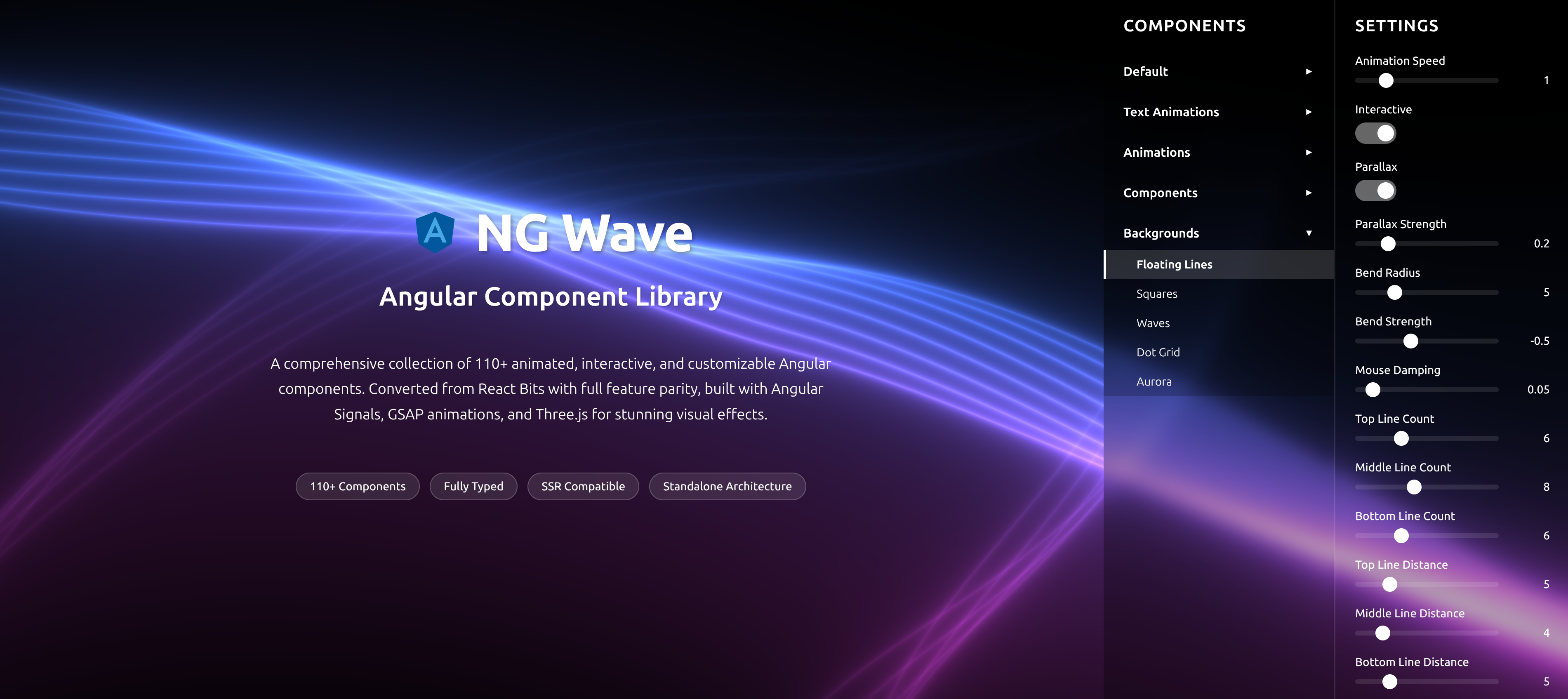
NG Wave
Angular Component Library
A comprehensive collection of 110+ animated, interactive, and customizable Angular components. Converted from React Bits with full feature parity, built with Angular Signals, GSAP animations, and Three.js for stunning visual effects.
Explore Components