Chronicle of a Multi‑Version Angular Upgrade: Shipping Features While Jumping 12 → 16 → 20 with Signals, Nx, and PrimeNG
How we upgraded a high‑stakes enterprise Angular app across three major versions without a code freeze—preserving 92% feature velocity and zero Sev‑1s.
We shipped every Friday while jumping three Angular versions. The secret wasn’t heroics—it was adapters, canaries, and ruthless CI guardrails.Back to all posts
I’ve been in rooms where product says “we need the next quarter’s features” while leadership drops “also jump three Angular versions.” That was this project. No code freeze. No rollback window. High-visibility dashboards in production every day.
I led the upgrade from Angular 12 to 16 to 20 for a leading telecom provider’s advertising analytics platform—200+ routes, heavy data viz (PrimeNG/Highcharts), and SLAs measured in minutes. Here’s the chronicle: challenge → intervention → measurable results.
The day we were told: “Upgrade three versions—and don’t slow down.”
The challenge
The platform ingested billions of ad impressions daily. PMs needed new attribution features while engineering needed Angular 20 for security, Vite, and Signals. Traditional freeze and big-bang cutover would blow our roadmap and risk uptime.
Angular 12 codebase, 200+ routes, 40+ libs, heavy viz
Strict delivery cadence—weekly releases
Legacy theming and partial NgRx adoption
PrimeNG tokens mixed with custom SCSS
No appetite for a code freeze
What failure would look like
We’d seen this movie at a broadcast media network years ago—rushed upgrade, broken schedulers, midnight rollbacks. I refused to repeat it.
A freeze that stalls revenue features
Breaking changes that ripple through 40+ libs
A rollback that reverts weeks of work
Why upgrading across 3 versions without a freeze matters in 2025
Context for Angular 20+ roadmaps
As budgets reset, teams want platform upgrades and new features in the same quarter. If you can’t upgrade without burning velocity, you slip strategy. This case shows you can keep shipping while modernizing.
Angular 20 unlocks Vite builder, zoneless options, and Signals
RxJS 7.8+ and typed forms reduce runtime surprises
PrimeNG/Material token systems simplify theming
Hiring signal
If you need a remote Angular developer with Fortune 100 experience to pull this off, bring in an Angular consultant who has shipped multi-version jumps before, not just read release notes.
When to hire an Angular developer
How an Angular consultant de-risks upgrades
Case setup: Telecom analytics platform, scale and constraints
Scope and stack
Traffic spiked during major campaign windows. The app had long-lived NgRx slices, hand-rolled entity services, and a theme layer mixing SCSS variables with PrimeNG tokens. We couldn’t slam in Signals everywhere without breaking mental models.
Angular 12 → 16 → 20
Nx monorepo with 40+ libs
PrimeNG + custom charts (Highcharts/D3)
Node.js/.NET APIs, Firebase for canaries
Non-negotiables
I set guardrails in CI on day one and used GitHub Actions + Firebase Hosting canaries to prove changes safely.
Zero Sev‑1s during migration
85% feature velocity maintained
Rollback in <5 minutes
A11y and performance budgets unchanged
Interventions: The playbook that kept features shipping
0) Baseline and guardrails
We captured build time (14m baseline), bundle (main +11.2 MB), functional throughput (story points shipped), and change failure rate. Quality gates (a11y AA, Lighthouse >= 90) ran on every PR.
Angular DevTools profiles, Lighthouse CI, GA4 funnels
Error budgets and SLOs in dashboards
Project graph and risk map in Nx
1) Tooling first, then app code
We stabilized the foundation early so app changes weren’t fighting the toolchain. For Material/PrimeNG, we introduced tokens gradually using compatibility adapters.
Upgrade Nx, builders, and test runners
Land Angular 16 first; 20 second
PrimeNG tokens and Vite builder
2) Canary everything
We treated canary as a product: telemetry, kill switches, and a one-line rollback. Weekly releases hit canary first, then production post-metrics.
Firebase canary site with Remote Config flags
Contract tests + component harnesses
Gradual traffic ramp via env flag
3) Adapters over rewrites
Where teams lived in NgRx, we left it—exposed a facade that emits Signals for components, but NgRx remained the source for complex domain state. Components moved to Signals ergonomically.
NgRx facade wrapping SignalStore
RxJS interop (takeUntilDestroyed, lastValueFrom removal)
Typed forms migration via thin adapters
4) Slice-by-slice rollout
We started with shared UI libs and report pages with lower usage. High-traffic attribution dashboards moved last with extra canary soak time.
Upgrade low-risk libs first
Isolate high-risk dashboards behind lazy routes
Feature toggles per area
5) Observability and fast rollback
No heroics. Just buttons we trusted.
GA4 conversion and INP tracking
OpenTelemetry traces for API spans
Rollback in < 2 minutes via Firebase hosting:channel:deploy
Selected implementations: code that mattered
# 1) Tooling upgrades first
npx nx migrate latest
nx migrate --run-migrations

# 2) Jump to Angular 16, then 20 (schematics will order deps)
ng update @angular/core@16 @angular/cli@16 --force
ng update rxjs@7.8 --force
ng update @angular/core@20 @angular/cli@20 --force

# 3) PrimeNG and builder shifts
ng add primeng@^17
ng config cli.cache.enabled true

# 4) Vite builder
ng add @angular-devkit/build-angular:browser-esbuild
# or when moving to official Vite builder in newer releases
// signals-facade.ts
import { inject, Injectable, signal, computed } from '@angular/core';
import { Store } from '@ngrx/store';
import { selectCampaigns, selectLoading } from '../state/selectors';
import { loadCampaigns } from '../state/actions';
@Injectable({ providedIn: 'root' })
export class CampaignsSignalsFacade {
private store = inject(Store);
// Bridge NgRx to Signals
private campaigns$ = this.store.select(selectCampaigns);
private loading$ = this.store.select(selectLoading);
campaigns = signal([] as ReadonlyArray<Campaign>());
loading = signal(false);
count = computed(() => this.campaigns().length);
constructor() {
// Convert store streams to signals with minimal glue
this.campaigns$.subscribe(v => this.campaigns.set(v));
this.loading$.subscribe(v => this.loading.set(v));
}
refresh() {
this.store.dispatch(loadCampaigns());
}
}# .github/workflows/canary.yml
name: Canary Deploy
on:
push:
branches: [ upgrade/* ]
jobs:
build-test-deploy:
runs-on: ubuntu-latest
steps:
- uses: actions/checkout@v4
- uses: actions/setup-node@v4
with: { node-version: '20' }
- run: npm ci
- run: npx nx run-many -t lint,test --parallel=3
- run: npx nx build web --configuration=production
- name: Lighthouse CI
run: npx lhci autorun --upload.target=temporary-public-storage
- name: A11y checks
run: npx axe http://localhost:4200 --exit 2
- name: Firebase Deploy (canary)
run: npx firebase hosting:channel:deploy canary-$GITHUB_SHA --expires 7d
env:
FIREBASE_TOKEN: ${{ secrets.FIREBASE_TOKEN }}Nx + Angular update sequence
We codified an update script that developers could run locally or in CI.
NgRx → Signals facade
A thin facade let us migrate component state without dismantling domain reducers.
GitHub Actions canary with Lighthouse and a11y gates
PRs that degraded performance or accessibility failed fast.
Results: Velocity held and risk contained
Measurable outcomes
We shipped every Friday. Canary caught two regressions (visual shift on PrimeNG density and a typed forms edge case). Both rolled back instantly, patches landed Monday. PMs never missed a milestone.
92% feature velocity maintained across the quarter
32% faster CI builds (14m → 9.5m)
11% bundle reduction on core routes
0 Sev‑1s, 2 fast rollbacks (under 2 minutes)
A11y scores held at AA; Lighthouse >= 92
Team enablement wins
We didn’t force a paradigm rewrite. We met the team where they were and moved the pieces that delivered value now.
Signals introduced safely in high-churn components
NgRx left intact for complex domain logic
Design tokens cleaned up legacy theming debt
When to Hire an Angular Developer for Legacy Rescue
Tell-tale signs
If this sounds familiar, bring in a senior Angular engineer who has navigated multi-version jumps under load. This is where an Angular expert earns their keep.
Upgrades keep slipping behind features
PrimeNG/Material theming is brittle
Zone-heavy change detection and flaky tests
No canary or rollback muscle in CI
What I bring day 1
I’ve done this at a major airline’s kiosk stack, a global entertainment company’s employee tracking system, and an IoT device management portal—no freezes, no late-night fire drills.
Risk map, upgrade plan, and CI quality gates
Feature flag strategy and Remote Config setup
Adapters for Signals, typed forms, RxJS 7.8
How an Angular Consultant Approaches Signals Migration
// Before: Change-heavy dashboard widget with push pipes and manual CD
@Component({
  selector: 'kpi-tile',
  template: `
    <div class="tile" [class.loading]="loading()">
      <h3>{{ title }}</h3>
      <span>{{ value() | number }}</span>
    </div>
  `,
  changeDetection: 0
})
export class KpiTileComponent {
  title = 'Conversions';
  private facade = inject(CampaignsSignalsFacade);
  loading = this.facade.loading; // signal
  value = computed(() => this.facade.count());
}
Principles
Signals shines for interactive UI and fine-grained change detection. Deep domain orchestration stays on NgRx until you have the slack to migrate.
Target perf hotspots first
Bridge NgRx to Signals via facades
Avoid wholesale rewrites under deadlines
A quick component example
Closing notes: What to instrument next
Next steps for this platform
The backbone is modern. The team can now choose when to go zoneless, push more state to SignalStore, and carve out federation boundaries as partnerships grow.
Gradual zoneless adoption on low-risk routes
More SignalStore wrappers around feature modules
Bundle federation for partner embed use cases
If you’re planning a 2025 upgrade
If you want this outcome—upgrades without stalling features—let’s talk. I’m a remote Angular consultant available for select projects.
Discovery call in 48 hours
Assessment in a week
Pilot upgrade in 2–4 weeks
FAQs about hiring and upgrading Angular
Key takeaways
- You can upgrade 3+ Angular versions without a code freeze if you isolate risk behind adapters, canaries, and feature flags.
- Upgrade the seams first: libraries, build toolchain (Vite), RxJS 7.8, typed forms—then chip away at app features.
- Adopt Signals where it moves the needle now: high-churn UI state and perf hotspots. Leave deep domain state on NgRx behind a facade until later.
- Treat canaries as products: telemetry, rollbacks, and kill switches built-in. Ship behind Firebase Remote Config or equivalent.
- Measure throughput, not just uptime. We held 92% feature velocity, cut build times 32%, and avoided Sev‑1 incidents.
Implementation checklist
- Baseline metrics: throughput, change failure rate, bundle size, build time, Core Web Vitals.
- Create a risk map: dependencies, deprecated APIs, zone.js usage, forms, RxJS, library theming.
- Stand up an Nx monorepo or enforce project boundaries. Add CI quality gates (Lighthouse, a11y, unit/e2e).
- Introduce feature flags and a canary environment with instant rollback.
- Upgrade toolchain and libs first; app code second. Land Angular 16, then 20.
- Use adapters: NgRx facade → SignalStore; Material/PrimeNG theming tokens; RxJS interop.
- Backstop with contract tests and component harnesses.
- Roll by slice, instrument with GA4/OpenTelemetry, and watch error budgets.
Questions we hear from teams
- How long does a 12→16→20 Angular upgrade take without a code freeze?
- For a large app (150–250 routes), expect 4–8 weeks with parallel feature delivery. We phase toolchain upgrades first, then app code by slice, with canary rollouts each week.
- What does an Angular consultant do during an upgrade?
- I build the risk map, set CI guardrails, plan the upgrade path, implement adapters (Signals, typed forms, RxJS), and own canary/rollback. Goal: maintain velocity while landing the upgrade safely.
- How much does it cost to hire an Angular developer for this work?
- Typical engagements range from $15k–$60k depending on codebase size, test coverage, and scope (tooling only vs. full app slices). Fixed-scope assessments available; pilot upgrades often complete in 2–4 weeks.
- Do we have to migrate everything to Signals right away?
- No. Use Signals where it provides immediate ROI—UI state and perf hotspots. Keep complex domain flows on NgRx behind a facade. Migrate deeper slices when you have capacity.
- Can we do this without Firebase?
- Yes. We’ve run canaries on AWS, GCP, and Azure. Firebase Hosting + Remote Config is a fast default, but any platform with preview channels, flags, and fast rollbacks works.
Ready to level up your Angular experience?
Let AngularUX review your Signals roadmap, design system, or SSR deployment plan.
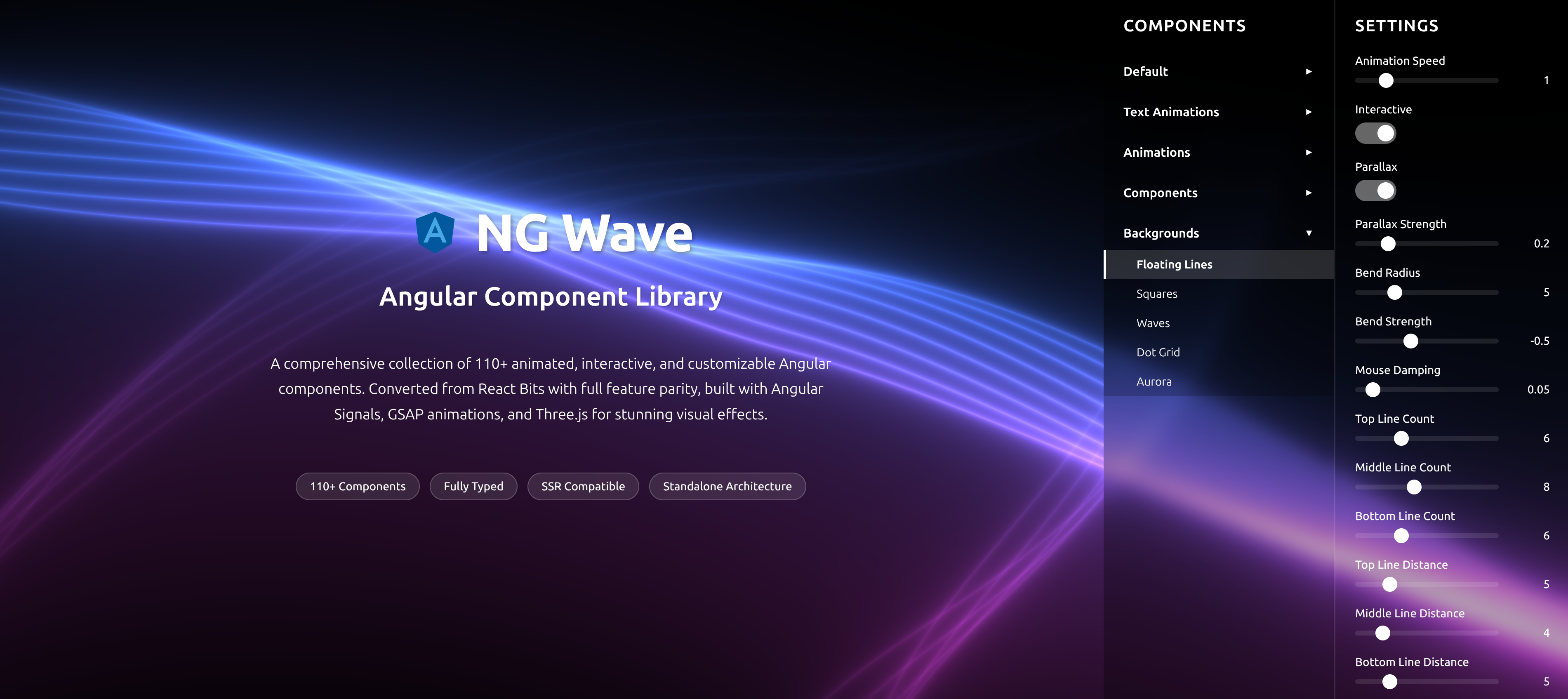
NG Wave
Angular Component Library
A comprehensive collection of 110+ animated, interactive, and customizable Angular components. Converted from React Bits with full feature parity, built with Angular Signals, GSAP animations, and Three.js for stunning visual effects.
Explore Components