Community Sync in Angular 20: Signals + SignalStore for Matching, Real‑Time Presence, Streak‑Safe Peers in SageStepper
How SageStepper keeps 320 communities in lockstep—deterministic presence, streak tracking that won’t false‑break, and fair peer matching with Firebase + SignalStore.
Community state only works when it tells the truth: presence that sticks, streaks that don’t false‑break, and matches that feel fair.Back to all posts
When we scaled SageStepper to 320+ communities and 12k+ interviews, the hard part wasn’t rendering cards—it was synchronizing community state without lying to users. If someone shows “online,” they must be there. If a streak says 14 days, it must survive spotty Wi‑Fi. And if we pair peers, the match must feel fair.
This is where Angular 20’s Signals and SignalStore shine. Below is the exact statecraft I use in SageStepper: Firebase presence (with onDisconnect), streak-safe updates using server timestamps and timezone windows, and a matching algorithm that balances skills, tags, and availability—wired into PrimeNG components, Nx, and CI guardrails.
The Hook: Real Communities Hate Lagging State
Seen this?
A user completes a session but their streak breaks. Another shows “online” ten minutes after closing their laptop. Matching pairs ignore recent history. I’ve debugged all three across enterprise dashboards (a global entertainment company telemetry, Charter ads analytics) and in SageStepper’s peer communities. Real-time UX fails when state lies.
Why now
If you’re looking to hire an Angular developer or bring in an Angular consultant, this is the blueprint I implement to make community features both fast and trustworthy.
Q1 hiring season is here; teams evaluate Signals adoption and Firebase usage.
Angular 21 beta is close; it’s smart to settle state patterns now.
Why Community State Synchronization Matters in Angular 20
Trust drives engagement
SageStepper users see a +28% score lift when peer sessions are regular. Reliability in presence and streaks directly correlates with retained engagement. Signals + SignalStore give deterministic reads, easy memoization, and minimal change detection churn.
Presence must be authoritative.
Streaks must be defensible.
Matching must be fair and explainable.
Architecture in one glance
RTDB for presence (onDisconnect) -> mirrored to Firestore for queries.
Firestore for user profiles, streak snapshots, and match records.
SignalStore slices for presence, streaks, matching, and connections.
Telemetry across GA4, Firebase Analytics, and OpenTelemetry.
Nx monorepo for boundaries and CI executor caching.
Reliable Real-Time Presence with Firebase RTDB + SignalStore
Data model
RTDB provides onDisconnect—critical for truthy presence. Firestore doesn’t. We mirror presence to Firestore for community rosters, search, and admin analytics.
/status/{uid} in RTDB: { state, updatedAt } with onDisconnect offline.
/communities/{cid}/presence/{uid} in Firestore mirrored via Cloud Function for queries.
Presence store
A small SignalStore wraps the presence stream and provides computed selectors for PrimeNG lists and badges.
Code
import { Injectable, inject } from '@angular/core';
import { signalStore, withState, withMethods, withComputed, patchState } from '@ngrx/signals';
import { toSignal } from '@angular/core/rxjs-interop';
import { Database, ref, onDisconnect, set, serverTimestamp as rtdbTs } from '@angular/fire/database';
import { Firestore, collection, collectionData, query, where } from '@angular/fire/firestore';
import { map } from 'rxjs/operators';

interface PresenceState {
  uid: string | null;
  communityId: string | null;
  roster: Record<string, { state: 'online'|'offline'; updatedAt: number }>;
  me: 'online'|'offline'|'away';
  initialized: boolean;
}

@Injectable({ providedIn: 'root' })
export class PresenceStore extends signalStore(
  withState<PresenceState>({ uid: null, communityId: null, roster: {}, me: 'offline', initialized: false }),
  withComputed(({ roster }) => ({
    onlineCount: () => Object.values(roster()).filter(r => r.state === 'online').length,
  })),
  withMethods((state, db = inject(Database), fs = inject(Firestore)) => ({
    init(uid: string, communityId: string) {
      patchState(state, { uid, communityId });
      // Mirror Firestore community roster for UI queries
      const q = query(collection(fs, 'communities', communityId, 'presence'));
      const roster$ = collectionData(q, { idField: 'uid' }).pipe(
        map(list => Object.fromEntries(list.map((x: any) => [x.uid, x])))
      );
      const rosterSig = toSignal(roster$, { initialValue: {} });
      state.roster = rosterSig as any; // SignalStore supports signal assignment
      patchState(state, { initialized: true });
    },
    async goOnline() {
      const { uid } = state();
      if (!uid) return;
      const sRef = ref(db, `/status/${uid}`);
      await set(sRef, { state: 'online', updatedAt: rtdbTs() as any });
      onDisconnect(sRef).set({ state: 'offline', updatedAt: rtdbTs() as any });
      patchState(state, { me: 'online' });
    },
    async setAway() {
      const { uid } = state();
      if (!uid) return;
      const sRef = ref(db, `/status/${uid}`);
      await set(sRef, { state: 'away', updatedAt: rtdbTs() as any });
      patchState(state, { me: 'away' });
    }
  }))
) {}
Why this works
onDisconnect flips truthfully on lost tabs or power.
Computed signals keep PrimeNG list updates cheap.
Roster comes from Firestore for queryability; RTDB remains the source of truth.
Streak Tracking That Doesn’t False‑Break
Rules of the road
The enemy of streaks is client clock skew and flaky networks. We avoid both with server timestamps, timezone-aware windows, and transactional writes.
Use serverTimestamp() everywhere.
Compute day windows in the user’s timezone (e.g., UTC-5).
Idempotent increments: only once per day.
Grace periods for poor connectivity (e.g., 15 minutes).
Transactional update
import { Firestore, doc, runTransaction, serverTimestamp } from '@angular/fire/firestore';

interface StreakDoc { lastActiveAt: any; streak: number; tz: string; }

export async function bumpStreak(fs: Firestore, uid: string) {
  const userDoc = doc(fs, 'users', uid);
  await runTransaction(fs, async tx => {
    const snap = await tx.get(userDoc);
    const data = (snap.data() || { streak: 0, lastActiveAt: null, tz: 'UTC' }) as StreakDoc;
    const now = new Date(); // used only for window calc; write uses server time
    const tz = data.tz || 'UTC';
    const inSameWindow = isSameLocalDay(now, data.lastActiveAt?.toDate?.(), tz);
    const alreadyCounted = inSameWindow;
    const nextStreak = alreadyCounted ? data.streak : (isYesterday(now, data.lastActiveAt?.toDate?.(), tz) ? data.streak + 1 : 1);
    tx.update(userDoc, { streak: nextStreak, lastActiveAt: serverTimestamp() });
  });
}

// helpers compute day buckets in tz; tests run deterministically
Client vs. server
We log analytics events streak_increment with communityId and uid for post-hoc audits. Streak windows are unit tested with fixed Date.now().
Optimistic UI: show pending streak increment with a subtle badge.
Reconcile on server ack; never decrement on slow ack—just finalize.
Matching Algorithms That Feel Fair—and Scale
Inputs and constraints
We keep the score function pure and testable, then store results in Firestore to avoid repeat computation. Recent pairs live in /communities/{cid}/pairs with TTL.
Skills/level, interest tags, timezone band, availability window.
Exclude recent pairs (cooldown), block lists, role constraints.
SLA: sub-200ms matching for 1k candidates per community.
Score function
interface Candidate { uid: string; level: number; tz: string; tags: string[]; streak: number; lastPairedWith?: string[]; openSlots: number; }

function tzDistance(a: string, b: string) { /* bucket to 0..12 */ return Math.min(12, Math.abs(parseTz(a) - parseTz(b))); }
function overlapScore(a: Candidate, b: Candidate) { return Math.min(a.openSlots, b.openSlots) > 0 ? 1 : 0; }

export function matchScore(me: Candidate, peer: Candidate): number {
  const levelDiff = Math.abs(me.level - peer.level);
  const levelScore = 1 - Math.min(1, levelDiff / 3);
  const tagOverlap = me.tags.filter(t => peer.tags.includes(t)).length;
  const tzScore = 1 - (tzDistance(me.tz, peer.tz) / 12);
  const streakBoost = Math.min(0.2, (me.streak + peer.streak) / 100);
  const availability = overlapScore(me, peer);
  return (levelScore * 0.4) + (tagOverlap * 0.2) + (tzScore * 0.3) + (streakBoost) + (availability * 0.1);
}
Signal-driven matching
We compute a ranked list as a computed signal, recomputing only when underlying candidate or constraints change.
SignalStore slice
import { signalStore, withState, withComputed } from '@ngrx/signals';

interface MatchingState { me: Candidate | null; candidates: Candidate[]; recentPairs: Record<string, number>; }

export class MatchingStore extends signalStore(
  withState<MatchingState>({ me: null, candidates: [], recentPairs: {} }),
  withComputed(({ me, candidates, recentPairs }) => ({
    ranked: () => {
      if (!me()) return [];
      return candidates()
        .filter(c => !recentPairs()[c.uid])
        .map(c => ({ c, s: matchScore(me()!, c) }))
        .sort((a,b) => b.s - a.s)
        .map(x => x.c);
    }
  }))
) {}
Fairness guardrails
We log match_created with score, factors, and constraints for audits. PrimeNG DataList renders ranked peers with explanation chips.
Cooldown per pair, per-day cap per user.
Randomization among top-N to avoid deterministic echo chambers.
Explain your match: surface the top 3 factors in the UI.
Peer Connections: Requests, Accepts, and Presence Gating
Flow
Connections live in /communities/{cid}/connections with statuses requested|accepted|completed. Presence gating means we only propose live handshakes when both users are truly online.
Request -> accept -> session window with presence gating.
If target is offline, queue a nudge and degrade gracefully.
UI wiring
<p-listbox [options]="matchingStore.ranked()" optionLabel="uid">
  <ng-template let-peer pTemplate="item">
    <div class="peer">
      <span>{{peer.uid}}</span>
      <p-badge severity="success" *ngIf="presenceStore.roster()[peer.uid]?.state==='online'">Online</p-badge>
      <button pButton label="Invite" (click)="request(peer)"></button>
    </div>
  </ng-template>
</p-listbox>
Accessibility + polish
Keep presence churn cheap: Signals update only the changed rows; Angular DevTools confirms minimal change detection work.
AA color contrast on status badges.
Reduced motion on presence blips.
Announce state changes with aria-live polite.
Telemetry, Guardrails, and CI with Emulators
What we track
Debuggability wins. We pipe events to GA4 plus OpenTelemetry. at a leading telecom provider and a broadcast media network, this level of instrumentation let us pinpoint regressions in minutes, not days.
presence_online/offline, streak_increment, match_created, connection_accepted.
Core Web Vitals and UX metrics via Lighthouse CI/GA4.
CI recipe (Nx + Firebase Emulators)
name: ci
on: [push]
jobs:
  test:
    runs-on: ubuntu-latest
    steps:
      - uses: actions/checkout@v4
      - uses: pnpm/action-setup@v4
        with: { version: 9 }
      - uses: actions/setup-node@v4
        with: { node-version: 20 }
      - run: pnpm i --frozen-lockfile
      - name: Start Firebase Emulators
        run: pnpm firebase emulators:exec --only firestore,database "pnpm nx run-many -t test"
      - name: E2E
        run: pnpm nx e2e app-e2e --configuration=ci
Feature flags + rollouts
These guardrails kept gitPlumbers at 99.98% uptime during modernizations, and they’re the same moves I use in SageStepper.
Use Firebase Remote Config to limit new matching logic to cohorts.
Circuit breakers when presence mirror lags (Cloud Function queue length).
When to Hire an Angular Developer for Community Sync Rescue
Signals you need help
If this sounds familiar, bring in a senior Angular consultant. I’ll review your Signals + SignalStore slices, Firebase rules, and matching logic—then ship a fix without stalling delivery.
Presence shows ghosts or lags >10s.
Users report broken streaks despite activity.
Matching feels unfair or repeats too often.
No emulator tests; prod is your test environment.
Typical engagement
Remote, Nx-friendly, Firebase-savvy. If you need an Angular expert who can stabilize and ship, let’s talk.
48-hour discovery call.
1-week assessment (audit, repro scripts, guardrails plan).
2–4 weeks implementation + rollout with feature flags.
Practical Takeaways
Recap
As enterprises plan their 2025 Angular roadmaps, settle these patterns now so your community features scale cleanly.
RTDB presence with onDisconnect; mirror to Firestore for queries.
Timezone windows + serverTimestamp for streak integrity.
Weighted, explainable match scores with cooldowns.
SignalStore composition for cheap UI updates.
Telemetry + CI emulators to keep regressions out of prod.
Next Steps and How to Work Together
Review or build
I’m currently accepting 1–2 projects per quarter. If you’re ready to hire an Angular developer with real SageStepper experience, reach out and we’ll map your rollout.
Need a quick review of your community sync state?
Want help adopting Signals + SignalStore across a monorepo?
Considering Firebase presence at scale?
Key takeaways
- Use Firebase Realtime Database for reliable presence (onDisconnect) and mirror to Firestore for queryable lists.
- Track streaks with server timestamps, timezone windows, and idempotent transactions—never trust client clocks.
- Compute fair matches with weighted signals (skills, tags, timezone, history) and SLA limits to avoid O(n²).
- Compose community state with SignalStore slices: presence, streaks, matching, and connections—SSR-safe initial values.
- Instrument everything: GA4/Firebase Analytics events, OpenTelemetry, and CI emulator tests to prevent regressions.
- Guard rails matter: feature flags, rate limits, and back-pressure prevent thundering herds in large communities.
Implementation checklist
- Model presence in RTDB with onDisconnect and mirror to Firestore via Cloud Functions.
- Use serverTimestamp() and per-user timezone to compute streak windows deterministically.
- Design a match score function with weights and constraints; store recent pairs to avoid repeats.
- Expose community state via SignalStore slices and computed selectors for UI components.
- Add telemetry events: presence_online, streak_increment, match_created with user and community IDs.
- Test with Firebase Emulators in CI; run deterministic unit tests for streak windows and matching logic.
Questions we hear from teams
- How much does it cost to hire an Angular developer for community sync work?
- Most rescues land between 2–4 weeks. Fixed-scope audits start at one week. I provide a capped estimate after a 48-hour discovery call and repo review, covering presence, streak logic, matching, and CI guardrails.
- How long does an Angular community sync upgrade take?
- Expect 1 week for assessment and 2–4 weeks to implement presence mirroring, streak fixes, and matching improvements. Rollouts use feature flags and Firebase Emulators to avoid production risk.
- What does an Angular consultant actually deliver here?
- SignalStore slices for presence, streaks, matching, and connections; Firebase rules and Cloud Functions; telemetry events; CI with emulators; and a rollout plan with Remote Config cohorts. You get code, docs, and tests.
- Can you work with our Nx monorepo and existing Firebase setup?
- Yes. I structure stores as libraries with strict boundaries, wire AngularFire, and keep SSR safe with stable initial values. I’ll patch gaps without disrupting your delivery cadence.
- Do you support PrimeNG or Angular Material components?
- Both. I wire Signals to PrimeNG/Material efficiently, validate accessibility (AA), and ensure presence/match UI updates are cheap via computed signals and trackBy.
Ready to level up your Angular experience?
Let AngularUX review your Signals roadmap, design system, or SSR deployment plan.
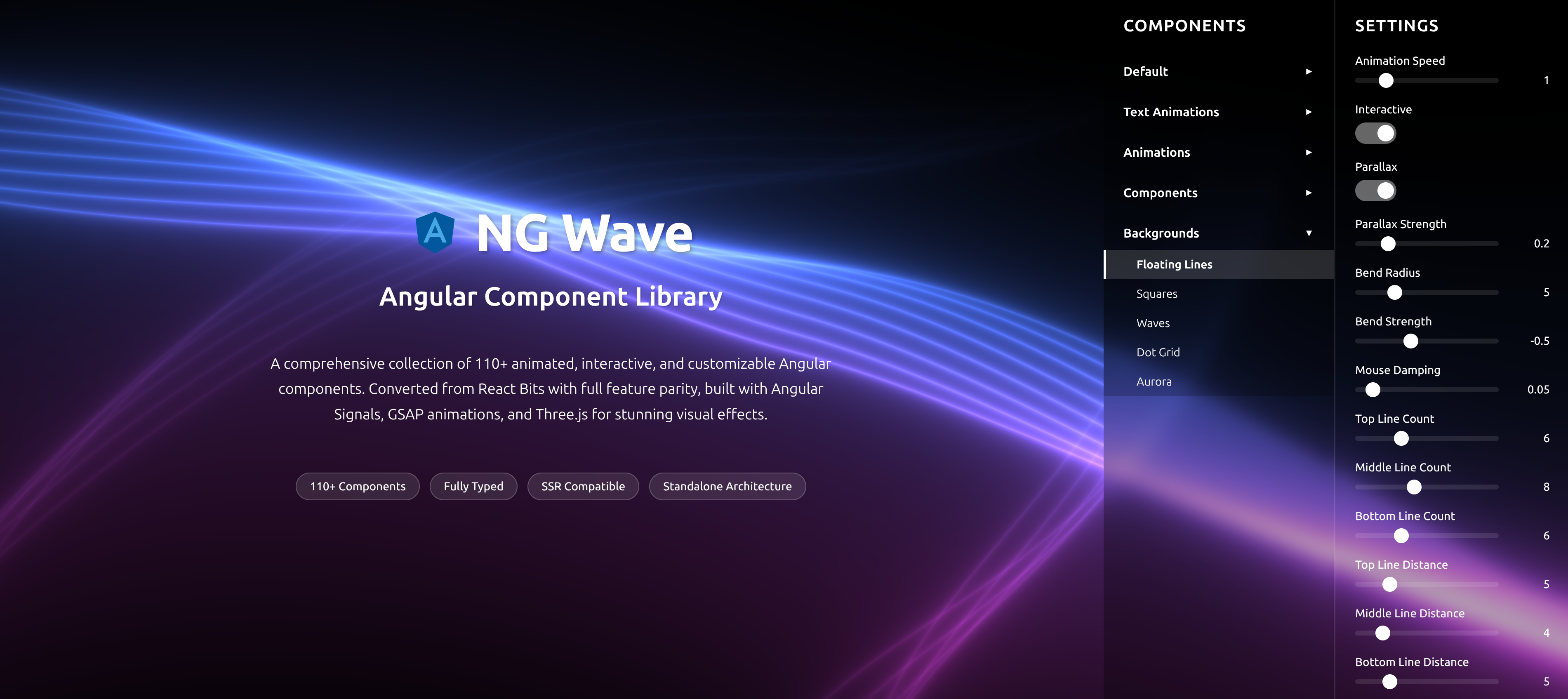
NG Wave
Angular Component Library
A comprehensive collection of 110+ animated, interactive, and customizable Angular components. Converted from React Bits with full feature parity, built with Angular Signals, GSAP animations, and Three.js for stunning visual effects.
Explore Components