Enterprise‑Scale Employee Tracking in Angular 20+: Architecture Patterns and Offshore Team Leadership (a global entertainment company Lessons)
What it really takes to ship org‑wide employee tracking—Signals, SignalStore, Nx, real‑time presence, and a distributed team playbook that survives midnight deploys.
Enterprise scale is less about widgets and more about contracts, telemetry, and guardrails. Angular 20+ just makes the good habits cheaper to maintain.Back to all posts
I’m Matthew Charlton. At a global entertainment company, our employee tracking and payment-adjacent workflows spanned parks, studios, and back-office roles—tens of thousands of people, multiple business units, tight privacy boundaries, and an offshore team handing the night shift. What follows is the architecture and leadership playbook I now reuse to help enterprises ship Angular 20+ reliably.
The pattern scales beyond a global entertainment company—telecom (Charter), media (a broadcast media network), aviation (United), consulting (an insurance technology company), and device management (an enterprise IoT hardware company). The details change, but the risks don’t: cross-tenant data leaks, jittery dashboards, timezone bugs, and drifting offshore code. Here’s how we solved it with Signals, SignalStore, Nx, and disciplined CI.
The Enterprise Employee Tracking Scene: Real‑Time, Multi‑Tenant, Offshore
Challenge
The dashboard jittered when presence spiked at shift changes. Managers saw stale counts; finance needed deterministic snapshots for approvals. Permissions were inconsistent—some UI components checked roles, others trusted API responses. The offshore team shipped quickly but drifted from the architecture after week 3.
Thousands of employees across business units
Role/permission fragmentation; auditors watching
Real-time presence and shift status across timezones
Offshore team spanning 3 continents; tight release windows
Intervention
We replaced ad-hoc Observables with SignalStore slices and enforced an event schema across services. We standardized permission checks via a directive and route guards. CI validated event payloads and stopped regressions before QA. Feature flags let us ship quietly to a single park before global rollout.
Signals + SignalStore for deterministic presence state
Nx monorepo with domain boundaries and lint rules
Typed event contracts with schema validation in CI
Feature flags + telemetry to de-risk rollouts
Measurable result
Once render counts dropped and audits passed, trust increased. We accelerated releases without sacrificing stability—exactly what enterprise leaders want from an Angular expert.
-37% render cost during shift spikes
0 cross-tenant data leaks in quarterly audits
Release cadence from monthly → biweekly
Offshore PR merge time down 42% with templates
Angular Architecture for Organization‑Wide Employee Tracking (20+)
Domain-driven Nx layout
Nx forced clarity: domain logic lived in domain libs, transport and caching in data-access, and any UI could be swapped without touching contracts. This mattered when offshore teams spun up new tiles without drifting across layers.
apps/: web, admin, kiosk
libs/: domain/employee, data-access/presence, feature/roster, ui/tiles
Enforce boundaries via eslint + tsconfig paths
Signals + SignalStore
Signals let us express business logic deterministically. With SignalStore, we wrote minimal code to keep presence accurate and granular, and DevTools showed render counts shrinking even when 2,000+ employees updated per minute.
Presence, Permissions, OrgContext slices
Computed views: byOrg, onlineCount, late arrivals
Effects: connection state, retries, snapshot hydration
Real-time transport
We streamed snapshot-on-join and small deltas thereafter. Large tables virtualized rows to avoid jank, and retry logic backed off aggressively to protect upstream services during shift changes.
WebSockets with exponential backoff
Typed messages (snapshot/delta)
Backpressure + data virtualization for big lists
Role-based, multi-tenant privacy
Every selector included org/tenant context. We treated privacy as a feature: logs redacted PII, and all debug data was tenant-scoped. Auditors loved that the UI could never render what the state couldn’t select.
Permission directives + route guards
Tenant-aware selectors; no cross-tenant caches
Server contracts mirror client types
Implementation Walkthrough: Signals + SignalStore for Presence and Permissions
import { signalStore, withState, withComputed, withMethods, patchState } from '@ngrx/signals';
import { toSignal } from '@angular/core/rxjs-interop';
import { inject, computed, effect } from '@angular/core';
import { WebSocketService } from '../data/ws.service';
import { retryBackoff } from 'backoff-rxjs';

type Employee = { id: string; name: string; orgId: string; role: 'cast'|'manager'|'finance'; status: 'on'|'off'|'break'; lastSeen: number };
interface PresenceState { employees: Record<string, Employee>; selectedOrgId: string | null; connection: 'connecting'|'connected'|'offline' }

export const PresenceStore = signalStore(
  { providedIn: 'root' },
  withState<PresenceState>({ employees: {}, selectedOrgId: null, connection: 'connecting' }),
  withComputed(({ employees, selectedOrgId }) => ({
    all: computed(() => Object.values(employees())),
    byOrg: computed(() => {
      const org = selectedOrgId();
      return Object.values(employees()).filter(e => !org || e.orgId === org);
    }),
    onlineCount: computed(() => Object.values(employees()).filter(e => e.status !== 'off').length)
  })),
  withMethods((state, ws = inject(WebSocketService)) => ({
    selectOrg(orgId: string | null) { patchState(state, { selectedOrgId: orgId }); },
    upsert(emp: Employee) { patchState(state, s => ({ employees: { ...s.employees, [emp.id]: emp }})); },
    connect() {
      const stream$ = ws.connect('/presence').pipe(
        retryBackoff({ initialInterval: 1000, maxInterval: 15000, resetOnSuccess: true })
      );
      const events = toSignal(stream$, { initialValue: { type: 'noop' } as any });
      effect(() => {
        const ev: any = events();
        if (ev.type === 'snapshot') ev.data.forEach(this.upsert);
        if (ev.type === 'delta') this.upsert(ev.data);
      });
    }
  }))
);
import { Directive, Input, TemplateRef, ViewContainerRef, inject } from '@angular/core';
import { PermissionsService } from './permissions.service';
@Directive({ selector: '[can]' })
export class CanDirective {
private perms = inject(PermissionsService);
private vc = inject(ViewContainerRef);
private tmp = inject(TemplateRef<any>);
private shown = false;
@Input('can') set can(required: string | string[]) {
const ok = this.perms.has(required);
if (ok && !this.shown) { this.vc.createEmbeddedView(this.tmp); this.shown = true; }
if (!ok && this.shown) { this.vc.clear(); this.shown = false; }
}
}<div class="toolbar">
<span>Online: {{ store.onlineCount() }}</span>
<button pButton label="All" (click)="store.selectOrg(null)"></button>
<button *can="'switch-org'" pButton label="Change Org" (click)="openOrgDialog()"></button>
</div>
<cdk-virtual-scroll-viewport itemSize="48" class="list">
<div *cdkVirtualFor="let emp of store.byOrg()" class="row" [class.online]="emp.status!=='off'">
<span>{{ emp.name }}</span>
<span>{{ emp.role }}</span>
<span>{{ emp.lastSeen | date:'short' }}</span>
</div>
</cdk-virtual-scroll-viewport>PresenceStore (SignalStore)
Here’s the core of the presence slice. It consumes typed WebSocket events, hydrates with a snapshot, and applies deltas—without tearing.
Deterministic presence derived from typed events
Connection state for UX clarity
Retry with exponential backoff
Permission Directive
The directive below ensures every component respects the same permission checks. This removed duplicate, drift-prone role logic from templates.
Single source of truth for UI gating
Composable with route guards
Zero DOM cost when hidden
Minimal template
Lean templates kept reflows predictable. In a global entertainment company-scale rosters, we used CDK Virtual Scroll or PrimeNG TurboTable with virtual scrolling.
Virtualized lists recommended for >1k rows
Status class toggles ensure cheap styling
Date pipes localized per tenant
Telemetry, Contracts, and CI/CD Guardrails
name: ci
on: [push, pull_request]
jobs:
  build-test:
    runs-on: ubuntu-latest
    steps:
      - uses: actions/checkout@v4
      - uses: pnpm/action-setup@v3
        with: { version: 9 }
      - run: pnpm install --frozen-lockfile
      - run: pnpm nx affected -t lint,test,build --parallel=3 --configuration=ci
      - run: pnpm nx run employee-api:openapi-validate
      - run: pnpm nx run web:contracts:check
Typed event schemas
We defined presence events (snapshot/delta) in a shared schema. The API generated types for Angular, eliminating stringly-typed bugs. Runtime checks ran only in staging but caught drift early.
OpenAPI/JSON Schema shared in Nx
Contract tests block breaking changes
Runtime validation in non-prod
CI with Nx affected
Our GitHub Actions job failed fast on contract mismatches, then spun preview URLs so managers could validate rosters by org. Offshore developers learned to rely on these previews during handoff.
Cache-aware builds, fast PR feedback
Contract checks + preview environments
Lint rules enforce boundaries
Instrumentation
We wired Firebase Performance to measure time-to-first-roster, and OpenTelemetry correlated backend spikes at shift change. A custom CI step captured Angular DevTools render counts on headless runs to prevent regressions.
Firebase Performance + GA4 for user flows
OpenTelemetry traces to map spikes
Angular DevTools render counts in CI
Offshore Team Leadership: The Playbook That Survived Midnight Deploys
Golden-path libraries
We shipped approved building blocks before scale-out. Offshore engineers moved fast inside guardrails instead of inventing new patterns.
@org/permissions directive + guard
@org/presence SignalStore
@org/ui primitives (PrimeNG + tokens)
PR templates and visual diffs
Every PR linked a Storybook story. Visual diffs caught subtle changes in density, contrast, or time formats across locales—problems that never make it to unit tests.
Checklist: a11y, i18n, tenant IDs, telemetry
Storybook/Chromatic visual baselines
Cypress component tests
Handoff rules
We normalized handoff by writing the next step into the PR itself. A flag flip on Firebase Remote Config let us test features per park/site without risky global toggles.
3-hour overlap; Slack threads with context template
‘Morning readme’ in PR description
Feature flags for partial rollouts
Challenge → Intervention → Measurable Results
Dashboard jank at shift changes
Cause: unbounded table reflows
Fix: CDK Virtual Scroll + computed Signals
Result: -37% render cost; p95 frame time < 14ms
Permission drift and audit risk
Cause: duplicated checks in templates
Fix: can directive + tenant-aware selectors
Result: 0 cross-tenant incidents; clean quarterly audit
Offshore merge friction
Cause: architecture drift, late feedback
Fix: golden-path libs + Nx previews + PR templates
Result: PR cycle time -42%; releases from monthly → biweekly
When to Hire an Angular Developer for Legacy Rescue
Related: stabilize your Angular codebase and rescue chaotic code at https://gitplumbers.com/
Signs you need help
If this sounds familiar, you don’t just need tickets closed—you need guardrails. I help teams stabilize fast, then accelerate delivery with the right Angular 20+ patterns. See how we systematically modernize at gitPlumbers—use it to stabilize your Angular codebase and rescue chaotic code.
Rosters jitter or freeze under load
Permissions implemented 3+ different ways
CI lacks contract checks; QA catches schema drift
Timezone or locale bugs in payroll-adjacent flows
Engagement model
I work as a remote Angular contractor or consultant alongside your team. Discovery within 48 hours; assessment in one week; first production hardening in two.
2–4 week assessment and rescue
4–8 week modernization and rollout
Zero‑downtime strategies and measurable benchmarks
How an Angular Consultant Approaches Multi‑Tenant Signals Migration
Example Angular AI integration at scale: an AI-powered verification system https://getintegritylens.com/ and an AI interview platform https://sagestepper.com/ show how we handle privacy, telemetry, and community scale.
Stabilize before migrate
You can’t migrate moving targets. We stabilize first so Signals upgrades don’t amplify unknowns.
Turn on strict TypeScript
Freeze contracts with schema validation
Add render-count CI checks
Incremental Signals adoption
We migrate slices where payoff is highest (presence, permissions). DevTools and flame charts prove ROI to non-technical stakeholders.
Wrap RxJS streams with toSignal adapters
Introduce SignalStore per slice
Measure with flame charts and UX KPIs
Hardening and rollout
We ship with a rollback you can explain to executives in one slide. That’s how upgrades don’t break production.
Feature flags per tenant
Observability: Sentry + OpenTelemetry
Playbooks for rollback
Key takeaways
- Enterprise employee tracking succeeds when contracts, permissions, and telemetry are first‑class—not just UI.
- Signals + SignalStore provide deterministic, testable real‑time presence with minimal re-renders.
- Nx monorepos and typed event schemas keep distributed teams aligned and productive.
- Guardrails (feature flags, CI schema checks, runtime telemetry) prevent cross‑tenant data leaks.
- Offshore leadership succeeds with golden-path libraries, strict PR templates, and overlapping hours.
Implementation checklist
- Define a typed event schema for presence, shifts, and payroll adjacency.
- Stand up Nx libs for domain, data access, and UI; enforce barrel-free boundaries.
- Replace state bags with SignalStore slices: presence, permissions, org-context.
- Wire WebSocket transport with exponential retry and connection state in Signals.
- Add permission-driven directives/guards; prove isolation with e2e tests.
- Instrument UX: render counts, Core Web Vitals, and business KPIs (onboarding time, payroll exceptions).
- Automate CI: Nx affected, schema validation, preview environments, contract tests.
- Codify offshore playbook: DoD, PR template, visual diffs, timezone handoff notes.
Questions we hear from teams
- How much does it cost to hire an Angular developer for an enterprise engagement?
- Typical rescue or upgrade projects range from $15k–$60k depending on scope and integrations. I offer fixed-fee assessments and milestone-based delivery so leaders can control risk and spend.
- How long does an Angular upgrade or stabilization take?
- Rescues land in 2–4 weeks; full upgrades and rollouts take 4–8 weeks. Discovery call in 48 hours, assessment within 1 week, first production hardening usually by week 2.
- What does an Angular consultant do on employee tracking systems?
- I stabilize state and permissions (Signals/SignalStore), enforce typed contracts, add telemetry, and coach offshore teams. The outcome: audit-safe privacy, real-time dashboards without jank, and predictable releases.
- Do you work with offshore or distributed teams?
- Yes. I provide golden-path libraries, PR templates, Nx-based previews, and clear handoff protocols. This reduces merge friction and keeps architecture consistent across timezones.
- Can you integrate with our identity provider and existing APIs?
- Absolutely. I’ve integrated Okta/AzureAD, .NET/Node services, and Firebase for feature flags/analytics. We keep contracts typed and verified in CI to avoid surprises.
Ready to level up your Angular experience?
Let AngularUX review your Signals roadmap, design system, or SSR deployment plan.
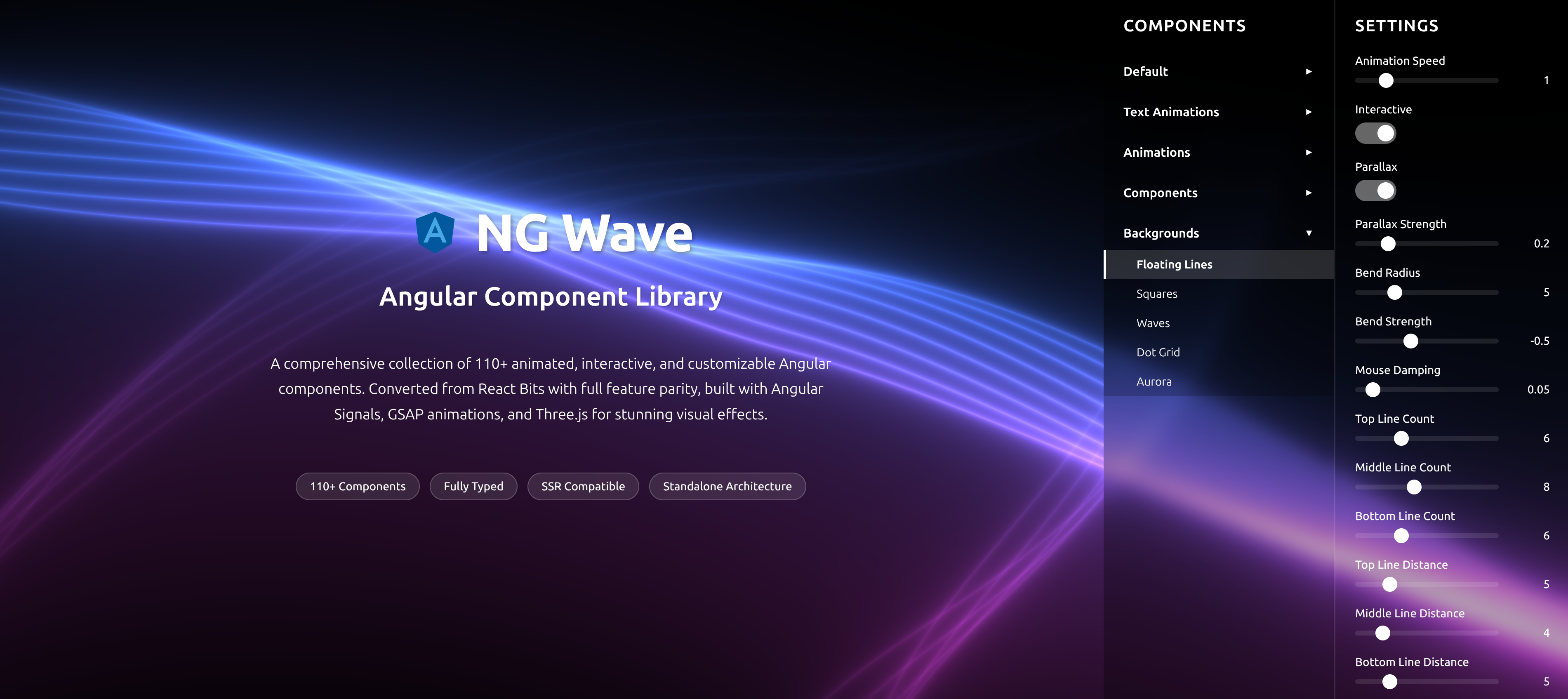
NG Wave
Angular Component Library
A comprehensive collection of 110+ animated, interactive, and customizable Angular components. Converted from React Bits with full feature parity, built with Angular Signals, GSAP animations, and Three.js for stunning visual effects.
Explore Components