From AI Prototype to Production: An Angular Consultant’s Playbook for Feature Flags and Observability (Angular 20+)
Turn AI-assisted Angular prototypes into production-grade features using flags, guardrails, and telemetry—without breaking prod or burning trust.
Ship AI behind flags, wrap it in guardrails, and observe everything—then scale it. That’s how you keep the demo magic without the production fires.Back to all posts
The demo that wowed—and the page that jittered
As companies plan 2025 Angular roadmaps, this playbook shows how to turn AI-assisted prototypes into production features with flags and observability—measurable, reversible, and boring-in-the-best-way.
A scene from the front lines
I’ve been in the room where an AI-powered Angular prototype crushed the demo—slick autocomplete, instant summaries, the CFO nodding. Two sprints later the same feature jittered in production: SSR mis-hydrated, token overages spiked spend, and a single malformed prompt took down a worker pool. I’ve hardened AI-assisted flows across enterprise Angular 20+ dashboards (telecom analytics, insurance telematics, IoT device portals, and IntegrityLens—12k+ biometric interviews). The pattern that works is simple: ship AI behind feature flags, wrap it in guardrails, and observe everything.
Who this is for
Directors and PMs who need a safe path to ship AI without reputational risk.
Senior engineers who want specifics: Signals, SignalStore, Firebase, Nx, OpenTelemetry, and CI/CD patterns.
Recruiters looking to hire an Angular developer or Angular consultant with Fortune 100 experience.
Why AI prototypes break in production
| Area | Prototype | Production |
|---|---|---|
| Availability | Best-effort | SLOs + circuit breaker + rollback |
| Access | Anyone on dev build | Role/tenant/region + server-verified flags |
| Prompts | Hardcoded | Versioned templates + content filter + PII scrubber |
| Requests | Client → LLM | Client → API proxy → LLM (rate limit, cache, audit) |
| UX | One path | Feature-flagged; fallbacks for offline/error/SSR |
| Observability | console.log | OTel + GA4/Firebase Logs + cost metrics + alerts |
| Testing | Happy-path | Unit + contract + E2E for both on/off paths |
| With Angular 21 beta on the horizon and Signals mainstream, teams shipping Angular 20+ today need predictable delivery: gated rollouts, typed events, and metrics that survive the field. That’s what follows. |
Prototype vs production reality
A quick comparison I see repeatedly when parachuting into vibe-coded apps:
The cost of skipping guardrails
Unbounded retries → runaway token costs.
No server verification → users toggle hidden flags via devtools.
Missing telemetry → incidents with no root cause.
SSR + streaming without guards → hydration mismatch and layout shifts.
Feature flags architecture for AI in Angular 20+
// feature-flags.store.ts (Angular 20+, @ngrx/signals)
import { Injectable, computed, inject } from '@angular/core';
import { SignalStore, withState, patchState } from '@ngrx/signals';
import { AuthService } from './auth.service';
import { RemoteConfigService } from './remote-config.service';

export type AiProvider = 'openai' | 'azure' | 'bedrock' | 'mock';
export interface FeatureFlagsState {
  loaded: boolean;
  killswitch: boolean;
  canaryPercent: number; // 0..100
  ai: {
    summarization: { enabled: boolean };
    autocomplete: { enabled: boolean };
    provider: AiProvider;
    maxTokens: number;
  };
  // local QA overrides for dev and Cypress
  overrides: Partial<FeatureFlagsState>;
}

const initialState: FeatureFlagsState = {
  loaded: false,
  killswitch: false,
  canaryPercent: 0,
  ai: {
    summarization: { enabled: false },
    autocomplete: { enabled: false },
    provider: 'mock',
    maxTokens: 512,
  },
  overrides: {},
};

@Injectable({ providedIn: 'root' })
export class FeatureFlagsStore extends SignalStore(
  { providedIn: 'root' },
  withState<FeatureFlagsState>(initialState)
) {
  private auth = inject(AuthService);
  private rc = inject(RemoteConfigService);

  readonly state = this.select((s) => s);

  readonly effective = computed(() => ({
    ...this.state(),
    ...this.state().overrides,
  } as FeatureFlagsState));

  readonly enabled = (path: keyof FeatureFlagsState['ai']) =>
    computed(() => !this.effective().killswitch && this.effective().ai[path].enabled);

  readonly provider = computed(() => this.effective().ai.provider);
  readonly canaryPercent = computed(() => this.effective().canaryPercent);

  async load() {
    const user = await this.auth.getUser();
    const tenant = await this.auth.getTenant();
    const cfg = await this.rc.getTypedConfig<FeatureFlagsState>({ tenantId: tenant?.id });
    patchState(this, { ...cfg, loaded: true });
  }

  override(partial: Partial<FeatureFlagsState>) {
    patchState(this, (s) => ({ overrides: { ...s.overrides, ...partial } }));
  }
}
// ux-if-flag.directive.ts
import { Directive, Input, TemplateRef, ViewContainerRef, effect, inject } from '@angular/core';
import { FeatureFlagsStore } from './feature-flags.store';
@Directive({ selector: '[uxIfFlag]' })
export class IfFlagDirective {
private tpl = inject(TemplateRef<any>);
private vcr = inject(ViewContainerRef);
private flags = inject(FeatureFlagsStore);
@Input('uxIfFlag') flag!: 'summarization' | 'autocomplete';
constructor() {
effect(() => {
const show = this.flags.enabled(this.flag)();
this.vcr.clear();
if (show) this.vcr.createEmbeddedView(this.tpl);
});
}
}// app.routes.ts
import { Routes, CanMatchFn } from '@angular/router';
import { inject } from '@angular/core';
import { FeatureFlagsStore } from './feature-flags.store';
const aiEnabled: CanMatchFn = () => inject(FeatureFlagsStore).enabled('summarization')();
export const routes: Routes = [
{
path: 'ai-tools',
canMatch: [aiEnabled],
loadComponent: () => import('./ai/ai-tools.component').then(m => m.AiToolsComponent)
}
];// ai.service.ts (client) with circuit breaker + fallback
import { inject, Injectable, signal, computed } from '@angular/core';
import { HttpClient } from '@angular/common/http';
import { FeatureFlagsStore } from './feature-flags.store';
@Injectable({ providedIn: 'root' })
export class AiService {
private http = inject(HttpClient);
private flags = inject(FeatureFlagsStore);
private failures = signal(0);
private open = computed(() => this.failures() >= 3); // trip after 3 errors
async summarize(text: string) {
if (!this.flags.enabled('summarization')() || this.open()) {
return this.localSummary(text); // deterministic fallback
}
try {
const res = await this.http.post<{ summary: string }>('/api/ai/summarize', {
text,
provider: this.flags.provider(),
maxTokens: this.flags.state().ai.maxTokens,
}, { headers: { 'x-canary': String(this.flags.canaryPercent()) } }).toPromise();
this.failures.set(0);
return res!.summary;
} catch (e) {
this.failures.update(v => v + 1);
return this.localSummary(text);
}
}
private localSummary(text: string) {
// trivial extractive fallback
return text.split('.').slice(0, 2).join('.') + '…';
}
}// server.ts (Node/Express proxy) - guardrails at the edge
import express from 'express';
import rateLimit from 'express-rate-limit';
import pino from 'pino';
import fetch from 'node-fetch';
const app = express();
app.use(express.json());
const log = pino();
const limiter = rateLimit({ windowMs: 60_000, max: 60 }); // 60 req/min per IP
app.use('/ai', limiter);
let killed = false;
app.post('/admin/killswitch', (req, res) => { killed = !!req.body.enabled; res.sendStatus(204); });
app.post('/ai/summarize', async (req, res) => {
if (killed) return res.status(503).json({ error: 'AI temporarily disabled' });
const { text, provider, maxTokens } = req.body;
if (!text || text.length > 10_000) return res.status(400).json({ error: 'invalid input' });
const scrubbed = text.replace(/\b\d{3}-?\d{2}-?\d{4}\b/g, '[SSN]'); // naive PII scrubber
const start = Date.now();
try {
const r = await fetch(`https://api.openai.com/v1/chat/completions`, {
method: 'POST',
headers: { 'Authorization': `Bearer ${process.env.OPENAI_KEY}`, 'Content-Type': 'application/json' },
body: JSON.stringify({
model: 'gpt-4o-mini',
messages: [{ role: 'system', content: 'Summarize professionally.' }, { role: 'user', content: scrubbed }],
max_tokens: Math.min(1024, Number(maxTokens || 512)),
})
});
const json = await r.json();
const latency = Date.now() - start;
log.info({ evt: 'ai.summary.ok', latency, tokens: json?.usage?.total_tokens });
res.json({ summary: json.choices?.[0]?.message?.content ?? '' });
} catch (err: any) {
const latency = Date.now() - start;
log.error({ evt: 'ai.summary.err', latency, error: err?.message });
res.status(502).json({ error: 'upstream failure' });
}
});
app.listen(8080, () => log.info('api up'));Design the flags you actually need
Keep flags typed and self-documenting. Use remote config for runtime changes and a local override for QA. Reflect flags in the UI with Signals so changes are instant without change-detection storms.
ai.summarization.enabled
ai.autocomplete.enabled
ai.provider=openai|azure|bedrock
ai.canaryPercent=0..100
ai.killswitch=true/false
ai.maxTokens=number
SignalStore for runtime flags (Firebase Remote Config example)
Below is a compact SignalStore that fetches flags, watches auth/tenant, and exposes computed helpers.
Guard routes and components
canMatch on routes to avoid loading AI-heavy bundles for users without access.
Structural directive to toggle fragments without scattering if statements.
Always verify on the server—client flags are hints, not trust boundaries.
Circuit breaker and fallback
Open the flag gradually (1% → 5% → 25% → 100%).
Trip breaker on error-rate or p95 latency; auto-reset with jitter.
Fallback to deterministic logic with a clear banner or icon state.
Observability for AI flows in Angular 20+
// telemetry.ts (browser) — minimal event bus
export type AiEventType = 'ai.request' | 'ai.response' | 'ai.error';
export interface AiEventBase { id: string; type: AiEventType; ts: number; userId?: string; tenantId?: string; route?: string; flags?: Record<string, any>; }
export interface AiRequest extends AiEventBase { type: 'ai.request'; provider: string; tokensMax: number; }
export interface AiResponse extends AiEventBase { type: 'ai.response'; latencyMs: number; tokensUsed?: number; }
export interface AiError extends AiEventBase { type: 'ai.error'; code: 'timeout'|'bad_request'|'killed'|'upstream'|'pii_blocked'; message: string; }

class TelemetryClient {
  track(evt: AiRequest|AiResponse|AiError) {
    // fan-out: GA4 + OTel exporter + Firebase Logs (callable)
    navigator.sendBeacon('/telemetry', JSON.stringify(evt));
  }
}
export const Telemetry = new TelemetryClient();
// open-telemetry-setup.ts (browser)
import { WebTracerProvider } from '@opentelemetry/sdk-trace-web';
import { BatchSpanProcessor } from '@opentelemetry/sdk-trace-base';
import { OTLPTraceExporter } from '@opentelemetry/exporter-trace-otlp-http';
const provider = new WebTracerProvider();
provider.addSpanProcessor(new BatchSpanProcessor(new OTLPTraceExporter({ url: '/otlp' })));
provider.register();
export const tracer = provider.getTracer('angularux-ai');// using the tracer in AiService
import { tracer } from './open-telemetry-setup';
async summarize(text: string) {
const span = tracer.startSpan('ai.summarize');
try {
const summary = await this.http.post<...>('/api/ai/summarize', { text }).toPromise();
span.end();
return summary;
} catch (e) {
span.recordException(e as any); span.setAttribute('error', true); span.end();
return this.localSummary(text);
}
}| Metric/Trace | Target | Alert |
|---|---|---|
| ai.summary.p95.latency | < 1200ms | page to on-call if > 2000ms for 5m |
| ai.summary.error_rate | < 2% | rollback if > 5% for 10m |
| ai.token.daily | budget-based | notify FinOps when +10% day-over-day |
| killswitch.toggled | 0 | page always |
Instrument everything with typed events
Typed events make dashboards and alerts trivial. Emit from both client and server; dedupe using correlationId.
request, response, error events with correlationId
userId, tenantId, route, feature flag state
latency buckets, token count, provider
OpenTelemetry + GA4/Firebase Logs
Firebase Analytics is great for funnels; OTel is great for latency/error histograms and traces across client and server.
Use OpenTelemetry for vendor-neutral traces/metrics.
Send business events to GA4 and technical traces to OTel backend (Grafana/Tempo, Honeycomb).
Error taxonomy that survives the field
ai.input.invalid, ai.provider.timeout, ai.provider.bad_request, ai.pii.detected, ai.killed
Map categories to alert routes and runbooks.
Progressive delivery, tests, and CI
# .github/workflows/deploy-flags.yml
name: Deploy Flags
on:
  workflow_dispatch:
    inputs:
      canary:
        description: 'Canary percent (0-100)'
        required: true
        default: '5'
jobs:
  push-remote-config:
    runs-on: ubuntu-latest
    steps:
      - uses: actions/checkout@v4
      - uses: actions/setup-node@v4
        with: { node-version: '20' }
      - run: npm i -g firebase-tools
      - run: |
          echo '{
            "killswitch": false,
            "canaryPercent": ${{ inputs.canary }},
            "ai": { "summarization": {"enabled": true}, "autocomplete": {"enabled": false}, "provider": "openai", "maxTokens": 512 }
          }' > flags.json
      - run: firebase remoteconfig:set -P ${{ secrets.FIREBASE_PROJECT }} ./flags.json
        env:
          FIREBASE_TOKEN: ${{ secrets.FIREBASE_TOKEN }}
// cypress/e2e/ai.cy.ts
describe('AI Summary', () => {
beforeEach(() => {
// local override for tests
window.localStorage.setItem('flags.overrides', JSON.stringify({ ai: { summarization: { enabled: true }}}));
cy.visit('/');
});
it('shows deterministic fallback when disabled', () => {
window.localStorage.setItem('flags.overrides', JSON.stringify({ ai: { summarization: { enabled: false }}}));
cy.reload();
cy.get('[data-cy=summary]').should('contain', '…');
});
it('returns AI summary when enabled', () => {
cy.get('[data-cy=summary-input]').type('Angular Signals reduce change detection work.');
cy.get('[data-cy=summary-generate]').click();
cy.get('[data-cy=summary]').should('not.contain', '…');
});
});Toggle-aware tests
Unit: assert fallback behavior when disabled.
Contract: pin provider JSON shapes.
E2E: run specs twice, flag off and on.
Canary rollouts via Remote Config
Seed percentage in CI, ramp manually from dashboard.
Use segments by tenant or role for safer exposure.
Rollback you’ll actually use
One-click killswitch in admin UI.
CI job to set canaryPercent=0 and killswitch=true.
SSR and hydration-safe AI UX
<!-- ai-tools.component.html -->
<section>
  <h2>Summary</h2>
  <textarea [(ngModel)]="text"></textarea>
  <button data-cy="summary-generate" (click)="generate()">Generate</button>
  <div data-cy="summary" aria-live="polite">
    <!-- Server renders fallback; client may replace post-hydration -->
    <ng-container *ngIfFlag="'summarization' ; else fallback">
      <span>{{ summary() }}</span>
    </ng-container>
    <ng-template #fallback>
      <span>{{ localSummary() }}</span>
    </ng-template>
  </div>
</section>
Keep AI invocation out of server code paths. With Angular 20 SSR, ensure hydrate-friendly IDs and avoid streaming into server-rendered containers until after isPlatformBrowser(true). Measure: keep CLS < 0.1 and zero hydration mismatches in production logs.
Avoid server-only surprises
Don’t call the LLM during SSR; render deterministic placeholders.
Hydrate then progressively enhance the AI state.
Measure stability
Use Angular DevTools + Lighthouse to monitor CLS and TBT.
Track hydration errors and retry strategy in telemetry.
Security, access, and multi-tenant flags
Pair feature flags with your existing RBAC. For Firebase projects, put allow lists and limits in Firestore and enforce via Callable Functions or your Node/.NET gateway. Log every allow/deny with reason for audit.
Server is the source of truth
Client flags are UX hints; enforce on the API.
Sign flags per-tenant or per-session to prevent tampering.
Role- and tenant-scoped targeting
In a telecom analytics platform I built, we used role + tenant + region targeting with a signed token for server decisions. The client reflected the same state via Signals for UX, but the API re-checked claims on every AI request.
Expose AI to internal roles first (ops, support).
Whitelist strategic tenants for canaries.
Real patterns from the field (IntegrityLens, telecom, IoT)
If you need a remote Angular developer with Fortune 100 experience to harden an AI prototype, this is the playbook I bring—measured, reversible, and boring enough to keep you out of incident review.
IntegrityLens (12k+ biometric interviews)
We shipped AI model changes behind flags, observed token/cost deltas in BigQuery, and rolled back within minutes when a provider regressed. The UI reflected flags via Signals, avoiding churn.
Flags for model/provider swaps without downtime.
PII scrubbers and audit trails tied to candidate IDs.
SLOs on verification latency; rollbacks on >3% errors.
Telecom advertising analytics dashboard
We gated “AI insights” cards tenant-by-tenant, streamed updates over WebSockets with typed event schemas, and tripped the circuit breaker on error spikes—no midnight pages.
AI insights flagged per tenant with canaries.
WebSocket updates + exponential backoff + typed events.
Grafana boards for p95 latency and error rate.
Enterprise IoT device portal
Edge vs cloud AI toggled remotely. When offline, the UI fell back to deterministic rules. Metrics proved stability: 0 hydration errors, CLS < 0.05, and incident MTTR under 15 minutes.
Offline-first paths with deterministic fallbacks.
Flags to switch between cloud and edge inference.
Docker-based envs for parity across CI and local.
Implementation details: Nx structure and config
npx create-nx-workspace@latest angularux-ai --preset=apps
cd angularux-ai
npx nx g @nx/angular:app web --ssr --bundler=vite
npx nx g @nx/node:app api
npx nx g @nx/angular:lib feature-flags
npx nx g @nx/angular:lib telemetry
npx nx g @nx/angular:lib ai
/* flags-badges.scss */
.badge-ai {
display: inline-flex; align-items: center; gap: .375rem;
padding: .125rem .5rem; border-radius: .375rem; font-size: .75rem; font-weight: 600;
background: color-mix(in srgb, var(--p-primary-500) 15%, transparent);
color: var(--p-primary-800);
}Use PrimeNG or your design system to show clear states (AI on, canary, fallback). Surface a small admin-only banner with the active provider and canary percent during staged rollouts.
Suggested Nx layout
Keep flags and telemetry in shared libs so E2E and storybook-sized environments can reuse them.
apps/web (Angular 20, SSR)
apps/api (Node proxy)
libs/feature-flags, libs/telemetry, libs/ai
tools/ (schematics, scripts)
Environment and tokens
Use build-time tokens for non-sensitive defaults.
Prefer runtime remote config for on/off and canary percent.
Comparison: flag options and guardrails that ship day one
| Option | Where | Pros | Cons |
|---|---|---|---|
| Build-time env | Angular env files | Simple, cached | Redeploy to change; easy to drift |
| Remote Config (Firebase) | Runtime | Instant toggles; per-tenant | Extra SDK; secure server check needed |
| Flag SaaS (LD/ConfigCat) | Runtime | Targeting UI; audits | Cost; SDK weight |
| Backend flags | API gateway | Source of truth; secure | UI needs mirror state |
| Guardrail | Client | Server |
|---|---|---|
| Rate limit | UI throttle/debounce | express-rate-limit, nginx |
| Circuit breaker | Fail-fast to fallback | Trip on error/latency; auto-reset |
| PII filter | Basic redaction | DLP service or regex bank + storage rules |
| Cost control | Show token estimate | Budget alert + deny if exceeded |
Choose your flag delivery
Pick runtime flags for AI behavior; avoid build-time branching that forces redeploys for every tweak.
Guardrails you shouldn’t skip
Rate limit and concurrency caps
PII scrubbing and content filters
Circuit breaker with backoff and jitter
Cost budget alerts and daily token caps
Takeaways and what to instrument next
If you’re planning AI features for Q1, don’t ship raw prototypes. Ship flags, guardrails, and observability. That’s how you avoid midnight rollbacks and how your stakeholders keep trusting Angular. If you need help, hire an Angular developer with enterprise experience—or bring me in as your Angular consultant to pressure-test and deliver.
What to ship this sprint
Flags in a SignalStore, a structural directive, and canMatch guards.
Server proxy with rate limiting, PII scrub, and a killswitch.
OTel tracer + typed events to GA4/Firebase Logs.
Cypress flow for flag off/on paths.
What to instrument next
p95 latency, error rate, daily tokens, killswitch events.
SSR hydration mismatches and CLS.
A/B tests for AI vs fallback user outcomes.
When to Hire an Angular Developer for Legacy Rescue
If any of these sound familiar, it’s time to bring in a senior Angular engineer. I can assess within a week, stabilize within 2–4 weeks, and leave you with a playbook and dashboards that survive the field.
Signals your AI prototype needs help
I rescue vibe-coded apps weekly at gitPlumbers—adding typed flags, telemetry, and tests without halting feature velocity.
Console logs as ‘observability’.
No server proxy for LLM calls.
Flags are build-time only.
SSR hydration warnings in prod.
How an Angular Consultant Approaches Signals Migration for Flagged Features
Pair Signals with your flag rollout. It’s the fastest way to gain perf and clarity while you harden AI features—especially in PrimeNG-heavy dashboards.
Pragmatic path
I’ve cut render counts 60%+ by moving hot UI switches like flags to Signals without rewriting the world. Start where it matters.
Wrap legacy state with adapters; expose Signals outward.
Use SignalStore for flags first—low-risk and high-visibility.
Measure render reductions via Angular DevTools flame charts.
Key takeaways
- Ship AI features behind feature flags first; target by role, tenant, and percentage with server-verified checks.
- Add guardrails: rate limits, circuit breakers, content/PII filters, and typed event schemas for every AI call.
- Instrument with OpenTelemetry + GA4/Firebase Logs; monitor SLOs (latency, error %, token cost) and set kill switches.
- Use Signals + SignalStore to reflect flags instantly in the UI without change detection churn.
- Test with toggles in unit, contract, and Cypress E2E; add canary deployments and rollbacks in CI.
- SSR/hydration: render stable fallbacks server-side; progressively enhance AI after hydration to avoid layout jank.
- Measure outcomes: crash-free sessions, p95 latency, Lighthouse stability, and defect reproduction speed.
Implementation checklist
- Inventory AI touchpoints: components, services, routes, and API surface.
- Define flags with typed names and default off; wire a kill switch in UI and API.
- Implement a SignalStore for flags with remote updates and local overrides for QA.
- Gate routes with canMatch and components with a structural directive; verify on server.
- Proxy all LLM calls through a Node/.NET API with rate limiting, PII redaction, and circuit breaker.
- Create typed telemetry events (request, response, error); add correlation IDs and user/tenant context.
- Set SLOs and alerts for latency, error %, and token spend; add dashboards in Grafana/GA4.
- Write Cypress specs that flip flags and assert both fallback and AI-enhanced paths.
- Enable canary rollout via Firebase Remote Config or your flag provider; add rollback in CI.
- Review weekly: flags to retire, queries to optimize, and docs/tests to align with production reality.
Questions we hear from teams
- How much does it cost to hire an Angular developer or Angular consultant for this work?
- Typical engagements start at 2–4 weeks. For flags, guardrails, and observability, budgets often range from $12k–$40k depending on scope, CI/CD, and backend complexity. I scope fast and deliver a fixed, outcomes-based plan when possible.
- How long does it take to harden an AI-assisted Angular feature for production?
- Expect 1–2 weeks for a single feature: flags, server proxy, telemetry, and tests. Add another 1–2 weeks for canary deployment, dashboards, and team training. Multi-feature programs naturally scale with parallelization.
- What does an Angular consultant actually deliver here?
- A working flag system (Signals + SignalStore), a secure AI proxy, typed telemetry, alerting, and a rollout plan in CI. You get dashboards, docs, and tests—plus a clear kill switch and rollback you can trust during high-traffic windows.
- Do we need LaunchDarkly or can we use Firebase?
- You can ship with Firebase Remote Config and server verification for most use cases. If you need advanced segmentation and audits at scale, LaunchDarkly or ConfigCat are great. I’ll align the choice to your budget and compliance needs.
- Will SSR or SEO break when we add AI?
- Not if you render deterministic fallbacks on the server and enhance only after hydration. Track CLS and hydration mismatches in observability. I’ve shipped AI on SSR apps without regressions in Lighthouse or Core Web Vitals.
Ready to level up your Angular experience?
Let AngularUX review your Signals roadmap, design system, or SSR deployment plan.
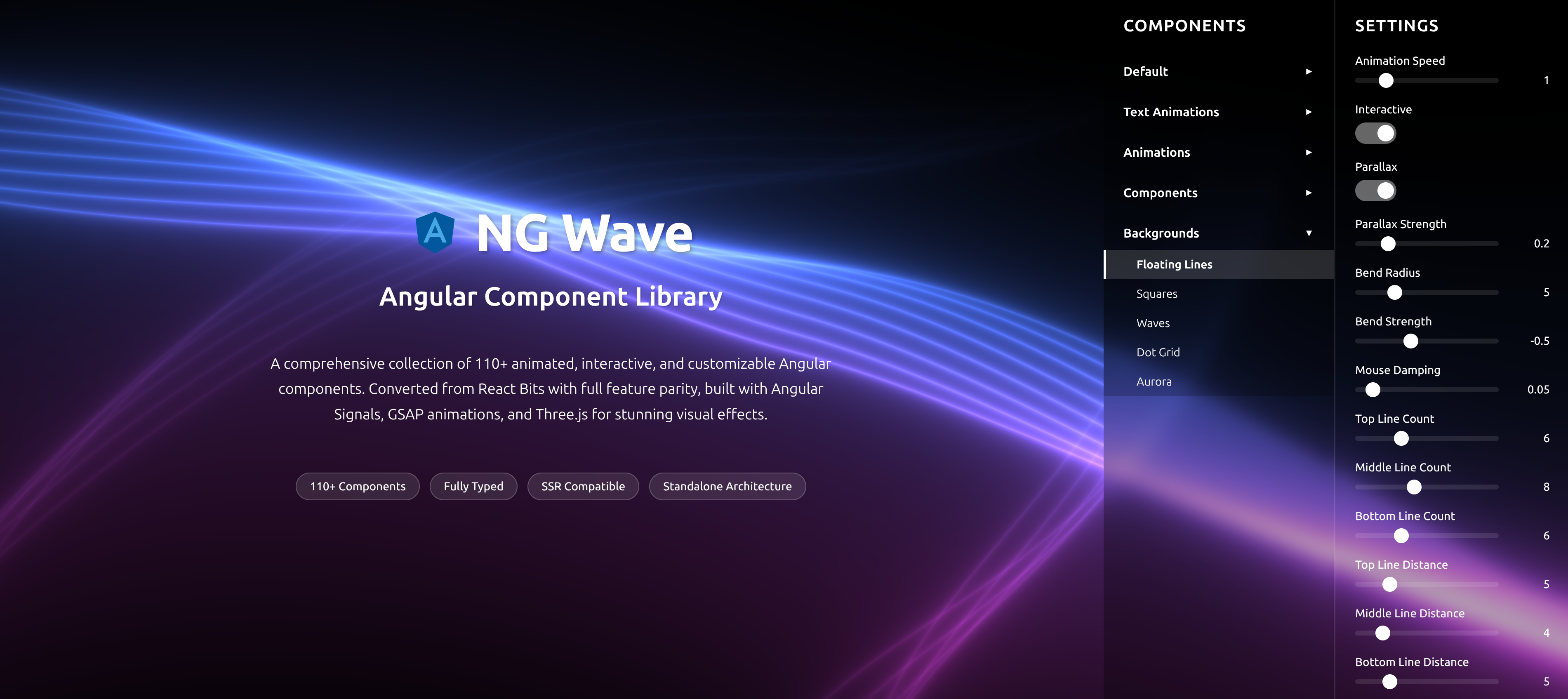
NG Wave
Angular Component Library
A comprehensive collection of 110+ animated, interactive, and customizable Angular components. Converted from React Bits with full feature parity, built with Angular Signals, GSAP animations, and Three.js for stunning visual effects.
Explore Components