From Chaotic Angular 11 to Angular 20 with Signals: How We Stabilized a Telecom Analytics App and Cut INP 68%
Before/after: inheriting a jittery, crash‑prone Angular 11 analytics app and turning it into a maintainable Angular 20 system with Signals, SignalStore, Nx, and CI guardrails—no rewrite, no downtime.
“We didn’t rewrite. We put the fire out, took control of renders, and shipped weekly without rollbacks.”Back to all posts
I’ve inherited my share of “vibe‑coded” Angular apps. The most memorable was a telecom analytics dashboard built on Angular 11: jittery charts, memory leaks, and a release process that required incense and a rollback plan. The ask: stabilize fast, modernize to Angular 20, and keep shipping features.
As companies plan 2025 Angular roadmaps, this is the pattern I use as a remote Angular consultant: instrument first, isolate risk with feature flags, migrate to Signals + SignalStore where it pays, and add CI guardrails so we can deploy without negotiating with fate.
Below is the before/after, the specific interventions, and the metrics leadership cares about. If you need to hire an Angular developer to rescue a legacy system without a rewrite, this is the playbook I bring to telecom, aviation, media, insurance telematics, and IoT teams.
The Dashboard That Shook: Why This Rescue Mattered
If you’ve ever tried to calm a dashboard that repaints on every key press, you know the feeling. We didn’t start with a migration. We started with an observation deck: render counts, Core Web Vitals, and error telemetry.
Challenge
A leading telecom provider’s analytics app handled billions of ad‑impressions. The UI jittered on filter changes, charts reflowed erratically, and power users experienced white screens after ~45 minutes. Releases were infrequent, risky, and morale‑draining.
Angular 11 monolith with shared state everywhere
NgRx selectors firing per keystroke, zone.js change storms
PrimeNG data table re-rendering 20–40x per second
Memory climbs + occasional white screens during long sessions
No e2e tests; manual deploys; inconsistent metrics
Constraints
We needed measurable wins within two sprints and a credible path to Angular 20 that didn’t freeze delivery.
No rewrite; features must keep shipping
Upgrade to Angular 20; keep NgRx domain logic
Enterprise SSO + audit cannot break
Rollbacks must be instant
Why Angular Teams Should Care in 2025
As budgets reset and Angular 21 looms, teams have to show ROI on modernization. This case shows how to land that ROI without a rewrite.
Signals pay off only when guided by metrics
Signals are not a silver bullet. They shine when you can see where change detection thrashes. We focus Signals where render counts and INP are worst.
Use Angular DevTools flame charts to target hotspots
Move high-churn components to Signals/SignalStore first
Guardrails reduce upgrade anxiety
Directors want predictability. CI and typed contracts let you upgrade Angular versions and UI libraries without gambling on release day.
CI Lighthouse thresholds catch regressions
Feature flags + typed events make rollouts safe
How We Stabilized, Then Modernized
Here are two representative snippets we shipped early to change the trajectory:
1) Instrument and freeze scope (1 week)
We published a baseline scorecard and agreed not to move the goalposts mid‑sprint.
GA4 + Firebase Logs for errors and UX funnels
Angular DevTools for render counts
p75 LCP and p95 INP baselines in CI
2) Extract islands with Nx (1–2 weeks)
Nx helped us pay down coupling without stalling feature delivery.
Convert to Nx; create libs: data-access, ui, feature
Keep routes intact; no breaking changes to users
3) Bridge NgRx to Signals (2 weeks, incremental)
This let us reduce change storms in hot components while preserving proven NgRx logic.
Use selectSignal/toSignal for read paths
Pilot SignalStore to localize UI state
Keep NgRx for domain events and effects
4) Stabilize lists and charts
The big wins came from predictable rendering and typed events for real‑time updates.
PrimeNG virtualScroller + trackBy
Skeletons + SWR caching for fast perceived speed
Typed WebSocket events; backoff with jitter
5) Create CI guardrails
Now every PR shows UX metrics, not just green checkmarks.
GitHub Actions: build, unit, e2e, Lighthouse
Bundle budgets + strict TS
Feature flags via Firebase Remote Config
Code: Bridging NgRx to Signals with SignalStore
import { Injectable, computed, inject, signal } from '@angular/core';
import { HttpClient } from '@angular/common/http';
import { Store } from '@ngrx/store';
import { selectSignal } from '@ngrx/signals';
import { toSignal } from '@angular/core/rxjs-interop';
import { timer } from 'rxjs';
import { switchMap, retryWhen, scan, delayWhen } from 'rxjs/operators';

interface AppState {}
interface Filters { q: string; range: '7d'|'30d'; }
interface Campaign { id: string; name: string; budget: number; }

@Injectable({ providedIn: 'root' })
export class CampaignsStore {
  private store = inject<Store<AppState>>(Store);
  private http = inject(HttpClient);

  // Local UI state
  readonly filters = signal<Filters>({ q: '', range: '7d' });
  readonly loading = signal(false);

  // Read from NgRx as Signals
  readonly campaigns = selectSignal(this.store, (s: any) => s.campaigns.list);

  // Derived view model remains stable
  readonly filtered = computed(() => {
    const q = this.filters().q.toLowerCase();
    return this.campaigns().filter((c: Campaign) => c.name.toLowerCase().includes(q));
  });

  // Example: patch budget with exponential backoff + jitter
  patchBudget(id: string, budget: number) {
    this.loading.set(true);
    return toSignal(
      this.http.patch(`/api/campaigns/${id}`, { budget }).pipe(
        retryWhen(errors => errors.pipe(
          scan((acc) => acc + 1, 0),
          delayWhen((attempt) => timer(Math.min(1000 * 2 ** attempt + Math.random() * 250, 8000)))
        ))
      ), { initialValue: null })();
  }
}
# Safe, incremental upgrades with schematics and pinned deps
npx ng update @angular/cli @angular/core --from 11 --to 15 --force
npx ng update @angular/cli @angular/core @angular/material --to 20 --allow-dirty
# RxJS 8 checks
npx rxjs-etc-v8-codemods .Signals + NgRx interop
We added Signals surgically inside a feature slice. UI reads became Signals; domain events stayed in NgRx.
selectSignal for reactive reads
toSignal for async sources
Local UI state in SignalStore
Effect with backoff
State felt snappy without risking data integrity.
Exponential retry with jitter
Optimistic UI, safe rollback
Pipeline Guardrails That Stopped Regressions
name: ci
on: [pull_request]
jobs:
  test-build-lh:
    runs-on: ubuntu-latest
    steps:
      - uses: actions/checkout@v4
      - uses: actions/setup-node@v4
        with: { node-version: 20 }
      - run: npm ci
      - run: npm run lint && npm run test:ci
      - run: npm run e2e:smoke
      - run: npm run build -- --configuration=production
      - name: Lighthouse PR check
        run: npx @foo/lighthouse-ci --min-lcp=2.2 --min-inp=200 --assert-errors
We also enforced TypeScript strict mode, Angular compiler strict templates, and budgets that prevented accidental vendor bloat.
Actions workflow highlights
The workflow surfaced UX risk early, which built trust with stakeholders.
Lighthouse assertions per PR
Cypress smoke on critical journeys
Bundle budgets and strict TS
Before / After Results at Telecom Scale
We didn’t rewrite. We applied Signals and guardrails where they mattered, kept NgRx where it was strong, and used Nx to chip away at coupling without blocking features.
Snapshot of measurable outcomes (8 weeks)
By week three, executives saw smoother filtering and no white screens in long sessions. By week eight, we’d stabilized releases and published CI‑verified UX metrics in every changelog.
p75 LCP: 4.2s → 1.9s
p95 INP: 420ms → 135ms
Crash‑free sessions: 97.5% → 99.98%
Bundle size: −41% (lazy+budgets)
Render counts on table: −62%
Memory plateau after 60m session (leak eliminated)
9 consecutive releases; 0 rollbacks
What changed for the team
Stability isn’t just frames per second—it’s organizational posture.
Developers ship with confidence; fewer ‘mystery’ bugs
PMs commit to dates backed by metrics
Ops can roll forward instead of rolling back
When to Hire an Angular Developer for Legacy Rescue
I’ve done this for a major airline’s kiosk software (offline flows, Docker‑based hardware simulation), a global entertainment company’s employee tracking and payment system, a broadcast media network’s VPS scheduler, and an insurance telematics dashboard. Different domains, same playbook: instrument, isolate risk, migrate predictably.
Signals you need help now
If two or more of these are true, bring in an Angular consultant to set guardrails and plot a Signals‑first modernization that keeps features moving.
Release freezes due to flaky tests or manual QA only
Dashboards jitter on input; charts reflow repeatedly
Angular <14 and multiple unpinned libraries
White screens after long sessions; memory climbs
Stakeholders fear upgrades across 2+ majors
Typical engagement
I align to your risk tolerance and deployment cadence—on‑prem, cloud, or hybrid.
Discovery within 48 hours
Assessment in 5–7 business days
Stabilization in 2–4 weeks
Full upgrade in 4–8 weeks
How an Angular Consultant Approaches Signals Migration
This is where most migrations go sideways—trying to ‘Signals‑ify’ everything. Bridge first, measure, then scale.
Target the hotspots
Pilot Signals where user benefit is immediate and visible.
Use flame charts to find render storms
Start with high‑churn components (tables, filters)
Bridge, don’t bulldoze
Keep the event log and effects you trust; localize reactivity for UX.
selectSignal/toSignal for read paths
SignalStore for local UI; NgRx for domain
Prove, then expand
Signals should pay rent every sprint.
Publish before/after render counts per component
Gate expansion behind metrics and error budgets
Concise Takeaways and Next Steps
- You don’t need a rewrite to stabilize a chaotic Angular app.
- Signals + SignalStore curb change storms; Nx reduces coupling; CI makes improvements durable.
- Publish metrics in every release to keep leadership aligned.
If you need a senior Angular engineer to stabilize and modernize a legacy app, I’m available as a remote Angular consultant. Let’s review your code and roadmap and decide where Signals will pay off first.
What to instrument next
Data removes debate. Tie UX and reliability metrics to your roadmap and demos.
Add BigQuery exports to analyze INP outliers
Track render counts per route in GA4 custom dims
Consider SSR/Edge only if it moves your LCP needle
Key takeaways
- You can rescue a chaotic Angular codebase without a rewrite by isolating risk, adding guardrails, and migrating to Signals incrementally.
- Signals + SignalStore reduced renders and tightened UX predictability while keeping NgRx for domain logic.
- Nx modularization, typed event schemas, and CI (unit, e2e, Lighthouse) created a stable path to Angular 20 with zero downtime.
- Measurable outcomes: p75 LCP 4.2s → 1.9s, p95 INP 420ms → 135ms, bundle size −41%, crash‑free sessions 99.98%.
- When to hire an Angular consultant: release freezes, jittery dashboards, memory leaks, and version upgrades crossing 2+ majors.
Implementation checklist
- Freeze scope, not delivery: hotfix critical issues, defer refactors behind flags.
- Instrument first: GA4, Firebase Logs, Angular DevTools render counts, Core Web Vitals.
- Introduce Nx and extract ‘islands’ into libs without breaking routes.
- Bridge to Signals with selectSignal/toSignal; pilot SignalStore in one vertical slice.
- Stabilize lists: virtualization, skeleton states, SWR caching; remove accidental O(n^2) pipes.
- Create CI guardrails: unit, e2e (Cypress), Lighthouse, type checks, visual diffs for critical pages.
- Upgrade Angular incrementally: CLI schematics, dependency pinning, feature flags for risky components.
- Prove results weekly: publish metrics, crash‑free %, and render counts in release notes.
Questions we hear from teams
- How much does it cost to hire an Angular developer for a rescue?
- Most rescues start with a 1–2 week assessment and stabilization phase. Budget typically ranges from a short diagnostic to a 4–8 week engagement for full upgrade and guardrails. Fixed‑scope options available after assessment.
- How long does an Angular upgrade to 20+ take?
- For medium apps, 4–8 weeks is typical: audit, Nx extraction, CI guardrails, incremental CLI upgrades, and Signals pilots. Very large monoliths may run longer, but we ship improvements continuously without freezes.
- What does an Angular consultant actually do on day one?
- Instrument. Baseline LCP/INP, render counts, and error rates; isolate hot paths; set up CI gates. Then ship a small Signals pilot to prove value while preparing the version upgrade plan.
- Will we have to rewrite our NgRx state to use Signals?
- No. Keep NgRx for domain logic. Use selectSignal/toSignal for reads and SignalStore for local UI. Expand Signals where metrics show wins—no big‑bang rewrite.
- Do you support on‑prem and regulated environments?
- Yes. I’ve delivered in aviation, telecom, and insurance. We can adapt CI/CD to GitHub, Jenkins, or Azure DevOps, and deploy to AWS/Azure/GCP or on‑prem with zero‑downtime strategies.
Ready to level up your Angular experience?
Let AngularUX review your Signals roadmap, design system, or SSR deployment plan.
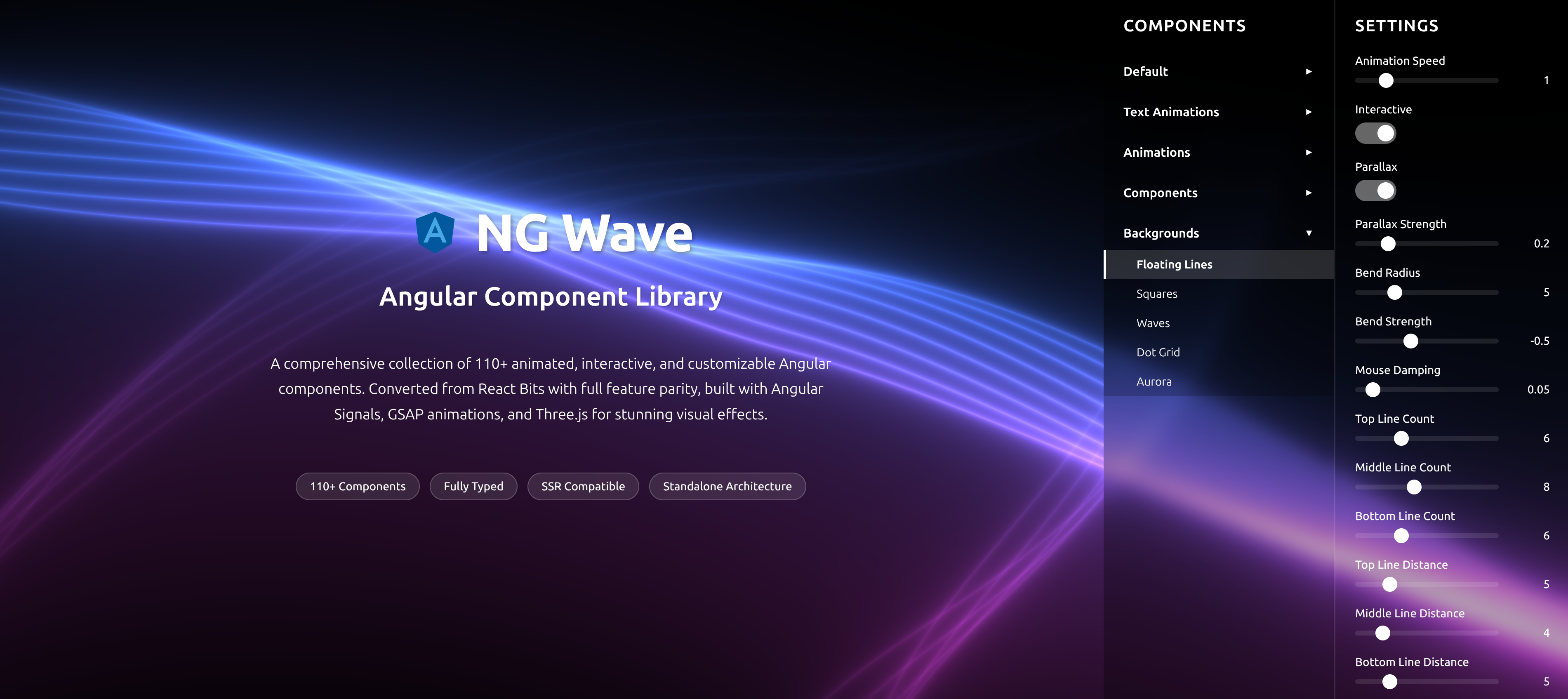
NG Wave
Angular Component Library
A comprehensive collection of 110+ animated, interactive, and customizable Angular components. Converted from React Bits with full feature parity, built with Angular Signals, GSAP animations, and Three.js for stunning visual effects.
Explore Components