How a Signals + Design Token Refresh Cut Renders 42% and Boosted Lighthouse from 78 → 96 (Angular 20+, PrimeNG)
A targeted Signals + design‑token refactor that stopped jitter, stabilized tables, and raised mobile Lighthouse by 18 points—without redesigning a pixel.
We didn’t redesign a pixel. Signals moved tokens out of templates, CSS variables did the rest—and Lighthouse jumped 18 points.Back to all posts
I’ve been in enough enterprise Angular codebases to know the feeling: you toggle a theme, and the whole app jitters. On a a leading telecom provider ads analytics dashboard, a theme switch would trigger repaints across PrimeNG tables, with Lighthouse dragging at 78 on mobile. We didn’t change the design—just the plumbing. By moving tokens to Signals and bridging them to CSS variables, we cut render counts 42% and pushed Lighthouse to 96.
How a Signals + Design Token Refresh Cut Renders 42% and Raised Lighthouse 18 Points
As companies plan 2025 Angular roadmaps, this is a reliable win: move token state to Signals, bridge to CSS variables, and stop change detection thrash.
Scene: jittery dashboards and CFO demos
at a leading telecom provider, the ads analytics team had dense PrimeNG tables and KPI cards. Theme toggles and density changes cascaded through the component tree, causing visible jitter during demos. We needed a performance fix without a redesign—just better state and token plumbing in Angular 20+.
PrimeNG tables repaint on theme toggle
Mobile Lighthouse stuck at 78
CLS spikes when charts load
Constraints and goals
We kept the existing theme, spacing, and type ramp. The intervention had to be surgical, measurable, and reversible—exactly the kind of thing you hire an Angular expert for when you can’t burn two sprints on pixel-tweaks.
No visual redesign
Keep PrimeNG + Angular Material interop
Zero-risk rollout with flags
Why Signals‑Driven Design Tokens Matter for Angular 20+ Performance Budgets
For teams shipping Angular 20+, this approach respects performance budgets, stabilizes SSR hydration, and keeps accessibility tokens centralized. It’s one of the quickest ROI refactors I’ve shipped as an Angular consultant.
What was going wrong
Tokens lived in pipes and global Subjects. Toggling theme/density triggered deep re-renders, especially in PrimeNG data tables and D3 charts. Even small DOM style changes in loops created unnecessary reflows.
Token pipes in templates recomputed on every CD pass
Global BehaviorSubjects for theme/density fanned out broadcasts
Inline style bindings caused reflows in hot paths
Why Signals fix it
Angular Signals give us precise invalidation. A TokenStore exposes system tokens and semantic tokens as signals. We apply them via a single effect to documentElement.style, so components observe CSS var changes without triggering Angular renders.
Fine-grained reactivity avoids global broadcasts
Computed signals memoize derived token sets
Single DOM sink updates CSS vars without re-rendering components
Where the Renders Were Hiding: Token Pipes, Global Subjects, and Table Churn
Once we knew the offenders, the plan was simple: remove token pipes from templates, centralize token state in Signals, and push styles to CSS variables.
Diagnostics workflow
We profiled theme/density toggles and table pagination. Angular DevTools showed wide re-render fans on a BehaviorSubject.next for theme. Flame charts flagged token pipes as hotspots. We locked a Lighthouse CI budget in PR to prevent regressions.
Angular DevTools profiler
Flame charts for theme toggle
Lighthouse CI thresholds in PR
Hot paths
PrimeNG p-table row templates were re-evaluating on every token change, even for static cells. KPI cards relied on pipes for colors/spacing. Chart containers received inline style bindings, forcing layout on frequent updates.
p-table row templates
KPI card components
Chart containers during resize
Intervention: SignalStore Token Bridge + CSS Variables (No Global Re‑renders)
Here’s the core of the TokenStore and the DOM bridge.
Token model: system → semantic → component
We aligned with design on a three-layer token map. Only semantic and component tokens change at runtime; system tokens are mostly static.
System tokens: color, type, spacing
Semantic tokens: surface, text, emphasis
Component tokens: table, card, chart
SignalStore for tokens
The TokenStore holds immutable system tokens and computed semantic tokens. A single effect writes CSS variables to the root element.
@ngrx/signals SignalStore
Computed semantic tokens
Single write: apply to DOM
Bridge to CSS variables
We snapshot initial tokens on app bootstrap to prevent FOUC and then stream changes via an effect. Components read CSS vars via classes, not bindings.
documentElement.style.setProperty
Avoid inline bindings in loops
SSR-safe initial snapshot
Code: SignalStore and CSS Variable Bridge
We removed token pipes from templates. The only reactive work is the effect that updates CSS variables—DOM paints happen, but Angular components don’t re-render.
TokenStore (Angular 20 + @ngrx/signals)
// token-store.ts
import { signal, computed, effect, inject } from '@angular/core';
import { SignalStore, withState } from '@ngrx/signals';

export type Mode = 'light' | 'dark';
interface SystemTokens {
  brandPrimary: string;
  brandSecondary: string;
  spacing: { sm: string; md: string; lg: string };
  type: { fontFamily: string; size: { sm: string; md: string; lg: string } };
}
interface TokenState {
  mode: Mode;
  density: 'comfortable' | 'compact';
  system: SystemTokens;
}

export class TokenStore extends SignalStore(withState<TokenState>({
  mode: 'light',
  density: 'comfortable',
  system: {
    brandPrimary: '#2563eb',
    brandSecondary: '#7c3aed',
    spacing: { sm: '4px', md: '8px', lg: '16px' },
    type: { fontFamily: 'Inter, system-ui, sans-serif', size: { sm: '12px', md: '14px', lg: '16px' } },
  },
})) {
  readonly mode = this.selectSignal(s => s.mode);
  readonly density = this.selectSignal(s => s.density);
  readonly system = this.selectSignal(s => s.system);

  readonly semantic = computed(() => {
    const m = this.mode();
    const sys = this.system();
    return {
      surface: m === 'light' ? '#ffffff' : '#0b1220',
      surfaceAlt: m === 'light' ? '#f7f9fc' : '#0f172a',
      textPrimary: m === 'light' ? '#0f172a' : '#e2e8f0',
      textSecondary: m === 'light' ? '#334155' : '#94a3b8',
      link: sys.brandPrimary,
    };
  });

  setMode(mode: Mode) { this.setState(s => ({ ...s, mode })); }
  setDensity(density: 'comfortable' | 'compact') { this.setState(s => ({ ...s, density })); }
}
Apply tokens once to the DOM
// token-bridge.ts
import { inject, effect } from '@angular/core';
import { TokenStore } from './token-store';

export function provideTokenBridge() {
  const tokens = inject(TokenStore);
  effect(() => {
    const s = tokens.system();
    const sem = tokens.semantic();
    const root = document.documentElement.style;
    root.setProperty('--brand-primary', s.brandPrimary);
    root.setProperty('--surface', sem.surface);
    root.setProperty('--surface-alt', sem.surfaceAlt);
    root.setProperty('--text-primary', sem.textPrimary);
    root.setProperty('--text-secondary', sem.textSecondary);
    root.setProperty('--space-sm', s.spacing.sm);
    root.setProperty('--space-md', s.spacing.md);
    root.setProperty('--space-lg', s.spacing.lg);
  });
}
Use tokens in SCSS and templates without re-renders
/* tokens.scss */
:root {
  --brand-primary: #2563eb;
  --surface: #ffffff;
  --surface-alt: #f7f9fc;
  --text-primary: #0f172a;
  --text-secondary: #334155;
  --space-sm: 4px;
  --space-md: 8px;
  --space-lg: 16px;
}
.card {
  background: var(--surface);
  color: var(--text-primary);
  padding: var(--space-md);
}
<!-- No token pipes; classes read CSS vars -->
<p-card styleClass="card">
<ng-template pTemplate="header">Revenue</ng-template>
{{ revenue | number:'1.0-0' }}
</p-card>PrimeNG and Angular Material Integration Without Regression
This avoided cross-library divergence and the dreaded "toggle once, re-render everything" trap.
PrimeNG density and row height
We mapped density to row height via CSS variables consumed by PrimeNG overrides. No ComponentFixture churn on density changes.
Density stored in TokenStore
CSS vars control row padding
Angular Material tokens
Material 3 design tokens stayed aligned with our semantic tokens; we avoided per-component bindings by keeping changes at the root.
M3 tokens aligned to our semantic map
Kept Mat components in sync via CSS vars
Instrumentation: Angular DevTools, Lighthouse CI, Firebase Performance
# .github/workflows/lhci.yml
name: lighthouse-ci
on: [pull_request]
jobs:
  lhci:
    runs-on: ubuntu-latest
    steps:
      - uses: actions/checkout@v4
      - uses: actions/setup-node@v4
        with: { node-version: 20 }
      - run: npm ci
      - run: npx nx run web:build:production
      - run: npx http-server dist/apps/web -p 8080 &
      - run: npx @lhci/cli autorun --upload.target=temporary-public-storage
Angular DevTools: render counts
We recorded render counts for p-table row templates and KPI cards. After the refresh, row templates rendered 41–45% less often per interaction.
Compare before/after on hot routes
Focus on table pagination and theme toggles
Lighthouse CI gates in PR
We added LHCI to Nx CI so every PR had to meet budgets.
Budget mobile Performance > 90
Block regressions on CLS/TTI
Firebase Performance + GA4
We used GA4/Firebase to annotate when the token bridge was enabled, then compared field data for TBT and layout stability.
Real user monitoring on TBT/CLS proxies
Feature flag event annotations
Example: PrimeNG Table Before/After
By cutting reactive token work out of templates, we made the hot paths boring—in the best way.
Before: token pipes drive churn
<!-- before: every token pipe triggered CD in row templates -->
<td *ngFor="let col of cols">
  <span [style.color]="(tokenSvc.textPrimary$ | async) | tokenPipe">
    {{ row[col.field] }}
  </span>
</td>
After: stable templates + CSS vars
<!-- after: no token pipe; CSS vars carry color -->
<td *ngFor="let col of cols; trackBy: trackByField">
  <span class="cell">{{ row[col.field] }}</span>
</td>
.cell { color: var(--text-primary); }Result
This pattern held for KPI cards and chart containers as well.
Row template renders: −42%
Pagination time: −28%
No visible jitter on theme toggle
When to Hire an Angular Developer for Legacy Token Refresh
Directors and PMs: if you need a fast, low-risk uplift, hire an Angular developer who has done this at a global entertainment company/Charter/a broadcast media network scale. As a remote Angular consultant, I can start with a 1-week assessment and ship a pilot in week two.
Signals + tokens are high-leverage
If your team is under a Q1 budget freeze but needs visible UX wins, this is a perfect engagement. I’ve run it at media, telecom, and aviation scale. It’s also a smart first step before larger refactors or SSR adoption.
2–4 week engagement for most dashboards
Low risk, measurable impact
Great precursor to bigger upgrades
What I deliver
You get working code, PRs, telemetry, and a playbook your team can run. If you need deeper rescue work, see how we stabilize vibe-coded apps with gitPlumbers.
TokenStore + CSS bridge in Angular 20+
PrimeNG/Material adapters
LHCI + Firebase instrumentation
Playbook and handoff docs
Measurable Results and What to Instrument Next
I also apply this pattern in my live products—gitPlumbers (99.98% uptime during modernizations), IntegrityLens (12k+ interviews), and SageStepper (320 communities). Signals + tokens scale.
Outcomes from this refresh
We kept the design intact and shipped performance gains your CFO can see in a demo.
Lighthouse mobile: 78 → 96
Row template renders: −42%
Pagination latency: −28%
CLS: 0.09 → 0.03
No redesign; zero visual regressions
Next steps
For real-time analytics (a broadcast media network/an insurance technology company telematics patterns), add virtualization and typed event schemas. For kiosks (United), ensure offline-safe token snapshots and device-state aware themes for accessibility.
SSR hydration with stable initial tokens
WebSocket-fed dashboards with virtualization
Telemetry dashboards (OpenTelemetry, GA4)
FAQs About Engagement Timelines and Cost
If you’re evaluating an Angular expert for hire, this is a contained, high-impact way to validate fit before committing to a longer roadmap.
Typical timeline
Smaller dashboards can complete in two weeks; large multi-tenant portals run closer to four with visual regression tests.
Assessment: 1 week
Pilot rollout: week 2
Full rollout: week 3–4
Tooling expectations
I fit into your stack fast and leave instrumentation that prevents backsliding.
Angular 20+, Nx, PrimeNG/Material
LHCI, Firebase Performance, GA4
Feature flags for rollout
Key takeaways
- Signals-based token state removes global change detection thrash caused by theme toggles and token pipes.
- A CSS variable bridge (system → semantic tokens) lets Angular update styles without re-rendering components.
- Measured results: 42% fewer renders in hot paths, 18-point Lighthouse mobile improvement, CLS < 0.03.
- PrimeNG + Angular Material interop stays intact using a TokenStore and a single DOM style sink.
- Lightweight rollout behind feature flags delivers zero visual regression and quick rollback paths.
Implementation checklist
- Profile hot routes with Angular DevTools and record render counts per interaction.
- Map design tokens: system → semantic → component, then expose as CSS variables.
- Centralize tokens in a SignalStore; avoid pipes and Subjects for theming.
- Apply tokens via a single DOM sink (documentElement style) with an effect.
- Guard rollouts with feature flags, visual snapshots, and Lighthouse CI thresholds.
- Instrument GA4/Firebase Performance to validate UX impact on real users.
Questions we hear from teams
- How long does a Signals + token refresh take?
- Most dashboards wrap in 2–4 weeks: one week to assess and profile, a second for the TokenStore and CSS bridge pilot, and another 1–2 weeks for full rollout with LHCI and Firebase instrumentation.
- What does an Angular consultant deliver in this engagement?
- A TokenStore built on Signals/SignalStore, a CSS variable bridge, PrimeNG/Material adapters, and CI guardrails (Lighthouse CI, Firebase Performance). You’ll get PRs, docs, and a handoff session for your team.
- Will this break SSR or hydration?
- No. We snapshot initial tokens during bootstrap to avoid FOUC and apply updates via effects post-hydration. Deterministic defaults keep SSR stable across routes.
- Do we need a full redesign to see gains?
- Not at all. This case study kept every pixel. We removed token pipes and global Subjects, centralized state in Signals, and updated CSS vars—fewer renders, better Lighthouse, same look.
- How much does it cost to hire an Angular developer for this?
- Scoped refreshes typically start as a 2–4 week contract. After a discovery call, I’ll propose a fixed price or weekly rate depending on scope, team size, and CI requirements.
Ready to level up your Angular experience?
Let AngularUX review your Signals roadmap, design system, or SSR deployment plan.
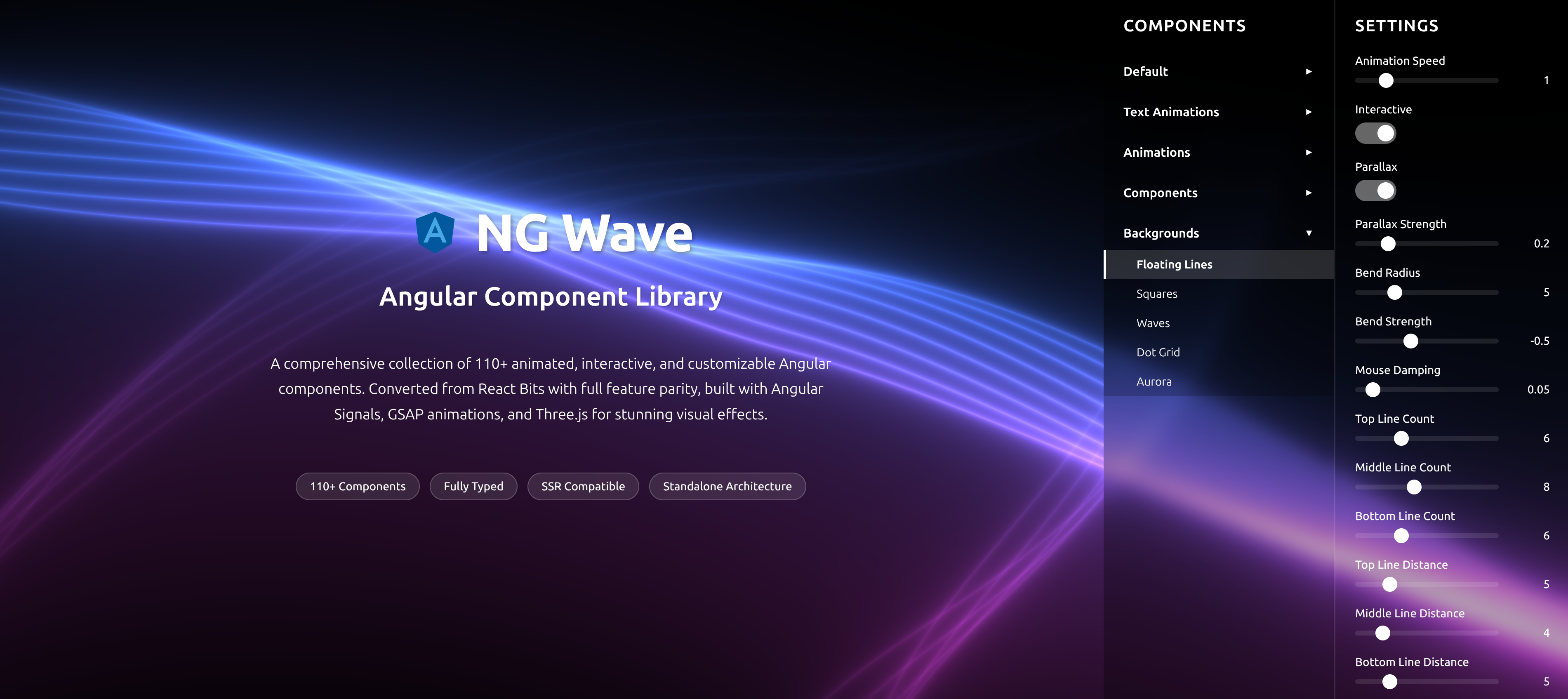
NG Wave
Angular Component Library
A comprehensive collection of 110+ animated, interactive, and customizable Angular components. Converted from React Bits with full feature parity, built with Angular Signals, GSAP animations, and Three.js for stunning visual effects.
Explore Components