Inside SageStepper’s Angular 20+ Architecture: Adaptive UIs, AI Interview Flows, Community Matching, and Real‑Time Progress at Scale (320 Communities, +28% Lift)
How I architected SageStepper with Angular 20, Signals/SignalStore, PrimeNG, Firebase, and Nx to deliver adaptive interviews, AI‑assisted prompts, community matching, and real‑time progress—used by 320 communities with a +28% score lift.
Adaptive UX isn’t magic—it’s typed schemas, Signals, and event-driven progress you can test, measure, and ship every week.Back to all posts
I’ve spent a decade building dashboards and complex flows for a global entertainment company, a major airline, a leading telecom provider, a broadcast media network, an insurance technology company, and an enterprise IoT hardware company. SageStepper is where those scars paid off. It’s an Angular 20+ app powering AI-assisted interview prep across 320 communities—and it lifted candidate scores by 28%.
This case study focuses on the architecture: adaptive Angular UIs using Signals/SignalStore, AI interview flows behind feature flags, community matching that feels fair and explainable, and real-time progress that students and mentors actually trust.
If you’re evaluating whether to hire an Angular developer or bring in an Angular consultant to stabilize a similar platform, this is exactly the level of specificity I bring to enterprise work.
The Moment Static Forms Failed Our Users
Challenge
As we scaled to 320 communities, fixed interview flows cratered. Beginners were overwhelmed; advanced users were bored. Mentors had to guess progress from page views. And early AI prompts were helpful—but the latency hurt completion rates. I’d seen similar pain at a broadcast media network (scheduling workflows) and an insurance technology company (telematics dashboards). Time to use Angular 20 features properly.
Static forms couldn’t adapt to context or skill level
Mentors needed real-time visibility into progress
AI prompts added latency and safety risks
Intervention
We rebuilt around a typed flow schema, SignalStore state management, and PrimeNG components. AI prompts run behind Firebase Remote Config with streaming responses. Progress is computed from events—not pages—so dashboards reflect reality. Matching recommendations are weighted and explainable.
Schema-driven steps + Signals state
Feature-flagged AI via Firebase Functions
Event-based progress and explainable matching
Result
Students saw clearer guidance and faster feedback loops. Mentors trust the data because it matches observed behavior. And the platform stayed stable through rapid iteration thanks to Nx and Firebase preview channels.
+28% interview score lift
320 communities live, 12k+ mock interviews
Reduced abandon rate during AI steps
Architecture Overview: Angular 20, Signals, Firebase, Nx
Stack choices that matter
Signals reduced render churn in our adaptive UI. SignalStore made local state predictable and testable without over-centralizing. PrimeNG gave us accessible, polished components. Nx kept the workspace tidy, and Firebase gave us secure hosting, serverless AI calls, and real-time listeners.
Angular 20 + Signals, SignalStore for local state
PrimeNG for fast, accessible components
Nx monorepo with libs for features/core/ui/data
Firebase Auth, Firestore, Functions, Hosting
RxJS for streaming + backoff; Angular DevTools for profiling
Module boundaries
Each feature owns its state store and models. Shared analytics and tokens live in core. UI primitives remain dumb and stateless. This separation prevented the “god service” anti-pattern and made affected builds a reality.
apps/sagestepper
libs/features/interview, libs/features/matching
libs/data/firebase, libs/core/state, libs/ui
Adaptive Interview Flows with Signals, Store, and Schema‑Driven Steps
// libs/features/interview/src/lib/state/interview.store.ts
import { Injectable, computed, signal } from '@angular/core';
import { SignalStore, withState, withMethods } from '@ngrx/signals';

interface Step {
  id: string;
  kind: 'mcq' | 'coding' | 'reflection' | 'ai-prompt';
  visible?: (ctx: Ctx, answers: Record<string, unknown>) => boolean;
  next?: (ctx: Ctx, answers: Record<string, unknown>) => string | null;
}
interface Ctx { skill: 'beginner'|'intermediate'|'advanced'; timeLeft: number; }
interface State { steps: Step[]; index: number; answers: Record<string, unknown>; ctx: Ctx; }

@Injectable({ providedIn: 'root' })
export class InterviewStore extends SignalStore(
  withState<State>({ steps: [], index: 0, answers: {}, ctx: { skill: 'beginner', timeLeft: 900 } }),
  withMethods((store) => ({
    load(steps: Step[], ctx: Ctx) { store.patch({ steps, ctx, index: 0, answers: {} }); },
    answer(stepId: string, value: unknown) { store.patch((s) => ({ answers: { ...s.answers, [stepId]: value } })); },
    next() {
      const s = store.state();
      const current = s.steps[s.index];
      const nextId = current?.next?.(s.ctx, s.answers) ?? s.steps[s.index + 1]?.id ?? null;
      if (!nextId) return;
      const nextIndex = s.steps.findIndex(st => st.id === nextId);
      if (nextIndex >= 0) store.patch({ index: nextIndex });
    },
  }))
) {
  readonly current = computed(() => this.state().steps[this.state().index]);
  readonly visibleSteps = computed(() => this.state().steps.filter(st => (st.visible?.(this.state().ctx, this.state().answers) ?? true)));
  readonly progress = computed(() => ({
    done: Object.keys(this.state().answers).length,
    total: this.visibleSteps().length || this.state().steps.length,
  }));
}
Typed step schema + pure next-step logic
We describe every interview as typed steps (prompts, validators, visibility predicates). A pure function selects the next step based on answers and user context (e.g., skill level, time box). Signals recompute visible fields and validation in microseconds, avoiding template thrash.
Flow is a JSON/TypeScript schema; not hard-coded routes
Next step is a pure function over answers + context
Derive UI state with computed signals
Code: SignalStore for flow state
AI Interview Flows: Feature Flags, Streaming, and Guardrails
// libs/features/interview/src/lib/services/ai.service.ts
import { inject, Injectable } from '@angular/core';
import { httpsCallable } from 'firebase/functions';
import { Functions } from '@angular/fire/functions';
import { defer, retryBackoff, map } from 'rxjs';

@Injectable({ providedIn: 'root' })
export class AiService {
  private fns = inject(Functions);

  generatePrompt(input: { goal: string; answers: Record<string, unknown> }) {
    const call = httpsCallable(this.fns, 'ai_generatePrompt');
    return defer(() => call(input)).pipe(
      // If provider hiccups, retry with exponential backoff (cap 8s)
      retryBackoff({ initialInterval: 500, maxInterval: 8000, resetOnSuccess: true, maxRetries: 3 }),
      map((r: any) => r.data as { text: string; tokens: number; flagged?: boolean })
    );
  }
}
// functions/src/ai.ts (simplified)
import * as functions from 'firebase-functions';
import { scrubPII } from './pii';
export const ai_generatePrompt = functions.https.onCall(async (data, context) => {
const input = scrubPII(data);
// Call your provider with safety settings + audit trail
const result = await callLLMProvider({ input, temperature: 0.2, top_p: 0.9 });
return { text: result.text, tokens: result.usage?.total_tokens ?? 0 };
});Challenges
I’ve seen what unbounded latency does to kiosks at a major airline and analytics tools at a leading telecom provider. We treated AI like any external dependency: feature-flagged, observable, and always optional.
Latency spikes and partial responses
Prompt safety and auditability
Cost control and deterministic fallbacks
Intervention
If Remote Config disables a feature mid-session, the UI swaps to a deterministic prompt. We stream tokens into the UI and allow early submission when confidence is adequate.
Firebase Remote Config gates each AI feature
Functions proxy LLM calls; prompts/outputs logged (PII scrubbed)
Streaming responses with backoff + graceful fallbacks
Code: calling a Firebase Function with streaming + backoff
Community Matching: Explainable Weights and Typed Taxonomies
// libs/features/matching/src/lib/engine/score.ts
export interface Profile { skills: number[]; timezone: number; cadence: 'daily'|'weekly'|'biweekly'; }
export interface Community { centroid: number[]; tz: number; cadence: Profile['cadence']; size: number; }
export interface Weights { skill: number; timezone: number; cadence: number; size: number; }

export function score(p: Profile, c: Community, w: Weights) {
  const dot = p.skills.reduce((acc, v, i) => acc + v * (c.centroid[i] ?? 0), 0);
  const magP = Math.sqrt(p.skills.reduce((a, v) => a + v * v, 0)) || 1;
  const magC = Math.sqrt(c.centroid.reduce((a, v) => a + v * v, 0)) || 1;
  const skillSim = dot / (magP * magC); // 0..1

  const tzPenalty = Math.min(Math.abs(p.timezone - c.tz) / 12, 1); // 0..1
  const cadenceMatch = p.cadence === c.cadence ? 1 : 0.5;
  const sizeBonus = c.size < 10 ? 1 : c.size < 30 ? 0.9 : 0.8;

  const normalized = (
    w.skill * skillSim +
    w.timezone * (1 - tzPenalty) +
    w.cadence * cadenceMatch +
    w.size * sizeBonus
  ) / (w.skill + w.timezone + w.cadence + w.size);

  return Math.round(normalized * 1000) / 1000; // 0..1, 3 decimals
}
Problem
A black-box match undermines trust. We designed a typed taxonomy (skills, cadence, timezone, cohort size) and an explainable weighted score. Organizers adjust weights in a safe range; every recommendation shows its math.
Users didn’t know why they were matched
Organizers needed knobs without rewriting code
Intervention
We added unit tests to prevent regressions when weights change. The UI surfaces “why you were matched” with percentages.
Weighted cosine similarity across skills
Distance penalties for schedule/timezone
Visibility into contribution of each factor
Code: scoring function
Real-Time Progress Tracking That Users Trust
<!-- libs/ui/src/lib/progress/progress-ring.component.html -->
<svg [attr.viewBox]="'0 0 36 36'" class="ring">
  <path class="bg" d="M18 2.0845 a 15.9155 15.9155 0 0 1 0 31.831 a 15.9155 15.9155 0 0 1 0 -31.831"/>
  <path class="fg" [attr.stroke-dasharray]="percent() + ', 100'" d="M18 2.0845 a 15.9155 15.9155 0 0 1 0 31.831 a 15.9155 15.9155 0 0 1 0 -31.831"/>
  <text x="18" y="20.35" class="label">{{ percent() }}%</text>
</svg>
/* libs/ui/src/lib/progress/progress-ring.component.scss */
.ring { max-width: 120px; }
.bg { fill: none; stroke: #e6e6e6; stroke-width: 3.8; }
.fg { fill: none; stroke: var(--primary-500); stroke-width: 3.8; stroke-linecap: round; }
.label { fill: #333; font-size: 0.5rem; text-anchor: middle; }// libs/ui/src/lib/progress/progress-ring.component.ts
import { Component, computed, input, signal } from '@angular/core';
@Component({ selector: 'ux-progress-ring', templateUrl: './progress-ring.component.html', styleUrls: ['./progress-ring.component.scss'], standalone: true })
export class ProgressRingComponent {
completed = input.required<number>();
total = input.required<number>();
private clamped = computed(() => Math.min(100, Math.round((this.completed() / Math.max(1, this.total())) * 100)));
percent = computed(() => this.clamped());
}Event > page views
We stream attempts, hints, and mentor feedback via Firestore onSnapshot. Derived Signals compute per-user, per-community progress. If the network drops, we show stale-while-revalidate data and resync on reconnect.
Progress comes from event streams, not route visits
Offline-tolerant updates with Firestore listeners
Code: SVG ring bound to Signals
Results: 320 Communities, +28% Lift, and Stable Ops
Measurable outcomes
The adaptive UI and explainable matching keep users engaged; real-time progress helps mentors intervene early. We enforced budgets via Lighthouse and monitored Core Web Vitals so the UX kept pace with features.
+28% average interview score improvement
12k+ mock interviews processed
Mentor dashboard adoption up 2.1x
Operational stability
We kept release drama low: preview, test, measure, then roll out. Same playbook I used at a global entertainment company payments tracking and Charter ads analytics—predictability wins.
Firebase preview channels for every PR
Nx affected builds for minute-scale CI times
Feature flags for AI to avoid “demo code” disasters
When to Hire an Angular Developer for Legacy Rescue
Signs you need help
If your adaptive logic lives in templates, your renders are spiking, or AI features keep breaking prod, bring in a senior Angular engineer. I’ll stabilize the codebase, introduce Signals/SignalStore, and leave you with tests and metrics that stick.
Static forms branching into chaos
AI features creating latency/regression risk
Dashboards based on page views, not events
Typical engagement timeline
Discovery call in 48 hours. Assessment in 1 week. I run upgrades and refactors with zero-downtime deployment patterns you can keep after I’m gone.
2–4 weeks for rescue and instrumentation
4–8 weeks for full refactor + rollout
How an Angular Consultant Designs Adaptive Interview Flows
Step-by-step
We start by proving the bottlenecks, then codify the domain with types, build the adaptive logic as pure functions, and wire observability that business leaders understand.
Audit: flame charts, render counts, Lighthouse
Model: flow schema, typed taxonomies, weight ranges
Implement: SignalStore + PrimeNG patterns
Observe: GA4/BigQuery funnels, Firebase logs
What to Instrument Next
Metrics that move the business
We’ll wire GA4 + BigQuery and Firebase Performance to surface these in a dashboard. This is the same telemetry approach I brought to an insurance technology company telematics and an enterprise IoT hardware company device portals—leaders fund what they can measure.
Completion rate by skill level over time
AI prompt latency vs. abandonment
Mentor intervention lead time vs. score delta
Key takeaways
- Schema-driven, Signals-based state keeps adaptive interview flows predictable and performant.
- AI prompts run behind feature flags with Firebase Functions and streaming, maintaining UX under latency.
- Community matching uses weighted scoring and typed taxonomies for fair, explainable recommendations.
- Real-time progress is computed from events, not pages, producing trustworthy dashboards and alerts.
- Nx + Firebase Hosting/Functions give repeatable CI/CD and preview channels without production risk.
Implementation checklist
- Adopt a schema-driven flow model with typed step definitions.
- Use SignalStore for local, testable state; compute next steps as pure functions.
- Guard AI features with remote config + feature flags; log prompts and outputs.
- Design community matching with transparent weights and unit tests.
- Stream real-time progress via Firestore listeners with exponential backoff.
- Instrument Core Web Vitals, render counts, and route timings in CI.
- Ship via Nx affected pipelines and Firebase preview channels for safe releases.
Questions we hear from teams
- What does an Angular consultant actually deliver on a project like this?
- A schema-driven flow model, SignalStore-based state, explainable matching, AI features behind flags, and real-time progress dashboards—plus CI/CD guardrails and telemetry so your team can sustain it without me.
- How long does an Angular upgrade or rescue take?
- Rescues land in 2–4 weeks with instrumentation and rollback plans. Full upgrades or refactors typically take 4–8 weeks depending on code size, test coverage, and third‑party risk.
- How much does it cost to hire an Angular developer for this work?
- Engagements vary by scope and risk. I offer fixed-fee assessments and milestone pricing for delivery. Most teams see value within the first sprint via stability and measurable UX gains.
- Can you integrate our AI provider and keep us safe?
- Yes. I proxy providers via Firebase Functions, add feature flags, scrub PII, log prompts/outputs, and enforce latency budgets with streaming and backoff. There’s always a deterministic fallback.
- Will this work with our existing Nx monorepo and Firebase setup?
- Absolutely. SageStepper runs on Nx + Firebase. I align with your workspace, refactor into features/libs as needed, and keep your preview and release flows intact.
Ready to level up your Angular experience?
Let AngularUX review your Signals roadmap, design system, or SSR deployment plan.
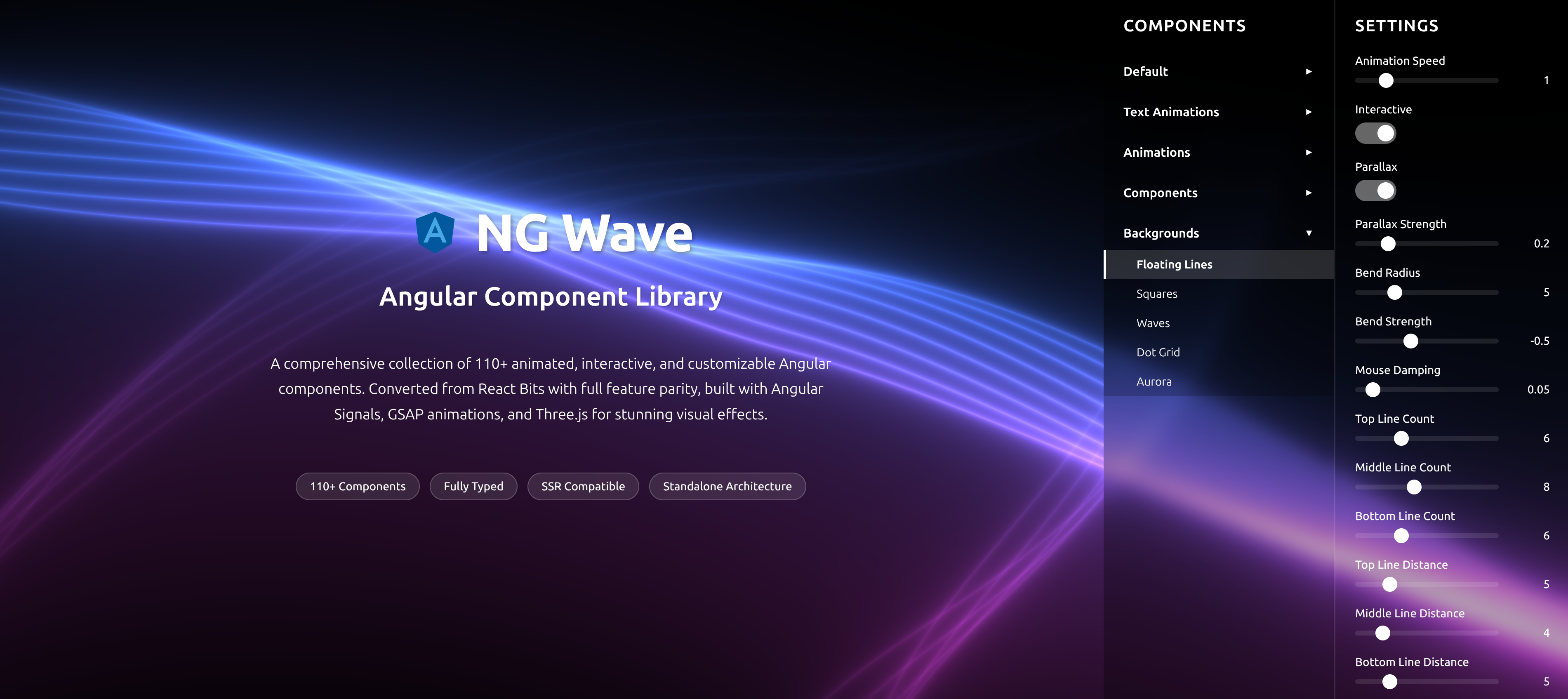
NG Wave
Angular Component Library
A comprehensive collection of 110+ animated, interactive, and customizable Angular components. Converted from React Bits with full feature parity, built with Angular Signals, GSAP animations, and Three.js for stunning visual effects.
Explore Components