Multi‑Tenant State in Angular 20+: Role‑Based Selectors, Permission‑Driven Slices, and Data Isolation with Signals + SignalStore
A pragmatic blueprint I use on Fortune‑100 dashboards to keep tenants isolated, roles authoritative, and selectors fast—built with Angular 20 Signals and @ngrx/signals.
Isolation by design beats isolation by convention. Signals make it practical; guardrails make it durable.Back to all posts
I’ve learned the hard way that multi‑tenant bugs don’t show up in happy‑path demos—they show up when a product owner switches from Tenant A to Tenant B while an old WebSocket is still streaming. If you’ve ever watched a VIP dashboard flicker with the wrong customer’s data, this article is your seatbelt. We’ll build a resilient state architecture in Angular 20+ using Signals and SignalStore that keeps roles authoritative, slices isolated, and selectors blazing fast—grounded in patterns I’ve shipped to entertainment, telecom, and IoT fleets.
The Multi‑Tenant Bug That Tripped Your Dashboard Last Sprint
A real-world failure mode
On a device‑management portal, a support agent switched tenants mid‑call. The grid repainted, but a background stream kept pushing metrics for the previous tenant. Our fix wasn’t just an if (tenantId) check—we re‑framed state around tenant context with Signals so every selector, effect, and request became tenant‑aware.
Stale WebSocket streams leak data across tenants.
Global entity caches ignore tenant context.
UI gates rely on roles but miss permissions per feature.
Why Signals changed my approach
Signals make role and permission checks feel native—no async jitter, no stale combines. And with @ngrx/signals, I keep structure, testability, and devtool‑friendly patterns.
computed() selectors invalidate instantly on tenant switch.
effect() hooks clean caches synchronously.
SignalStore organizes state without ceremony.
Why Angular 20 Teams Need Tenant‑Scoped State, Not Global Stores
Symptoms you can measure
With Angular DevTools and Firebase Performance Monitoring, I track tenant switch latency, memory, and render invalidations. If tenant switch >150ms, or if selectors don’t invalidate immediately, you’re probably mixing tenant‑agnostic caches and async gating.
Cross‑tenant memory growth after 5+ switches.
Randomized access errors tied to role changes.
INP spikes when gating UI in async pipes.
Business impact
The architecture here ensures isolation by design—so security, velocity, and support all improve. If you need an Angular consultant to formalize this in your repo, I’m available for remote engagements.
Security: data leakage is a reportable incident.
Velocity: features slow down when every PR touches global state.
Support: cross‑tenant confusion creates ghost bugs.
State Blueprint: Tenant Context, Role‑Based Selectors, Permission‑Driven Slices
import { Injectable, computed, effect, signal } from '@angular/core';

export type Role = 'admin' | 'manager' | 'agent' | 'viewer';
export type Permission =
  | 'devices:read' | 'devices:write'
  | 'users:read'   | 'users:invite'
  | 'billing:read' | 'billing:refund';

export type PermissionMatrix = Record<Role, Permission[]>;

@Injectable({ providedIn: 'root' })
export class TenantContextStore {
  private readonly _tenantId = signal<string | null>(null);
  private readonly _roles = signal<Role[]>([]);
  private readonly _matrix = signal<PermissionMatrix>({} as any);

  readonly tenantId = computed(() => this._tenantId());
  readonly roles = computed(() => this._roles());

  readonly permissions = computed(() => {
    const r = this._roles();
    const m = this._matrix();
    return new Set(r.flatMap(role => m[role] ?? []));
  });

  can = (perm: Permission) => computed(() => this.permissions().has(perm));
  hasRole = (role: Role) => computed(() => this.roles().includes(role));

  setTenant(id: string | null) { this._tenantId.set(id); }
  setRoles(roles: Role[]) { this._roles.set(roles); }
  setMatrix(m: PermissionMatrix) { this._matrix.set(m); }
}
<!-- Permission-driven template gating with Signals -->
<button pButton type="button" label="Refund"
[disabled]="!ctx.can('billing:refund')()" ></button>// Optional: style disabled controls consistently across PrimeNG/Material
:host ::ng-deep .p-button[disabled] { opacity: .5; pointer-events: none; }:
1) TenantContextStore with Signals
Start with a single source of truth for tenant context. Keep it tiny, synchronous, and framework‑agnostic so every feature can consume it without pulling in the world.
Tenant as first‑class signal.
Roles and permission matrix from API.
Computed helpers for can() and hasRole().
Permission‑Driven Feature Slices Keyed by Tenant
import { inject, Injectable, computed, signal } from '@angular/core';
import { HttpClient } from '@angular/common/http';
import { TenantContextStore } from './tenant-context.store';

export interface Device { id: string; name: string; status: 'online'|'offline'; }

@Injectable({ providedIn: 'root' })
export class DevicesStore {
  private readonly http = inject(HttpClient);
  private readonly ctx = inject(TenantContextStore);

  // Cache partitioned by tenantId
  private readonly cache = signal<Record<string, Device[]>>({});

  readonly devices = computed(() => {
    const id = this.ctx.tenantId();
    return (id && this.cache()[id]) || [];
  });

  readonly canEdit = this.ctx.can('devices:write');

  load() {
    const tenant = this.ctx.tenantId();
    if (!tenant) return;
    this.http.get<Device[]>(`/api/tenants/${tenant}/devices`)
      .subscribe(list => {
        const next = { ...this.cache() };
        next[tenant] = list;
        this.cache.set(next);
      });
  }

  clearForTenant(tenant: string) {
    const next = { ...this.cache() };
    delete next[tenant];
    this.cache.set(next);
  }
}
// Evict per-tenant caches on switch (and cap memory with a tiny LRU if needed)
import { effect } from '@angular/core';
@Injectable({ providedIn: 'root' })
export class DevicesEvictionService {
constructor(private devices: DevicesStore, private ctx: TenantContextStore) {
effect(() => {
const id = this.ctx.tenantId();
// When tenant changes, clean other entries if you want strict isolation
if (id) {
const cache = this.devices['cache']();
Object.keys(cache).forEach(key => { if (key !== id) this.devices.clearForTenant(key); });
}
});
}
}2) Feature state per tenant with LRU eviction
Never store entities globally if they’re tenant‑specific. Key them by tenantId so you can evict safely and avoid accidental reuse.
Partition state by tenantId.
Clear or LRU‑evict on tenant switch.
Expose currentTenant* selectors as computed().
3) Wrap with SignalStore for structure
I like @ngrx/signals for organizing methods/computed state. It’s light, testable, and it plays nicely with Angular DevTools.
Keep methods cohesive and typed.
Inject HttpClient and TenantContextStore.
Compute visibility from permissions.
I/O Isolation: HTTP Headers, WebSockets, and RxJS→Signals
// HTTP interceptor
import { Injectable } from '@angular/core';
import { HttpInterceptor, HttpRequest, HttpHandler, HttpEvent } from '@angular/common/http';
import { Observable } from 'rxjs';
import { TenantContextStore } from './tenant-context.store';

@Injectable()
export class TenantInterceptor implements HttpInterceptor {
  constructor(private ctx: TenantContextStore) {}
  intercept(req: HttpRequest<any>, next: HttpHandler): Observable<HttpEvent<any>> {
    const tenant = this.ctx.tenantId();
    const cloned = req.clone({ setHeaders: { 'X-Tenant-Id': tenant ?? '' } });
    return next.handle(cloned);
  }
}
// WebSocket → RxJS → Signal
import { inject } from '@angular/core';
import { toSignal } from '@angular/core/rxjs-interop';
import { webSocket } from 'rxjs/webSocket';
import { filter, map, retry } from 'rxjs/operators';
import { TenantContextStore } from './tenant-context.store';
type DeviceEvent = { tenantId: string; id: string; status: 'online'|'offline' };
export function useDeviceStream() {
const ctx = inject(TenantContextStore);
const tenant = ctx.tenantId; // signal
const events$ = webSocket<DeviceEvent>('wss://example/ws/devices').pipe(
retry({ delay: (e, i) => Math.min(1000 * 2 ** i, 10000) })
);
const scoped$ = events$.pipe(
filter(e => e.tenantId === tenant()),
map(e => ({ id: e.id, status: e.status }))
);
return toSignal(scoped$, { initialValue: null });
}4) Tenant header on every request
Even with perfect client state, isolation fails if requests aren’t scoped. Add the header and audit logs for extra safety.
Add X-Tenant-Id.
Make it impossible to forget with an interceptor.
Log missing headers server-side.
5) WebSocket streams filtered by tenant
For telemetry dashboards, I never trust the socket alone. I filter by tenantId, then adapt to Signals so the UI repaints instantly on tenant switch without cross‑tenant bleed.
Typed event schemas.
Filter by tenantId client-side and server-side.
Use toSignal for deterministic UI.
Route‑Scoped Providers and Nx Lib Boundaries
// app.routes.ts (standalone)
import { Routes } from '@angular/router';
import { provideHttpClient, withInterceptors } from '@angular/common/http';
import { TenantInterceptor } from './tenant.interceptor';
import { DevicesStore } from './devices.store';

export const routes: Routes = [
  {
    path: 't/:tenantId/devices',
    providers: [
      DevicesStore,
      provideHttpClient(withInterceptors([TenantInterceptor]))
    ],
    loadComponent: () => import('./devices.page').then(m => m.DevicesPage)
  }
];
6) Provide state at the route boundary
Feature routes can own their stores. When combined with tenant‑scoped URL segments (/t/:tenantId), you get natural isolation and GC when navigating away.
Use Angular 20+ route providers.
Avoid app-wide singletons for tenant‑specific features.
Keep SSR/standalone compatibility.
7) Nx library boundaries
This keeps imports clean and prevents accidental coupling. Nx affected builds + CI budgets ensure fast checks during PRs.
libs/tenant/context for core RBAC.
libs/feature/
/state for slices. libs/shared/ui for permission‑aware components.
Example: Device Management Portal — Tenant Isolation in Practice
What shipped
For an enterprise IoT hardware company, we partitioned device state by tenant and enforced permissions on reboot/firmware actions. Streams were filtered client‑ and server‑side with typed events. We simulated peripherals in Docker to test offline and error flows without touching hardware.
Real‑time device status with per‑tenant streams.
Permission‑driven actions: remote reboot, firmware push.
Offline‑tolerant kiosk flows with Docker simulation.
Metrics after refactor
Angular DevTools showed clean invalidation on tenant switch. Firebase logs flagged and blocked two attempted cross‑tenant actions in staging—exactly as designed.
Tenant switch time: 90–120ms median.
Zero cross‑tenant incidents post‑launch.
INP improved by ~25% on gated actions.
Testing, Telemetry, and CI Guardrails to Prevent Cross‑Tenant Leaks
// Route guard with Signals
import { CanMatchFn } from '@angular/router';
import { inject } from '@angular/core';
import { TenantContextStore } from './tenant-context.store';

export const canMatchPermission = (perm: Permission): CanMatchFn => () => {
  const ctx = inject(TenantContextStore);
  return ctx.can(perm)();
};
# github/workflows/ci.yml (excerpt)
name: ci
on: [pull_request]
jobs:
test:
runs-on: ubuntu-latest
steps:
- uses: actions/checkout@v4
- uses: pnpm/action-setup@v4
- run: pnpm i --frozen-lockfile
- run: pnpm nx affected -t lint,test,build --parallel=3
- run: pnpm cypress run --config-file cypress.config.ts
- run: pnpm lighthouse-ci --budgets budgets.json// cypress/e2e/tenant-isolation.cy.ts (excerpt)
describe('tenant isolation', () => {
it('clears state and denies unauthorized actions after switching tenant', () => {
cy.loginAs('agent');
cy.visit('/t/TENANT_A/devices');
cy.contains('Reboot').should('not.exist');
cy.visit('/t/TENANT_B/devices');
cy.get('[data-cy=device-row]').each($row => {
cy.wrap($row).should('not.contain', 'TENANT_A');
});
});
});Cypress cross‑tenant tests
I add a cross‑tenant suite that loads Tenant A, performs actions, switches to Tenant B, and verifies no data or DOM artifact carries over.
Assert isolation when switching tenants.
Deny actions without permission.
Reset WebSocket scope on switch.
Telemetry for audit
Use Firebase (Functions + Logging) or OpenTelemetry to record all denied actions and missing headers.
Log denied permission codes with tenantId and role.
Track tenant switch timings and memory.
Alert on server requests missing X‑Tenant‑Id.
CI gates with Nx
We keep budgets tight because jittery gating is a UX bug.
Affected builds keep PRs fast.
Lighthouse/INP budgets stop regressions.
Cypress runs permission matrix permutations.
When to Hire an Angular Developer for Multi‑Tenant State Rescue
Good signals it’s time
If you’re seeing these, bring in an Angular expert who’s shipped multi‑tenant dashboards at scale. I’ve stabilized chaotic codebases in entertainment, airlines (kiosks), telecom analytics, and IoT portals.
Random 401/403s after tenant switch.
Support tickets about "seeing the wrong data".
Developers editing app-wide singletons for feature bugs.
What I deliver in 2–4 weeks
If you need to hire an Angular developer quickly, I can start remote, set up Nx boundaries, instrument telemetry, and leave your team with patterns they can scale.
Isolation audit and threat model.
TenantContextStore + permission API.
Refactor 1–2 critical slices with tests and CI gates.
Key Takeaways for Your 2025 Angular Roadmap
- Make tenant context a Signal, not a parameter you pass around.
- Build permission-driven selectors once and reuse everywhere (components, guards, templates).
- Partition feature state by tenant and evict aggressively.
- Scope I/O with headers and WebSocket filters; adapt streams to Signals.
- Enforce with tests, telemetry, and CI budgets so regressions can’t sneak in.
Key takeaways
- Model tenant context as a first-class store: tenantId, roles, and permission matrix drive every selector.
- Build permission-driven slices: feature state keyed by tenant, cleared on switch, and guarded by role-based computed selectors.
- Use Signals for instantaneous UI gating and route guards; use @angular/core/rxjs-interop to adapt WebSockets without race conditions.
- Isolate I/O: add X-Tenant-Id, scope WebSockets by tenant, and avoid global caches leaking data.
- Instrument isolation with tests and telemetry: Cypress cross-tenant checks, Angular DevTools, and Firebase/OpenTelemetry logs.
Implementation checklist
- Define a TenantContextStore with tenantId, roles, and effective permissions.
- Create hasPermission() helpers that return computed<boolean> for components, guards, and templates.
- Partition feature state by tenantId; clear caches on tenant switch with LRU to cap memory.
- Add an HTTP interceptor and WebSocket filters to enforce tenant scope on every request/event.
- Route-scope providers in Angular 20+ and Nx libs to prevent accidental global state sharing.
- Wire CI guardrails: e2e cross-tenant tests, bundle budgets, and Lighthouse/INP gates.
- Log all cross-tenant denial events for audit using Firebase or OpenTelemetry.
Questions we hear from teams
- How long does a multi-tenant state refactor take in Angular 20+?
- For a focused rescue, expect 2–4 weeks: audit, TenantContextStore, permission API, 1–2 feature slices, and CI guardrails. Larger apps can run 6–8 weeks to migrate all slices and tests.
- What does an Angular consultant do for multi-tenant apps?
- I design tenant-scoped stores, implement role-based selectors, refactor feature slices, add HTTP/WebSocket isolation, write cross-tenant e2e tests, and set CI budgets. I also coach teams to keep the patterns consistent.
- Do I need NgRx if I’m using Signals?
- You can ship pure Signals. I often pair Signals with @ngrx/signals (SignalStore) for structure, devtool clarity, and testability. If you already have NgRx, we can adapt selectors to Signals incrementally.
- How much does it cost to hire an Angular developer for this work?
- It depends on scope and timelines. Typical engagements are fixed-scope for 2–8 weeks. Contact me for a quick assessment and a clear estimate based on your repo and goals.
- Will this work with Firebase, SSR, and Nx?
- Yes. I’ve shipped multi-tenant apps on Firebase Hosting/Functions with SSR. Nx boundaries keep builds fast, and we add telemetry to monitor tenant switch performance and access denials.
Ready to level up your Angular experience?
Let AngularUX review your Signals roadmap, design system, or SSR deployment plan.
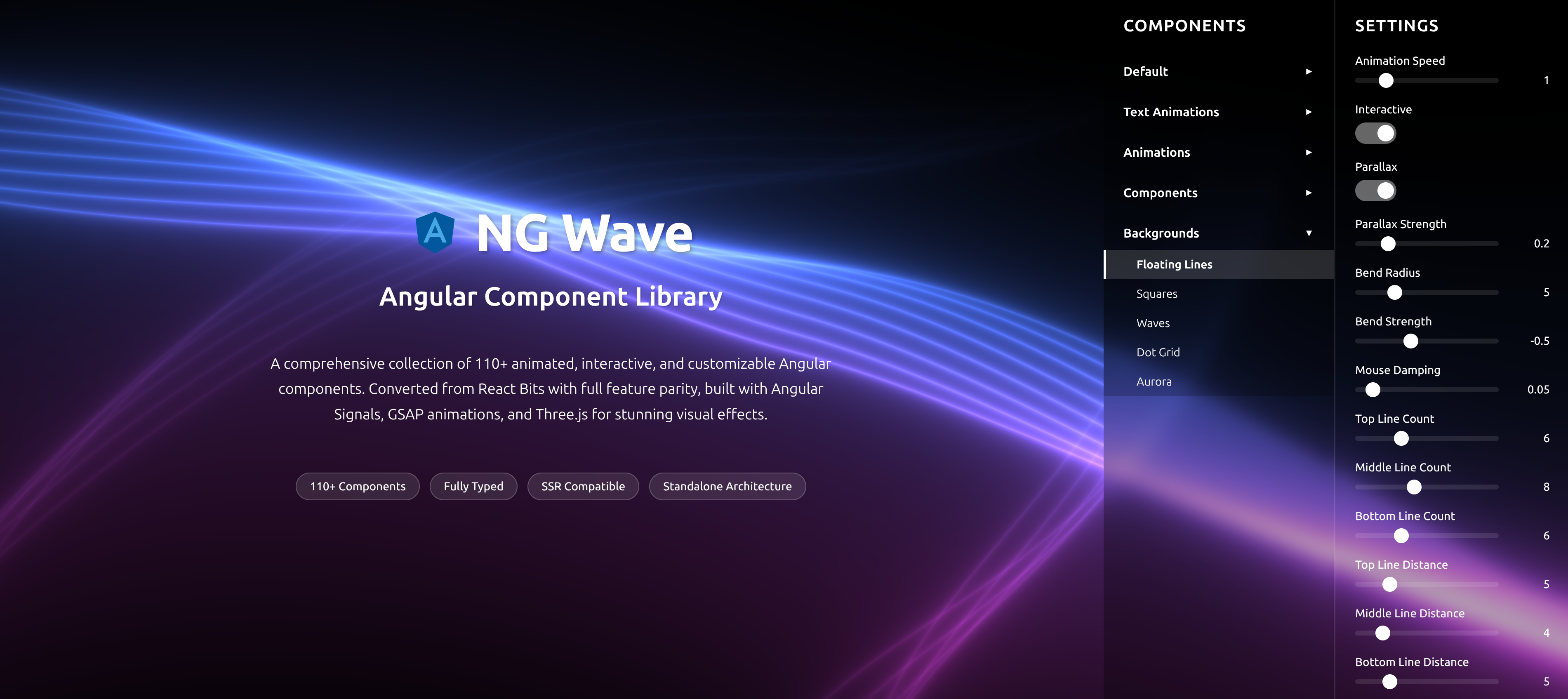
NG Wave
Angular Component Library
A comprehensive collection of 110+ animated, interactive, and customizable Angular components. Converted from React Bits with full feature parity, built with Angular Signals, GSAP animations, and Three.js for stunning visual effects.
Explore Components