Production‑Grade Real‑Time NgRx in Angular 20+: Typed WebSockets, Optimistic Updates, and SignalStore Dashboards
How I wire NgRx, WebSockets, and Signals so telemetry dashboards stay smooth under load—typed actions/effects, optimistic updates with rollback, and backoff that never melts the UI.
Typed effects + SignalStore turned our 60k events/min firehose into a calm UI. That’s the difference between a demo and a dependable enterprise dashboard.Back to all posts
At 9:17am ET, our ad analytics dashboard spiked to 60k events/min. The boardroom didn’t care that a node in the telemetry pipeline flapped—only that the charts didn’t jitter and the numbers stayed trustworthy. That’s where real-time statecraft matters: NgRx for events, Signals for rendering, and typed effects so nothing surprises you in prod.
I’ve shipped these patterns across Fortune 100 teams: telematics for an insurance technology company, ads analytics for a telecom provider, and kiosk hardware monitors for an airline. Angular 20+, NgRx, RxJS 8, and SignalStore give you the primitives; the difference is in how you compose them and the guardrails you add.
The 9:17am Dashboard Spike
A real production story
In a telecom ads analytics platform I built, WebSocket bursts and brief disconnects were normal during rollouts. We kept the boardroom calm by separating concerns: NgRx handled the event firehose and durability; Signals/SignalStore fed PrimeNG and Highcharts without over-rendering; effects enforced typed contracts and retries.
60k events/min sustained
Transient socket drops during deploys
No visible jitter, zero data loss
Why Typed Real‑Time State Matters in Angular 20+
Typed actions/effects ensure every message through your pipeline is validated at compile time. Signals prevent the zone.js re-render tax on hot paths. Add heartbeats and exponential backoff so reconnections don’t melt your APIs.
Hiring lens: you need rigor you can trust
As companies plan 2025 Angular roadmaps, I’m seeing the same ask: ship real-time dashboards that never feel fragile. If you need to hire an Angular developer with Fortune 100 experience, look for typed event schemas, correlation-aware effects, and Signals-first rendering. Those are the difference between a demo and a dependable system.
Typed streams reduce incident blast radius.
Optimistic UX keeps operators fast.
Backoff + heartbeats prevent thundering herds.
Implement Typed WebSocket Streams with NgRx
// contracts/models.ts
export type TenantId = string;
export type CorrelationId = string;

export interface TelemetryBase { ts: number; tenantId: TenantId; }
export interface CpuEvent extends TelemetryBase { type: 'cpu'; host: string; pct: number; }
export interface ErrorEvent extends TelemetryBase { type: 'error'; code: string; message: string; }
export type TelemetryEvent = CpuEvent | ErrorEvent;

export interface SetThresholdCmd { kind: 'set-threshold'; host: string; pct: number; cid: CorrelationId; }
export interface Ack { kind: 'ack'; cid: CorrelationId; }
export interface Nack { kind: 'nack'; cid: CorrelationId; reason: string; }
export type ServerMsg = TelemetryEvent | Ack | Nack;
export type ClientMsg = SetThresholdCmd;
// store/telemetry.actions.ts
import { createActionGroup, emptyProps, props } from '@ngrx/store';
import { TelemetryEvent, Ack, Nack, ClientMsg, CorrelationId } from '../contracts/models';
export const TelemetryActions = createActionGroup({
source: 'Telemetry',
events: {
'Connect': emptyProps(),
'Connected': emptyProps(),
'Disconnected': props<{ reason?: unknown }>(),
'HeartbeatTimeout': emptyProps(),
'Event In': props<{ event: TelemetryEvent }>(),
'Cmd Send': props<{ cmd: ClientMsg }>(),
'Cmd Ack': props<{ ack: Ack }>(),
'Cmd Nack': props<{ nack: Nack }>(),
'Cmd Timeout': props<{ cid: CorrelationId }>(),
}
});// services/websocket.service.ts
import { webSocket, WebSocketSubject } from 'rxjs/webSocket';
import { defer, Observable, timer } from 'rxjs';
import { backoff } from 'rxjs-backoff'; // or write your own expo backoff
import { ServerMsg, ClientMsg } from '../contracts/models';
export class WebSocketService {
private socket$?: WebSocketSubject<ServerMsg | ClientMsg>;
messages$: Observable<ServerMsg> = defer(() => {
this.socket$ = webSocket<ServerMsg | ClientMsg>({ url: this.url, deserializer: e => JSON.parse(e.data) });
return this.socket$ as unknown as Observable<ServerMsg>;
}).pipe(
backoff({ initialInterval: 500, maxInterval: 10_000, resetOnSuccess: true })
);
constructor(private url: string) {}
send(msg: ClientMsg) { this.socket$?.next(msg); }
close() { this.socket$?.complete(); }
}// store/telemetry.effects.ts
import { Actions, createEffect, ofType } from '@ngrx/effects';
import { inject, Injectable } from '@angular/core';
import { TelemetryActions } from './telemetry.actions';
import { WebSocketService } from '../services/websocket.service';
import { filter, map, merge, mergeMap, of, race, take, takeUntil, tap, timer } from 'rxjs';
import { isTelemetryEvent } from '../contracts/guards';
@Injectable({ providedIn: 'root' })
export class TelemetryEffects {
private actions$ = inject(Actions);
private ws = new WebSocketService('/ws/telemetry');
connect$ = createEffect(() =>
this.actions$.pipe(
ofType(TelemetryActions.connect),
mergeMap(() => this.ws.messages$.pipe(
tap({ error: err => console.error('socket error', err) }),
map(msg => {
if ('type' in msg) return TelemetryActions.eventIn({ event: msg });
if (msg.kind === 'ack') return TelemetryActions.cmdAck({ ack: msg });
if (msg.kind === 'nack') return TelemetryActions.cmdNack({ nack: msg });
return TelemetryActions.disconnected({ reason: 'unknown-msg' });
}),
takeUntil(this.actions$.pipe(ofType(TelemetryActions.disconnected)))
))
)
);
sendCmd$ = createEffect(() =>
this.actions$.pipe(
ofType(TelemetryActions.cmdSend),
tap(a => this.ws.send(a.cmd)),
mergeMap(a => {
const cid = a.cmd.cid;
const ack$ = this.actions$.pipe(ofType(TelemetryActions.cmdAck), filter(x => x.ack.cid === cid), take(1));
const nack$ = this.actions$.pipe(ofType(TelemetryActions.cmdNack), filter(x => x.nack.cid === cid), take(1));
const timeout$ = timer(5000).pipe(map(() => TelemetryActions.cmdTimeout({ cid })));
return race(ack$, nack$, timeout$);
})
)
);
}// store/telemetry.reducer.ts
import { createReducer, on } from '@ngrx/store';
import { TelemetryActions } from './telemetry.actions';
import { TelemetryEvent } from '../contracts/models';
export interface DashboardState {
events: TelemetryEvent[]; // windowed, not infinite
pending: Record<string, { host: string; pct: number; ts: number }>; // by cid
thresholdByHost: Record<string, number>;
}
const initial: DashboardState = { events: [], pending: {}, thresholdByHost: {} };
export const dashboardReducer = createReducer(
initial,
on(TelemetryActions.eventIn, (s, { event }) => ({
...s,
events: [event, ...s.events].slice(0, 1000) // window
})),
// optimistic patch on send
on(TelemetryActions.cmdSend, (s, { cmd }) => ({
...s,
pending: { ...s.pending, [cmd.cid]: { host: cmd.host, pct: cmd.pct, ts: Date.now() } },
thresholdByHost: { ...s.thresholdByHost, [cmd.host]: cmd.pct },
})),
// confirm
on(TelemetryActions.cmdAck, (s, { ack }) => {
const { [ack.cid]: _, ...rest } = s.pending; return { ...s, pending: rest };
}),
// rollback on NACK/timeout
on(TelemetryActions.cmdNack, (s, { nack }) => {
const p = s.pending[nack.cid]; if (!p) return s;
const { [nack.cid]: _, ...rest } = s.pending;
const current = { ...s.thresholdByHost };
// simple rollback: remove optimistic if known previous exists (not shown here)
delete current[p.host];
return { ...s, pending: rest, thresholdByHost: current };
}),
);// store/telemetry.store.ts (SignalStore)
import { signalStore, withState, withComputed, patchState } from '@ngrx/signals';
import { computed, effect } from '@angular/core';
import { DashboardState } from './telemetry.reducer';
export const TelemetryStore = signalStore(
withState<DashboardState>({ events: [], pending: {}, thresholdByHost: {} }),
withComputed(({ events }) => ({
cpuAvg: computed(() => {
const slice = events().filter(e => e.type === 'cpu').slice(0, 300);
const sum = slice.reduce((s, e: any) => s + e.pct, 0);
return slice.length ? Math.round(sum / slice.length) : 0;
}),
tableRows: computed(() => events().slice(0, 500)),
})),
);1) Define contracts once
Create discriminated unions for telemetry events and commands. Share them across server, client, and tests.
2) Actions and reducers stay boring
Reducers should be idempotent and event-sourced where possible. Keep complex logic in effects and selectors/signals.
3) Effects translate socket <> store
Effects own the transport lifecycle: connect, authenticate, heartbeat, backoff, and correlation of acks/NACKs.
4) Derive view models with SignalStore
Expose computed signals for charts/tables and throttle to frame budgets.
Optimistic Updates with Correlation IDs and Rollback
// component example
submitThreshold(host: string, pct: number) {
  const cid = crypto.randomUUID();
  this.store.dispatch(TelemetryActions.cmdSend({ cmd: { kind: 'set-threshold', host, pct, cid } }));
}
<!-- PrimeNG DataTable w/ pending indicator -->
<p-table [value]="rows()">
<ng-template pTemplate="body" let-row>
<span>{{ row.host }}</span>
<span [class.pending]="pendingByHost()[row.host]">{{ thresholdByHost()[row.host] }}%</span>
</ng-template>
</p-table>.pending { position: relative; }
.pending::after { content: '•'; color: var(--orange-500); margin-left: .25rem; }Why correlation beats guesswork
Operators must not wait for round-trips to feel responsive. We patch state on Cmd Send, then confirm/rollback by correlation ID. Effects race ACK/NACK/timeout; reducers stay idempotent. In kiosks, I also render a tiny pending indicator per row when a command is inflight.
Confirm intent with ack/nack/timeout.
Rollback precisely the command that failed.
Signals‑First Rendering with NgRx Pipes
// bridging selector to signal when not using SignalStore
import { toSignal } from '@angular/core/rxjs-interop';
this.cpuAvg = toSignal(this.store.select(selectCpuAvg), { initialValue: 0 });
Keep NgRx for events, Signals for views
For hot paths, drive PrimeNG/Material components from signals to cut change detection costs. Angular DevTools flame charts should show minimal component re-checks even at 1k+ events/sec. If selectors are used, wrap with toSignal and throttle with auditTime on the effect side.
Use toSignal(store.select(...)) where needed.
Prefer SignalStore for local/derived UI state.
Multi‑Tenant and Role‑Aware Streams
// effect guard for tenant context
const tenantId$ = this.store.selectSignal(selectTenantId);
...
map(msg => (msg.tenantId && msg.tenantId !== tenantId$()) ? null : msg),
filter(Boolean)
Partition by tenantId and role
In enterprise dashboards (insurance telematics, device fleets), we partition streams by tenantId, and effects drop anything that doesn’t match the current context. For super‑admins, we multiplex per tenant with local buffers and backpressure so charts don’t thrash.
Guard server channels by role.
Client filters by tenantId to prevent cross-tenant bleed.
When to Hire an Angular Developer for Legacy Rescue
I’ve done this across airport kiosks (Docker hardware simulation for scanners/printers), telecom analytics, and insurance telematics. The result: resilient transport, smooth UIs, and measurable KPIs your PM can take to leadership.
Red flags I fix quickly
If your dashboard jitters during traffic bursts or your socket reconnects stampede your servers, bring in an Angular expert. I stabilize chaotic codebases fast—NgRx hygiene, typed effects, SignalStore, and CI guardrails. See how we rescue and modernize at gitPlumbers (70% delivery velocity increase, 99.98% uptime).
Socket reconnect storms
UI jank on bursts
Missing rollback paths
Zone.js choking hot paths
How an Angular Consultant Approaches Signals Migration for NgRx Interop
# GitHub Actions fragment: run e2e + perf budgets
jobs:
  e2e:
    runs-on: ubuntu-latest
    steps:
      - uses: actions/checkout@v4
      - uses: actions/setup-node@v4
        with: { node-version: 20 }
      - run: npm ci
      - run: npm run test:ci && npm run e2e:ci
      - run: npm run lhci:assert # Core Web Vitals gates
Step‑by‑step
We keep NgRx for intent and effects, then move volatile view state into SignalStore. I implement feature flags to ship incrementally, and use CI (Cypress + Lighthouse) to prevent regressions. Firebase Logs + GA4 track real latency and error rates.
Inventory selectors and mutation hotspots
Introduce SignalStore for read models
Bridge with toSignal/takeUntilDestroyed
Audit change detection with Angular DevTools
Practical Outcomes and What to Measure Next
Metrics that matter
Track UX and transport side by side. Angular DevTools should show stable render counts; GA4 logs correlate command intents to ACKs; Firebase traces measure effect latency. As you scale, add data virtualization and window compaction to keep the DOM lean.
Socket reconnect rate < 0.1% per hour
No UI reflow on 1k+ events/sec
Ack/Nack SLA < 2s with 99% success
Key takeaways
- Use typed event schemas end-to-end: Actions, effects, and WebSocket payloads share a single TypeScript contract.
- Drive the UI with Signals/SignalStore and feed them via NgRx effects to avoid jank and over-rendering.
- Implement optimistic updates with correlation IDs and rollbacks for rock-solid UX under flaky networks.
- Treat WebSockets as a transport: handshake, heartbeats, retry with exponential backoff, and idempotent reducers.
- Partition state by tenant/role and window with data virtualization for high-velocity telemetry.
- Instrument everything: Angular DevTools, GA4, Firebase Logs, and store-scoped tracing for production debugging.
Implementation checklist
- Define a TelemetryEvent union and Command union with discriminated tags.
- Create createActionGroup for typed inbound/outbound events with correlation IDs.
- Implement a WebSocketService with multiplex, heartbeats, and exponential backoff.
- Write NgRx effects to translate socket messages to actions and to send commands.
- Patch local state optimistically and rollback on NACK/timeout.
- Expose read models via SignalStore with derived selectors and view-ready signals.
- Virtualize lists/charts and throttle reactivity to frame budgets.
- Add CI guardrails (Cypress, Lighthouse, Pa11y) and runtime telemetry (GA4/Firebase).
Questions we hear from teams
- How long does a real-time Angular NgRx integration take?
- For an existing app, I typically deliver a typed WebSocket pipeline with optimistic updates in 2–4 weeks. Full dashboard rewires with SignalStore and CI guardrails usually take 4–8 weeks, depending on tenants, roles, and charting.
- What does an Angular consultant do on a telemetry dashboard?
- Define typed schemas, implement NgRx actions/effects, stabilize WebSockets with backoff/heartbeats, add optimistic updates with rollback, and wire Signals/SignalStore to PrimeNG/Material. I also add CI gates (Cypress, Lighthouse) and production telemetry.
- How much does it cost to hire an Angular developer for this work?
- Enterprise real-time engagements start at $12k–$40k depending on scope, integrations, and compliance. Fixed-scope audits are available, with discovery and an implementation plan delivered within a week.
- Can we migrate from NgRx selectors to Signals without a rewrite?
- Yes. Keep NgRx for event intent and effects. Introduce SignalStore for read models and bridge selectors with toSignal. Ship behind flags and verify with Angular DevTools and e2e tests.
- Will this work with Firebase or .NET backends?
- Absolutely. I’ve shipped the pattern on Firebase (Functions + Hosting) and .NET WebSockets. The key is typed contracts and idempotent reducers—transport becomes an implementation detail.
Ready to level up your Angular experience?
Let AngularUX review your Signals roadmap, design system, or SSR deployment plan.
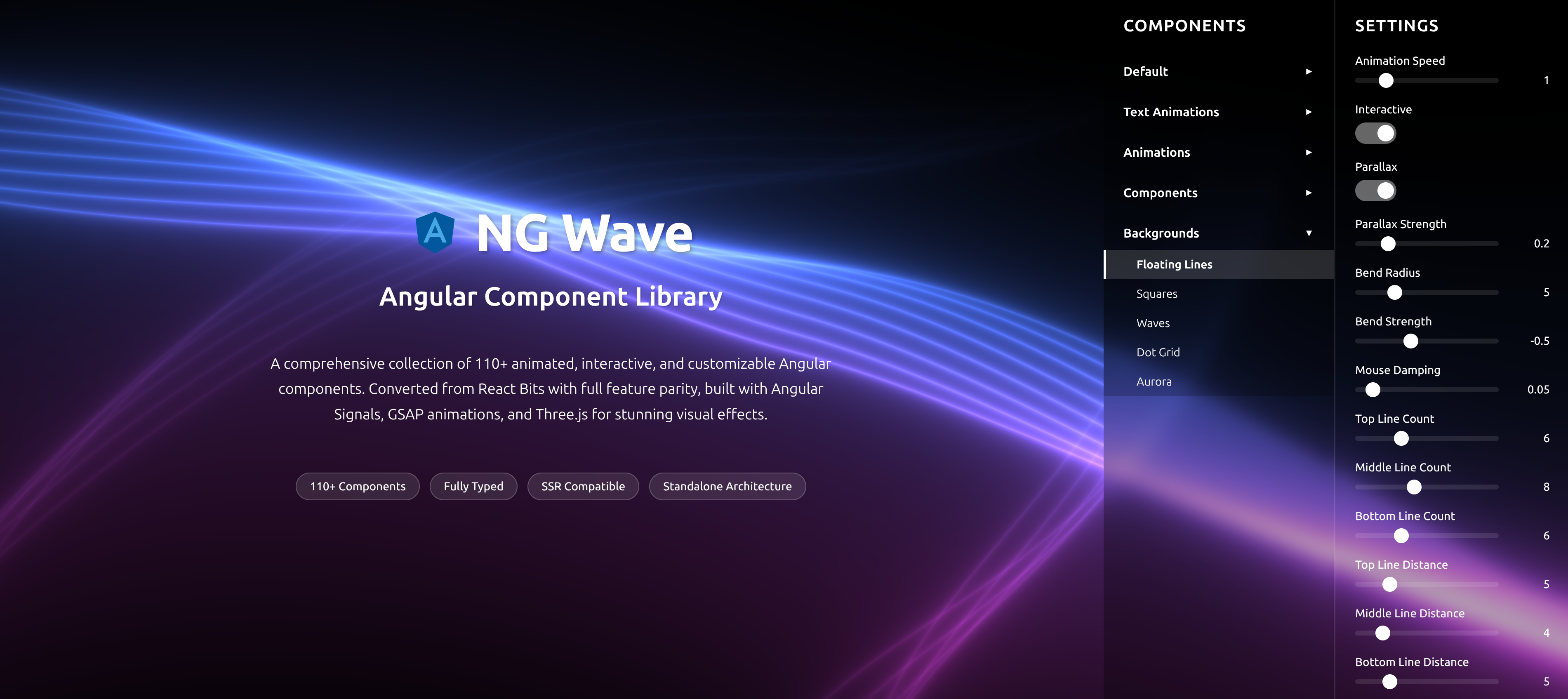
NG Wave
Angular Component Library
A comprehensive collection of 110+ animated, interactive, and customizable Angular components. Converted from React Bits with full feature parity, built with Angular Signals, GSAP animations, and Three.js for stunning visual effects.
Explore Components