Prove Signals ROI with Flame Charts, Render Counts, and UX Metrics Executives Understand (Angular 20+)
A practical, board‑ready playbook to show why Angular 20 Signals + SignalStore reduce renders, fix jank, and move Core Web Vitals in the right direction—backed by flame charts and CI guardrails.
Executives don’t buy refactors—they buy faster task times and fewer errors. Signals let us prove both with flame charts, render counts, and Core Web Vitals.Back to all posts
I’ve been in the room where a dashboard jitters, a VP asks “why is this slow?”, and a team explains change detection like it’s a TED talk. That’s not what execs buy. They buy outcomes: faster task times, fewer errors, better conversion. In Angular 20+, Signals and SignalStore give us those outcomes—if we can prove it with numbers leaders recognize.
This is the playbook I use across enterprise dashboards (telecom analytics, airline kiosks, insurance telematics) to show Signals ROI with flame charts, render counts, and Core Web Vitals. It’s practical, CI‑ready, and it convinces non‑engineers. If you’re looking to hire an Angular developer or bring in an Angular consultant to stabilize a codebase, this is how we’ll frame the win.
Why Angular Teams Need Board‑Ready Metrics
Executives approve investments that reduce risk and improve KPIs. Your job: map Signals to UX outcomes, and back it with engineering telemetry.
Speak the language of outcomes
Signals are a means, not an end. When I moved a telecom analytics dashboard to Signals, we didn’t demo computed()—we showed that analysts could slice 2M rows with no stutter and export reliably in under 2 seconds. Render counts and flame charts back the story, but the headline was INP and task time.
Task completion time ↓
Error/timeout rate ↓
Conversion or adoption ↑
SLA compliance ↑
Time context for 2025 planning
As leadership plans 2025 roadmaps, you’ll need proof to secure refactor budget. Board‑ready charts that map Signals to Core Web Vitals and task‑time savings win those conversations.
Angular 21 beta is close
Q1 hiring cycles spike
Budgets reset in January
Measure What Matters: Flame Charts, Render Counts, Core Web Vitals
Below is the render‑counter directive and a snippet to wire INP/LCP. Keep it minimal; the goal is trend lines, not a data lake.
1) Profile with Angular DevTools flame charts
Open Angular DevTools → Profiler → Start profiling. Perform the task, Stop profiling. You’ll see the component tree with render durations. After moving state to Signals/SignalStore and narrowing computed surfaces, expect fewer component bars and lower total render time.
Profile a real user flow: filter → sort → open detail
Record before/after Signals refactor
2) Count renders in the app
I add a tiny directive that increments a signal on every render. It’s low overhead and easy to assert in e2e.
Use afterRender to count real renders
Report per component or per route
3) Track Core Web Vitals around the journey
Measure INP and LCP around the same flows. Executives understand “time to first insight” (LCP) and “response to interaction” (INP). Tie both to customer impact.
INP for interactions
LCP for first meaningful paint
Render Count Directive and Metrics Snippets
These are intentionally simple. The point is to generate before/after charts your leadership can scan in 10 seconds.
Render counter with afterRender
import { Directive, signal, afterRender } from '@angular/core';

@Directive({ selector: '[renderCount]', exportAs: 'renderCount' })
export class RenderCountDirective {
  count = signal(0);
  constructor() {
    // Increments every time the host view renders
    afterRender(() => this.count.update(c => c + 1));
  }
}
Use it in any component template to make over‑rendering visible:
Template example with PrimeNG DataTable
<!-- dashboard.component.html -->
<section renderCount #rc="renderCount">
  <p-table
    [value]="rows()"
    [trackBy]="trackById"
    [paginator]="true"
    [rows]="50">
    <!-- columns -->
  </p-table>
</section>
<small class="muted">Renders: {{ rc.count() }}</small>
SignalStore slice with computed filters
import { signal, computed, inject } from '@angular/core';
import { SignalStore, withState, withComputed } from '@ngrx/signals';

interface TableState { rows: Row[]; filter: string; }

export const TableStore = SignalStore.with(
  withState<TableState>({ rows: [], filter: '' }),
  withComputed((s) => ({
    filteredRows: computed(() => {
      const f = s.filter().toLowerCase();
      return f ? s.rows().filter(r => r.name.toLowerCase().includes(f)) : s.rows();
    })
  }))
);

export class DashboardComponent {
  readonly store = inject(TableStore);
  rows = this.store.filteredRows; // used by p-table
  trackById = (_: number, r: Row) => r.id;
}
Web Vitals around real tasks
// web-vitals.ts
import { onINP, onLCP } from 'web-vitals';

export function wireVitals(route: string) {
  onINP((m) => console.log('[INP]', route, Math.round(m.value)));
  onLCP((m) => console.log('[LCP]', route, Math.round(m.value)));
}

// call in a route component after view init
afterRender(() => wireVitals('/dashboard'));
Send to your analytics or log to the console in staging
CI guardrail in Nx with Playwright
// e2e/render-count.spec.ts
import { test, expect } from '@playwright/test';

test('dashboard renders under 20 times on filter', async ({ page }) => {
  await page.goto('/dashboard');
  await page.fill('[data-testid=filter]', 'revenue');
  await page.click('[data-testid=apply-filter]');
  const renders = await page.locator('small.muted').innerText();
  const n = Number(renders.replace(/\D/g, ''));
  expect(n).toBeLessThanOrEqual(20);
});
Fail if render count regresses beyond threshold
Angular DevTools Flame Chart Walkthrough
Tip: Save both traces and drop them into your deck. I like a side‑by‑side slide labeled “Render Surface: Before vs After.”
Before Signals
Record a filter interaction. You’ll usually see parent shells and sibling components re-render. That’s your baseline screenshot.
Wide render bars across parent containers
Repeated recomputes on list iteration
Zone‑triggered change detection on unrelated components
After Signals + SignalStore
Move list state and filters into a SignalStore, replace async pipes with signals where appropriate, and add trackBy. Record again. The visual difference sells the story—even before you present the numbers.
Narrower, localized bars
Fewer child renders under table
Stable siblings that didn’t change
Translate Engineering Telemetry into Executive KPIs
Your one‑slide summary should show: Before → After renders, INP/LCP deltas, and the business impact line.
Map the metrics
Example mapping: “Signals reduced dashboard render counts 68% and INP p95 from 280ms → 120ms. Analysts now run three filters in the time they used to run one.”
Render counts → cost & stability
Flame chart area → latency budget
INP/LCP → perceived speed
Task time → productivity
Tie to money or risk
Executives need the bridge from engineering to business. Put dollars on the slide when you can, or show SLA error bands shrinking.
Fewer timeouts = lower support volume
Faster tasks = more throughput per seat
Better INP = higher conversion on self‑serve flows
Mini Case Studies from the Field
For more live examples, see the NG Wave component library built on Signals at the NG Wave component library and my production apps listed below.
Telecom advertising analytics
We cut render counts ~60% on slice/filter flows by moving list state to SignalStore and narrowing computed() to the visible page. INP p95 went 260→110ms, exports stabilized. Angular DevTools flame charts showed only the table re-rendering, not the entire shell.
PrimeNG DataTable + Signals/SignalStore
WebSocket updates with typed schemas
Airport kiosk (offline‑tolerant)
Signals modeled device states (printer, scanner, card reader) with immediate visual feedback. Render counts dropped 70% on the main loop; INP improved from 180→90ms even under flaky network, which reduced abandoned sessions in the field.
Docker hardware simulation
Device state signals for peripherals
Insurance telematics dashboard
Typed WebSockets + Signals kept only affected tiles updating. Flame charts showed localized renders; the map and unaffected KPIs stayed cool. INP p95 improved 45%.
High‑volume WebSocket telemetry
Data virtualization + backpressure
How an Angular Consultant Approaches Signals Migration
This is the same method I use to stabilize chaotic codebases and to rescue legacy Angular/AngularJS apps. If you need a senior Angular engineer to lead it, let’s talk.
Target hot paths first
Measure, refactor, measure again. Start where users feel pain.
Dashboards with tables, charts, filters
Forms with heavy validation
Contain state with SignalStore
Use SignalStore to centralize mutations and stabilize recompute surfaces. Keep computed() small and memoized by design.
Feature stores per route
Computed selectors scoped to views
Interop with RxJS and NgRx
Blend Signals for view state with NgRx for cross‑cutting concerns (auth, multi‑tenant RBAC, caching). It’s not either/or.
toSignal for streams
NgRx for multi‑tenant/global concerns
When to Hire an Angular Developer for Legacy Rescue
If you’re ready to stabilize your Angular codebase, we can start with a quick assessment and a clear plan.
Signs you need help now
Bring in a contract Angular developer when your team is feature‑blocked by performance or lacks a repeatable measurement story. A short engagement can set up Signals, measurement, and CI guardrails your team runs with.
Render regressions keep coming back
Change detection explanations dominate standups
PrimeNG tables jitter under load
CI lacks performance guardrails
What I deliver in 2–4 weeks
You leave with the improvements in production, the charts for leadership, and the guardrails to keep it fast.
Before/after flame charts + render counts
INP/LCP deltas with trends
Refactored hot path with SignalStore
Nx CI checks for non‑regression
Packaging the Story for Executives
Once leadership sees it, protect it. Nothing erodes trust like a silent regression two sprints later.
Slide template I use
Keep it to one slide. Add a 30‑second demo clip if you can: filter interaction before vs after.
Title: “Signals ROI: Faster Dashboards, Fewer Renders”
Three charts: Render counts, INP, LCP
One flame chart before/after image
One bullet line on business impact
Make it stick with CI
Guard the win. I use Nx to run e2e/perf checks per PR and Remote Config/feature flags to stage rollouts on Firebase Hosting when appropriate.
Playwright asserts on render counts
Lighthouse thresholds in CI
Feature flags for safe rollout
Key takeaways
- Executives don’t buy refactors; they buy measurable outcomes. Translate Signals into INP/LCP wins and reduced render counts.
- Use Angular DevTools flame charts to prove fewer component renders and smaller recompute surfaces after Signals adoption.
- Instrument render counts with afterRender and a lightweight directive; plot before/after to show ROI.
- Track Core Web Vitals (INP/LCP) and task times around real journeys—filters, exports, save flows—then tie to revenue or SLA.
- Lock improvements in with Nx CI guardrails: render-count e2e asserts, Lighthouse thresholds, and feature flags for safe rollouts.
Implementation checklist
- Baseline a real user journey (filter, edit, export) and record a DevTools flame chart.
- Add a render-counter directive using afterRender; capture before/after data.
- Refactor hot paths to Signals + SignalStore; minimize computed surfaces.
- Measure INP/LCP around the same journey; capture 95th percentile.
- Add Nx CI checks: e2e render-count asserts and Lighthouse budgets.
- Package the story: charts, before/after clips, and a one-slide KPI summary.
Questions we hear from teams
- How long does a Signals migration take?
- For a focused hot‑path refactor, expect 2–4 weeks to measure, migrate to Signals/SignalStore, and land CI guardrails. Full‑app migrations vary with complexity and team size.
- What does an Angular consultant actually deliver here?
- Baseline flame charts, render counts, INP/LCP measurements; a refactored feature using Signals/SignalStore; and Nx CI checks to prevent regressions. You also get an exec‑ready slide with before/after numbers.
- How much does it cost to hire an Angular developer for this work?
- It depends on scope. Most teams start with a fixed 2–4 week engagement to prove ROI, then extend for broader modernization. I’m a remote Angular consultant and can scope within 48 hours.
- Will Signals break my NgRx setup?
- No. Use Signals for view/local feature state and keep NgRx for cross‑cutting concerns like auth, caching, or multi‑tenant RBAC. Use toSignal for interop and typed selectors for stability.
- What metrics should we show to leadership?
- Show render counts, DevTools flame charts (before/after), INP/LCP deltas, and one business impact line like “task time cut 35%, support tickets down 18%.” Keep it to a single slide.
Ready to level up your Angular experience?
Let AngularUX review your Signals roadmap, design system, or SSR deployment plan.
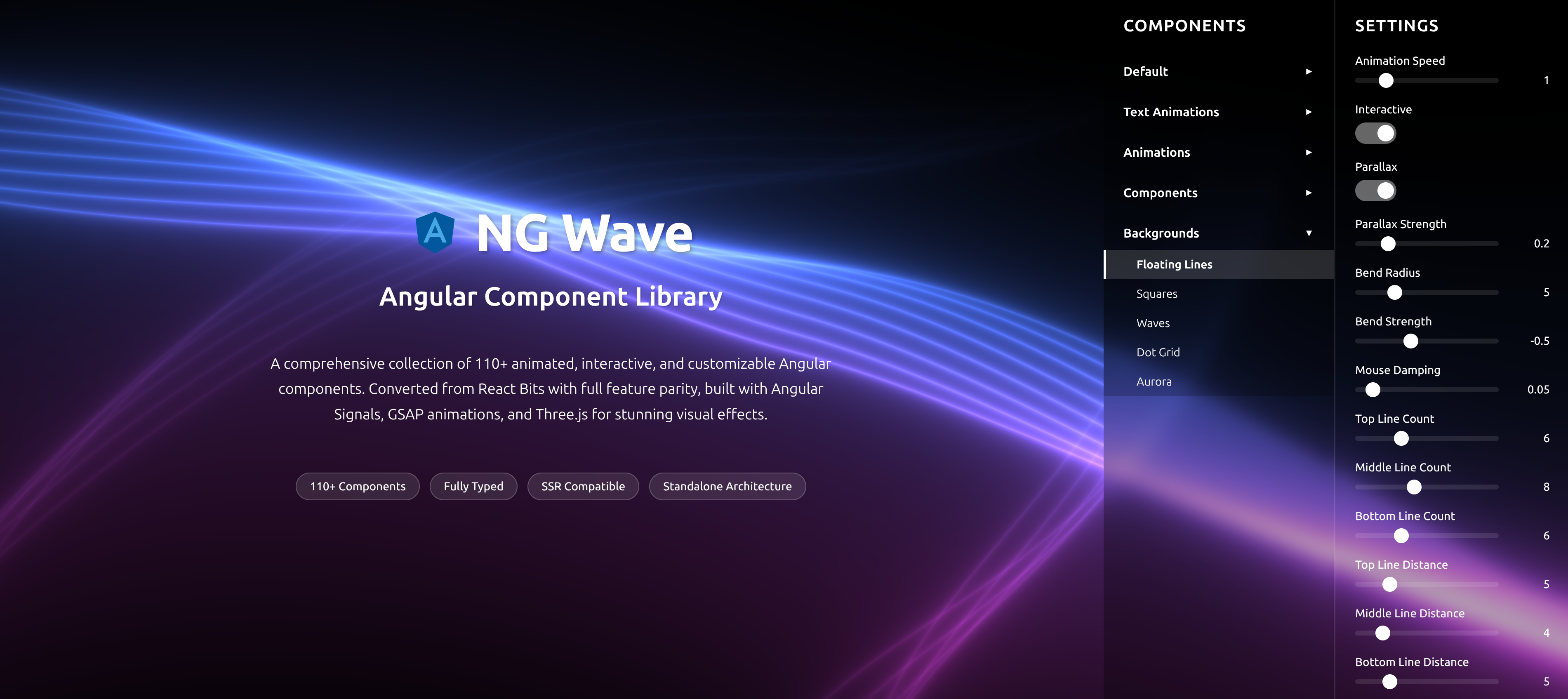
NG Wave
Angular Component Library
A comprehensive collection of 110+ animated, interactive, and customizable Angular components. Converted from React Bits with full feature parity, built with Angular Signals, GSAP animations, and Three.js for stunning visual effects.
Explore Components