Real‑Time NgRx for Telemetry Dashboards in Angular 20+: WebSockets, Optimistic Updates, and Typed Effects (Why to Hire an Angular Consultant)
A senior, field‑tested blueprint for NgRx in real‑time dashboards—typed actions/effects, WebSocket resilience, and optimistic updates that never jitter.
Typed NgRx + Signals turns ‘live data’ into a calm, trustworthy dashboard—WebSockets included.Back to all posts
The Real‑Time Angular Dashboard That Jitters: Why NgRx + WebSockets Fix It
A scene from the trenches
On a telecom advertising analytics dashboard I built, traffic spikes would hit 200–400 events/second during prime time. Early on, charts jittered, tables glitched, and stakeholders questioned whether the data was actually real‑time. The culprit wasn’t Angular—it was statecraft. We had streams, but not a strategy.
I rebuilt the pipeline with NgRx: typed actions/effects, a resilient WebSocket client, EntityAdapter for fast normalized writes, and optimistic updates that gracefully roll back. With Angular 20+, Signals/SignalStore bridged selectors into ultra‑snappy components. The jitter disappeared; trust returned.
Hundreds of updates per second
UI churn and missed frames
Ops asking for proof the data is ‘live’
Why teams struggle
Most teams ‘get a socket working’ but stop short of production patterns: discriminated union schemas, correlation IDs, replay rules, and typed effects. You don’t need hero code. You need simple, repeatable state patterns. If you’re looking to hire an Angular developer or bring in an Angular consultant, this is where senior experience saves months.
Ad‑hoc RxJS in components
Untyped message blobs
No plan for reconnect/dup suppression
Why Angular 20 Teams Need Typed NgRx for Telemetry Streams
Here’s the short version: typed NgRx keeps your pipeline honest, Signals keep your UI smooth, and a few ops‑grade patterns keep it online. If you need an Angular expert who’s shipped this at scale, I’m available for remote engagements.
What “real‑time” really means
Real‑time isn’t just speed; it’s stability under burst load, predictable reconnection, and confidence you’re rendering the latest truth. For Angular 20+, that means NgRx for event discipline, Signals for low‑overhead reactivity, and CI guardrails proving every change improves metrics.
Low latency UI and stable frame rate
Loss‑tolerant, duplicate‑resistant pipelines
Observable metrics, not vibes
Typed event schemas prevent drift
Typed schemas force discipline across frontend, gateway, and services. When an event changes, the build fails loudly instead of silently degrading the dashboard. Effects become self‑documenting, and onboarding drops from weeks to days.
Discriminated unions
Versioned payloads
Compile‑time guarantees
Signals + NgRx synergy
With NgRx 16+ and Angular 20, convert selectors to Signals (selectSignal) or wrap a façade with SignalStore. Components become tiny and fast; your heavy lifting stays in effects and reducers where it’s testable.
Selectors as Signals
Minimal change detection
Composable derived state
Architecture Blueprint: NgRx, WebSockets, Optimistic Updates, and SignalStore
Comparison: delivery channels for ‘live’ data
| Channel | Pros | Cons | Use When |
|---|---|---|---|
| WebSocket | Full‑duplex, lowest latency | Complex lifecycle, backpressure | High‑frequency telemetry, bi‑directional acks |
| SSE | Simple server→client | No client→server by default | One‑way event feeds, lower rates |
| Polling | Easiest infra | Latency, wasted bandwidth | Rare changes, cost > complexity |
For dashboards that must accept user commands (filters, edits, control signals) and reflect server acks, WebSockets + NgRx effects win.
Data path overview
- WebSocket connects with auth and subscriptions. 2) Messages are parsed into typed actions. 3) Reducers normalize into Entity state. 4) Selectors feed Signals via selectSignal or a SignalStore façade. 5) Optimistic commands write to an outbox; acks confirm or roll back.
Socket lifecycle
Typed actions
Store + Signal façade
Resilience matters
Treat socket connection as first‑class state. Effects own retry, exponential backoff with jitter, re‑auth, and resubscribe on reconnect. Maintain seen message IDs for dedupe and measure heartbeats.
Backoff and jitter
Replay and dedupe
Heartbeat and liveness
Nx Workspace Layout for Real‑Time State
# Generate libraries (example)
nx g @nx/angular:lib dashboard-feature --directory=app --standalone
nx g @nx/angular:lib dashboard-data-access --directory=app
nx g @nx/angular:lib shared-schemas --directory=app

# Add NgRx in data-access
nx g @ngrx/schematics:store State --module app/dashboard-data-access/src/lib/data-access.module.ts --creators --minimal
Recommended libs
Keep effects and reducers in data‑access libs; keep components thin in feature libs. Put typed event schemas in utils shared by the gateway client and test harnesses.
feature libs for dashboard
data‑access libs for NgRx
util libs for schemas
Generators
Typed Event Schemas and Actions
// app/shared-schemas/src/lib/telemetry.events.ts
export type ServerEvent =
  | { type: 'telemetry.batch.v1'; seq: number; items: TelemetryPoint[] }
  | { type: 'telemetry.upsert.v1'; item: TelemetryPoint }
  | { type: 'ack.v1'; correlationId: string }
  | { type: 'nack.v1'; correlationId: string; reason: string };

export type ClientCommand =
  | { type: 'filter.update.v1'; filter: Filter }
  | { type: 'point.update.v1'; id: string; patch: Partial<TelemetryPoint>; correlationId: string };

export interface TelemetryPoint { id: string; ts: number; value: number; source: string }
export interface Filter { site?: string; region?: string; campaign?: string }

export const isServerEvent = (m: unknown): m is ServerEvent =>
  typeof m === 'object' && m !== null && 'type' in (m as any);
// app/dashboard-data-access/src/lib/telemetry.actions.ts
import { createActionGroup, props, emptyProps } from '@ngrx/store';
import { ServerEvent, ClientCommand, TelemetryPoint, Filter } from '@app/shared-schemas';
export const socketActions = createActionGroup({
source: 'Socket',
events: {
'Connect': emptyProps(),
'Connected': props<{ sessionId: string }>(),
'Disconnected': props<{ code?: number; reason?: string }>(),
'Error': props<{ error: unknown }>(),
'Incoming': props<{ event: ServerEvent }>(),
'Send': props<{ cmd: ClientCommand }>(),
}
});
export const telemetryActions = createActionGroup({
source: 'Telemetry',
events: {
'UpsertMany': props<{ items: TelemetryPoint[] }>(),
'UpsertOne': props<{ item: TelemetryPoint }>(),
'Ack': props<{ correlationId: string }>(),
'Nack': props<{ correlationId: string; reason: string }>(),
'ApplyFilter': props<{ filter: Filter }>(),
'OptimisticPatch': props<{ id: string; patch: Partial<TelemetryPoint>; correlationId: string }>(),
'RollbackPatch': props<{ id: string; correlationId: string }>(),
}
});Discriminated unions
Define both directions. Use a version and id for dedupe/rollback.
Compile‑time safety
Forward compatibility
Action groups
Action groups keep names consistent and reduce typo bugs.
Self‑documenting
Simple tests
Reducers with EntityAdapter and Latency Compensation
// app/dashboard-data-access/src/lib/telemetry.reducer.ts
import { createReducer, on } from '@ngrx/store';
import { createEntityAdapter, EntityState } from '@ngrx/entity';
import { telemetryActions } from './telemetry.actions';
import { TelemetryPoint } from '@app/shared-schemas';

interface OptimisticLog {
  [correlationId: string]: { id: string; before: TelemetryPoint };
}

export interface TelemetryState extends EntityState<TelemetryPoint> {
  filter: Partial<{ site: string; region: string; campaign: string }>;
  optimistic: OptimisticLog;
}

const adapter = createEntityAdapter<TelemetryPoint>({ selectId: (p) => p.id });
const initialState: TelemetryState = adapter.getInitialState({ filter: {}, optimistic: {} });

export const telemetryReducer = createReducer(
  initialState,
  on(telemetryActions.UpsertMany, (s, { items }) => adapter.upsertMany(items, s)),
  on(telemetryActions.UpsertOne, (s, { item }) => adapter.upsertOne(item, s)),
  on(telemetryActions.ApplyFilter, (s, { filter }) => ({ ...s, filter })),
  on(telemetryActions.OptimisticPatch, (s, { id, patch, correlationId }) => {
    const before = s.entities[id];
    if (!before) return s;
    const after = { ...before, ...patch };
    const withEntity = adapter.upsertOne(after, s);
    return { ...withEntity, optimistic: { ...withEntity.optimistic, [correlationId]: { id, before } } };
  }),
  on(telemetryActions.Ack, (s, { correlationId }) => {
    const { [correlationId]: _, ...rest } = s.optimistic; // drop log
    return { ...s, optimistic: rest };
  }),
  on(telemetryActions.RollbackPatch, (s, { id, correlationId }) => {
    const entry = s.optimistic[correlationId];
    if (!entry) return s;
    const withEntity = adapter.upsertOne(entry.before, s);
    const { [correlationId]: _, ...rest } = withEntity.optimistic;
    return { ...withEntity, optimistic: rest };
  })
);

export const { selectAll: selectAllPoints, selectEntities: selectPointMap } = adapter.getSelectors();
Normalize for speed
EntityAdapter gives you blazing writes and simple rollbacks by storing the previous snapshot keyed by correlationId.
EntityAdapter
O(1) writes
Rollback strategy
If no ACK within T, rollback and surface a toast/log.
Store patch pre‑image
Timeout cleanup
Effects for WebSocket Lifecycle and Exponential Backoff
// app/dashboard-data-access/src/lib/telemetry.effects.ts
import { inject, Injectable } from '@angular/core';
import { Actions, createEffect, ofType } from '@ngrx/effects';
import { Store } from '@ngrx/store';
import { webSocket, WebSocketSubject } from 'rxjs/webSocket';
import { concatMap, delayWhen, filter, map, merge, mergeMap, of, retryWhen, scan, switchMap, takeUntil, tap, timer } from 'rxjs';
import { socketActions, telemetryActions } from './telemetry.actions';
import { isServerEvent, ServerEvent, ClientCommand } from '@app/shared-schemas';

@Injectable({ providedIn: 'root' })
export class TelemetryEffects {
  private actions$ = inject(Actions);
  private store = inject(Store);

  private connect$ = createEffect(() =>
    this.actions$.pipe(
      ofType(socketActions.Connect),
      switchMap(() => {
        const ws = webSocket({ url: 'wss://api.example.com/telemetry', deserializer: (e) => JSON.parse(e.data) });

        const incoming$ = ws.pipe(
          filter(isServerEvent),
          map((event: ServerEvent) => socketActions.Incoming({ event })),
          retryWhen((errors) =>
            errors.pipe(
              scan((acc, err) => ({ count: acc.count + 1, err }), { count: 0, err: null as unknown }),
              delayWhen((s) => timer(Math.min(30000, 1000 * Math.pow(2, s.count)) + Math.floor(Math.random() * 500)))
            )
          )
        );

        const outgoing$ = this.actions$.pipe(
          ofType(socketActions.Send),
          tap(({ cmd }) => ws.next(cmd as ClientCommand)),
          filter(() => false)
        );

        const disconnect$ = this.actions$.pipe(ofType(socketActions.Disconnected));

        return merge(incoming$, outgoing$).pipe(takeUntil(disconnect$));
      })
    )
  );

  handleIncoming$ = createEffect(() =>
    this.actions$.pipe(
      ofType(socketActions.Incoming),
      mergeMap(({ event }) => {
        switch (event.type) {
          case 'telemetry.batch.v1':
            return of(telemetryActions.UpsertMany({ items: event.items }));
          case 'telemetry.upsert.v1':
            return of(telemetryActions.UpsertOne({ item: event.item }));
          case 'ack.v1':
            return of(telemetryActions.Ack({ correlationId: event.correlationId }));
          case 'nack.v1':
            return of(telemetryActions.Nack({ correlationId: event.correlationId }));
          default:
            return of();
        }
      })
    )
  );
}
Lifecycle effect
Use rxjs/webSocket with backoff + jitter. Never block the main thread; effects orchestrate and emit typed actions.
Connect→auth→subscribe
Handle server events
Backoff strategy
Avoid thundering herds after outages; add jitter.
bounded exponential
random jitter
Optimistic Updates with Outbox and Correlation IDs
// app/dashboard-data-access/src/lib/optimistic.effects.ts
import { Injectable, inject } from '@angular/core';
import { Actions, createEffect, ofType } from '@ngrx/effects';
import { Store } from '@ngrx/store';
import { delay, map, merge, mergeMap, of, race, take, timer } from 'rxjs';
import { socketActions, telemetryActions } from './telemetry.actions';

@Injectable({ providedIn: 'root' })
export class OptimisticEffects {
  private actions$ = inject(Actions);
  private store = inject(Store);

  // Dispatch a command and apply optimistic change
  sendPatch$ = createEffect(() =>
    this.actions$.pipe(
      ofType(telemetryActions.OptimisticPatch),
      map(({ id, patch, correlationId }) =>
        socketActions.Send({ cmd: { type: 'point.update.v1', id, patch, correlationId } })
      )
    )
  );

  // Rollback on NACK or timeout
  watchdog$ = createEffect(() =>
    this.actions$.pipe(
      ofType(telemetryActions.OptimisticPatch),
      mergeMap(({ id, correlationId }) =>
        race(
          this.actions$.pipe(ofType(telemetryActions.Ack), take(1)),
          this.actions$.pipe(ofType(telemetryActions.Nack), take(1)),
          timer(5000).pipe(map(() => ({ type: 'timeout' as const })))
        ).pipe(
          map((signal) => {
            if ((signal as any).type === 'timeout') {
              return telemetryActions.RollbackPatch({ id, correlationId });
            }
            if ((signal as any).correlationId !== correlationId) {
              // ignore unrelated ack/nack, rely on timeout
              return { type: '[noop] IrrelevantAck' } as any;
            }
            return signal.type === 'nack.v1'
              ? telemetryActions.RollbackPatch({ id, correlationId })
              : telemetryActions.Ack({ correlationId });
          })
        )
      )
    )
  );
}
Two‑phase workflow
Send command with correlationId, apply local patch, then confirm or rollback on ACK/NACK/timeout. Keep the user unblocked.
PATCH→optimistic
ACK→keep or rollback
Outbox effect
If no ACK in T, rollback and surface error. Optionally retry based on business rules.
Timeout watchdog
Retry policy
Bridging to Signals and PrimeNG UI
// app/dashboard-data-access/src/lib/telemetry.selectors.ts
import { createFeatureSelector, createSelector } from '@ngrx/store';
import { TelemetryState, selectAllPoints } from './telemetry.reducer';

export const selectTelemetryState = createFeatureSelector<TelemetryState>('telemetry');
export const selectFilter = createSelector(selectTelemetryState, (s) => s.filter);
export const selectPoints = createSelector(selectTelemetryState, selectAllPoints);
export const selectFilteredPoints = createSelector(
  selectPoints,
  selectFilter,
  (points, f) => points.filter(p => (!f.site || p.source === f.site))
);
// app/dashboard-feature/src/lib/telemetry-table.component.ts
import { ChangeDetectionStrategy, Component, computed, inject } from '@angular/core';
import { Store } from '@ngrx/store';
import { selectSignal } from '@ngrx/store';
import { selectFilteredPoints } from '@app/dashboard-data-access';
@Component({
selector: 'app-telemetry-table',
standalone: true,
templateUrl: './telemetry-table.component.html',
changeDetection: ChangeDetectionStrategy.OnPush
})
export class TelemetryTableComponent {
private store = inject(Store);
points = this.store.selectSignal(selectFilteredPoints);
total = computed(() => this.points().length);
}<!-- app/dashboard-feature/src/lib/telemetry-table.component.html -->
<p-table
[value]="points()"
[virtualScroll]="true"
[rows]="50"
[scrollHeight]="'60vh'"
[style]="{ fontSize: '12px' }"
>
<ng-template pTemplate="header">
<tr><th>Time</th><th>Source</th><th>Value</th></tr>
</ng-template>
<ng-template pTemplate="body" let-row>
<tr>
<td>{{ row.ts | date:'mediumTime' }}</td>
<td>{{ row.source }}</td>
<td>{{ row.value | number:'1.0-2' }}</td>
</tr>
</ng-template>
</p-table>Selectors as Signals
With NgRx 16+, expose store selectors as Signals to keep components tiny and fast.
selectSignal
derived computed
PrimeNG virtualization
Render tens of thousands of rows smoothly by pairing Signals with virtualization.
with virtualScroll ChangeDetectionStrategy.OnPush
Testing, Telemetry, and CI Guardrails
// sample effect test (Jasmine + marble)
import { TestBed } from '@angular/core/testing';
import { provideMockActions } from '@ngrx/effects/testing';
import { hot, cold } from 'jasmine-marbles';
import { TelemetryEffects } from './telemetry.effects';
import { socketActions, telemetryActions } from './telemetry.actions';

it('emits UpsertMany on batch event', () => {
  const actions$ = hot('-a', { a: socketActions.Incoming({ event: { type: 'telemetry.batch.v1', seq: 1, items: [{ id: '1', ts: 1, value: 10, source: 's' }] } }) });
  TestBed.configureTestingModule({ providers: [TelemetryEffects, provideMockActions(() => actions$)] });
  const effects = TestBed.inject(TelemetryEffects);
  expect(effects.handleIncoming$).toBeObservable(cold('-b', { b: telemetryActions.UpsertMany({ items: [{ id: '1', ts: 1, value: 10, source: 's' }] }) }));
});
# CI snippet: run tests + budgets
name: ci
on: [push, pull_request]
jobs:
build:
runs-on: ubuntu-latest
steps:
- uses: actions/checkout@v4
- uses: actions/setup-node@v4
with: { node-version: 20 }
- run: npm ci
- run: npx nx run-many -t lint,test --parallel=3
- run: npx nx build app --configuration=production
- run: npx lighthouse-ci http://localhost:4200 --budget-path=./budgets.jsonEffect tests
Effects are your engine. Test reconnection, acks, and timeout rollbacks with marble tests to keep behavior locked down.
Marble tests
Virtual time
OpenTelemetry + GA4/Firebase
Instrument effect durations, reconnect counts, and message parse errors. Ship dashboards that monitor your dashboard.
Spans for reconnects
Custom metrics
CI integrations
Automate smoke tests with mocked sockets and protect performance with budgets.
Cypress WS mocks
Bundle budgets
Comparison: RxJS‑Only vs NgRx Store vs SignalStore for Real‑Time
| Approach | Pros | Cons | When to choose |
|---|---|---|---|
| RxJS only in components | Few deps, fast to prototype | Hard to scale/test; lifecycle scattered; no normalized state | Spikes, small widgets |
| NgRx Store (actions/reducer/effects) | Typed pipeline, testable, normalized, great for websockets | Boilerplate; learning curve | Dashboards, multi‑tenant, bi‑directional traffic |
| NgRx SignalStore (façade) | Localized state with Signals ergonomics; rxMethod integration | Less global visibility; still need discipline | Feature‑local real‑time or bridging selectors to Signals |
Teams often blend: global NgRx store for shared streams; SignalStore for feature‑local cohesion and component Signals. That’s my default on enterprise dashboards.
Trade‑offs you can defend in architecture review
Case Snapshots From the Field
If your team needs to stabilize a chaotic codebase or modernize to Angular 20+, see how I can help you stabilize your Angular codebase via gitPlumbers—rescue chaotic code without a rewrite.
Telecom advertising analytics
I led a real‑time ads analytics dashboard for a telecom provider. With NgRx + WebSockets + EntityAdapter, we kept updates under 16ms per frame at peaks. Data virtualization in PrimeNG and typed effects eliminated jitter; execs monitored campaigns confidently.
200–400 events/sec
<16ms updates
Airline kiosks with offline tolerance
For an airport kiosk project, devices (printers/scanners) went offline intermittently. We used an NgRx outbox and a retrying WebSocket channel to synchronize transactions when connectivity returned. I built a Docker‑based hardware simulator to reproduce edge cases and codify effects.
Docker device simulation
Outbox patterns
When to Hire an Angular Developer for Legacy Rescue
For modernization projects (AngularJS→Angular, RxJS 7/8, TypeScript strict), I’ve done the upgrades and shipped zero‑downtime releases. See live products and proof at NG Wave, IntegrityLens, and SageStepper.
Signals of trouble
If your dashboard jitters or loses updates, you’re burning trust. Bringing in a senior Angular consultant for a 2–4 week rescue can implement typed actions/effects, normalize state, and add reconnection/rollback patterns—without freezing feature delivery.
Jitter, memory bloat, missed frames
Untyped sockets and implicit contracts
Crashes on reconnects
Deliverables I typically ship
I leave teams with a typed event catalog, NgRx slices, deterministic tests, and a runbook for ops. If you need a remote Angular developer with Fortune 100 experience, let’s talk.
Schema + action catalog
Outbox + retry effects
CI guardrails + docs
How an Angular Consultant Approaches Signals Migration in NgRx Dashboards
// SignalStore façade example
import { signalStore, withState, patchState, withComputed, withMethods } from '@ngrx/signals';
import { inject } from '@angular/core';
import { Store } from '@ngrx/store';
import * as sel from '../data-access/telemetry.selectors';

interface VMState { filterText: string }

export const useTelemetryStore = signalStore(
  withState<VMState>({ filterText: '' }),
  withComputed((store) => ({
    points: inject(Store).selectSignal(sel.selectFilteredPoints),
    count: () => store.points().length,
  })),
  withMethods((store) => ({ setFilterText(v: string) { patchState(store, { filterText: v }); } }))
);
Keep NgRx, add Signals where it helps
Don’t rip out NgRx. Bridge selectors to Signals in components; when a feature needs local derived state and imperative rxMethod hooks, wrap it in a SignalStore.
selectSignal
SignalStore façades
Migration checklist
Move side‑effects into effects, collapse component RxJS, and shift rendering to Signals. Keep SSR and tests deterministic; avoid unpredictable async in templates.
Turn on strict TS
Add discriminated unions
Introduce selectSignal
Takeaways and Next Steps
If you’re considering hiring Angular help for a high‑stakes dashboard—telemetry, multi‑tenant analytics, or kiosks—bring in experience early. I’ve done this work across telecom, airlines, insurance telematics, and IoT. Let’s review your state pipeline and ship a plan in a week.
What to implement this week
Measure before/after with Angular DevTools and flame charts. Track FPS and event latency. Your users will feel the difference immediately.
Ship typed event schemas
Add Outbox + ACK/rollback
Expose selectors as Signals
What to instrument next
Use Firebase Performance Monitoring or GA4 custom metrics to log stream behavior and regressions. Tie them to CI via budgets and alerts.
Reconnect counters
Effect duration spans
Feature flags for stream versions
FAQs: Real‑Time NgRx, WebSockets, and Hiring
How long does a typical NgRx real‑time rescue take?
Most teams see stability in 2–4 weeks: schema/catalog, typed actions/effects, outbox/ack, and CI tests. Full modernization or multi‑tenant refactors can run 4–8 weeks, staged with canaries.
Do we need to replace NgRx with Signals?
No. Keep NgRx for global streams and typed effects; expose selectors as Signals. Use SignalStore for local, feature‑scoped reactivity. This hybrid keeps testability and improves UX.
How do you test WebSocket effects?
Marble tests for deterministic effects, Cypress with mocked sockets for E2E, and offline/online API tests for reconnection. I also add contract tests against a Dockerized socket simulator.
What about Firebase instead of custom sockets?
Firestore/RTDB offer serverless real‑time. I’ve shipped both. If you need bi‑directional commands with acks, a WebSocket gateway still fits well; Firebase can handle auth/analytics.
Key takeaways
- Model your telemetry with discriminated union event schemas and typed actions/effects to prevent drift.
- Use NgRx EntityAdapter + correlation IDs for optimistic updates with clean rollback on NACK/timeouts.
- Treat WebSocket lifecycle as state: connect, authenticate, resubscribe, backoff, and replay safely.
- Bridge NgRx selectors to Signals via selectSignal or a SignalStore façade for simple, reactive components.
- Instrument everything: heartbeat metrics, reconnection counters, and effect durations with OpenTelemetry.
- Guard production with CI: effect tests, virtual-time WebSocket mocks, visual diffs, and feature flags.
Implementation checklist
- Define a typed event schema (server→client and client→server).
- Create action groups for socket lifecycle, telemetry events, and optimistic mutations.
- Implement NgRx reducers with EntityAdapter for fast updates and rollbacks.
- Write effects for connect/auth, stream handling, exponential backoff, and outbox processing.
- Expose selectors as Signals (selectSignal) or a SignalStore façade.
- Wire PrimeNG virtualization and change detection to Signals for 60fps rendering.
- Add OpenTelemetry spans, GA4/Firebase logs, and Angular DevTools profiling in CI.
- Test with marble tests, Cypress WebSocket mocks, and browser offline/online events.
- Use feature flags and canary environments for new streams or message versions.
Questions we hear from teams
- How much does it cost to hire an Angular developer or consultant for a real-time NgRx project?
- Most rescues land in the $10k–$30k range over 2–4 weeks. Larger upgrades or multi-tenant refactors run longer. I scope fast: discovery call in 48 hours, written plan within a week.
- What does an Angular consultant do on a real-time dashboard engagement?
- Establish typed event schemas, implement NgRx actions/effects, add optimistic updates with outbox, wire Signals for the UI, and install CI/observability. You get a stable, measured pipeline that won’t jitter in production.
- How long does an Angular upgrade or NgRx migration take?
- Small rescues: 2–4 weeks. Full upgrades or migrations: 4–8 weeks with canaries and feature flags. I target zero downtime and measurable improvements in latency and FPS.
- Do we need Signals if we already use NgRx?
- Signals reduce component overhead and improve UX. Keep NgRx for typed streams, then bridge selectors with selectSignal or a SignalStore façade for lean components and deterministic tests.
- Can you work remote and integrate with our Nx monorepo, Firebase, or .NET backend?
- Yes—remote by default. I’ve delivered Angular 20+ in Nx with Firebase, Node.js, and .NET backends. I’ll align with your CI/CD and add guardrails without blocking releases.
Ready to level up your Angular experience?
Let AngularUX review your Signals roadmap, design system, or SSR deployment plan.
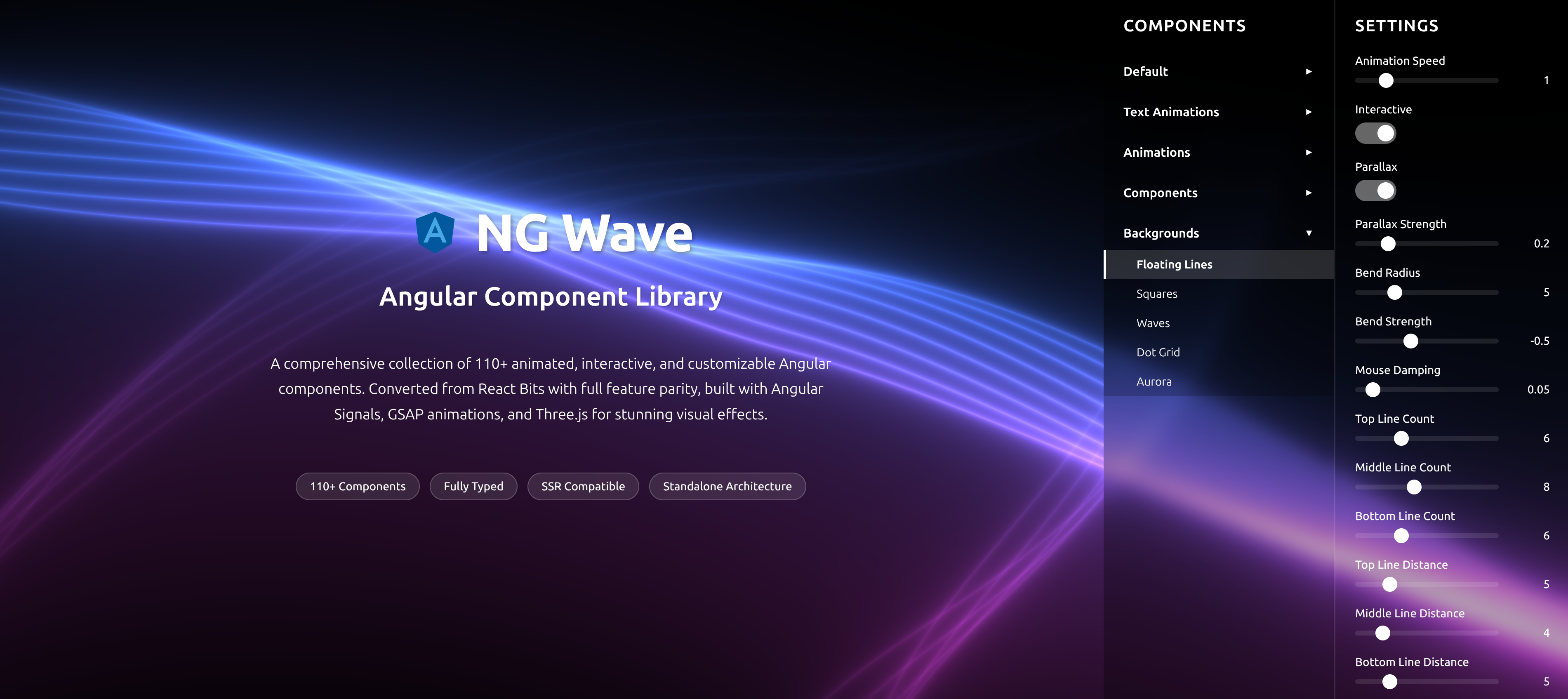
NG Wave
Angular Component Library
A comprehensive collection of 110+ animated, interactive, and customizable Angular components. Converted from React Bits with full feature parity, built with Angular Signals, GSAP animations, and Three.js for stunning visual effects.
Explore Components