Rescue Legacy AngularJS/9–14 State Without a Rewrite: Signals Adapters, Facades, and a Strangler Path That Ships
A senior Angular rescue playbook: convert brittle state to Angular 20+ Signals with adapters and SignalStore—no code freeze, no big-bang rewrite.
Modernize the surface area first. Strangle the internals second. Keep shipping the whole time.Back to all posts
I’ve walked into more than a few Angular rescues where the dashboard jitters, effects race each other, and no one dares touch the store before the release train. The PM needs features next sprint; you need stability yesterday. Good news: you can modernize state to Angular 20+ Signals without a rewrite or code freeze.
This is the state-first rescue I run for Fortune 100 teams—in media, aviation, telecom, and insurance—when we can’t pause delivery. We wrap legacy state (AngularJS or Angular 9–14 with NgRx/services) behind a Signals facade, start measuring UX/telemetry wins, and then replace internals gradually with SignalStore using a strangler pattern.
The Fire Drill: Your Dashboard Jitters, No Time for a Rewrite
What I usually find on day 1
When I stabilized an employee-tracking app for a global entertainment company, we had effects that fanned out to three APIs and retried incorrectly—users saw flicker and duplicate rows. We couldn’t stop shipping. The fix was not “rewrite everything”; the fix was modernizing state exposure to Signals and tightening the contracts.
Legacy NgRx selectors chained with heavy map/switchMap.
Zone churn from impure pipes and async + ChangeDetectionStrategy.Default.
AngularJS islands sharing state via $rootScope, localStorage, or ad‑hoc services.
Coupling between components and store action shapes.
Why Signals helps under load
Angular 20+ Signals gives you predictable change propagation and component ergonomics that reduce jitter. You can keep RxJS for server I/O, and adapt the surface area that components read from today.
Deterministic pull-based updates (no accidental fan-out).
Computed memoization reduces work under bursty WebSocket/polling.
Interop with RxJS via toSignal/fromSignal so you don’t rewrite effects day one.
Why Angular 20+ Signals Fix the Root Problems in Legacy State
Symptoms we target
Signals gives you a single source of truth per feature and cheaper computed paths. You’ll see immediate wins in INP and layout thrash by swapping read paths to signals—even before replacing NgRx or AngularJS internals.
Selectors recompute too often; components render too much.
Action storms cause racing effects and inconsistent UI.
AngularJS islands mutate global state; Angular views miss updates.
What stays, what changes
This is a state-first strangler: adapt reads now, evolve writes later. It’s how we shipped an airport kiosk upgrade with Docker-based hardware simulation and zero downtime while modernizing device state.
Keep: HTTP/WS services and most effects.
Change: Component reads become signal-based; add facades.
Later: Migrate store internals to SignalStore when safe.
The Rescue Plan: Adapters, Facades, SignalStore, and a Strangler Path
Step 1 — Inventory and triage
Use Angular DevTools flame charts and your telemetry (GA4, OpenTelemetry) to find the components causing the most work. Start where you can show impact within a sprint.
List selectors/subjects used by top 10 components by traffic.
Trace racey effects and identify global state writes.
Pick one feature with clear ROI (e.g., dashboard KPIs).
Step 2 — Wrap legacy state with a Signals facade
This creates a stable contract. Components stop caring if the backing store is NgRx, AngularJS, or SignalStore.
Expose read-only signals using toSignal.
Keep legacy dispatch/effects behind methods.
Hide action shapes from components.
Step 3 — Introduce SignalStore for a single feature
We’ll do this only where telemetry shows gains (e.g., expensive joins).
Replace one facade’s internals with @ngrx/signals.
Use computed selectors and patchState for updates.
Keep API the same so components don’t change.
Step 4 — Strangle via routing and feature flags
This is how I ship upgrades while features keep landing. It’s the same pattern we used in telecom analytics dashboards with real-time charts and role-based views.
Lazy-load a new feature shell; keep legacy route behind a flag.
Use Firebase Remote Config to canary to internal users.
Roll forward with confidence; roll back in seconds.
Step 5 — Measure and iterate
Modernization is done when metrics say so. Numbers beat opinions.
Track INP/LCP with Lighthouse CI; monitor error taxonomy.
Count re-renders; aim to reduce by 30–60% on hot screens.
Document deltas in your ADRs; keep the team aligned.
Code Patterns You Can Paste In
// Step 2 — Signals facade over existing NgRx store
import { Injectable, computed, inject } from '@angular/core';
import { toSignal } from '@angular/core/rxjs-interop';
import { Store } from '@ngrx/store';
import { selectUsers, selectLoading, selectError } from '../state/users.selectors';
import { UsersActions } from '../state/users.actions';

@Injectable({ providedIn: 'root' })
export class UsersFacade {
  private store = inject(Store);

  // Read paths become signals today
  readonly users = toSignal(this.store.select(selectUsers), { initialValue: [] });
  readonly loading = toSignal(this.store.select(selectLoading), { initialValue: false });
  readonly error = toSignal(this.store.select(selectError), { initialValue: null });

  // Cheap derived views via computed
  readonly activeUsers = computed(() => this.users().filter(u => u.active));

  // Write paths stay as methods (can still dispatch to NgRx for now)
  load() { this.store.dispatch(UsersActions.load()); }
  add(user: User) { this.store.dispatch(UsersActions.add({ user })); }
}
// Step 3 — Swap internals to SignalStore for the same facade API
import { signalStore, withState, withMethods, withHooks, patchState } from '@ngrx/signals';
import { inject, computed } from '@angular/core';
import { firstValueFrom } from 'rxjs';
export interface UsersState {
entities: Record<string, User>;
ids: string[];
loading: boolean;
error: string | null;
}
export const UsersStore = signalStore(
withState<UsersState>({ entities: {}, ids: [], loading: false, error: null }),
withMethods((store, api = inject(UsersApi)) => ({
async load() {
patchState(store, { loading: true });
try {
const users = await firstValueFrom(api.list());
patchState(store, {
entities: Object.fromEntries(users.map(u => [u.id, u])),
ids: users.map(u => u.id),
loading: false,
error: null
});
} catch (e: any) {
patchState(store, { loading: false, error: String(e?.message ?? e) });
}
},
upsert(user: User) {
patchState(store, s => ({
entities: { ...s.entities, [user.id]: user },
ids: s.ids.includes(user.id) ? s.ids : [...s.ids, user.id]
}));
}
}))
);
// Facade keeps the same API; components don’t change
@Injectable({ providedIn: 'root' })
export class UsersFacade2 {
private store = inject(UsersStore);
readonly users = computed(() => this.store.ids().map(id => this.store.entities()[id]));
readonly loading = this.store.loading;
readonly error = this.store.error;
readonly activeUsers = computed(() => this.users().filter(u => u.active));
load() { this.store.load(); }
add(user: User) { this.store.upsert(user); }
}// Step 4 — AngularJS bridge: forward events into Angular 20+ as signals
// AngularJS side (example):
// $window.postMessage({ type: 'user:updated', payload: user }, '*');
// Angular 20+ shell:
import { Injectable, signal } from '@angular/core';
import { fromEvent } from 'rxjs';
@Injectable({ providedIn: 'root' })
export class LegacyBusAdapter {
private lastEvent = signal<any | null>(null);
constructor() {
fromEvent<MessageEvent>(window, 'message').subscribe(evt => {
if (evt.data?.type?.startsWith('user:')) {
this.lastEvent.set(evt.data);
}
});
}
event = this.lastEvent;
}
// Use it in a facade
@Injectable({ providedIn: 'root' })
export class UsersLegacyFacade {
constructor(private bus: LegacyBusAdapter) {}
readonly lastUserEvent = this.bus.event; // signal
}# CI guardrail: Nx + Firebase preview for safe rollouts
name: ci
on: [push, pull_request]
jobs:
build_test_preview:
runs-on: ubuntu-latest
steps:
- uses: actions/checkout@v4
- uses: actions/setup-node@v4
with: { node-version: 20 }
- run: npm ci
- run: npx nx graph --file=project-graph.json || true
- run: npx nx affected -t lint test build --parallel=3
- name: Lighthouse CI
run: npm run lhci:ci || true
- name: Firebase Preview
if: github.event_name == 'pull_request'
run: |
npx firebase hosting:channel:deploy pr-${{ github.event.number }} --expires 7dSignals facade over NgRx selectors
Expose signals to components; keep NgRx under the hood.
SignalStore for a feature
Swap the internals of your facade to SignalStore with no component changes.
AngularJS bridge to Signals
If you still have AngularJS islands, bridge events into your Angular 20+ shell and turn them into signals.
How an Angular Consultant Approaches a Signals Migration
Day 0–2: Assessment
You’ll get a written plan with an inventory, risk list, and the first feature to modernize. Discovery call within 48 hours; assessment delivered within a week.
State map, selector pressure points, effect races.
Angular DevTools traces + error taxonomy audit.
Rollback plan and canary strategy agreed.
Week 1–2: Facades + first SignalStore
In a broadcast media scheduler, this cut component re-renders by 43% on the busiest screen without pausing feature work.
Introduce signals facades; keep writes in legacy store.
Replace one feature with SignalStore behind same API.
Measure INP, re-renders, and errors; share deltas.
Week 3+: Strangle and expand
This is the same cadence I used to stabilize telecom advertising analytics (WebSocket KPIs, data virtualization, exponential retries) while keeping releases green.
Route-level shells and flags for safe rollout.
Replace high-impact modules; defer low ROI areas.
Automate regression with contract tests.
When to Hire an Angular Developer for Legacy Rescue
Signals that it’s time
If this reads like your app, bring in a senior Angular engineer who has shipped state-first rescues. An Angular expert can protect delivery while cutting the root-cause complexity.
INP over 200ms on top screens; jitter on live charts.
Developers avoid store changes; tests brittle around effects.
AngularJS islands block upgrades and accessibility fixes.
Implementation Notes: RxJS Interop, Change Detection, and UX Metrics
RxJS interop without pain
I regularly keep WebSocket and polling logic in RxJS with typed schemas and exponential backoff, then surface the settled state through signals for render stability.
Use toSignal/fromSignal for observables; keep typed streams.
Continue using retry/backoff for I/O; surface results as signals.
Change detection hygiene
Signals reduce zone churn; you don’t have to go zoneless to see wins.
Default CD is fine if signals feed templates.
Prefer OnPush with signals in hot paths; avoid impure pipes.
Use Angular DevTools to verify re-render counts drop.
UX and production telemetry
Data makes upgrades boring—in a good way. gitPlumbers has held 99.98% uptime through modernizations using these guardrails.
Track LCP/INP with Lighthouse CI; log state transitions to Firebase Logs.
Adopt a simple error taxonomy (network/validation/auth/unknown).
Feature-flag risky changes with Firebase Remote Config.
Concise Takeaways and Next Steps
What to do Monday
You can rescue legacy AngularJS/9–14 state without a rewrite. Modernize the surface area first, strangle the internals second, and keep shipping the whole time.
Add a Signals facade over your noisiest selectors.
Pick one feature and swap its internals to SignalStore.
Turn on Nx CI + Firebase preview; measure INP/re-renders.
Questions Teams Ask Before a State-First Rescue
Do we need a code freeze?
I’ve shipped across multiple sprints with zero downtime using this model.
No. We adapt read paths first; writers remain compatible.
We use flags/canaries to isolate risky changes.
Will our NgRx knowledge be wasted?
You can migrate module-by-module without retraining the whole team at once.
No. RxJS and effects remain useful; we change the consumption layer.
SignalStore complements, not replaces, your mental model.
Key takeaways
- You can migrate state first—without rewriting features—by adapting existing NgRx/AngularJS state to Signals.
- Use a facade layer to expose signals today while you strangle legacy stores behind stable APIs.
- Introduce @ngrx/signals SignalStore feature-by-feature and measure UX improvements with telemetry.
- Guard rollouts with Nx CI, Firebase preview channels, and Angular DevTools to keep delivery unblocked.
- Target high-churn features first; defer edge modules until telemetry shows ROI.
Implementation checklist
- Inventory state sources (NgRx, services, AngularJS $rootScope, local storage).
- Wrap selectors/observables with toSignal and stabilize with initialValue.
- Publish read-only signal facades; keep legacy dispatch/effects behind methods.
- Introduce SignalStore for a single feature; measure LCP/INP and error rates.
- Strangle routes: lazy-load new feature shells; fallback via Remote Config feature flags.
- Add contract tests to prevent regression while refactoring internals.
- Instrument telemetry for state timings, error taxonomy, and re-render counts.
Questions we hear from teams
- How much does it cost to hire an Angular developer for a state rescue?
- Typical engagements start at two to four weeks. Scope depends on feature count, NgRx/AngularJS complexity, and CI maturity. I offer fixed-scope assessments and sprint-based delivery so you can control budget while we measure wins fast.
- How long does a Signals migration take for a legacy app?
- Expect 2–4 weeks for the first feature and CI guardrails, then 4–8 weeks to strangle the highest-impact modules. We migrate state first so you see UX gains early without a rewrite or code freeze.
- What does an Angular consultant actually do on a rescue?
- I inventory state, build Signals facades, introduce SignalStore where ROI is clear, add CI/telemetry guardrails, and coach the team. You get a written plan, measurable UX metrics, and safe rollouts via canaries and feature flags.
- Can we keep NgRx and still use Signals?
- Yes. Keep effects and selectors for I/O, adapt reads with toSignal, and gradually replace internals with SignalStore. This avoids risky big-bang migrations and preserves your team’s RxJS expertise.
- What’s involved in a typical engagement?
- Discovery call in 48 hours, assessment in a week, first feature modernization in the next sprint, and then staged rollouts. We use Nx CI, Firebase previews, and telemetry so changes are observable and reversible.
Ready to level up your Angular experience?
Let AngularUX review your Signals roadmap, design system, or SSR deployment plan.
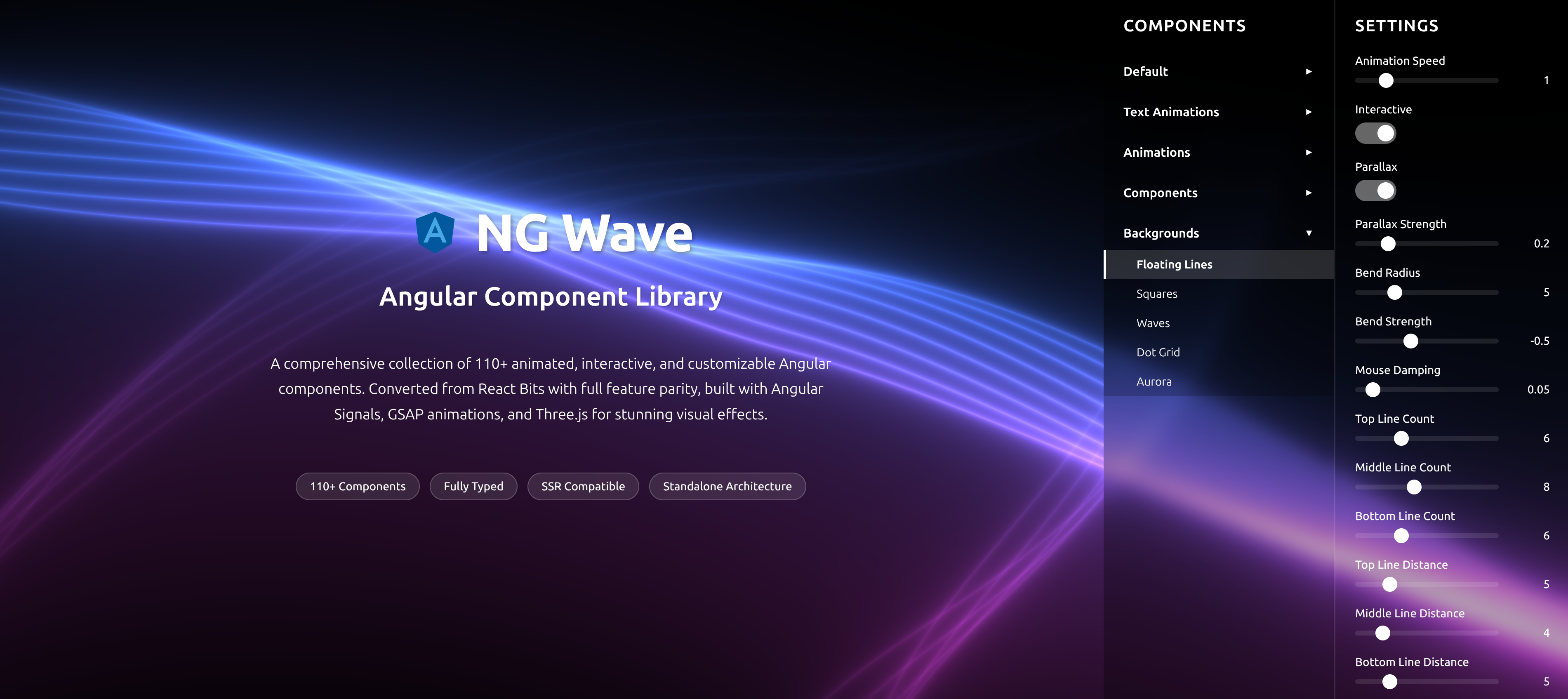
NG Wave
Angular Component Library
A comprehensive collection of 110+ animated, interactive, and customizable Angular components. Converted from React Bits with full feature parity, built with Angular Signals, GSAP animations, and Three.js for stunning visual effects.
Explore Components