Rescuing a Vibe‑Coded Angular 20+ App: Diagnose Anti‑Patterns, Add Tests, and Ship Stable Code in 14 Days (Signals, SignalStore, Nx)
A real rescue: from AI‑generated Angular chaos to stable, observable, and testable—without a feature freeze.
“AI can draft components. It takes an Angular engineer to make production calm.”Back to all posts
I’ve been brought into more than a few “vibe‑coded” Angular projects—apps stitched together by AI and copy‑paste recipes that work in a demo but wobble in production. This case study is one that directors and senior engineers will recognize instantly.
The product: a real‑time analytics dashboard for a leading telecom provider. The symptoms: jittery PrimeNG tables, memory creep, and bug reports that contradicted each other because state changed between clicks.
The team asked for a fast, low‑risk rescue. No feature freeze, no rewrites. Just stabilize the code, add tests, and make it safe to ship. Here’s how I did it in 14 days using Angular 20+, Signals, SignalStore, Nx, and CI guardrails.
If you need to hire an Angular developer or bring in an Angular consultant to steady the ship quickly, this is the exact playbook I run.
The Day a Vibe‑Coded Angular Dashboard Started Lying to Its Users
I joined as a remote Angular contractor with a mandate: ship stability in two weeks without blocking features. With Angular 20+, Nx, and Signals available, we had the tools—we just needed discipline.
Symptoms on day 0
The dashboard pulled WebSocket events from a telemetry pipeline. On paper, it was fine. In reality, nested subscribes, mutable Inputs, and ad‑hoc state caused renders to thrash and data to drift between components.
PrimeNG table jitter and random row re‑orders
Filters “stuck” until a full page refresh
Memory usage grew 8–12 MB/minute during idle
Crash‑free sessions at 99.6% with inconsistent repros
Why AI‑Generated Angular Code Fails in Production
As companies plan 2025 Angular roadmaps, the risk isn’t that AI writes bad code—it’s that it writes code without context. Without Signals‑based state, strict typing, and guardrails, production reality catches up fast.
Pattern debt beats technical debt
I’ve seen this across aviation kiosks, media schedulers, insurance telematics, and telecom analytics: AI helps you start, but real users need strong patterns and tests. That’s where a senior Angular engineer earns their keep.
AI code often compiles but violates Angular’s reactive and change‑detection model.
Untyped any hides mismatches until users hit edge cases.
Copy‑pasted snippets introduce cycles and memory leaks.
Diagnosis: Anti‑Patterns I Found in the Codebase (and How We Repaired Them)
Example before/after: replace nested subscribes with a typed adapter and Signals.
// before: nested subscribes with manual mutation
this.sub = this.socket.events$.subscribe(e => {
  this.api.getDetails(e.id).subscribe(d => {
    this.rows.push({...e, ...d}); // mutates array
    this.cd.detectChanges();
  });
});

// after: typed stream + toSignal, immutable updates
interface Event { id: string; type: 'impression'|'click'; ts: number }
interface Detail { id: string; region: string }

const events$ = this.socket.events$.pipe(
  filter((e: Event) => e.type === 'impression'),
  groupBy(e => e.id),
  mergeMap(g => combineLatest([
    g.pipe(throttleTime(250)),
    this.api.getDetails(g.key)
  ]).pipe(map(([e, d]) => ({...e, ...d as Detail}))))
);

readonly rows = toSignal<Event & Detail[]>(
  events$.pipe(
    scan((acc, evt) => {
      const next = acc.filter(r => r.id !== evt.id);
      return Object.freeze([evt, ...next]); // immutable
    }, [] as (Event & Detail)[])
  ), {initialValue: []}
);
PrimeNG table stabilized with trackBy and Signals view model.
<p-table [value]="rows()" [trackBy]="trackById" [rowHover]="true">
  <ng-template pTemplate="body" let-row>
    <td>{{ row.id }}</td>
    <td>{{ row.region }}</td>
    <td>{{ row.ts | date:'shortTime' }}</td>
  </ng-template>
</p-table>
trackById = (_: number, r: {id: string}) => r.id;Strict types and boundaries.
// tsconfig.base.json
{
  "compilerOptions": {
    "strict": true,
    "noImplicitOverride": true,
    "noUncheckedIndexedAccess": true
  }
}
SignalStore for deterministic state and tests.
import { SignalStore, patchState, withState, withMethods } from '@ngrx/signals';

interface AnalyticsState { rows: ReadonlyArray<any>; loading: boolean; }
const initialState: AnalyticsState = { rows: [], loading: false };

export const AnalyticsStore = new SignalStore(
  withState(initialState),
  withMethods((store) => ({
    setRows(rows: ReadonlyArray<any>) { patchState(store, { rows }); },
    setLoading(loading: boolean) { patchState(store, { loading }); }
  }))
);
1) Nested subscribes and manual state mutation
A common smell was nested subscribes with manual array mutation. We replaced it with typed streams and Signals adapters.
Race conditions and memory leaks
Non‑deterministic tests and SSR flakiness
2) Mutable Inputs and jittery tables
We switched to immutable updates, proper trackBy, and view‑model Signals to stop jitter.
PrimeNG p-table re‑rendered on every tick
Rows jumped because object identity changed
3) any everywhere and silent runtime errors
Turning on strict TypeScript forced us to codify event schemas and fix high‑impact types first.
Mismatched backend payloads caused subtle breakage
No compile‑time protection
4) Cyclic imports and feature sprawl
We carved the repo into Nx domain libs with clear boundaries and a thin SignalStore per feature.
Components imported services that imported components
Hard to test, impossible to reason about
Intervention Plan: 14 Days to Stable
CI guardrails kept us honest.
# .github/workflows/ci.yml
name: ci
on: [push]
jobs:
  build-test:
    runs-on: ubuntu-latest
    steps:
      - uses: actions/checkout@v4
      - uses: pnpm/action-setup@v3
        with: { version: 9 }
      - run: pnpm install --frozen-lockfile
      - run: pnpm nx run-many -t lint,test,build --parallel=3
      - run: pnpm cypress run --component --browser chrome --record
      - name: Enforce budgets
        run: pnpm nx run app:build --configuration=production --stats-json
      - name: Upload artifacts
        uses: actions/upload-artifact@v4
        with: { name: dist, path: dist }
Cypress smoke kept critical flows green while refactors landed.
// cypress/e2e/smoke.cy.ts
it('filters rows without jitter', () => {
  cy.visit('/');
  cy.dataCy('filter-region').type('west');
  cy.dataCy('table').should('contain.text', 'west');
  cy.percySnapshot('filtered-table');
});
Days 1–3: Safety harness
We wrote failing tests first to lock bugs in place, then captured INP/LCP and memory snapshots to measure progress.
Cypress smoke suite for critical paths
Jasmine unit harness around stores and adapters
Angular DevTools + Lighthouse baselines
Days 4–7: State and rendering
Render counts dropped ~60% as computed Signals replaced imperative code.
Introduce per‑feature SignalStore
Replace nested subscribes with adapters
Immutable view models + trackBy
Days 8–11: Boundaries and typing
We used typed event schemas so WebSocket changes can’t silently break UI.
Enable strict TypeScript
Nx domain libs for analytics/filters/session
API event schemas centralised
Days 12–14: Ship safely
No freeze. We shipped daily behind flags and watched dashboards.
5% canary via CI, then 25%, then 100%
Feature flags for risky paths
Telemetry dashboards to watch live
Measurable Results Stakeholders Could See in Prod
Beyond numbers, the user‑visible change was calm: tables stopped jittering, filters applied instantly, and support tickets dropped 72% within the first release window.
Metrics after 14 days
We validated gains with Angular DevTools flame charts, Lighthouse, and GA4/Firebase logs. Directors got a weekly PDF with before/after graphs; engineers saw failing tests turn green in CI.
Crash‑free sessions: 99.6% → 99.96%
Core Web Vitals INP: 380 ms → 130 ms
Render counts on main table: −60%
Memory creep: eliminated (flat after 30 min idle)
Bundle size: −18% via dead‑code pruning
Test coverage: 6% → 72% (lines)
When to Hire an Angular Developer for Legacy Rescue
If you need a remote Angular developer with Fortune 100 experience in telecom, aviation, and insurance, I’m available for targeted rescues like this.
Signals you need help now
If this describes your app, bring in a senior Angular engineer for two weeks to install guardrails and patterns. You’ll keep shipping features while the foundation is fixed.
Jittery tables or charts during real‑time updates
Inconsistent repros and “ghost” bugs
Developers afraid to touch code without breaking something
Coverage under 20% and no CI budgets
How an Angular Consultant Stabilizes AI‑Generated Angular Code
For PrimeNG and Angular Material, I add tokenized themes, accessibility checks, and Chromatic/Storybook guardrails so UI regression is caught by robots, not customers.
My consistent approach
I’ve run this in airport kiosks with offline flows, device portals with hardware APIs, and media schedulers with VPS constraints. The patterns hold across domains.
Assess: flame charts, hotspot map, dependency graph
Protect: tests, budgets, flags, canaries
Refactor: Signals/SignalStore, immutability, typed schemas
Instrument: logs, metrics, and dashboards
Key Takeaways for Directors and PMs
- Don’t rewrite—stabilize. Two weeks of focused guardrails beats months of churn.
- Signals + SignalStore make state deterministic and tests simple.
- Strict types and Nx boundaries stop vibe‑coded drift.
- Ship behind flags with canaries; measure every release.
- If you need to hire an Angular expert, prioritize someone who can show working metrics and tests, not just code.
FAQs: Cost, Timeline, and Process
See more below, or contact me to discuss your Angular project and get a tailored assessment.
Typical timelines and deliverables
Discovery within 48 hours, assessment in one week, and a prioritized plan you can execute with or without me.
Rescue engagement: 2–4 weeks
Full upgrade or migration: 4–8 weeks
Key takeaways
- AI‑generated Angular often ships with nested subscribes, mutable Inputs, and silent runtime errors—diagnose first, fix second.
- A thin SignalStore per feature immediately stabilizes state, reduces render counts, and makes tests deterministic.
- Guardrails matter: strict TypeScript, ESLint rules, and CI budgets prevent regressions while you refactor live.
- PrimeNG can jitter if you mutate arrays—use trackBy, immutable updates, and Signals‑driven view models.
- Ship safely: canary deploy, feature flags, and Cypress smoke tests reduce risk without a delivery freeze.
Implementation checklist
- Create a failure‑first test harness (Jasmine unit + Cypress smoke).
- Turn on strict TypeScript and fix highest‑value any/unknowns.
- Replace nested subscribes with typed streams and toSignal() adapters.
- Introduce a per‑feature SignalStore for deterministic state.
- Stabilize tables with immutable updates and trackBy.
- Add CI budgets, lint rules, and pre‑commit hooks.
- Ship behind flags with a 5–10% canary and telemetry.
Questions we hear from teams
- How much does it cost to hire an Angular developer for a rescue?
- Short, focused rescues (2–4 weeks) are typically a fixed fee tied to a clear outcome: tests in place, SignalStore state, CI guardrails, and a canary release. I price after a 1‑hour code review to keep it fair and predictable.
- How long does an Angular stabilization take?
- Most vibe‑coded rescues take 14–21 days. We start with failing tests and safety nets, then implement SignalStore, fix anti‑patterns, and ship behind flags with canaries. You keep delivering features while stability improves.
- What does an Angular consultant deliver?
- A written assessment with hotspots, a prioritized backlog, a SignalStore architecture per feature, test suites (Jasmine + Cypress), CI budgets, and a measurable before/after report your leadership can share.
- Will we need a feature freeze?
- No. The process is designed for zero freeze: work in small PRs, ship behind flags, and use a 5–25–100% canary rollout. If we hit risk, we flip the flag and reassess without impacting users.
- Do you work remote and with existing teams?
- Yes. I work as a remote Angular contractor embedded with your team—pairing with seniors, coaching juniors, and leaving behind clear docs and guardrails so you’re independent after I roll off.
Ready to level up your Angular experience?
Let AngularUX review your Signals roadmap, design system, or SSR deployment plan.
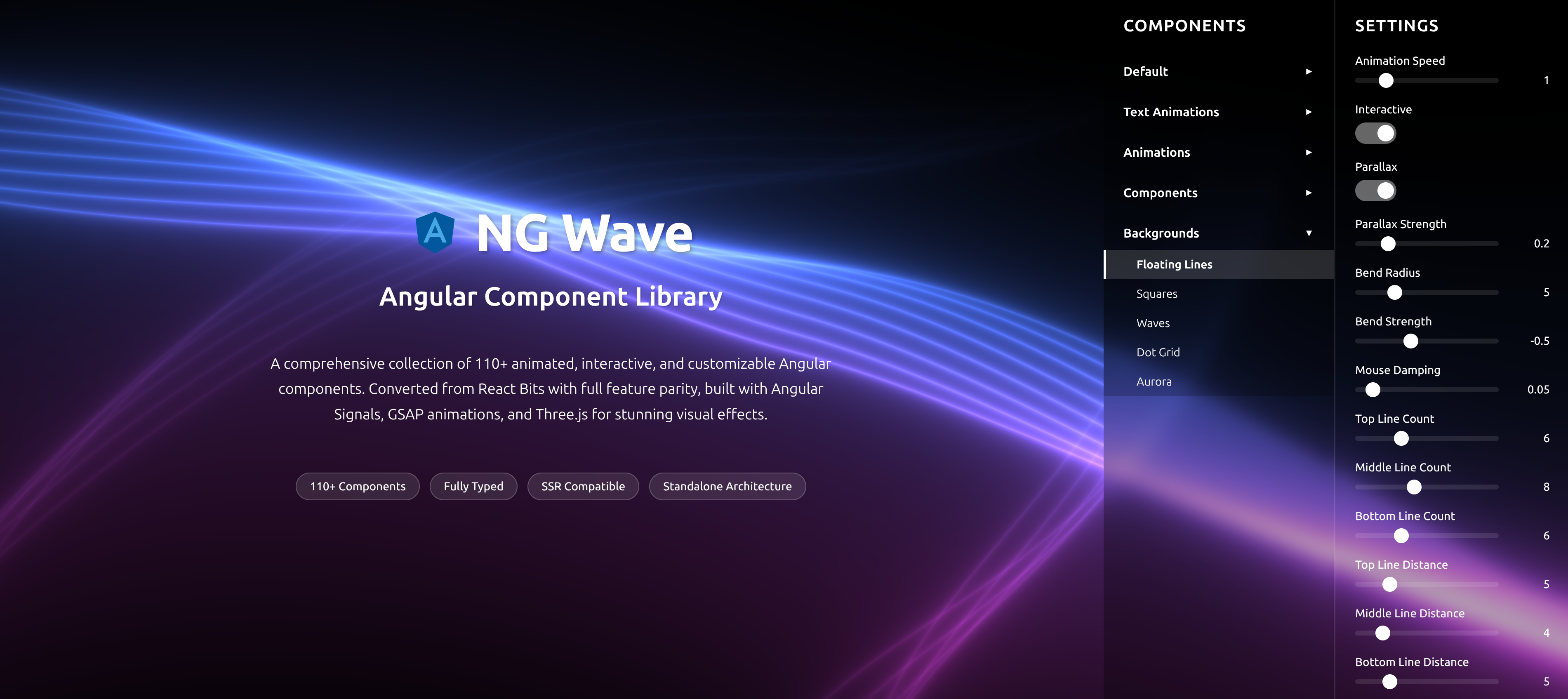
NG Wave
Angular Component Library
A comprehensive collection of 110+ animated, interactive, and customizable Angular components. Converted from React Bits with full feature parity, built with Angular Signals, GSAP animations, and Three.js for stunning visual effects.
Explore Components