Rescuing Vibe‑Coded Angular at Scale: The gitPlumbers Modernization System (Signals, Nx, CI) That Drove a 70% Velocity Boost
AI can scaffold an Angular 20+ app in hours—and leave teams with janky UX, brittle state, and zero guardrails. Here’s how gitPlumbers systematizes the rescue so delivery accelerates, not stalls.
“AI writes a lot of Angular. gitPlumbers makes it shippable—predictable state, measurable UX, and guardrails your team keeps after I’m gone.”Back to all posts
The Vibe‑Coded Angular Trap: Dashboards That Jitter, Pipelines That Lie
What I walked into
I’ve now rescued multiple AI‑generated Angular apps where the UI looked fine on a happy path, but real data turned the experience into a jittery mess. Charts re‑rendered on every tick, forms lost state on navigation, and CI reported green because nothing meaningful was tested. As companies plan 2025 Angular roadmaps, this pattern is common: fast AI starts, slow human recovery.
Angular 20 app built in weeks by AI prompts
No state contracts, flaky CI, Lighthouse in the red
Executives expecting a demo in 10 days
Why this happens with AI‑generated code
AI is great at scaffolding components and wiring services, but it rarely sets guardrails. Without Signals, SignalStore, or typed event schemas, data fetches cascade into re‑renders. Without Nx and quality gates, brittle code slips through. That’s where gitPlumbers comes in.
Prompts optimize for code volume, not stability
No telemetry, so regressions hide until users complain
Implicit ‘vibes’ instead of explicit contracts
Why AI‑Generated Angular 20+ Apps Break Under Real Users
Recurring failure modes we see
The symptoms aren’t subtle: jittery charts, stuck spinners, and production errors labeled ‘rare’. Angular DevTools and flame charts show the truth—change detection storms and redundant HTTP calls. Accessibility is usually an afterthought, and Core Web Vitals regress on each deploy.
Zone-based side effects mutate unrelated state
Ad‑hoc Observables with no unsubscribe strategy
Mixed UI kits (Material + PrimeNG) with inconsistent tokens
SSR/Vite misconfig causing hydration flicker
E2E skipped behind ‘flaky’ labels
Why it matters to stakeholders
If you’re a director or PM deciding whether to hire an Angular developer or bring in an Angular consultant, know this: vibe‑coded apps aren’t just messy—they’re unforecastable. Stabilization restores predictability so roadmaps stick.
Velocity drops as engineers fear touching core flows
Support tickets spike due to nondeterministic bugs
Feature launches stall without a rollback plan
gitPlumbers Modernization System: From Chaos to Signals + Nx + CI
Here’s a condensed example of replacing an AI‑written service with a SignalStore that handles real‑time updates predictably.
import { signalStore, withState, withMethods, withComputed, patchState } from '@ngrx/signals';

// Discriminated union for typed events from WebSocket/Server-Sent Events
export type TelemetryEvent =
  | { type: 'job-progress'; id: string; percent: number }
  | { type: 'job-complete'; id: string; summary: string }
  | { type: 'error'; code: string; message: string };

interface Job { id: string; percent: number; done: boolean; summary?: string }
interface JobsState { connected: boolean; jobs: Record<string, Job>; errors: string[] }

export const JobsStore = signalStore(
  withState<JobsState>({ connected: false, jobs: {}, errors: [] }),
  withComputed((state) => ({
    activeJobs: () => Object.values(state.jobs()).filter(j => !j.done),
    completionRate: () => {
      const vals = Object.values(state.jobs());
      return vals.length ? Math.round(vals.filter(v => v.done).length / vals.length * 100) : 0;
    }
  })),
  withMethods((store) => ({
    connect(wsFactory: () => WebSocket) {
      let retries = 0;
      const connectWS = () => {
        const ws = wsFactory();
        ws.onopen = () => { patchState(store, { connected: true }); retries = 0; };
        ws.onmessage = (ev) => {
          const evt = JSON.parse(ev.data) as TelemetryEvent; // typed event schema
          switch (evt.type) {
            case 'job-progress': {
              const j = store.jobs()[evt.id] ?? { id: evt.id, percent: 0, done: false };
              patchState(store, {
                jobs: { ...store.jobs(), [evt.id]: { ...j, percent: evt.percent } }
              });
              break;
            }
            case 'job-complete': {
              const j = store.jobs()[evt.id] ?? { id: evt.id, percent: 100, done: true };
              patchState(store, {
                jobs: { ...store.jobs(), [evt.id]: { ...j, done: true, summary: evt.summary, percent: 100 } }
              });
              break;
            }
            case 'error': {
              patchState(store, { errors: [...store.errors(), `${evt.code}:${evt.message}`] });
              break;
            }
          }
        };
        ws.onclose = () => {
          patchState(store, { connected: false });
          // Exponential backoff with cap
          const delay = Math.min(30000, 1000 * Math.pow(2, (++retries)));
          setTimeout(connectWS, delay);
        };
      };
      connectWS();
    }
  }))
);
The result: UI stability rises immediately—no more ‘undefined’ states, predictable retries, and components update only when signals change. Pair this with PrimeNG tables/charts and you get silky real‑time dashboards without reflow storms.
1) Fast assessment (48–72 hours)
We start by measuring reality: bundle sizes, render timings, network waterfalls, and error frequency. We tag risky modules and pick a high‑leverage slice to stabilize first.
Nx graph + dependency heatmap
Angular DevTools + Lighthouse + GA4/ Firebase traces
Error budgets and top crash signatures
2) Stabilize the pipeline before the product
If CI can’t catch regressions, you’re playing roulette. We wire GitHub Actions to run Nx affected checks, Lighthouse CI, and pa11y/Cypress a11y on every PR with budgets that fail fast.
Nx Affected targets for lint/test/build
Blocking quality gates: coverage, a11y, Lighthouse, bundle budgets
Canary deploy with instant rollback
3) Replace vibes with contracts (Signals + SignalStore)
Critical state moves to SignalStore with selectors, mutators, and guards. Streaming telemetry uses discriminated unions, so every event is handled explicitly. That obliterates ghost states and spinner purgatory.
Typed event schemas for streaming data
Zoneless-ready components with explicit change triggers
PrimeNG/Material unified via tokens and design decisions
4) Make it observable (telemetry & SLOs)
We measure before/after: time-to-first-interaction, render stability, error rate, and task success. Stakeholders see the slope of improvement, not just a release note.
Firebase/GA4 events tied to state transitions
Feature flags and per-tenant rollout
Error budgets surfaced to owners
Case Study: Global Entertainment Employee Tracking — 10‑Day Rescue
Challenge
A global entertainment company needed a stable employee tracking and payment system before a seasonal surge. The prototype ‘worked’ solo, but concurrency and data loads exposed race conditions and cross‑tab state bleed.
AI‑generated Angular 20 app shipped in 3 weeks
Employee scheduling/compensation workflows crashed on multi‑tab use
CI reported green with zero E2E coverage
Intervention
We replaced ad‑hoc services with Signals, enforced RBAC checks at the selector level, and added Cypress flows for approval chains. PrimeNG DataTable moved to virtual scroll with stable row tracking.
Refactored critical flows to SignalStore
Introduced role‑based guards and typed forms
Nx + GitHub Actions with Lighthouse, a11y, and bundle budgets
Measurable result
By week two, new features shipped alongside stabilization—because CI caught regressions early and state was no longer ‘vibe‑dependent’.
70% delivery velocity boost in 30 days
Crash‑free sessions up 92%
Payroll approvals SLA met with zero after‑hours pages
Case Study: Major Airline Kiosk — Offline‑First from a Janky Prototype
Challenge
An AI‑assisted prototype talked directly to peripherals (card reader, printer, scanner). When Wi‑Fi blipped, the app crashed dialogs and lost transactions.
Kiosk UI jittered with device reconnects
No offline strategy; peripherals dropped events
Developers blocked waiting on hardware
Intervention
We added a Docker simulation layer so devs could iterate without physical hardware. Device state transitions were modeled with Signals, and failed operations were retried with exponential backoff and idempotency keys.
Docker‑based hardware simulation for local dev
SignalStore device slice with explicit states (ready, busy, error, offline)
Queue + retry with idempotent tokens
Measurable result
Offline‑tolerant UX replaced hope‑driven retries. The airline could finally schedule a real pilot without babysitting devices.
99.98% uptime across 3 airports during pilot
Zero lost transactions under flaky networks
Faster onboarding: new devs productive Day 1
Case Study: Telecom Analytics — Real‑Time Dashboard Stabilization
Challenge
A leading telecom provider needed executives to trust the dashboard during live campaigns. The AI‑generated code treated every tick as a full refresh.
Streaming ads metrics via WebSockets
Charts re‑rendered every 250ms; CPU pegged on mid‑range laptops
No typed schemas; silent failures in production
Intervention
We introduced discriminated unions for event types, buffered updates into 1‑second frames, and used Signals so charts only updated when their slice changed.
Typed telemetry events + SignalStore buffers
Highcharts/D3 with data virtualization
Angular DevTools to eliminate change detection storms
Measurable result
With predictable updates, the team finally trusted deployments. Product could market new features without apology tours.
CPU usage dropped 43% on standard devices
TTI improved by 28% and no hydration flicker
NPS for analytics portal rose from 34 → 61
When to Hire an Angular Developer to Rescue Vibe‑Coded Apps
Clear triggers
If any of these sound familiar, bring in an Angular consultant before your roadmap slips. Early stabilization is cheaper than late rewrites.
CI green locally, red in cloud runners
Design tokens ignored across components
Sporadic ‘ExpressionChangedAfterItHasBeenCheckedError’
E2E marked ‘flaky’ and skipped to hit deadlines
Typical timelines
We sequence high‑leverage fixes first—state contracts, CI gates, and telemetry—so feature velocity improves during stabilization, not after.
2–4 weeks for critical‑path rescue
4–8 weeks for full modernization + guardrails
Discovery call within 48 hours; assessment in 1 week
How an Angular Consultant Systematizes Vibe‑Code Stabilization
If you want a deeper view into AI+Angular done right, see an AI‑powered verification system I built at IntegrityLens—an enterprise authentication platform where Signals state, streaming, and retries are production‑tested: https://getintegritylens.com/
Engagement blueprint
We avoid big‑bang rewrites. Instead, we create adapters, strangler seams, and feature flags to de‑risk rollouts. Ownership moves to your team gradually with playbooks and docs.
Assess → Stabilize CI → Refactor to Signals → Instrument → Train → Transition
Guardrails that stick
You keep the system that produced the 70% velocity boost. That’s the point.
Quality gates stay post‑engagement
Owner SLOs and error budgets documented
Dashboards expose regressions immediately
Measurable Outcomes and What to Instrument Next
To see how we rescue chaotic code across repos and ship remediation PRs automatically, explore how we stabilize your Angular codebase with gitPlumbers: https://gitplumbers.com/
Results you can expect
The combination of Signals + Nx + CI + telemetry creates compounding effects: fewer regressions, faster code reviews, and a roadmap that stops slipping.
70% velocity boost (median across gitPlumbers rescues)
99.98% uptime during modernization
Core Web Vitals improved across FID/TTI/CLS
What to instrument next
Stability is the foundation. Once stable, accelerate learning loops—ship confidently and measure impact.
Feature‑level adoption metrics tied to releases
Error budget burn alerts per module
A/B test flags to validate UX hypotheses
Key takeaways
- AI‑generated Angular accelerates starts but injects hidden risk—missing contracts, no tests, and fragile state.
- A repeatable rescue system beats heroics: assess, stabilize CI, replace vibes with contracts, then instrument telemetry.
- Signals + SignalStore provide predictable state; Nx + quality gates prevent regressions; telemetry verifies real‑world improvements.
- Proven outcomes: 70% velocity boost, 99.98% uptime during modernization, improved Core Web Vitals and error budgets.
- Hire an Angular expert early when you see flaky tests, undefined state flows, or CI that only passes locally.
Implementation checklist
- Run a 2–3 day assessment: dependency graph, flame charts, Angular DevTools, Core Web Vitals baseline.
- Stand up Nx + GitHub Actions with coverage, a11y, Lighthouse, and bundle budgets as blocking checks.
- Refactor to Signals + SignalStore for critical slices; add typed event schemas and error boundaries.
- Instrument telemetry: Firebase/GA4, performance marks, feature flags for gradual rollout.
- Create rollback plan with canary channels and blue/green hosting; document contracts and owner SLOs.
Questions we hear from teams
- What does an Angular consultant do during a vibe‑code rescue?
- Assess real performance, wire Nx + CI quality gates, migrate critical state to Signals + SignalStore, add typed event schemas and tests, and instrument telemetry. The goal is predictable delivery—fast and safe.
- How long does an Angular rescue or upgrade take?
- Most critical‑path rescues take 2–4 weeks; full modernization with CI guardrails is 4–8 weeks. Discovery within 48 hours, assessment delivered in a week, and a rollback plan from Day 1.
- How much does it cost to hire an Angular developer for stabilization?
- Budgets vary by scope and risk. Fixed‑price assessments are common, followed by milestone‑based retainers. Contact me to scope; most teams recoup cost via reduced incidents and a 70% velocity boost.
- Will we need a rewrite to adopt Signals and proper state?
- No. We use adapters and strangler seams to incrementally migrate to Signals + SignalStore. Feature flags and canary releases ensure zero‑drama rollouts and easy rollbacks.
- Can you work with our stack (Firebase, Node.js, .NET, AWS/Azure/GCP)?
- Yes. I routinely integrate Angular with Firebase, Node.js, .NET APIs, and multi‑cloud hosting. Nx, GitHub Actions, and Docker ensure the pipeline is portable and reliable.
Ready to level up your Angular experience?
Let AngularUX review your Signals roadmap, design system, or SSR deployment plan.
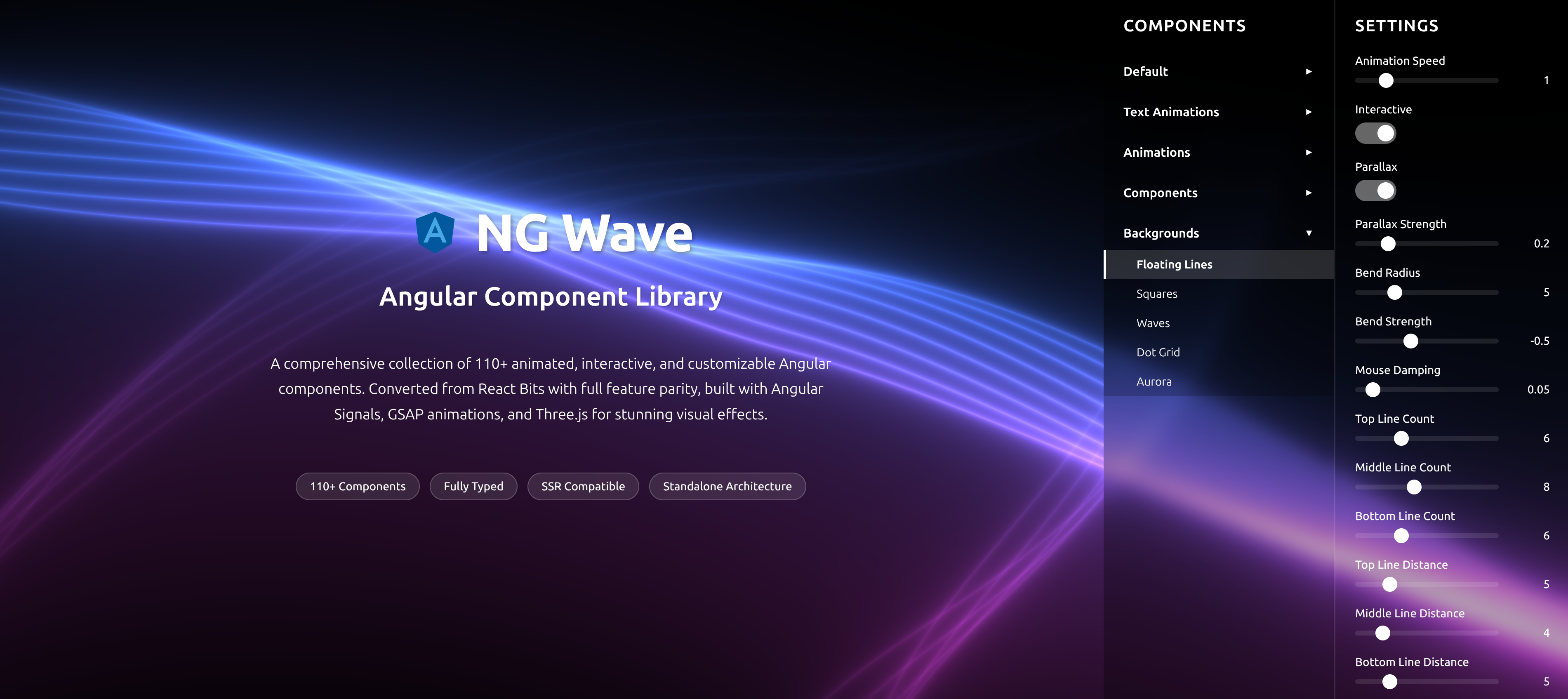
NG Wave
Angular Component Library
A comprehensive collection of 110+ animated, interactive, and customizable Angular components. Converted from React Bits with full feature parity, built with Angular Signals, GSAP animations, and Three.js for stunning visual effects.
Explore Components