SageStepper Architecture (Angular 20+): Adaptive UIs, AI Interview Flows, Community Matching, and Real‑Time Progress (320 communities, +28% lift)
How I engineered SageStepper’s Angular 20+ platform—Signals state, AI‑guided interviews, cohort matching, and live progress telemetry—scaling to 320 communities with a measurable +28% score lift.
Adaptive UIs, typed telemetry, and Signals state let us turn practice into measurable progress—at community scale.Back to all posts
I’ve shipped Angular for a major airline, a global entertainment company, and a leading telecom provider—but SageStepper is personal: an Angular 20+ platform that helps students and professionals practice interviews with adaptive flows and community accountability. This case study breaks down the architecture that scaled SageStepper to 320 communities and delivered a +28% score lift.
If you’re evaluating whether to hire an Angular developer or bring in an Angular consultant, this is exactly how I approach adaptive UIs, AI orchestration, cohort matching, and real-time dashboards—production patterns, not slides.
Inside SageStepper: Angular 20 Architecture for Adaptive Interviews and Community‑Scale Learning
As companies plan 2025 Angular roadmaps, this architecture shows how to combine Signals, PrimeNG, and Firebase to achieve measurable outcomes—not just pass Lighthouse, but move user scores and completion rates.
Challenge
Before Signals, session state lived in a tangle of subjects and service flags. Add AI scoring, timers, and retries, and the UI would jitter under load. Communities wanted shared milestones and progress visibility without exposing private data.
Unpredictable session state across async AI calls and user actions
Fragmented prep tools with poor accountability and drop‑offs
Need for real‑time progress and reliable cohort matching at scale
Intervention
We consolidated state into a SignalStore that derives read‑only selectors for UI and progress, backed by typed events for interview steps, scoring, and milestones. Matching uses skill vectors with throttle windows to prevent churny cohort reshuffles.
Signals + SignalStore for deterministic session state
Typed telemetry over WebSocket/Firestore for live updates
Community matching using skills/difficulty vectors with guardrails
Result
The adaptive UI and real‑time tracking kept users engaged. Cohorts saw steady completion and higher confidence, validated by GA4 funnels and Firebase Analytics custom events.
320 active communities
+28% average score improvement across cohorts
Sustained usage and lower mid‑session drop‑offs
Why Adaptive Angular UIs and Real‑Time Progress Matter in 2025
The result was a system that treats telemetry, state, and UX as first‑class citizens, not afterthoughts.
What leaders asked for
Directors and PMs wanted proof: score deltas, completion rates, and retention by cohort. Engineering needed a safe way to iterate AI prompts and UI density under CI guardrails.
Reliable, measurable learning outcomes
Progress visibility without privacy leaks
Fast iteration without breaking production
Constraints
We optimized for low‑latency updates, offline tolerance for brief hiccups, and graceful degradation when AI endpoints throttled.
Mobile‑first, AA accessible UI
Spiky traffic during cohort sessions
LLM latency and partial failures
Signals + SignalStore for Session State and Progress
Signals make session computation cheap and predictable; SignalStore keeps reads/writes explicit for team review.
Store design
We model the session as a SignalStore with explicit mutators (startQuestion, submitAnswer, advanceStep) and derived signals for timers, blockers, and progress percentage. The store is deterministic and debuggable via Angular DevTools.
Single source of truth for interview session
Derived selectors for UI flags and progress
Effect methods for telemetry and persistence
Code: SessionSignalStore
import { signal, computed, Injectable, effect } from '@angular/core';
import { createSignalStore } from '@ngrx/signals';

export interface Step {
  id: string;
  type: 'mcq'|'code'|'behavioral';
  difficulty: number; // 1-5
  completed: boolean;
  score?: number;
}

interface SessionState {
  steps: Step[];
  currentIndex: number;
  startedAt: number | null;
  aiPending: boolean;
  network: 'online'|'degraded'|'offline';
}

@Injectable({ providedIn: 'root' })
export class SessionStore extends createSignalStore<SessionState>({
  steps: [],
  currentIndex: 0,
  startedAt: null,
  aiPending: false,
  network: 'online'
}) {
  readonly current = computed(() => this.state().steps[this.state().currentIndex]);
  readonly progressPct = computed(() => {
    const s = this.state().steps;
    return s.length ? Math.round((s.filter(x => x.completed).length / s.length) * 100) : 0;
  });
  readonly canAdvance = computed(() => !!this.current()?.completed && !this.state().aiPending);

  start(steps: Step[]) { this.patch({ steps, startedAt: Date.now(), currentIndex: 0 }); }
  markCompleted(score: number) {
    const { steps, currentIndex } = this.state();
    const updated = steps.map((st, i) => i===currentIndex ? { ...st, completed: true, score } : st);
    this.patch({ steps: updated });
  }
  next() { if (this.state().currentIndex < this.state().steps.length-1) {
    this.patch({ currentIndex: this.state().currentIndex + 1 });
  }}
  setNetwork(n: SessionState['network']) { this.patch({ network: n }); }
}
Guardrails
We log progressPct deltas and step transitions, guarded by Cypress tests that assert no regression in completion logic. Firebase Remote Config toggles model versions and UI density.
Effect logging to Firebase Analytics/GA4
Feature flags for AI and density experiments
E2E assertions on progress invariants
Real‑Time Progress: Typed Telemetry with WebSocket and Firestore
The combination of WebSocket + Firestore gives low latency when available and graceful fallback when networks degrade—critical for real-time confidence.
Event schema
We used a union schema so both the front‑end and functions agree on structure, enabling graceful rollout of new fields.
step.started, step.answered, ai.scored, cohort.milestone
Versioned payloads for safe evolution
Code: Typed stream
// typed-events.ts
export type Event =
 | { type: 'step.started'; sessionId: string; stepId: string; at: number }
 | { type: 'step.answered'; sessionId: string; stepId: string; answer: unknown; at: number }
 | { type: 'ai.scored'; sessionId: string; stepId: string; score: number; rubric: string; at: number }
 | { type: 'cohort.milestone'; cohortId: string; milestone: '50%|100%'; at: number };

// telemetry.service.ts (WebSocket)
import { webSocket } from 'rxjs/webSocket';
const socket = webSocket<Event>('wss://telemetry.sagestepper.com');

socket.subscribe(evt => {
  switch (evt.type) {
    case 'ai.scored': this.sessionStore.markCompleted(evt.score); break;
    case 'cohort.milestone': /* toast / banner update */ break;
  }
});

// Firestore fallback for server-sent updates
// firestore.collection('sessions/{id}/events').onSnapshot(...)
No-jitter UI
We optimistically set completed, then reconcile with server echoes using event ids. RxJS retryWhen/backoff prevents thundering herds. Micro‑animations keep focus without stealing time.
Optimistic updates with idempotent server echoes
Exponential retry with jitter for flaky networks
Animation budget < 150ms for progress changes
AI Interview Flow Orchestrator in Angular: Prompting, Scoring, and Safety Rails
AI features are only as good as their guardrails. Typed events, flags, and analytics make the system safe to iterate.
Flow
We ship prompt versions behind flags. Scoring is rubric-based and logged alongside step ids for audit. If AI times out, we surface human‑review paths without losing progress.
Prompt templates versioned via Remote Config
Rubric-based scoring with explainability
Timeouts and human‑fallback paths
Code: Orchestrator snippet
@Injectable({ providedIn: 'root' })
export class AiFlowService {
  constructor(private http: HttpClient, private session: SessionStore) {}

  async scoreAnswer(stepId: string, answer: unknown) {
    this.session.patch({ aiPending: true });
    try {
      const res = await firstValueFrom(this.http.post<{ score:number; rubric:string }>(
        '/api/ai/score', { stepId, answer, promptVersion: RC.promptVersion() }
      ));
      this.session.markCompleted(res.score);
      // emit typed event for telemetry pipeline
      emit({ type: 'ai.scored', sessionId: sid(), stepId, score: res.score, rubric: 'v3', at: Date.now() });
    } finally {
      this.session.patch({ aiPending: false });
    }
  }
}
Observability
We tied score distributions to promptVersion and cohortId to detect regressions quickly and roll back via Remote Config without redeploys.
Firebase Analytics for funnels
GA4 custom dims: promptVersion, cohortId
Feature flags to A/B prompt variants
Community Matching Algorithms that Improve Outcomes
Matching isn’t just a graph problem—it’s a UX problem. Stability matters as much as raw skill similarity.
Signal-driven matching
We use low-frequency recompute windows so people aren’t reshuffled mid‑week. Consistency score weights on‑time check‑ins and completion.
Inputs: skills, difficulty tolerance, timezone, consistency score
Outputs: stable pairs/squads; minimal weekly churn
Code: Vector scoring
interface Profile { id: string; skills: number[]; level: number; tz: number; consistency: number; }

function scorePair(a: Profile, b: Profile) {
  const skillCosine = cosine(a.skills, b.skills);
  const levelGap = Math.abs(a.level - b.level);
  const tzOverlap = 1 - Math.min(12, Math.abs(a.tz - b.tz))/12;
  const stability = (a.consistency + b.consistency)/2;
  return (skillCosine * 0.45) + ((1 - levelGap/3) * 0.25) + (tzOverlap * 0.15) + (stability * 0.15);
}

export function matchCohort(profiles: Profile[]) {
  // greedy pair with backtracking for top N scores; stable unless score delta > threshold
  // pseudo-impl shown; full version keeps audit logs for fairness
}
Outcome
Matching aligned difficulty and cadence, enabling productive practice. We surfaced health signals (attendance, completion) to moderators without leaking private answers.
Lower churn, better meeting rates
+28% average score lift for engaged cohorts
Adaptive UI with PrimeNG, Tokens, and Accessibility AA
The UI feels native on mobile and desktop—no layout jumps during real-time updates.
Components
We extended PrimeNG with tokens for density and color ramps. Keyboard flows mirror native patterns, validated with AXE and manual screen-reader checks.
PrimeNG Stepper, Dialog, Toast, ProgressBar
Custom keyboard nav and focus traps
Template: Progress and actions
<p-steps [model]="steps" [readonly]="true"></p-steps>
<p-progressBar [value]="session.progressPct()"></p-progressBar>
<button pButton label="Next" [disabled]="!session.canAdvance()" (click)="session.next()"></button>
<p-toast position="bottom-right"></p-toast>
Design tokens
We lint tokens for contrast and run Lighthouse/AXE audits in CI. Density toggles are persisted per device for comfort.
Density scale: compact/comfortable
AA contrast budgets in CI
When to Hire an Angular Developer for Adaptive UIs and AI Interview Flows
If you need a remote Angular developer with Fortune 100 patterns and live product proof, let’s talk.
Signals you’re ready
Bringing in an Angular consultant with enterprise telemetry and Signals/SignalStore experience prevents costly rework. I focus on predictable state, typed events, and CI guardrails so you can scale safely.
You need real-time progress without jitter or double-writes
AI scoring/prompt versions must ship behind flags with auditability
Cohort matching needs stability and measurable outcomes
Typical engagement
Zero‑drama releases via Nx Affected, Firebase preview channels, and one‑command rollbacks.
Assessment in 1 week
Stabilize state + telemetry in 2–4 weeks
Cohort matching + AI iteration in 2–4 weeks
Challenge → Intervention → Measurable Results
Outcomes beat aesthetics every time—here we shipped both.
Challenge
Users bounced mid‑session; leaders lacked visibility. AI scoring was helpful but brittle without flags and telemetry.
Fragmented prep, noisy state, cohort churn
Intervention
We re‑platformed session state, added real‑time progress, stabilized matching, and introduced AA‑compliant UI with density controls.
Signals + SignalStore, typed telemetry, PrimeNG adaptive UI, cohort matching
Result
Funnels in GA4 show reduced drop‑offs at step transitions. Moderator tools flagged at‑risk cohorts early, improving completion.
320 active communities
+28% score lift across cohorts
12k+ mock interviews processed
99.98% uptime on releases with Nx/Firebase CI
Key Takeaways and Next Steps
Want a second set of eyes on your Angular roadmap, Signals migration, or real-time dashboards?
Takeaways
These patterns scale beyond interview prep—any real-time, multi-tenant Angular dashboard benefits from the same guardrails.
Treat telemetry as a feature: typed, versioned, observable
Keep session state in a SignalStore with derived selectors
Use flags to iterate AI prompts safely
Match cohorts for stability, not just similarity
Polish UI with tokens and AA, then measure funnels
What to instrument next
We’re expanding cohort health models and deep-diving into step-level friction to keep pushing outcomes.
Per-step dwell time to refine prompts
Retry success after degraded networks
Cohort health predictors with early alerts
FAQs: Hiring and Tech Details
If you’re ready to stabilize state, ship AI safely, and make outcomes measurable, I can help.
How much does it cost to hire an Angular developer for this scope?
Budgets vary by scope. Typical engagements range from a short 2–4 week rescue to 8–12 weeks for full delivery (AI flows, telemetry, matching). I offer fixed-scope options after a one-week assessment to de-risk timelines and cost.
How long does an Angular upgrade or Signals migration take?
For most apps, upgrading to Angular 20 and introducing Signals + SignalStore takes 2–4 weeks with CI guardrails and feature flags, assuming adequate test coverage. Larger monorepos add 1–2 weeks for dependency alignment and rollbacks.
What does an Angular consultant deliver beyond code?
Architecture maps, typed event schemas, CI/CD templates, Lighthouse budgets, accessibility audits, and a rollback plan. You also get dashboards for real-time outcomes and a short playbook the team can maintain without me.
Can you integrate with Firebase, .NET, or Node.js backends?
Yes—SageStepper uses Firebase Hosting/Analytics and functions, but I routinely integrate Angular with Node.js and .NET APIs, feature flags, and WebSocket pipelines.
What proof do you have this works at scale?
SageStepper runs across 320 communities with 12k+ interviews and a +28% score improvement. My other live products—gitPlumbers (99.98% uptime) and IntegrityLens—demonstrate reliability under enterprise constraints.
Key takeaways
- Signals + SignalStore kept interview session state predictable under real-time updates and AI scoring.
- Typed telemetry streams (WebSocket/Firestore) enabled smooth progress tracking without UI jitter.
- Community matching used skill vectors and completion signals to improve pairing and outcomes.
- Adaptive UI with PrimeNG + tokens delivered accessibility AA and measurable engagement.
- The architecture scaled to 320 communities and delivered a +28% score improvement in practice outcomes.
Implementation checklist
- Define typed event schemas for interview telemetry and AI scoring.
- Centralize session state in a SignalStore with derived selectors for progress/UI flags.
- Instrument Firebase Analytics, GA4, and custom events for funnel visibility.
- Use PrimeNG components with design tokens, density controls, and AA color contrast.
- Deploy with Nx CI, Firebase Hosting previews, Lighthouse budgets, and Cypress gates.
- Measure outcomes with cohort reports: score deltas, time-on-task, drop-off, retry success.
Questions we hear from teams
- How much does it cost to hire an Angular developer for this scope?
- Budgets vary. Expect 2–4 weeks for a targeted rescue and 8–12 weeks for a full build (AI flows, telemetry, matching). I can propose fixed‑scope pricing after a one‑week assessment.
- How long does a Signals migration take in Angular 20+?
- Most teams can adopt Signals + SignalStore in 2–4 weeks with feature flags, CI tests, and dashboards. Larger monorepos may add 1–2 weeks for dependency alignment and rollbacks.
- What backend works best for real-time progress tracking?
- I’ve used Firebase (Firestore/Analytics) and WebSockets with Node.js/.NET. Choose based on latency needs, ops maturity, and audit requirements—typed events and retries are non‑negotiable.
- Can you work as a remote Angular contractor?
- Yes. I’m a remote Angular consultant with Fortune 100 experience, available for select projects. Discovery call within 48 hours; assessment delivered within a week.
- What outcomes can we expect from this architecture?
- Expect smoother sessions, fewer drop‑offs, and measurable score gains. SageStepper’s implementation scaled to 320 communities with a +28% score lift and 12k+ interviews processed.
Ready to level up your Angular experience?
Let AngularUX review your Signals roadmap, design system, or SSR deployment plan.
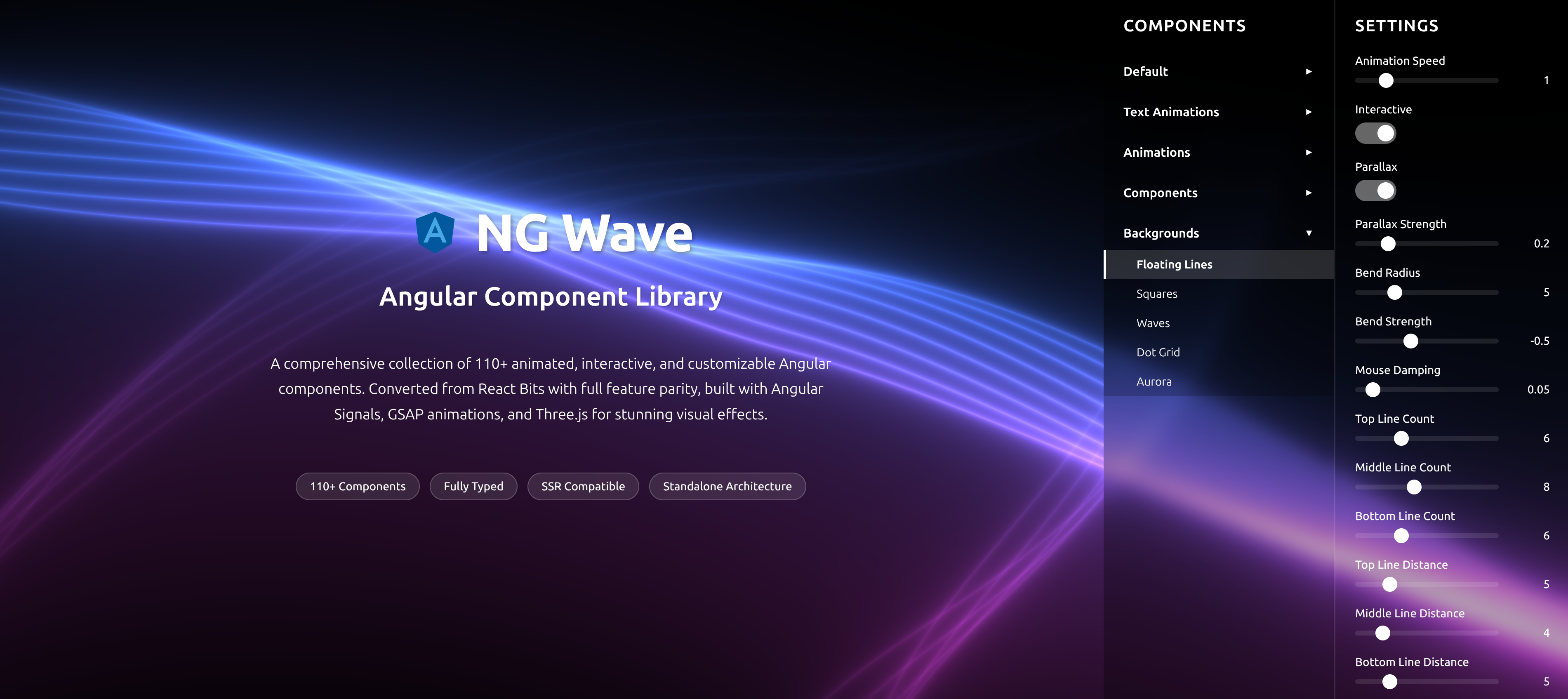
NG Wave
Angular Component Library
A comprehensive collection of 110+ animated, interactive, and customizable Angular components. Converted from React Bits with full feature parity, built with Angular Signals, GSAP animations, and Three.js for stunning visual effects.
Explore Components