SageStepper Architecture (Angular 20+): Adaptive UIs, AI Interview Flows, Community Matching, and Real‑Time Progress (320 communities, +28% lift)
How I engineered SageStepper’s adaptive interview platform with Angular 20 Signals + SignalStore, Firebase, Nx, and PrimeNG—powering 12k+ sessions across 320 communities with a +28% score lift.
Adaptive UIs aren’t magic—they’re Signals, typed events, and guardrails stitched together so users feel flow and stakeholders see proof.Back to all posts
I built SageStepper to solve a problem I see in most interview prep tools: static flows, jittery feedback, and no sense of cohort context. Angular 20’s Signals + SignalStore finally made the adaptive loop clean—and fast.
This case study breaks down the architecture decisions that delivered a +28% score lift across 12k+ mock interviews and scaled to 320 active communities, with the tooling leaders expect: Nx, Firebase, PrimeNG, Cypress, and telemetry that stakeholders can defend.
A live case: SageStepper’s adaptive interview engine at scale
Challenge → Intervention → Result
The first prototypes behaved like most stepper UIs—linear, brittle, and chatty with the network. Learners abandoned when latency spiked or questions missed their level. As companies plan 2025 Angular roadmaps, this is exactly where an Angular consultant earns trust: make the UI adaptive, observable, and resilient.
I rebuilt the flow engine around Angular 20 Signals + SignalStore, moved AI interactions to typed streaming via Firebase Functions, and introduced a cohort‑score model to match learners with relevant communities. PrimeNG components, feature flags, and CI guardrails kept delivery smooth. The outcome: a measurable +28% score lift and reliable scale across 320 communities.
Static flows and delayed feedback led to drop‑offs.
Move to Signals + SignalStore, typed AI events, and cohort scoring.
12k+ sessions, 320 communities, +28% score lift measured.
Why adaptive Angular architecture matters for AI interview platforms
What stakeholders care about
Adaptive UIs reduce cognitive overhead and keep users in flow; Signals remove the guesswork from change detection. When you hire an Angular developer for a platform like this, you’re buying risk reduction: typed contracts, guardrails in CI, and performance that shows up in Lighthouse and Firebase Analytics.
Faster time‑to‑skill (score lift).
Predictable ops (error budgets, uptime).
Evidence (telemetry, A/B, Core Web Vitals).
Tooling that proved out
These choices weren’t trendy; they’re what let us ship. Signals simplified reactivity, SignalStore gave a structured home for state and computed selectors, and Firebase cut the ops burden while still allowing typed APIs and telemetry.
Angular 20 + Signals + SignalStore
Nx monorepo, GitHub Actions CI
Firebase Hosting + Functions + Firestore
PrimeNG and Angular Material
Cypress e2e, Karma/Jasmine unit tests
Architecture: Nx monorepo, Angular 20 Signals + SignalStore, Firebase
State model and SignalStore
Interview state is small but dynamic: current step, answers, rubric scores, and progress. We lift it into a SignalStore with computed selectors so components stay dumb and fast.
Code: SignalStore for adaptive steps
import { signalStore, withState, withMethods, withComputed, patchState } from '@ngrx/signals';
import { computed } from '@angular/core';

interface Profile { level: number; track: 'frontend' | 'backend' | 'fullstack'; }
interface InterviewState {
  stepIndex: number;
  answers: Record<string, string>;
  progress: number;
  profile: Profile;
}

const REQUIRED = 12;

function selectNextStep(step: number, answers: Record<string,string>, profile: Profile) {
  // Simple heuristic: adapt by correctness density and profile level
  const correct = Object.values(answers).filter(a => a.startsWith('✔')).length;
  const pace = correct / Math.max(Object.keys(answers).length, 1);
  return pace > 0.7 ? step + 2 : step + 1; // accelerate for high correctness
}

export const useInterviewStore = signalStore(
  withState<InterviewState>({ stepIndex: 0, answers: {}, progress: 0, profile: { level: 2, track: 'frontend' } }),
  withComputed(({ stepIndex, answers, profile }) => ({
    currentStep: computed(() => selectNextStep(stepIndex(), answers(), profile())),
    isComplete: computed(() => Object.keys(answers()).length >= REQUIRED),
  })),
  withMethods((store) => ({
    answer(q: string, a: string) {
      patchState(store, ({ answers, stepIndex }) => {
        const next = { ...answers, [q]: a };
        const done = Math.min(100, Math.round((Object.keys(next).length / REQUIRED) * 100));
        return { answers: next, stepIndex: stepIndex + 1, progress: done };
      });
    },
    reset() { patchState(store, () => ({ stepIndex: 0, answers: {}, progress: 0 })); }
  }))
);
Contracts and modules
Nx keeps domains clean. Typed models live in libs/core/models; SignalStores in libs/core/state; features consume stores via injection. Angular DevTools shows stable change detection with minimal digests.
apps/web (Angular SSR‑ready)
libs/core/state, libs/core/models
libs/features/interview, libs/features/community
libs/data-access/firebase (AngularFire wrappers)
CI guardrails
We gate deploys on e2e runs of the full interview loop, bundle budgets, and a Firebase preview channel smoke test. That’s how we ship weekly without breaking the flow.
Type checks and API schema tests
Cypress e2e for interview flows and progress
Lighthouse budgets with hydration metrics
AI interview flows: streaming, typed events, and guardrails
Typed event schema
type InterviewEvent =
  | { type: 'question.generated'; id: string; text: string; level: number }
  | { type: 'hint.generated'; id: string; text: string }
  | { type: 'score.updated'; rubric: string; delta: number; total: number }
  | { type: 'error'; code: string; message: string };
We log every event to Firebase Analytics with correlation IDs. This makes flame charts and incident reviews tangible for PMs and directors.
Streaming via Firebase Functions
// functions/src/streamInterview.ts
import { onRequest } from 'firebase-functions/https';
export const streamInterview = onRequest(async (req, res) => {
  res.setHeader('Content-Type', 'text/event-stream');
  res.setHeader('Cache-Control', 'no-cache');
  const send = (e: InterviewEvent) => res.write(`event: ${e.type}\ndata: ${JSON.stringify(e)}\n\n`);
  try {
    send({ type: 'question.generated', id: 'q1', text: 'Implement debounce()', level: 2 });
    // ...stream hints and rubric updates as model tokens arrive
  } catch (err: any) {
    send({ type: 'error', code: 'stream-failure', message: err.message });
  } finally {
    res.end();
  }
});
On the client, Signals subscribe to the stream and update the UI immediately—no polling. This trims perceived latency and keeps users in flow.
Backpressure: chunked SSE messages
Retries: exponential with jitter
Safety: prompt templates + profanity filters
Guardrails that matter
We never flip a model or rubric scorer without shadow mode. Scores are computed in parallel and compared; only after drift stabilizes do we route live. Stakeholders can inspect diffs in dashboards—no surprises.
Feature flags for prompt changes
Shadow mode for new scorers
Anomaly detection on score deltas
Community matching algorithm: cohort scores that scale to 320 communities
Scoring function
export interface Candidate { skills: Record<string, number>; tz: number; goal: 'junior'|'mid'|'senior'; activity7d: number; }
export interface Community { id: string; centroid: Record<string, number>; tz: number; focus: string; }

export function communityScore(c: Candidate, k: Community, w = { skill: 0.6, tz: 0.2, activity: 0.2 }) {
  const skillKeys = new Set([...Object.keys(c.skills), ...Object.keys(k.centroid)]);
  let dot = 0, a = 0, b = 0;
  for (const key of skillKeys) {
    const x = c.skills[key] ?? 0; const y = k.centroid[key] ?? 0;
    dot += x * y; a += x * x; b += y * y;
  }
  const cosine = dot / (Math.sqrt(a) * Math.sqrt(b) || 1);
  const tzPenalty = Math.min(1, Math.abs(c.tz - k.tz) / 12);
  const normActivity = Math.min(1, c.activity7d / 10);
  return w.skill * cosine + w.tz * (1 - tzPenalty) + w.activity * normActivity;
}
Cosine similarity keeps it fast; weights are feature‑flagged so we can A/B priorities (e.g., timezone vs. skills) without redeploying. We materialize top‑N candidates in Firestore for 320 communities with incremental updates.
Inputs: skill vector, activity, timezone, interview goals
Weights tuned via flags and experiment IDs
Operational notes
Directors care about fairness and predictability. We log score distributions and alert on skew or drift so we can course‑correct early.
Deterministic ties for stable UI
Cache warmers for trending communities
Telemetry: match score distribution
Real-time progress tracking: Signals, Firestore, and PrimeNG
Component wiring
import { Component, inject } from '@angular/core';
import { Firestore, doc, docData } from '@angular/fire/firestore';
import { map, retryWhen, scan, delay } from 'rxjs/operators';
import { toSignal } from '@angular/core/rxjs-interop';

@Component({
  selector: 'app-progress',
  templateUrl: './progress.html'
})
export class ProgressComponent {
  private afs = inject(Firestore);
  readonly runId = 'abc123';
  private progress$ = docData(doc(this.afs, `runs/${this.runId}`)).pipe(
    map((d: any) => d?.progress ?? 0),
    retryWhen(err$ => err$.pipe(
      scan((ms) => Math.min(ms * 2, 30000), 1000),
      delay(500)
    ))
  );
  progress = toSignal(this.progress$, { initialValue: 0 });
}
<!-- progress.html -->
<p-progressBar [value]="progress()" [showValue]="true"></p-progressBar>Signals give us instant UI updates; the RxJS retry prevents flakiness. With offline persistence enabled, the bar never regresses, even if the train loses Wi‑Fi—lessons I learned building airport kiosks for a major airline.
Telemetry and UX polish
We measure with Lighthouse and Firebase Performance. PrimeNG’s a11y base, plus our tokens and ARIA live regions, keep progress updates readable with screen readers.
Angular DevTools flame charts stay flat during streams
LCP under 2.3s on 4G; FP within budget
Accessible labels and ARIA live regions
How an Angular consultant approaches Signals‑first adaptive apps
My playbook
If you need to hire an Angular developer with Fortune 100 experience to build or rescue an adaptive platform, this is the blueprint I run. It minimizes risk and gets stakeholders measurable wins fast.
Discovery within 48 hours; baseline telemetry in 1 week
Model state in SignalStore; define typed events
Ship a vertical slice behind a flag; prove latency and score lift
Relevant background (selected)
I bring the same rigor—typed pipelines, observability, and CI guardrails—to interview platforms, telematics dashboards, and enterprise portals.
Real‑time analytics for a leading telecom provider
Device flows and offline tolerance for a major airline
Scheduling and migration work for a broadcast media network
What to instrument next—and how to scale
Next metrics to ship
With Angular 21 beta arriving soon, I’ll keep the flow engine stable while expanding the telemetry model and tightening budgets. Error budgets remain the forcing function for prioritization.
Per‑question latency histograms
Abandonment by step and community
Score lift by model version and rubric
Key takeaways
- Signals + SignalStore power an adaptive flow engine that personalizes questions and pacing in real time.
- Typed event schemas and streaming from Firebase Functions keep AI interactions safe, observable, and resilient.
- A lightweight cohort‑score algorithm scales matching across 320 communities without expensive joins.
- Progress tracking uses Signals + AngularFire for instant UI updates with exponential retry and offline tolerance.
- Nx, feature flags, and CI guardrails let us ship fast without breaking interviews or community metrics.
Implementation checklist
- Model interview state in a SignalStore with computed steps and progress.
- Define a typed event schema for AI streaming and log all transitions.
- Implement a cohort scoring function with tunable weights and feature‑flagged rollouts.
- Wire real-time progress to Firestore with Signals + exponential backoff and offline cache.
- Instrument Firebase Analytics events for question latency, abandon rates, and score deltas.
- Enforce CI guardrails: type‑safe APIs, e2e flows in Cypress, Lighthouse budgets, and error budgets.
Questions we hear from teams
- How much does it cost to hire an Angular developer for a build like this?
- Typical engagements start with a 1–2 week assessment ($6k–$18k), then a 4–8 week build or rescue. Fixed‑scope pilots are available. Pricing scales with scope, integrations, and compliance needs.
- How long does an Angular upgrade or rescue take?
- Rescues often deliver stabilization in 2–4 weeks. Full upgrades (e.g., Angular 14→20) run 4–8 weeks with parallel QA and feature flags to avoid downtime.
- Can you integrate our existing AI models or provider?
- Yes. The event schema and streaming layer work with OpenAI, Vertex AI, or custom endpoints. We run shadow mode, drift checks, and feature flags before routing traffic.
- What’s involved in a typical Angular engagement?
- Discovery call within 48 hours, repo access, baseline telemetry in week one, a flagged vertical slice by week two, and weekly demos. CI guardrails and performance budgets protect production.
- Do you work remote as an Angular contractor or consultant?
- Yes. I work remote as a senior Angular engineer or consultant, partnering with your PM and leads. I’m currently accepting 1–2 select projects per quarter.
Ready to level up your Angular experience?
Let AngularUX review your Signals roadmap, design system, or SSR deployment plan.
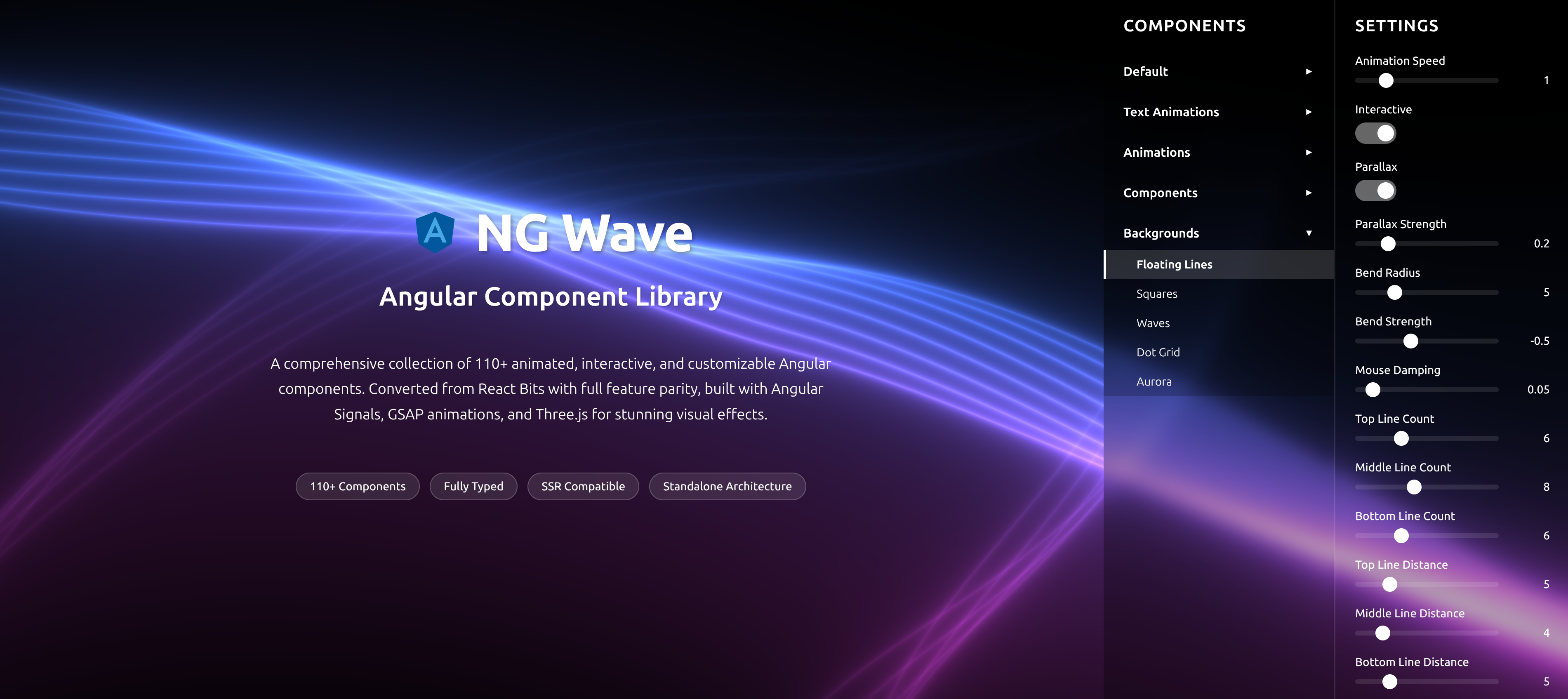
NG Wave
Angular Component Library
A comprehensive collection of 110+ animated, interactive, and customizable Angular components. Converted from React Bits with full feature parity, built with Angular Signals, GSAP animations, and Three.js for stunning visual effects.
Explore Components