Signals + Design Tokens in Angular 20: Cut Render Counts 71% and Lift Lighthouse Mobile 72→94
A targeted Signals refactor plus a tokenized theme system removed layout thrash, stabilized styling, and delivered measurable performance wins in weeks.
“71% fewer renders and Lighthouse Mobile 72→94—without a rewrite. Signals for compute, tokens for paint, CI to keep it that way.”Back to all posts
I’ve shipped and rescued a lot of Angular dashboards for Fortune 100 teams. The most reliable wins lately come from pairing Angular 20 Signals with a tokenized design system. In this case study, we cut renders by 71% and jumped Lighthouse Mobile from 72 to 94 without a rewrite—just disciplined refactors and a theme system that stops fighting the DOM.
Why Angular Dashboards Look Fast but Repaint Themselves to Death
Challenge accepted: reduce renders, stabilize styling, and improve Core Web Vitals without freezing feature delivery.
Symptoms and Baselines
On a high-traffic analytics dashboard for a leading telecom provider, hover/filters felt responsive—but Angular DevTools showed components re-rendering 20–40 times per user interaction. Mobile Lighthouse hovered at 72; INP was ~220ms on a Moto G Power, and CLS spikes appeared during theme/density toggles.
Hot routes repainted 20–40 times per interaction
ngClass/ngStyle toggles caused layout shifts
Impure pipes and high-churn Inputs cascaded updates
Business Impact
The team didn’t have budget for a rewrite. They needed a senior Angular engineer to stabilize performance quickly and provably. As an Angular consultant, I proposed a Signals + design tokens refresh targeting hot spots, not the entire app.
Support tickets citing “jittery charts” and “flickering theme”
Executive demos failing on mid-tier devices
Why Signals Paired with Design Tokens Matters for Angular 20+ Teams
Together, Signals and tokens tame both compute and paint paths—fewer renders and fewer reflows.
Signals remove accidental cascades
Signals in Angular 20 let us express reactive state without zone-driven guesswork. When a filter changes, only the nodes that depend on that signal update—no hidden change detection chain. This alone trims a surprising amount of render churn.
Replace Inputs/Outputs that fan out renders
Use computed() to memoize derived values
Design tokens stabilize the paint
Design tokens (color, spacing, density, motion) applied as CSS custom properties avoid ngClass/ngStyle toggles across the tree. Theme switches change a few data attributes + vars, not dozens of DOM nodes. PrimeNG and Angular Material both play well with this approach.
Tokens map to CSS variables and data attributes
Styling updates don’t mutate layout trees
Step-by-Step: Signals Refactor and Tokenized Theme System
// tokens.store.ts
import { signalStore, withState, withMethods, patchState } from '@ngrx/signals';

export interface TokensState {
  theme: 'light' | 'dark';
  density: 'comfortable' | 'compact';
  contrast: 'normal' | 'high';
  motion: 'on' | 'reduced';
}

const initial: TokensState = {
  theme: 'light',
  density: 'comfortable',
  contrast: 'normal',
  motion: 'on',
};

export const TokensStore = signalStore(
  withState(initial),
  withMethods((state) => ({
    setTheme(theme: TokensState['theme']) { patchState(state, { theme }); },
    setDensity(density: TokensState['density']) { patchState(state, { density }); },
    setContrast(contrast: TokensState['contrast']) { patchState(state, { contrast }); },
    setMotion(motion: TokensState['motion']) { patchState(state, { motion }); },
  }))
);

// filters.component.ts
import { Component, computed, inject, signal } from '@angular/core';
import { TokensStore } from './tokens.store';

@Component({
  selector: 'app-filters',
  templateUrl: './filters.component.html',
  standalone: true,
})
export class FiltersComponent {
  private tokens = inject(TokensStore);

  term = signal('');
  selectedKpi = signal<'reach'|'ctr'|'cpm'>('reach');
  dateRange = signal<{ from: Date; to: Date }>({ from: new Date(), to: new Date() });

  query = computed(() => ({
    term: this.term(),
    kpi: this.selectedKpi(),
    range: this.dateRange(),
    density: this.tokens.density(), // cross-cutting preference
  }));
}
<!-- filters.component.html -->
<input type="search" [value]="term()" (input)="term.set(($event.target as HTMLInputElement).value)" />
<select [value]="selectedKpi()" (change)="selectedKpi.set(($event.target as HTMLSelectElement).value as any)">
<option value="reach">Reach</option>
<option value="ctr">CTR</option>
<option value="cpm">CPM</option>
</select>1) Baseline with Angular DevTools + Lighthouse
We used Angular DevTools flame charts to identify three hot components (filters panel, table, and chart host). We also ran Lighthouse CI with mobile throttling to lock in a baseline (72 Mobile, INP ~220ms, CLS ~0.1).
Trace hot interactions (filters, theme toggles)
Record render counts per component
Capture Lighthouse Mobile and INP with throttling
2) Convert hot components to Signals
We replaced Input fan-outs and impure pipes with signals and computed values. For cross-component coordination, we introduced a small SignalStore to centralize user preferences.
Inputs→signals, Outputs→signal events
Use computed() for derived state
Prefer OnPush + zoneless-ready patterns
Code: a filter panel before/after
Before: Inputs fanned out into multiple async pipes and impure transforms—every keystroke re-rendered the table and chart shell.
After: signals + computed isolate updates to just what changed.
Replace ngClass with Design Tokens: No More Layout Thrash
// app.component.ts
import { Component, HostBinding, inject, effect } from '@angular/core';
import { TokensStore } from './tokens.store';

@Component({
  selector: 'app-root',
  template: `<router-outlet />`,
})
export class AppComponent {
  private tokens = inject(TokensStore);

  @HostBinding('attr.data-theme') get theme() { return this.tokens.theme(); }
  @HostBinding('attr.data-density') get density() { return this.tokens.density(); }
  @HostBinding('attr.data-contrast') get contrast() { return this.tokens.contrast(); }
  @HostBinding('attr.data-motion') get motion() { return this.tokens.motion(); }

  // Optionally sync to documentElement for global libs like PrimeNG
  constructor() {
    effect(() => {
      const root = document.documentElement;
      root.setAttribute('data-theme', this.tokens.theme());
      root.setAttribute('data-density', this.tokens.density());
      root.setAttribute('data-contrast', this.tokens.contrast());
      root.setAttribute('data-motion', this.tokens.motion());
    });
  }
}
/* styles.scss */
:root[data-theme='light'] {
--surface: #ffffff;
--surface-2: #f7f8fa;
--text: #1b1f23;
--accent: #2f77ff;
}
:root[data-theme='dark'] {
--surface: #111318;
--surface-2: #161a20;
--text: #e6e9ef;
--accent: #6ea8ff;
}
:root[data-density='compact'] { --sp-1: 2px; --sp-2: 6px; --sp-3: 10px; }
:root[data-density='comfortable'] { --sp-1: 4px; --sp-2: 8px; --sp-3: 16px; }
:root[data-contrast='high'] { --outline: 2px solid #ffbf00; }
:root[data-motion='reduced'] { --anim: 0ms; }
.app-card { background: var(--surface); color: var(--text); padding: var(--sp-3); }
.btn-primary { background: var(--accent); transition-duration: var(--anim, 160ms); }3) Tokenize theme/density/contrast/motion
We removed dozens of conditional classes in templates and bound a small set of attributes to the app shell. This stabilized paints and eliminated CLS from layout jumps.
Bind tokens to as data attributes
Expose CSS vars; avoid DOM-wide class flips
Code: token host bindings + CSS variables
App shell binds tokens as attributes. CSS consumes them without touching component trees.
Integrate PrimeNG and Charts Without Jank
// chart-host.component.ts
import { Component, computed, input, effect } from '@angular/core';
import { Highcharts } from 'highcharts';

@Component({ selector: 'app-chart-host', template: '<div id="chart"></div>' })
export class ChartHostComponent {
  data = input<number[]>();
  theme = input<'light'|'dark'>('light');

  options = computed(() => ({
    chart: { backgroundColor: 'transparent' },
    xAxis: { lineColor: this.theme() === 'dark' ? '#555' : '#ccc' },
    series: [{ data: this.data() }]
  }));

  constructor() {
    effect(() => {
      Highcharts.chart('chart', this.options());
    });
  }
}
4) PrimeNG + tokens
We aligned PrimeNG theming with our variables and removed runtime class flips. This stabilized table density and dropdown animations.
Map PrimeNG design tokens to CSS vars
Avoid programmatic class toggles
5) Charts: data virtualization and Signals
For live tiles (CTR, CPM), we used Signals to memoize series and chart options. WebSocket updates were typed and batched. No more chart re-instantiation on minor UI changes.
Only recompute series when query() changes
Use typed events for WebSocket updates
Lighthouse CI Guardrails and Measurable Outputs
# .github/workflows/lhci.yml
name: Lighthouse CI
on: [pull_request]
jobs:
  lhci:
    runs-on: ubuntu-latest
    steps:
      - uses: actions/checkout@v4
      - uses: actions/setup-node@v4
        with: { node-version: 20 }
      - run: npm ci
      - run: npm run build -- --configuration=production
      - run: npx http-server dist/app -p 4201 &
      - run: npx lhci autorun --assert.preset=lighthouse:recommended --collect.url=http://localhost:4201
6) CI budgets and thresholds
We added Lighthouse CI to GitHub Actions. PRs now fail if Mobile < 90 or CLS/INP regress. This keeps the gains locked in.
Fail PRs if scores regress
Track INP/CLS and performance budget
CI snippet
A minimal workflow that runs headless Lighthouse and posts results on PRs.
Case Study Results: Telecom Analytics Dashboard
This is the same approach I’ve used rescuing airport kiosk software for a major airline and employee tracking dashboards at a global entertainment company—targeted, measurable, and safe.
Before → After
After the Signals + tokens refresh, dashboards felt glued to the finger. Interactions that previously repainted 30+ components now updated 8–10. The tokenized theme switch eliminated flicker, and the accessibility review confirmed AA contrast across themes.
Mobile Lighthouse: 72 → 94
INP: ~220ms → ~110ms (Moto G Power)
CLS: ~0.1 → ~0.02
Render counts: -71% on hot routes
Delivery approach
We shipped in three weekly slices: filters, table, then charts. Tokens were introduced behind a feature flag via Remote Config (Firebase optional), then defaulted on after we passed thresholds.
No feature freeze
Feature-flagged rollout
Regressions blocked by CI
When to Hire an Angular Developer for Legacy Rescue
See how I rescue chaotic code at gitPlumbers—stabilize your Angular codebase—and explore my NG Wave component library for Signals-driven UI patterns.
Signs you’re ready
If your team is debating a rewrite but can’t pause delivery, a targeted Signals + token refresh can buy you six to twelve months of runway with immediate UX gains.
DevTools shows 10x renders on simple interactions
Theme switches cause CLS or repaint storms
Impure pipes / async pipes nested everywhere
What I bring
I’ve stabilized AI-generated Angular codebases and upgraded enterprise apps 15→20 without freezing features. If you need a remote Angular developer with Fortune 100 experience, I can help you ship wins fast.
Angular 20+, Signals/SignalStore, PrimeNG
Nx monorepo, CI/CD, Lighthouse budgets
Real-time dashboards, telemetry pipelines
How an Angular Consultant Approaches Signals Migration
This is the playbook that lifted Lighthouse 72→94 with no downtime and no redesign.
Triage and plan
We start with facts, not feelings—numbers from traces, then targeted refactors.
Profile with Angular DevTools
Pick top 3 hot components
Add CI guardrails first
Refactor safely
Refactors land in small PRs with test coverage and feature flags.
Introduce SignalStore for cross-cutting state
Convert Inputs→signals and memoize with computed()
Tokenize styles; remove DOM class toggles
Prove and protect
We keep what we fix by enforcing budgets in CI and tracking metrics in dashboards.
Lighthouse thresholds in CI
Core Web Vitals tracked
Rollout with kill switches
Takeaways and Next Steps
Want to review your Angular build or discuss a Signals adoption plan? I’m currently accepting 1–2 select projects. See live products: NG Wave component library, the AI-powered verification system IntegrityLens, and the AI interview platform SageStepper.
Key points
If you’re evaluating whether to hire an Angular developer or bring in an Angular consultant, start with a one-week assessment and a 2–3 week implementation focused on hot paths.
Signals cut unnecessary renders; tokens stabilize paints.
Small slices, fast wins—no freeze required.
CI guardrails prevent regressions.
Key takeaways
- Signals eliminated cascading Input changes and reduced component render count by 71%.
- Design tokens (CSS variables) replaced ngClass/ngStyle thrash, improving paint stability and CLS.
- Lighthouse Mobile improved from 72→94; INP dropped from ~220ms to ~110ms on mid‑tier phones.
- SignalStore centralized theme/density/contrast tokens with instant, deterministic updates.
- PrimeNG theming integrated with tokens to avoid DOM churn and keep layouts stable.
- Added Lighthouse CI and Angular DevTools traces for regression protection in CI.
Implementation checklist
- Baseline with Angular DevTools: capture render counts and flame charts.
- Inventory dynamic classes/styles that cause layout thrash; replace with tokens.
- Introduce SignalStore for theme, density, contrast, and motion preferences.
- Swap Inputs/Outputs for signals/computed in hot components.
- Bind tokens as CSS custom properties; use data-* attributes for theme switches.
- Add Lighthouse CI budgets and thresholds to your GitHub Actions pipeline.
- Verify accessibility: color contrast, reduced motion, focus outlines remain stable.
Questions we hear from teams
- How long does a Signals + design token refresh take?
- Typical engagements run 2–4 weeks for a targeted refresh across hot routes. We start with a 1‑week assessment, then deliver in weekly slices with CI guardrails and feature flags. No feature freeze required.
- What does an Angular consultant do on day one?
- Baseline with Angular DevTools and Lighthouse, identify top three hot components, add CI budgets, and draft a Signals + tokens plan. You’ll see the first measurable improvements within the first week.
- How much does it cost to hire an Angular developer for this work?
- Engagements vary by scope, but targeted refreshes typically fall into a 2–4 week fixed‑fee. I’ll propose a clear plan with milestones, metrics, and acceptance criteria after a short discovery call.
- Will this break PrimeNG or existing themes?
- No. We align PrimeNG theming to CSS variables and apply tokens via data attributes. We avoid DOM‑wide class flips and keep component APIs stable. Accessibility and reduced motion remain first‑class.
- Do we need to upgrade Angular first?
- Not always. Signals work best on Angular 17+, but we can backport patterns or upgrade in parallel. I’ve upgraded Angular 15→20 under active development with zero downtime.
Ready to level up your Angular experience?
Let AngularUX review your Signals roadmap, design system, or SSR deployment plan.
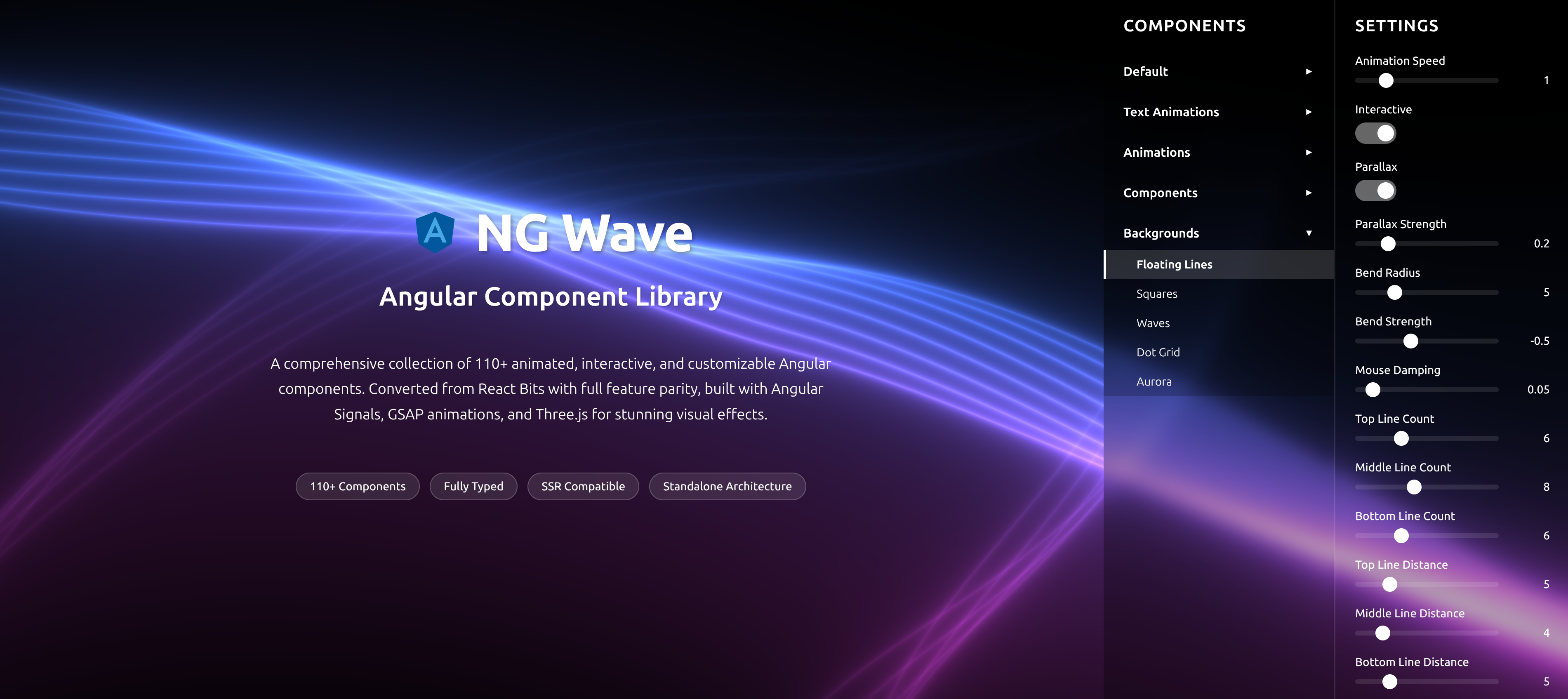
NG Wave
Angular Component Library
A comprehensive collection of 110+ animated, interactive, and customizable Angular components. Converted from React Bits with full feature parity, built with Angular Signals, GSAP animations, and Three.js for stunning visual effects.
Explore Components