Signals-Driven Accessibility, Animations, and Complex Forms in Angular 20+: Focus, Motion, and Error UX That React Instantly
How I use Angular 20+ Signals and SignalStore to ship accessible UI, smooth animations, and complex, high‑confidence forms—without jank or regressions.
Deterministic state is the difference between ‘works on my machine’ and ‘works for every user.’ Signals make accessibility, motion, and forms predictable.Back to all posts
I’ve shipped Angular dashboards for airlines, telecom analytics, insurance telematics, and student platforms. The biggest UX wins lately haven’t come from a new component kit—they’ve come from Angular 20+ Signals. Deterministic state makes accessibility, animation, and complex forms feel instant and predictable.
This is the playbook I use across Nx monorepos with PrimeNG/Material, Firebase for analytics/feature flags, and SignalStore for UI state. If you’re looking to hire an Angular developer or Angular consultant, this is the level of rigor I’ll bring to your app.
The Jitter Problem—and Why Signals Fix It
A real scene from the front lines
On a telecom analytics dashboard, hover states and validation toasts were fighting change detection. The result: input jitter and an INP spike over 200 ms on mid‑range laptops. Signals gave us dependency‑tracked updates and let us gate animations per user preference, dropping INP below 80 ms without feature cuts.
What Signals change for teams
In Angular 20+, Signals let you model UX as data: focus targets, reduced‑motion flags, and validation summaries. That turns a11y, animations, and forms into deterministic systems you can test and monitor.
Predictable reads/writes replace zone.js guesswork.
Computed state expresses cross-field logic without subscriptions.
Effects consolidate DOM concerns like focus and live-region updates.
Why Angular 20 Signals Matter for A11y, Animations, and Forms
Accessibility impact
With Signals, focus and aria‑live announcements are driven by explicit state, not cascading event timing. You can prove in tests that a specific interaction produces a single, correct announcement.
Focus is a pure function of intent + state.
Announcements happen once, at the right time.
User prefs flow everywhere via a single store.
Animation impact
Signals make parameterized animations trivial and safe: when state changes, animation triggers receive stable values. Pair that with prefers‑reduced‑motion and you get performance and empathy.
Triggers read signals to set params and enable/disable.
No jitter from out‑of‑band subscriptions.
Frame‑safe effects for animation scheduling.
Forms impact
Complex cross‑field rules become computed signals. Async steps (e.g., server checks) are adapted into signals so both SSR and tests remain deterministic.
Derived validation graphs without subscription soup.
Async validators orchestrated with typed adapters.
Error UX updated instantly, instrumented for analytics.
Model User Preferences with SignalStore for A11y
UI preferences store
Centralize reduced motion, contrast mode, and input method. The store watches matchMedia and persists user overrides.
Code: SignalStore for motion and contrast
import { Injectable, effect, signal, computed, untracked } from '@angular/core';
import { toSignal } from '@angular/core/rxjs-interop';

@Injectable({ providedIn: 'root' })
export class UiPrefsStore {
  private readonly mqlMotion = window.matchMedia('(prefers-reduced-motion: reduce)');
  private readonly mqlContrast = window.matchMedia('(prefers-contrast: more)');

  private reducedMotionMedia = signal(this.mqlMotion.matches);
  private highContrastMedia = signal(this.mqlContrast.matches);

  private reducedMotionOverride = signal<boolean | null>(null);
  private highContrastOverride = signal<boolean | null>(null);

  readonly reducedMotion = computed(() =>
    this.reducedMotionOverride() ?? this.reducedMotionMedia()
  );

  readonly highContrast = computed(() =>
    this.highContrastOverride() ?? this.highContrastMedia()
  );

  constructor() {
    const motionHandler = () => this.reducedMotionMedia.set(this.mqlMotion.matches);
    const contrastHandler = () => this.highContrastMedia.set(this.mqlContrast.matches);
    this.mqlMotion.addEventListener('change', motionHandler);
    this.mqlContrast.addEventListener('change', contrastHandler);

    effect(() => {
      // Persist as needed (e.g., localStorage or Firebase Remote Config)
      const prefs = { rm: this.reducedMotion(), hc: this.highContrast() };
      untracked(() => localStorage.setItem('ui:prefs', JSON.stringify(prefs)));
    });
  }

  setReducedMotion(v: boolean | null) { this.reducedMotionOverride.set(v); }
  setHighContrast(v: boolean | null) { this.highContrastOverride.set(v); }
}
Why it helps
On an airline kiosk project, we used a similar store to drive device state and motion prefs. Offline‑tolerant flows respected reduced motion automatically across steppers, toasts, and printer alerts.
One source of truth feeds components, animations, and forms.
Easy to test: stub store values in component tests.
Instrument changes with Firebase Analytics or GA4.
Accessible Focus Management and Live Regions with Signals
Focus queue pattern
Use a signal to represent the next focus target. An effect runs on animationFrame to apply focus, then clears the target so it won’t loop.
Avoid focusing before the element exists.
Coalesce multiple requests into one focus action.
Log focus moves for telemetry.
Code: Focus service and live announcements
import { Injectable, signal, effect, untracked } from '@angular/core';

@Injectable({ providedIn: 'root' })
export class A11yUxService {
  private nextFocusId = signal<string | null>(null);
  private announcement = signal<string>('');

  constructor() {
    effect(() => {
      const id = this.nextFocusId();
      if (!id) return;
      requestAnimationFrame(() => {
        const el = document.getElementById(id);
        el?.focus({ preventScroll: true });
        untracked(() => this.nextFocusId.set(null));
      });
    });
  }

  moveFocus(id: string) { this.nextFocusId.set(id); }
  announce(msg: string) { this.announcement.set(msg); }
  liveText() { return this.announcement; }
}
<!-- One live region for the whole app -->
<div aria-live="polite" class="sr-only" [textContent]="a11y.liveText()()"></div>.sr-only { position: absolute; width: 1px; height: 1px; overflow: hidden; clip: rect(0 0 0 0); white-space: nowrap; }Usage notes
With Signals, both focus and live-region text are single-writer concerns. In Angular DevTools you’ll see one effect firing per event—no duplicated announcements.
Call a11y.announce() on validation changes or route transitions.
Prefer focusing headings or landmarks after major updates.
Record focus moves and announcements to DevTools timeline in debug builds.
Animations that Respect User Preferences and Avoid Jank
Parameterized triggers powered by Signals
Bind animation params and enable/disable state to computed signals. When reducedMotion is true, skip transitions entirely.
Code: Trigger with motion gating
import { trigger, transition, style, animate } from '@angular/animations';

export const fadeScale = trigger('fadeScale', [
  transition(':enter', [
    style({ opacity: 0, transform: 'scale({{s}})' }),
    animate('{{d}} ease-out', style({ opacity: 1, transform: 'scale(1)' }))
  ]),
  transition(':leave', [
    animate('{{d}} ease-in', style({ opacity: 0, transform: 'scale({{s}})' }))
  ])
]);<div [@fadeScale]="{ value: '', params: { s: ui.reducedMotion() ? 1 : 0.98, d: ui.reducedMotion() ? '1ms' : '160ms' } }"></div>CSS variables + Signals for theming and motion
<div [style.--elev]="ui.highContrast() ? 0 : 8" [style.--motion]="ui.reducedMotion() ? 0 : 1"></div>.card { box-shadow: 0 var(--elev, 8px) 24px rgba(0,0,0,.12); transition: box-shadow calc(120ms * var(--motion)); }Measuring success
On a media network’s VPS scheduler, motion gating plus parameterized triggers reduced interaction jank and eliminated intermittent hover flickers in CI visual diffs.
Use Lighthouse and Core Web Vitals to verify INP improvements.
Profile with Angular DevTools flame charts to ensure no extra change detection.
Add visual regression tests for motion on/off in Storybook/Chromatic.
Complex Forms with Signals: Derived Validators and Error UX
Model validation as computed()
Complex cross-field rules—think start/end time, country/phone, password/confirm—fit naturally as computed signals. Use a single error summary signal to drive screen-reader announcements and inline hints.
Code: Cross-field validation and announcements
import { Component, computed, signal, effect } from '@angular/core';
import { FormBuilder, Validators } from '@angular/forms';

@Component({
  selector: 'account-form',
  template: `
    <form [formGroup]="form" (ngSubmit)="submit()">
      <input id="email" formControlName="email" type="email"/>
      <input id="pwd" formControlName="password" type="password"/>
      <input id="pwd2" formControlName="confirm" type="password"/>
      <p class="error" *ngIf="errorSummary()">{{ errorSummary() }}</p>
      <button id="submitBtn" type="submit">Create account</button>
    </form>
  `
})
export class AccountFormComponent {
  constructor(private fb: FormBuilder, private a11y: A11yUxService) {
    effect(() => {
      const msg = this.errorSummary();
      if (msg) this.a11y.announce(msg);
    });
  }

  form = this.fb.group({
    email: ['', [Validators.required, Validators.email]],
    password: ['', [Validators.required, Validators.minLength(8)]],
    confirm: ['', Validators.required]
  });

  private pwd = signal('');
  private confirm = signal('');

  constructorInit = (() => {
    this.form.get('password')!.valueChanges.subscribe(v => this.pwd.set(v ?? ''));
    this.form.get('confirm')!.valueChanges.subscribe(v => this.confirm.set(v ?? ''));
  })();

  mismatch = computed(() => this.pwd() && this.confirm() && this.pwd() !== this.confirm());

  errorSummary = computed(() => {
    if (this.form.get('email')!.invalid && this.form.get('email')!.touched) return 'Enter a valid email.';
    if (this.mismatch()) return 'Passwords do not match.';
    return '';
  });

  submit() {
    if (this.form.invalid || this.mismatch()) {
      this.a11y.moveFocus('email');
      return;
    }
    // Submit to API
  }
}
Async validators and SSR/test determinism
I blend RxJS with Signals using toSignal and typed adapters. For a global entertainment company’s employee tracking system, async checks (employee ID uniqueness, address verification) stayed deterministic in tests and SSR thanks to clear signal lifecycles.
Wrap remote checks with typed adapters to signals.
Debounce at the edge, not in the component.
Gate announcements until async signals settle.
PrimeNG and enterprise forms
On IntegrityLens (12k+ interviews), we tracked form error summaries and focus traps per step. Signals made it trivial to correlate error UX with drop‑offs and fix them quickly.
PrimeNG components bind cleanly to form groups while reading Signals for hints.
Use SignalStore to toggle dense/compact layouts and validation display mode.
Emit anonymized error telemetry to Firebase/GA4 to find friction.
Real-World Examples from Airlines, Telecom, and Insurance
Airport kiosk with hardware simulation
Signals ensured that device state transitions never stole focus from the active input. Offline‑tolerant flows remained predictable—even during printer retries—because the UI read from a single store.
Docker-based peripheral simulation (printers, scanners, card readers).
Reduced motion defaults for accessibility in public spaces.
Focus queue guarded against device reconnect events.
Telecom analytics dashboards
We pushed interaction INP below 100 ms by removing nonessential transitions during live updates. Angular DevTools confirmed minimal change detection around row expansion.
Data virtualization + WebSocket updates with typed event schemas.
Animation gating on heavy grids to prevent hover jank.
Validation summaries announced once per commit.
Insurance telematics platform
Signals kept cross-field logic obvious and testable. When a release bumped INP, we pinpointed an animation regression in minutes via flame charts.
Role-based, multi-tenant forms with cross-field rules.
Async validators for VIN and policy checks via RxJS → Signals adapters.
GA4 funnels to observe error UX regressions after releases.
When to Hire an Angular Developer for Legacy Rescue
Signs you need help now
I specialize in stabilizing chaotic codebases, migrations to Angular 20+, and Signals/SignalStore adoption. If you need a remote Angular developer or Angular consultant with Fortune 100 experience, let’s review your repo and ship a plan.
Users report screen reader double announcements or lost focus.
Hover/expand animations jitter under load; INP > 150 ms.
Forms have subscription soup and async race conditions.
What I deliver in 2–4 weeks
See my work in action: NG Wave’s animated components built on Signals, and production apps like IntegrityLens. I’ll stabilize, document, and hand off clean patterns your team can own.
A11y audit with focus and live-region fixes driven by Signals.
Motion gating strategy + param triggers with measurable INP wins.
Form refactors with derived validators and analytics instrumentation.
Takeaways: Instrument, Measure, and Keep State Honest
- Use a SignalStore for UI prefs and device state; let a11y, animations, and forms subscribe to truth.
- Parameterize animations from signals, and gate with reduced motion to kill jitter.
- Make cross-field validation a computed signal; announce error summaries once.
- Track INP and error surfaces with Angular DevTools + Lighthouse + GA4/Firebase.
- Lock guardrails with Nx CI, Storybook a11y checks, and visual diffs.
FAQs: Hiring and Implementation Quick Answers
Key takeaways
- Signals give you deterministic, dependency-tracked UI state that unlocks reliable focus management and live-region updates for accessibility.
- Animation triggers can read signals to parameterize motion, respect user preferences, and eliminate jitter that hurts INP and CLS.
- Complex forms become simpler with derived validators, async validation orchestration, and instant error UX—all modeled as computed signals.
- Use a central SignalStore for user prefs (reduced motion, contrast) and device state so a11y, animations, and forms respond consistently.
- Instrument everything: Lighthouse/INP, Angular DevTools flame charts, Firebase Analytics events for error surfaces and focus traps.
- Build guardrails: Storybook a11y tests, Playwright/Cypress flows, and Nx‑powered CI to prevent regressions as you scale.
Implementation checklist
- Create a UI preferences SignalStore (reduced motion, contrast, input method).
- Wire focus management via an effect that targets stable element IDs/refs.
- Gate animations using prefers-reduced-motion and Allow/Block lists.
- Model cross-field validation as computed(() => …) signals.
- Emit aria-live announcements from a single live region bound to a signal.
- Instrument INP and animation frame timing; watch for jitter on interaction.
- Snapshot form error signals to Firebase/GA4 with anonymized metadata.
- Add Storybook + AXE checks and visual diffs for motion states in CI.
- Blend RxJS streams to signals for async validators and real-time hints.
- Document derived selectors and mutators in your SignalStore README.
Questions we hear from teams
- How long does it take to refactor accessibility and animations with Signals?
- Typical engagements run 2–4 weeks. Week 1: audit and SignalStore setup. Week 2: focus/live-region fixes and motion gating. Weeks 3–4: complex forms refactor, tests, and CI guardrails. We keep delivery continuous—no freeze required.
- What does it cost to hire an Angular developer for this work?
- It depends on scope and team enablement. Most teams see value in a focused 2–4 week engagement with a fixed deliverable: measurable INP improvements, a11y fixes, and a documented SignalStore. Request a brief code review for an accurate estimate.
- Will Signals break our existing RxJS patterns?
- No. Blend RxJS with Signals using toSignal and typed adapters. Keep SSR and tests deterministic by funneling async into well-defined signals and effects. I document adapters and lifecycles so your team can maintain them.
- Do you support PrimeNG and Angular Material forms?
- Yes. I’ve upgraded PrimeNG and Material across major versions and wired Signals for validation hints, density modes, and motion tokens—guarded with Storybook a11y checks and CI visual diffs.
- What’s involved after the refactor?
- You’ll get a playbook: SignalStore docs (derived selectors, mutators), a11y patterns (focus/live regions), animation tokens, and CI checks. We can do a 1–2 day enablement workshop for your team to own it going forward.
Ready to level up your Angular experience?
Let AngularUX review your Signals roadmap, design system, or SSR deployment plan.
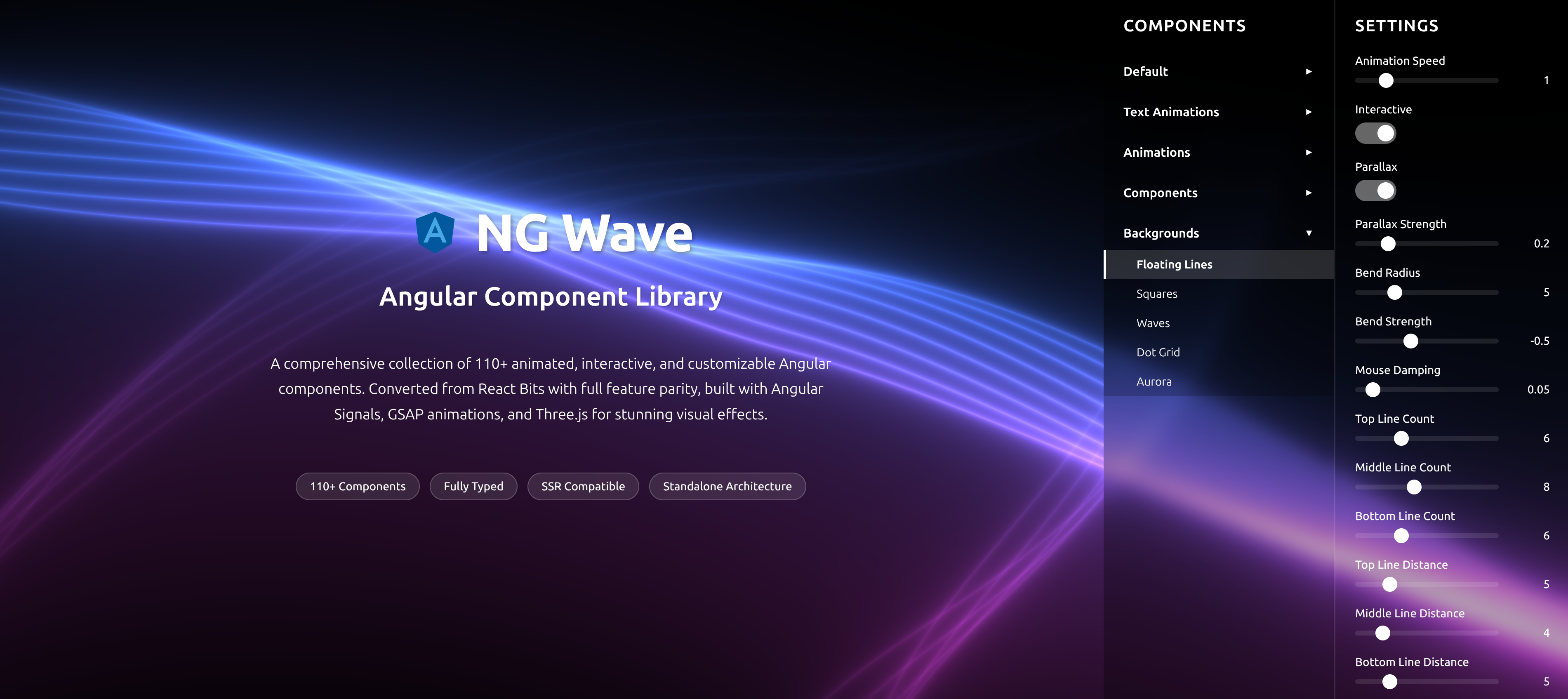
NG Wave
Angular Component Library
A comprehensive collection of 110+ animated, interactive, and customizable Angular components. Converted from React Bits with full feature parity, built with Angular Signals, GSAP animations, and Three.js for stunning visual effects.
Explore Components