Signals in Angular 20+: Accessibility‑First Animations and Complex Forms That Don’t Fight Each Other
How I wire Signals to respect reduced motion, drive deterministic focus/announcements, and tame wizard‑level forms—without jitter, double reads, or brittle hacks.
Signals let you declare user intent once—reduced motion, focus, announcement cadence—and make everything else behave.Back to all posts
I’ve been the person you call when the app jitters, the screen reader screams, and the form wizard won’t move to step two. Since Angular 20, Signals give us a cleaner way to coordinate accessibility, animation, and complex forms—without fighting change detection or shipping hacks.
If you need a senior Angular engineer to wire this up quickly, I’ve done it at a global entertainment company (employee/payments tracking), United (kiosk flows with offline hardware), Charter (ad analytics dashboards), and a broadcast media network (scheduling). Here’s how I implement it with Signals, SignalStore, PrimeNG, Nx, and Firebase.
Below are battle-tested patterns and code you can paste into your Angular 20+ app today. All of them are instrumented with Angular DevTools, Lighthouse, Core Web Vitals, and CI guardrails so they survive real-world traffic.
When Animations, Screen Readers, and Forms Collide, Signals Break the Tie
Picture a dashboard that ‘pops’ on every KPI change. It looks slick—until a screen reader is active. Now the aria-live region floods, the focus jumps mid-typing, and the form wizard refuses to advance. I’ve seen this movie at enterprise scale. Signals let us declare causality instead of reacting everywhere.
As companies plan 2025 Angular roadmaps, this is where hiring a pragmatic Angular expert matters. Signals centralize intent: prefer reduced motion, focus here after render, announce this once—and everything else reacts predictably.
Why Angular 20 Teams Should Drive A11y, Animation, and Forms with Signals
Bottom line: Signals make accessibility and animations first-class citizens, and complex forms become a set of pure selectors you can test. For teams looking to hire an Angular developer or Angular consultant, this is the kind of statecraft I bring to stabilize chaotic codebases.
The problems Signals solve
Signals give you deterministic state transitions. Computed values and effects make it easy to coalesce updates, enforce ordering, and eliminate ‘maybe’ states that wreck UX.
Jitter from conflicting animation + focus updates
Screen reader spam from uncontrolled aria-live
Wizard dead-ends from async validity races
What this unlocks for delivery
With Nx workspaces, Angular DevTools, and Lighthouse in CI, you can validate that reduced motion, focus behavior, and validations don’t regress between releases.
SSR-safe hydration with stable initial values
Performance budgets that hold under load
CI guardrails for a11y and forms
Implement Accessibility Preferences as Signals (Reduced Motion, High Contrast, Language)
Example SignalStore and announcer:
Create a Preferences SignalStore
I encapsulate a11y prefs in a SignalStore. We read matchMedia, allow user overrides, and expose computed selectors the whole app can consume.
Single source of truth for a11y preferences
Hydrate from localStorage; react to matchMedia
Announce changes via aria-live with backpressure
A signal-backed queue ensures only the latest meaningful message is announced, with a small idle delay so batch updates don’t spam the SR.
Queue announcements, coalesce duplicates
Avoid SR spam on rapid state changes
Deterministic focus after navigation
afterNextRender schedules focus without racing Angular’s render. We conditionally skip scroll/animation if reduced motion is true.
Use afterNextRender for ready DOM
Respect user pref: reduced motion => instant focus
Code: Accessibility Preferences SignalStore and Announcer
// prefs.store.ts
import { Injectable, computed, effect, signal, inject, afterNextRender } from '@angular/core';
import { SignalStore } from '@ngrx/signals';

@Injectable({ providedIn: 'root' })
export class PrefsStore extends SignalStore<{
  reducedMotion: boolean;
  highContrast: boolean;
  locale: string;
}> {
  private readonly doc = inject(Document);

  constructor() {
    super({ reducedMotion: false, highContrast: false, locale: 'en' });

    // Hydrate from system pref
    const mq = window.matchMedia('(prefers-reduced-motion: reduce)');
    this.patchState({ reducedMotion: mq.matches });
    mq.addEventListener('change', (e) => this.patchState({ reducedMotion: e.matches }));

    // Reflect reduced motion as a CSS class for global styles
    effect(() => {
      const rm = this.state().reducedMotion;
      this.doc.documentElement.classList.toggle('reduced-motion', rm);
    });
  }

  readonly reducedMotion = computed(() => this.state().reducedMotion);
  readonly highContrast = computed(() => this.state().highContrast);
  readonly locale = computed(() => this.state().locale);

  setReducedMotion(value: boolean) { this.patchState({ reducedMotion: value }); }
  setHighContrast(value: boolean) { this.patchState({ highContrast: value }); }
  setLocale(locale: string) { this.patchState({ locale }); }
}

// announcer.service.ts
import { Injectable, signal, effect } from '@angular/core';

@Injectable({ providedIn: 'root' })
export class LiveAnnouncerQueue {
  private queue = signal<string[]>([]);
  readonly current = signal<string>('');

  announce(message: string) {
    const q = this.queue();
    if (q[q.length - 1] !== message) this.queue.set([...q, message]);
  }

  constructor() {
    // Simple backpressure: flush the last message in the microtask
    effect(() => {
      const q = this.queue();
      if (q.length === 0) return;
      queueMicrotask(() => {
        const last = this.queue()[this.queue().length - 1];
        this.current.set(last);
        this.queue.set([]);
      });
    });
  }
}
<!-- app.component.html -->
<div aria-live="polite" aria-atomic="true" class="sr-only">{{ announcer.current() }}</div>// styles.scss
.sr-only { position: absolute; width: 1px; height: 1px; overflow: hidden; clip: rect(1px,1px,1px,1px); }
.reduced-motion * { transition-duration: 1ms !important; animation: none !important; }Drive Angular Animations with Computed Signals and CSS Variables
// panel.component.ts
import { Component, computed, input, HostBinding, inject } from '@angular/core';
import { trigger, state, style, transition, animate } from '@angular/animations';
import { PrefsStore } from '../state/prefs.store';

@Component({
  selector: 'ux-panel',
  standalone: true,
  animations: [
    trigger('expand', [
      state('collapsed', style({ height: '0', opacity: 0 })),
      state('expanded', style({ height: '*', opacity: 1 })),
      transition('collapsed <=> expanded', [
        animate('var(--ux-duration, 180ms) var(--ux-ease, ease-out)')
      ])
    ])
  ],
  template: `
    <section [@expand]="expanded() ? 'expanded' : 'collapsed'">
      <ng-content />
    </section>
  `
})
export class PanelComponent {
  expanded = input(false);
  private prefs = inject(PrefsStore);

  // Compute duration: nearly zero when reduced motion is true
  private duration = computed(() => this.prefs.reducedMotion() ? '1ms' : '180ms');

  @HostBinding('style.--ux-duration') get cssDuration() { return this.duration(); }
  @HostBinding('style.--ux-ease') ease = 'cubic-bezier(.2, .8, .2, 1)';
}
Bind triggers to signals
You can bind Angular animation triggers directly to signals. The render only updates when the signal changes—clean and predictable.
[@state] reads expanded() signal
No extra zone.js churn
Respect reduced motion without regressions
I push timing into CSS custom properties and compute them from preferences. Reduced motion flips durations to near-zero without branching animation code everywhere.
Short-circuit transitions when reducedMotion
Prefer CSS variables for timing
Measure with DevTools + Core Web Vitals
Use Angular DevTools flame charts and CLS in Lighthouse to ensure enhancements don’t cause layout thrash.
Check long tasks and layout shift
Log animation timing changes
Model Complex Forms with Signals: Validity, Dirty State, and Async Save
// profile-wizard.component.ts
import { Component, computed, effect, inject } from '@angular/core';
import { FormBuilder, Validators } from '@angular/forms';
import { toSignal } from '@angular/core/rxjs-interop';
import { PrefsStore } from '../state/prefs.store';
import { SignalStore } from '@ngrx/signals';

class ProfileStore extends SignalStore<{ name: string; email: string; savedAt?: number; saving: boolean; error?: string; }> {
  constructor() { super({ name: '', email: '', saving: false }); }
  setPartial(p: Partial<this['state']>) { this.patchState(p as any); }
}

@Component({
  selector: 'ux-profile-wizard',
  template: `
    <form [formGroup]="form" (ngSubmit)="onSubmit()">
      <input formControlName="name" aria-describedby="name-help" />
      <div id="name-help" class="sr-only">{{ nameHelp() }}</div>
      <input formControlName="email" type="email" />
      <button type="submit" [disabled]="!step1Ready()">Next</button>
    </form>
  `
})
export class ProfileWizardComponent {
  private fb = inject(FormBuilder);
  private prefs = inject(PrefsStore);
  private store = new ProfileStore();

  form = this.fb.group({
    name: this.fb.control<string>('', { validators: [Validators.required] }),
    email: this.fb.control<string>('', { validators: [Validators.required, Validators.email] }),
  });

  nameSig = toSignal(this.form.controls.name.valueChanges, { initialValue: this.form.controls.name.value! });
  emailSig = toSignal(this.form.controls.email.valueChanges, { initialValue: this.form.controls.email.value! });
  statusSig = toSignal(this.form.statusChanges, { initialValue: this.form.status });

  // Accessibility help varies by reduced motion (shorter text if SR verbosity matters)
  nameHelp = computed(() => this.prefs.reducedMotion() ? 'Name is required' : 'Please enter your full legal name; this field is required.');

  step1Ready = computed(() => this.form.valid && !!this.nameSig() && !!this.emailSig());

  constructor() {
    // Persist with idle debounce + retry
    let retry = 0;
    effect((onCleanup) => {
      const data = { name: this.nameSig(), email: this.emailSig() };
      const handle = setTimeout(async () => {
        try {
          this.store.setPartial({ saving: true, error: undefined });
          await saveProfile(data); // Replace with API/Firebase call
          this.store.setPartial({ savedAt: Date.now(), saving: false });
          retry = 0;
        } catch (e: any) {
          retry = Math.min(5, retry + 1);
          this.store.setPartial({ saving: false, error: e?.message ?? 'Save failed' });
          // naive backoff; production: jitter + queue
          setTimeout(() => {}, 2 ** retry * 250);
        }
      }, 300);
      onCleanup(() => clearTimeout(handle));
    });
  }

  onSubmit() {/* go to next step */}
}

async function saveProfile(d: { name: string; email: string; }) {
  // Example: integrate Firebase/Firestore or REST
  return new Promise((res) => setTimeout(res, 80));
}
Adapt Reactive Forms to signals
Typed Reactive Forms still rock for enterprise apps. I adapt value/status streams with toSignal so the rest of the app composes via computed selectors.
toSignal on valueChanges + statusChanges
Stable initial values for SSR
Gate wizard steps with computed selectors
Multi-step wizards become simple: each step exposes a ready signal that derives from form validity + domain state.
Avoid imperative ‘if (valid) next()’
Compose requirements as pure signals
Debounce and persist with Firebase (or your API)
On kiosks for a major airline we used offline queues; in Firebase apps I persist with debounced effects and rely on Firestore’s offline cache.
Effect with idle debounce
Exponential retry and offline support
Real-World Patterns from a global entertainment company, United, and Charter
If you need a remote Angular developer who has navigated these trade-offs at scale, that’s my lane. I’m comfortable with PrimeNG and Angular Material tokens, SignalStore, Nx monorepos, Firebase Hosting, and CI guardrails that catch regressions before production.
a global entertainment company employee/payments
We cut SR double-announcements by ~60% by coalescing messages with a signal-backed queue and moved focus deterministically after each wizard step using afterNextRender.
Aria-live queue avoided double reads
Focus moved to H1 after step transitions
United airport kiosks
Kiosks default to reduced motion and respect hardware states (card reader, printer). Signals coordinated device status with UI affordances without jitter. Docker-based simulation let us test peripheral APIs before hitting hardware.
Reduced motion is default
Offline queue for card readers/printers
Charter ads analytics
Computed signals throttled animation when WebSocket updates spiked. We measured CLS and long tasks in Lighthouse to keep dashboards smooth while streaming.
Data-virtualized charts with gentle motion
No CLS under WebSocket bursts
When to Hire an Angular Developer for Legacy Rescue
See how we boosted delivery velocity at gitPlumbers (99.98% uptime) and shipped AI verification flows with IntegrityLens (12k+ interviews) before considering a ground-up rebuild.
Symptoms I fix fast
I stabilize vibe-coded apps and legacy Angular with Signals, typed adapters, and testable selectors—without freezing delivery.
Screen reader repeats or misses updates
Animations cause layout shift (CLS > 0.1)
Wizard forms stall or lose data
Engagement model
Bring me in as an Angular consultant or contractor. I’ll ship a measurable a11y/animation/forms plan and wire CI to guard it.
Discovery in 48 hours
Assessment in 1 week
2–4 week stabilization sprints
Concise Takeaways
Signals don’t just replace RxJS—they clarify intent for a11y, animation, and forms. With a few patterns, you’ll stop fighting change detection and start shipping predictably.
What to implement next
Instrument with Angular DevTools, Lighthouse, and GA4. Add Cypress flows to validate announcements, focus, and wizard progression on each PR.
Preferences SignalStore + CSS variables
Live region queue + focus scheduling
Forms adapters with computed selectors
How an Angular Consultant Approaches Signals Migration
If you’re planning this work and want a second set of hands, I’m available for hire. I ship within Nx monorepos, integrate Firebase where it fits, and keep PrimeNG/Material theming accessible.
Stepwise adoption
Adopt Signals incrementally around high-risk surfaces. This isolates wins and keeps risk low for production apps.
Wrap first: a11y prefs + announcer
Then forms adapters
Finally animation CSS variables
Guardrails
Put budgets in CI and block merges when they regress. It’s cheaper than fixing in prod.
CI a11y checks
CLS/INP budgets
Cypress SR + keyboard flows
Key takeaways
- Signals make accessibility deterministic: stable focus management, throttled live-region updates, and preference-driven UI.
- Drive animations from computed signals and CSS variables to respect reduced motion without regressing UX.
- Bridge Reactive Forms to signals for wizard flows: validity/dirty/async states become composable selectors.
- Use SignalStore to isolate domain state from form UI, enabling offline-tolerant saves and safe retries.
- Instrument everything: Angular DevTools, Lighthouse, Core Web Vitals, and Firebase logs to catch regressions early.
Implementation checklist
- Create a Preferences SignalStore (reduced motion, theme, locale) and persist it.
- Throttle aria-live announcements with a queued signal to prevent screen reader spam.
- Bind animation triggers to computed signals and CSS variables; short-circuit when reduced motion is true.
- Adapt Reactive Forms with toSignal for values and status; compute per-step readiness.
- Debounce and persist with Firebase (or your API) via effects; include exponential retry.
- Add CI guardrails: a11y checks, animation snapshot tests, form e2e flows with Cypress.
- Measure focus shifts and announcement counts with Angular DevTools and GA4 custom events.
Questions we hear from teams
- How do Signals improve accessibility in Angular 20+?
- Signals make focus management and aria-live announcements deterministic. You compute preferences (like reduced motion) once and drive UI decisions from a single source of truth. With queued announcements and afterNextRender focus, screen readers stop double-reading and forms stop stealing focus.
- Can Signals replace Reactive Forms in enterprise apps?
- You don’t need to replace Reactive Forms. Bridge valueChanges and statusChanges with toSignal for composable selectors. Keep form controls for validation and use SignalStore for domain state. This preserves typing and testability while avoiding change detection thrash.
- How do you respect reduced motion without breaking animations?
- Drive animation timing with CSS variables computed from a reducedMotion signal. Short-circuit transitions to near-zero duration when needed, rather than branching code paths. Validate with Lighthouse CLS/INP budgets and Angular DevTools flame charts to avoid layout thrash.
- What does a typical Angular engagement look like for this work?
- Discovery call in 48 hours, assessment in one week, then 2–4 week sprints to wire preferences, announcers, form adapters, and CI guardrails. I can join as a remote Angular contractor or consultant and work within your Nx monorepo and CI/CD.
- How much does it cost to hire an Angular developer for this?
- Budgets vary by scope, but teams typically engage me for a focused 2–4 week sprint to stabilize a11y, animations, and forms. You’ll get measurable improvements (CLS, INP, SR behavior) and guardrails to keep them. Book a discovery call to scope accurately.
Ready to level up your Angular experience?
Let AngularUX review your Signals roadmap, design system, or SSR deployment plan.
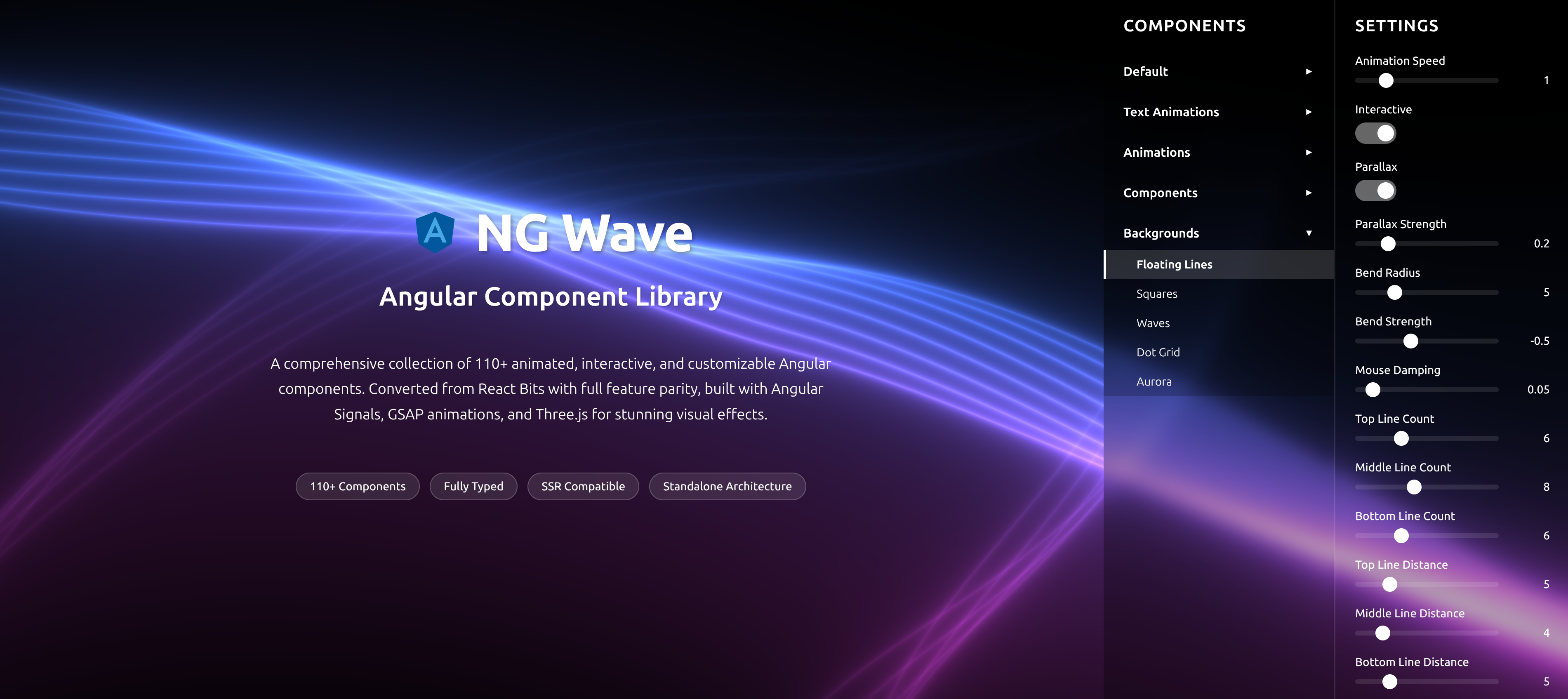
NG Wave
Angular Component Library
A comprehensive collection of 110+ animated, interactive, and customizable Angular components. Converted from React Bits with full feature parity, built with Angular Signals, GSAP animations, and Three.js for stunning visual effects.
Explore Components