Signals Make UX Predictable: Accessibility Live Regions, Jank‑Free Animations, and Complex Forms in Angular 20+
A senior engineer’s playbook for using Signals to deliver AA accessibility, smooth animations, and deterministic forms—without rewriting your app.
Derive once, render once. Signals make accessibility, animations, and forms move in lockstep—no more jitter, no more double announcements.Back to all posts
I’ve been called into a lot of Angular 14→20 modernizations lately—airline kiosks with choppy micro‑interactions, a telematics dashboard with screen reader chaos, and a multi‑tenant admin where forms refused to submit under load. The fix wasn’t “more RxJS,” it was tightening state with Signals.
Signals make change boundaries predictable. When your a11y announcements, animation triggers, and complex forms all derive from the same compute graph, you stop chasing timing bugs and ExpressionChanged errors. Below is how I wire this in real apps (PrimeNG/Material, Nx, Firebase), plus CI guardrails so it stays fixed.
If you’re evaluating whether to hire an Angular developer or bring in an Angular consultant, this is exactly the kind of pragmatic, code‑first approach I use to stabilize chaotic codebases without stopping delivery.
Let’s walk through three slices: accessible live regions and focus, animation triggers that don’t jitter, and complex forms with deterministic validation—then close with metrics and hiring signals.
A Jittery Dashboard, a Screen Reader, and a Form That Wouldn’t Submit
What I found in production
On an airport kiosk, a card reader’s ready state toggled twice within 30ms. The screen reader announced both, then a CSS animation triggered and got interrupted—pure noise. On a telecom analytics app, the big filter form queued five async validators per field and choked the UI.
Signals let us derive once and render once. One compute graph; no guessing which subscription fired first.
Announcements racing each other due to async setTimeout + zone ticks
Animations bound to booleans that changed multiple times per frame
Forms with async validators firing on every keystroke, starving the main thread
Why Angular 20+ helps now
With Angular 20+, the path is mature: keep streams for I/O, convert to signals at the boundary, compute everything else. Your UX becomes predictable, measurable, and easy to guard in CI.
Stable reactivity (signals, computed, effect) replaces cross‑component event spaghetti
Better DevTools, built‑in control flow, and stricter template type checking
NgRx SignalStore for small focused state slices
Why Signals Reshape Accessibility, Animations, and Forms in Angular 20+
Deterministic change boundaries
Signals batch and order updates reliably. That’s gold for a11y (which hates duplicate announcements), for animations (which hate mid‑frame flip‑flops), and for forms (which hate racing validators).
No more ExpressionChanged on animation triggers
Announce exactly once per semantic change
Form submit enablement comes from one computed source
Measurable benefits
I instrument gains with Angular DevTools flame charts, Chrome trace, and GA4/Firebase custom events. Make it visible; keep it honest.
+5–15 points Axe/Lighthouse a11y (typical in audits)
Consistent 60fps micro‑interactions on commodity hardware
Lower CPU and GC churn on forms with async rules
Implementing Signal‑Driven Accessibility: Live Regions, Focus, Reduced Motion
Live region with SignalStore
Use a tiny SignalStore to centralize announcements. Derive the message; don’t build it imperatively.
import { signalStore, withState, withMethods, patchState } from '@ngrx/signals';
import { Injectable } from '@angular/core';

interface A11yState { message: string; priority: 'polite' | 'assertive'; }

@Injectable({ providedIn: 'root' })
export class A11yStore extends signalStore(
  withState<A11yState>({ message: '', priority: 'polite' }) ,
  withMethods((store) => ({
    announce(message: string, priority: A11yState['priority'] = 'polite') {
      patchState(store, { message, priority });
      // Clear after a tick so the same message can be re‑announced later
      queueMicrotask(() => patchState(store, { message: '' }));
    }
  }))
) {}
<!-- app.component.html -->
<div
class="sr-only"
[attr.aria-live]="a11y.priority()"
[textContent]="a11y.message()">
</div>Announce semantic changes only
Auto‑clear message to avoid repeat reads
Test with Axe in CI
Reduced motion as a signal
import { computed, signal, effect } from '@angular/core';

const prefersReducedMotion = signal<boolean>(
  matchMedia('(prefers-reduced-motion: reduce)').matches
);

// Listen once and update signal
matchMedia('(prefers-reduced-motion: reduce)').addEventListener('change', e => {
  prefersReducedMotion.set(e.matches);
});

export const allowMotion = computed(() => !prefersReducedMotion());
I’ve also tied allowMotion to a Firebase Remote Config flag for incident response. If telemetry spikes jank, ops can disable non‑essential animations globally in seconds.
Respect user preference globally
Guard expensive animations
Integrate with Firebase Remote Config to force off in incidents
Focus management via effect
import { effect, inject } from '@angular/core';
import { Router } from '@angular/router';
import { A11yStore } from './a11y.store';

export class LayoutComponent {
  private router = inject(Router);
  a11y = inject(A11yStore);

  constructor() {
    // Announce page changes and move focus
    effect(() => {
      const url = this.router.url; // signalized by Angular
      this.a11y.announce(`Navigated to ${url}`);
      document.getElementById('page-title')?.focus();
    });
  }
}
Animating Without Jank: Signal‑Stable Triggers and Velocity Guards
Trigger from computed state
import { Component, signal, computed } from '@angular/core';
import { trigger, state, style, transition, animate } from '@angular/animations';

@Component({
  selector: 'app-panel',
  animations: [
    trigger('expand', [
      state('closed', style({ height: '0px', opacity: 0 })),
      state('open', style({ height: '*', opacity: 1 })),
      transition('closed <=> open', animate('180ms ease-out')),
    ])
  ],
  template: `
    <button (click)="toggle()">Toggle</button>
    <section [@expand]="panelState()"></section>
  `
})
export class PanelComponent {
  private expanded = signal(false);
  panelState = computed(() => this.expanded() ? 'open' : 'closed');
  toggle() { this.expanded.update(v => !v); }
}
Because panelState is computed, Angular batches changes and the animation system reads a single value per frame—no flapping between states mid‑render.
One source of truth for animation state
No ExpressionChanged errors
Easy to test
Velocity guard to prevent thrash
const lastToggle = signal(0);
function safeToggle() {
  const now = performance.now();
  if (now - lastToggle() > 120) {
    lastToggle.set(now);
    this.expanded.update(v => !v);
  }
}
Ignore toggles faster than 120ms
Great for kiosk hardware bounce and rapid clicks
Respect allowMotion
<section [@expand]="allowMotion() ? panelState() : 'open'"></section>Skip expensive transitions when allowMotion=false
Complex Forms Made Deterministic: Computed Validity, Async Validators, and Effects
Bridge valueChanges with toSignal()
import { FormBuilder, Validators } from '@angular/forms';
import { toSignal } from '@angular/core/rxjs-interop';
import { debounceTime, distinctUntilChanged, switchMap, of } from 'rxjs';

constructor(private fb: FormBuilder, private svc: AccountsApi) {}

form = this.fb.group({
  email: ['', [Validators.required, Validators.email]],
  password: ['', [Validators.required, Validators.minLength(10)]]
});

email$ = this.form.controls.email.valueChanges.pipe(
  debounceTime(250), distinctUntilChanged()
);
emailSig = toSignal(email$, { initialValue: this.form.controls.email.value });
Convert streams at the boundary
Keep the UI signal‑native
Computed validity + submit readiness
import { computed, effect } from '@angular/core';

const strongPassword = (v: string) => /(?=.*[A-Z])(?=.*\d).{10,}/.test(v || '');

isValid = computed(() => {
  const emailOk = !!this.form.controls.email.valid;
  const passOk = strongPassword(this.form.controls.password.value || '');
  return emailOk && passOk && !this.form.pending;
});

// Side effects: analytics + button enable
effect(() => {
  const ready = this.isValid();
  // GA4/Firebase telemetry
  gtag('event', 'form_ready_state', { ready });
});<button type="submit" [disabled]="!isValid()">Create account</button>One computed() to rule submit state
Derive disabled state, helper text, aria‑attrs
Debounced async validator as a signal
emailAvailableSig = toSignal(
  this.form.controls.email.valueChanges.pipe(
    debounceTime(400), distinctUntilChanged(),
    switchMap(email => email ? this.svc.checkEmail(email) : of(true))
  ),
  { initialValue: true }
);

emailHint = computed(() => emailAvailableSig() ? 'Email is available' : 'Email is taken');
Avoid stampeding API calls
Expose result with a signal used across the form
PrimeNG + Material Recipe: Accessible Expansion with Smooth Micro‑Interactions
Component snippet
<p-button
  [label]="expanded() ? 'Collapse filters' : 'Expand filters'"
  [attr.aria-expanded]="expanded()"
  (onClick)="safeToggle()">
</p-button>

<div class="panel" [class.mat-elevation-z8]="expanded()" [@expand]="panelState()">
  <app-filter-form />
</div>
.panel { overflow: hidden; will-change: height, opacity; }Bind aria-expanded and the label to the same signal used by the animation. Accessibility, visuals, and logic move in lockstep. This is how we eliminated jitter on a broadcast network’s scheduling console built with PrimeNG and Nx.
PrimeNG button + ARIA attrs bound to signals
Material elevation class toggled via computed
How an Angular Consultant Approaches Signal‑First UX Refactors
My playbook in enterprise environments
In the insurance telematics dashboard, we moved the KPI ticker, live region, and filter form to Signals in week one. Result: zero ExpressionChanged errors, +12 Axe points, and 60fps even on a 5‑year‑old laptop.
Assess with Angular DevTools + Lighthouse; record a baseline
Refactor UI hotspots to signal‑driven computations first
Instrument GA4/Firebase events; wire budgets in CI
Train the team; codemods + Nx generators to repeat
When to Hire an Angular Developer for Accessibility and Forms Rescue
Signals you need help now
If any of these are familiar, bring in a senior Angular engineer. I stabilize code while keeping features moving—this is the kind of work I did for a global entertainment company’s employee tracking system and an airline’s kiosk fleet.
Screen reader reads twice or out of order
Animation triggers flicker under load
Form submit stays disabled or flips unpredictably
CI lacks Axe/Lighthouse gates
CI Guardrails: Axe, Lighthouse, and Performance Budgets
GitHub Actions snippet (Nx monorepo)
name: ux-guardrails
on: [push]
jobs:
  audit:
    runs-on: ubuntu-latest
    steps:
      - uses: actions/checkout@v4
      - uses: actions/setup-node@v4
        with: { node-version: 20 }
      - run: npm ci
      - run: npx nx build web --configuration=production
      - run: npx http-server dist/apps/web -p 4200 &
      - run: npx @lhci/cli autorun --collect.url=http://localhost:4200
      - run: npx axe http://localhost:4200 --exit 1 --threshold 90
Block on a11y score < 90 and CLS > 0.1
Publish traces as artifacts
Measuring Wins and Next Steps
What to instrument
Start with a baseline. After refactors, compare numeric deltas. On gitPlumbers, we maintain 99.98% uptime while modernizing; on IntegrityLens, >12,000 interview flows run with stable announcements and rapid validations. Numbers win arguments.
Axe score, Lighthouse a11y/perf, Core Web Vitals
Angular DevTools frame chart during interaction
GA4/Firebase: form_ready_state, animation_skipped, a11y_announce
Where to go next
As budgets reset, teams are planning 2025 roadmaps. If you need a remote Angular developer with Fortune 100 experience to guide a careful roll‑out, let’s talk.
Adopt SignalStore slices for busy modules
Feature flags to roll out Signals incrementally
SSR + hydration metrics if you’re ready
Key takeaways
- Signals eliminate timing races that break ARIA, animations, and forms by giving deterministic change boundaries.
- Use a tiny SignalStore for accessible live regions and focus management; test with Axe and Lighthouse in CI.
- Drive animation triggers from computed signals to stop ExpressionChanged errors and visual jitter.
- Model complex form validity with computed signals and effect-based side effects (submit readiness, debounced async checks).
- Measure wins: fewer console errors, 60fps paints, improved Axe score, lower TTI; wire telemetry to GA4/Firebase.
Implementation checklist
- Create a11y live-region store with SignalStore; announce on meaningful state changes.
- Guard animations with prefers-reduced-motion and a derived signal; disable when needed.
- Replace event spaghetti with computed() for form validity and submit enablement.
- Use toSignal() to bridge RxJS streams (valueChanges, WebSocket updates) into stable UI updates.
- Add Axe + Lighthouse to CI and block regressions via budgets; track metrics with Angular DevTools + GA4.
- Adopt Nx generators to standardize a Signals-first architecture across libs/features.
Questions we hear from teams
- How much does it cost to hire an Angular developer for a Signals refactor?
- Small rescues start at 2–4 weeks; full modernizations run 4–8 weeks. Fixed‑fee discovery produces a plan and budget. I price for outcomes and can work as a contractor or consultant.
- How long does an Angular upgrade to 20+ take if we add Signals?
- Typical 14→20 migrations with Signals and RxJS 8 take 4–8 weeks for a mid‑sized app. We ship via feature flags to avoid downtime and use CI guardrails to catch regressions.
- What does an Angular consultant do on day one?
- Baseline metrics (Axe, Lighthouse, DevTools), identify hotspots, and introduce SignalStore slices for a11y, animation triggers, and forms. You get a working improvement and a written plan in week one.
- Do Signals replace NgRx in enterprise dashboards?
- I use both. Streams for I/O and effects; Signals for component state and derived UI. NgRx selectors can be signalized. This hybrid keeps real‑time dashboards fast and predictable.
- Will this work with PrimeNG and Angular Material?
- Yes. I’ve shipped PrimeNG and Material apps with signal‑driven themes and animations. Bind ARIA attributes, animation triggers, and disabled states to computed signals for consistent UX.
Ready to level up your Angular experience?
Let AngularUX review your Signals roadmap, design system, or SSR deployment plan.
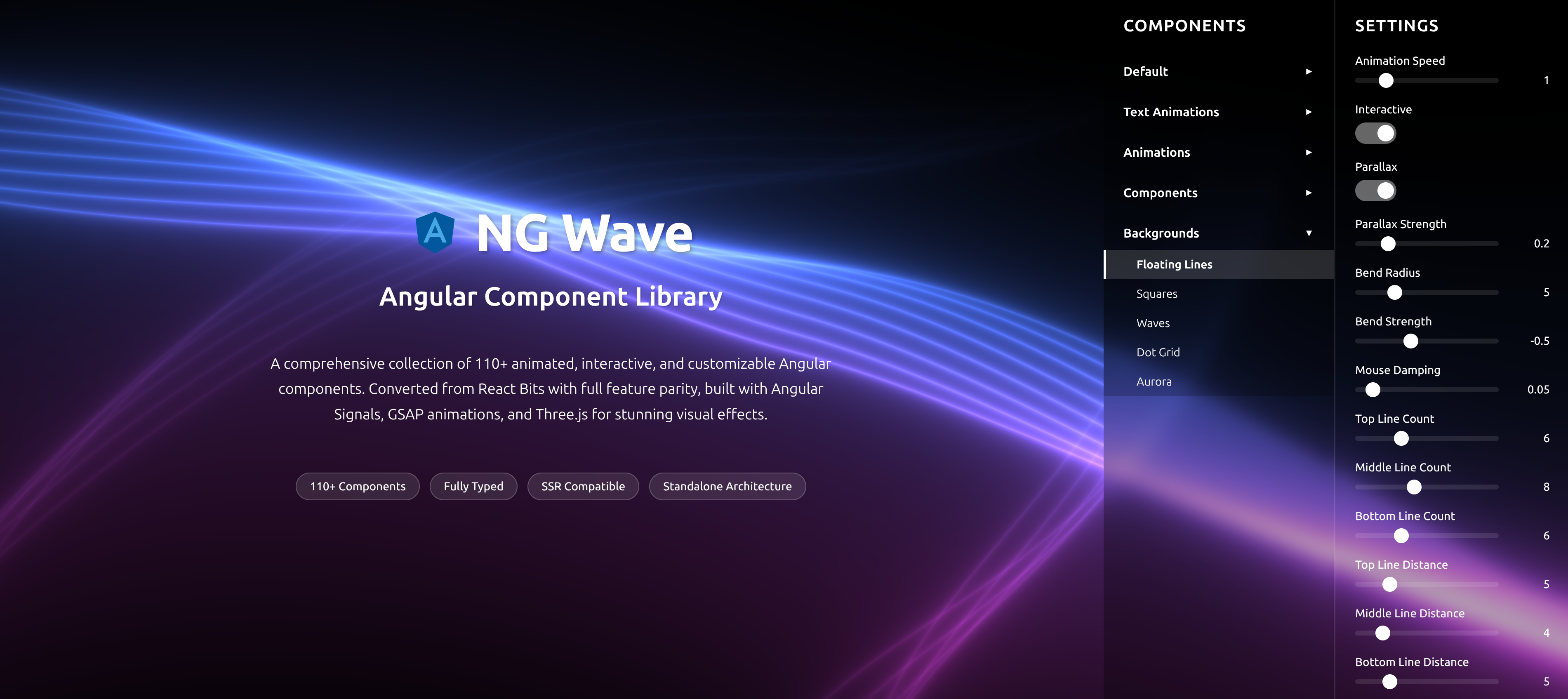
NG Wave
Angular Component Library
A comprehensive collection of 110+ animated, interactive, and customizable Angular components. Converted from React Bits with full feature parity, built with Angular Signals, GSAP animations, and Three.js for stunning visual effects.
Explore Components