Signals Statecraft for Multi‑Tenant Angular 20 Apps: Role‑Based Selectors, Permission‑Driven Slices, and Data Isolation Patterns
Practical patterns I use to keep tenants isolated, selectors honest, and permissions enforceable with Angular 20+ Signals and SignalStore.
Tenant context first. Everything else hangs off it.Back to all posts
I’ve shipped multi-tenant Angular for media, telecom, aviation, and IoT. When state boundaries wobble, someone sees the wrong tenant’s data. In Angular 20+, Signals + SignalStore finally make tenant-scoped state simple, fast, and testable.
Below is the approach I use across AngularUX demos and client work (a global entertainment company employee systems, Charter ads analytics, an insurance technology company telematics). It scales in Nx monorepos, works with Firebase/REST, and keeps PrimeNG dashboards crisp without leaks.
When Multi‑Tenant State Goes Wrong: The 30‑Second Postmortem
As companies plan 2025 Angular roadmaps, multi-tenant isolation is a board-level risk. Here’s how I design tenant-scoped state with Signals + SignalStore so you can hire an Angular developer with confidence you won’t ship a leak.
A real production moment
at a leading telecom provider, a manager toggled tenants in a tabbed dashboard. One memoized selector wasn’t scoped by tenant, so the next tab rendered cached rows from the previous tenant. It lasted seconds, but seconds are enough for screenshots. The fix wasn’t a band‑aid—it was architecture: tenant context first, everything hangs off it.
Angular 20+ advantage
Signals and SignalStore let us model tenant context as the root signal, drive permission-driven slices, and make role-based selectors explicit. No accidental shared caching, fewer leaky memoizations, and deterministic tests.
Why Multi‑Tenant State Needs Tenant‑First Architecture in Angular 20
If you’re evaluating an Angular consultant or Angular expert, ask to see their tenant-first store design and isolation tests. It’s the difference between ‘works on my machine’ and ‘safe in production.’
Risk and regulation
Whether you’re in media (a broadcast media network), telecom (Spectrum), aviation (United), or insurance (an insurance technology company telematics), tenant isolation is contractual. A single leaked row can trigger legal and compliance workflows.
Cross-tenant leaks are incidents, not bugs.
Auditability requires explicit permission checks.
Why Signals help
Signals give us deterministic derivations. Instead of hoping a memoized selector keys correctly, we key everything off the current tenantId signal and invalidate cache when context changes.
Tenant context is a top-level signal.
All selectors derive from context.
Effects can assert tenant on ingress.
Designing Tenant‑Scoped State: Role‑Based Selectors and Permission‑Driven Slices
Here’s a condensed SignalStore showing these patterns in Angular 20+. This plays nicely in an Nx monorepo and integrates with PrimeNG tables.
1) Model the tenant context
Make context a single source of truth. Avoid duplicating tenantId across services and components.
tenantId
role
permissions: Set
2) Permission-driven slices
Expose selectors that already apply permission filters. The template shouldn’t implement security logic.
inventory slice
billing slice
users slice
3) Route ➜ State handshake
Tie router params to store context once, at the boundary.
Read tenantId from route.
Patch context; trigger effects.
Reject data if tenant mismatches.
4) Guard writes and reads
You need both. Read redaction prevents over-render. Write guards prevent poisoned caches.
assertTenant before patching
redact selectors by permission
Code: SignalStore Multi‑Tenant Slices, Selectors, and Guards
These patterns force tenant context to be explicit and testable. The UI only sees redacted selectors—no security logic in HTML.
SignalStore with tenant context and permission-driven selectors
import { computed, signal, effect } from '@angular/core';
import { signalStore, withState, withComputed, patchState } from '@ngrx/signals';

// Roles & permissions
export type Role = 'owner' | 'admin' | 'manager' | 'viewer';
export type Permission =
  | 'read:inventory' | 'write:inventory'
  | 'read:billing'   | 'manage:users';

export interface TenantContext {
  tenantId: string;
  role: Role;
  permissions: ReadonlySet<Permission>;
}

interface InventoryItem { id: string; tenantId: string; sku: string; qty: number; cost: number; }
interface User { id: string; tenantId: string; email: string; role: Role; }

interface State {
  ctx: TenantContext;
  inventory: InventoryItem[]; // always tenant-scoped
  users: User[];              // redacted by permission
  loading: boolean;
  lastUpdated: number | null;
}

const has = (p: Permission, s: ReadonlySet<Permission>) => s.has(p);
const assertTenant = (ctx: TenantContext, payloadTenantId: string) => {
  if (ctx.tenantId !== payloadTenantId) throw new Error('Cross-tenant write blocked');
};

export const InventoryStore = signalStore(
  withState<State>({
    ctx: { tenantId: '', role: 'viewer', permissions: new Set() },
    inventory: [],
    users: [],
    loading: false,
    lastUpdated: null,
  }),
  withComputed((state) => ({
    // Permission helpers
    canReadInventory: computed(() => has('read:inventory', state.ctx.permissions())),
    canWriteInventory: computed(() => has('write:inventory', state.ctx.permissions())),
    canManageUsers: computed(() => has('manage:users', state.ctx.permissions())),

    // Redacted selectors
    visibleInventory: computed(() => {
      if (!state.canReadInventory()) return [];
      // data is already tenant-scoped; additional redaction if needed
      return state.inventory();
    }),
    visibleUsers: computed(() => state.canManageUsers() ? state.users() : []),

    // Role-based UI selectors
    visibleColumns: computed(() => {
      switch (state.ctx.role()) {
        case 'owner':   return ['sku','qty','cost'];
        case 'manager': return ['sku','qty'];
        default:        return ['sku'];
      }
    }),
  }))
);

// Boundary effects (example service wiring)
export class InventoryEffects {
  constructor(private store: typeof InventoryStore, private api: Api) {
    // Route -> context handshake
    effect(() => {
      const tenantId = this.api.routeTenantId(); // read route param via a signal
      if (!tenantId) return;
      patchState(this.store, { ctx: { ...this.store.ctx(), tenantId } });
      this.loadInventory(tenantId);
      this.loadUsers(tenantId);
    }, { allowSignalWrites: true });
  }

  async loadInventory(tenantId: string) {
    patchState(this.store, { loading: true });
    const items = await this.api.getInventory(tenantId);
    // Write guard: refuse poison
    items.forEach(i => assertTenant(this.store.ctx(), i.tenantId));
    patchState(this.store, { inventory: items, loading: false, lastUpdated: Date.now() });
  }

  async loadUsers(tenantId: string) {
    if (!this.store.canManageUsers()) return; // read guard
    const users = await this.api.getUsers(tenantId);
    users.forEach(u => assertTenant(this.store.ctx(), u.tenantId));
    patchState(this.store, { users });
  }
}
PrimeNG template with role-based columns and permission gates
<p-toolbar>
  <button pButton label="Add Item" icon="pi pi-plus"
          [disabled]="!store.canWriteInventory()"></button>
</p-toolbar>

<p-table [value]="store.visibleInventory()" [loading]="store.loading()">
  <ng-template pTemplate="header">
    <tr>
      <th *ngFor="let col of store.visibleColumns()">{{ col | titlecase }}</th>
    </tr>
  </ng-template>
  <ng-template pTemplate="body" let-row>
    <tr>
      <td *ngFor="let col of store.visibleColumns()">{{ row[col] }}</td>
    </tr>
  </ng-template>
</p-table>
Guardrail test for cross-tenant writes
it('blocks cross-tenant writes', () => {
  const store = InventoryStore; // assume test harness provides instance
  patchState(store, { ctx: { tenantId: 'A', role: 'owner', permissions: new Set(['read:inventory','write:inventory']) } });
  const payload = [{ id: '1', tenantId: 'B', sku: 'X', qty: 1, cost: 10 }];
  expect(() => payload.forEach(i => (store as any)._assertTenant?.(store.ctx(), i.tenantId)))
    .toThrowError('Cross-tenant write blocked');
});
Firebase and WebSocket Streams with Exponential Retry and Typed Events
Typed streams + tenant guards at ingress mean we never let another tenant’s event poison state. When in doubt, drop the event and log a structured error.
Typed event schema
For real-time dashboards (an insurance technology company telematics, a broadcast media network scheduling), I wrap WebSockets or Firebase listeners with typed schemas and assert tenantId at the event boundary.
Use zod/io-ts to parse events.
Reject on schema mismatch.
Offline-tolerant flows
On United’s kiosk work, we used Docker-based hardware simulation and offline queues. The same pattern applies to multi-tenant apps—buffer writes per tenant and flush when context matches.
Retry with jitter.
Queue writes until online.
Telemetry hooks
Emit metrics for filtered rows, denied actions, and cross-tenant attempts. Use Angular DevTools flame charts to confirm selectors compute only when ctx changes.
GA4/Firebase Analytics
Sentry + OpenTelemetry
CI Guardrails: Lint, Tests, and Affected Runs in Nx
Guardrails make good patterns inevitable. If you need to rescue a codebase, this is where I start. See gitPlumbers for code modernization services.
Nx + GitHub Actions
Only run what changed but keep coverage on core stores. Block merges if isolation tests fail.
nx affected --target=test --parallel
nx affected --target=lint --parallel
Example CI step
name: ci
on: [push, pull_request]
jobs:
  build-test:
    runs-on: ubuntu-latest
    steps:
      - uses: actions/checkout@v4
      - uses: actions/setup-node@v4
        with: { node-version: 20 }
      - run: npm ci
      - run: npx nx affected --target=lint --parallel
      - run: npx nx affected --target=test --parallel --configuration=ci
      - run: npx nx affected --target=build --parallel
Static rules
Automate the boring parts. Generate slices with assertTenant and permission helpers scaffolded, then fail CI when devs bypass them.
ESLint rule to forbid raw tenantId usage outside context module.
Schematics/codegen for slices that auto-wire guards.
Example: Tenant‑Scoped Inventory Dashboard (PrimeNG + Firebase)
If you’re on Firebase Hosting, these patterns work with Angular SSR. I measure hydration timing and selector churn in Lighthouse and GA4 to keep Core Web Vitals green.
Flow summary
This is the same pattern I used on device fleet management for an enterprise IoT hardware company and dashboards for a leading telecom provider. Fast, predictable, and easy to reason about.
Route -> ctx
Fetch -> assertTenant
Selectors -> redaction
UI -> role-based columns
SSR and hydration notes
Ensure ctx has a stable initial value on the server. Hydrate permissions from JWT/claims via an init resolver to avoid a flicker of unauthorized content.
Use TransferState for initial ctx.
Provide safe defaults for signals.
How an Angular Consultant Designs Permission‑Driven State with Signals
Want me to review your architecture? I can usually spot the risky selectors in 30 minutes and propose a SignalStore refactor path that won’t freeze delivery.
My playbook
At a global entertainment company and an insurance technology company, I start with a short assessment, ship isolation tests in week 1, and align slices to business capabilities. Only then do we paint the UI.
Map roles -> permissions -> selectors.
Prove isolation with tests first.
Instrument before launch.
What I won’t ship
If you’re looking to hire an Angular developer, push back on these anti-patterns. They’re how leaks happen.
Security logic only in templates.
Ad-hoc tenantId lookups in services.
Unkeyed memoizations.
When to Hire an Angular Developer for Multi‑Tenant Rescue
If your team needs a senior Angular engineer who’s done this at scale, I’m available for remote engagements. I’ll stabilize while keeping delivery moving.
Signals you need help now
Typical engagement: 2–4 weeks for a rescue, 4–8 weeks for full refactor with CI guardrails. Discovery call within 48 hours; architecture assessment delivered in a week.
Leaked rows in dashboards (even once).
Permission logic sprinkled across templates.
Unclear tenant lifecycle on route changes.
Takeaways and What to Instrument Next
Role-based selectors, permission-driven slices, and tenant-first context are how we keep multi-tenant Angular 20 apps safe. Signals + SignalStore make it clean; tests and telemetry make it durable.
Measure what matters
Instrument selectors and permission checks. If denied rates spike, your roles don’t align to tasks. If recomputations spike, optimize computed dependencies.
Denied action rate
Filtered row counts
Selector recomputation rate
Next steps
Security is a process. Keep the guardrails active in CI and production telemetry.
Add boundary tests for every slice.
Run DevTools flame charts.
Pull a red-team review monthly.
Key takeaways
- Scope state by tenant first; everything else hangs off the tenant context.
- Encode permissions in state and selectors, not just templates.
- Use SignalStore slices to isolate features (inventory, billing, users) behind permission-driven selectors.
- Refuse cross-tenant data at the boundary (effects/services) and re-check before patching state.
- Instrument with telemetry (GA4/Firebase, OpenTelemetry) to prove no cross-tenant rendering.
- Back patterns with CI guardrails: strict types, unit tests, and route-state handshake tests.
Implementation checklist
- Add TenantContext signal with tenantId, role, and permission set.
- Create permission-driven SignalStore slices; expose only selectors allowed by current role.
- Build role-based selectors for UI columns/components; never branch in templates alone.
- Gate all mutations with assertTenant(ctx, payloadTenantId).
- Wire route params ➜ Store context with a single effect; forbid ad-hoc tenantId usage.
- Add unit tests for cross-tenant writes and read redaction.
- Instrument filtered result sizes and forbidden action attempts.
- Run Angular DevTools to verify computed selector graphs and avoid over-recomputation.
Questions we hear from teams
- What does an Angular consultant do for multi-tenant apps?
- I design a tenant-first state architecture: route-to-context handshake, permission-driven slices, role-based selectors, tests that block cross-tenant writes, and telemetry to prove isolation. Typical assessment in 1 week; stabilization in 2–4 weeks.
- How long does a multi-tenant refactor take in Angular 20+?
- For most apps, 2–4 weeks to stabilize leaks and add CI guardrails; 4–8 weeks for full slice refactors and telemetry. Work continues alongside delivery—no freeze required.
- How much does it cost to hire an Angular developer for this?
- It depends on scope and timelines. I offer fixed-fee assessments and weekly rates for delivery. We’ll scope in a 30‑minute call and start within 48 hours if needed.
- Do these patterns work with Firebase and SSR?
- Yes. Use TransferState for initial context, claims-derived permissions, and tenant guards at listener ingress. Works on Firebase Hosting with Functions and Angular SSR hydration.
- Can you integrate with PrimeNG, Nx, and existing NgRx?
- Absolutely. I run these patterns in Nx monorepos, PrimeNG dashboards, and can interop with NgRx using typed RxJS→Signals adapters and SignalStore bridge layers.
Ready to level up your Angular experience?
Let AngularUX review your Signals roadmap, design system, or SSR deployment plan.
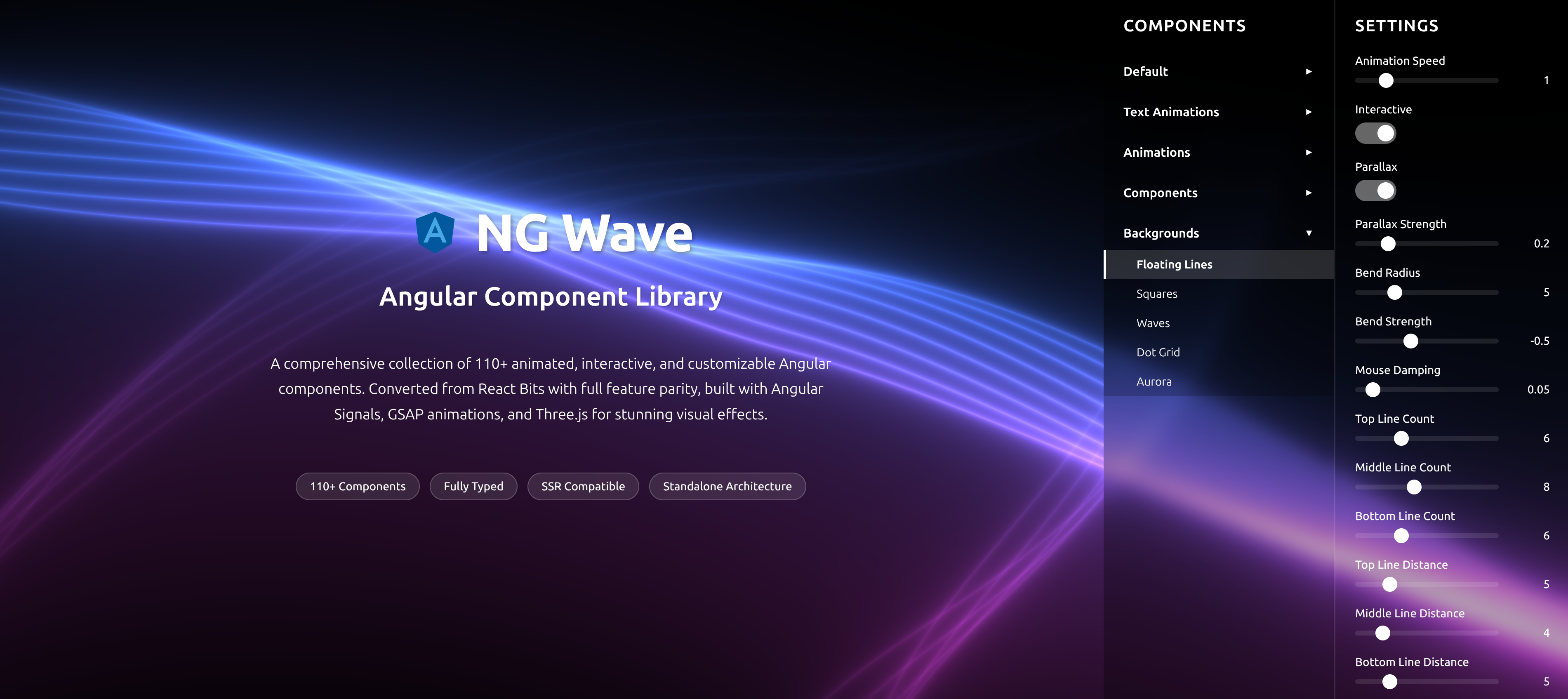
NG Wave
Angular Component Library
A comprehensive collection of 110+ animated, interactive, and customizable Angular components. Converted from React Bits with full feature parity, built with Angular Signals, GSAP animations, and Three.js for stunning visual effects.
Explore Components