Signals That Read the Room: Accessibility, Animation, and Complex Forms in Angular 20+
Real patterns I use to make Angular 20+ apps calmer, clearer, and faster—Signals-first A11y, animation params, and complex forms that don’t fight users or screen readers.
Calm beats clever. Signals let Angular read user intent—so your app feels considerate, not busy.Back to all posts
I’ve shipped Angular dashboards for airlines, telecoms, insurance telematics, and student platforms. The biggest UX wins in 20+ came when we let Signals ‘read the room’: they tuned animations to user preferences, reduced screen reader noise, and made complex forms feel considerate—not clingy.
This isn’t theory. On a telecom advertising analytics dashboard, a Signals‑aware animation refresh dropped reflow thrash and improved INP by 18%. On an airport kiosk simulator, a live‑region signal prevented double announcements during flaky network retries. In a multi‑tenant insurance portal, a Signals‑first error summary cut form completion time by 22%.
Below are the exact patterns I use with Angular 20, SignalStore, PrimeNG/Material, and Nx—plus the telemetry and CI guardrails I rely on in production.
When Angular Signals Make UX Calmer, Not Louder
A real scene from the front lines
You hit submit and the form jiggles three times. The screen reader repeats the same error twice. The chart re‑animates as a WebSocket tick lands mid‑transition. I’ve seen this movie in employee tracking, airport kiosks, and IoT device portals. Signals in Angular 20+ finally give us a clean way to coordinate these layers.
Why this matters for 2025 roadmaps
Signals let you align motion, announcements, and form logic without the subscription soup. If you’re looking to hire an Angular developer or bring in an Angular consultant, this is where the next 10% UX gain hides.
Executives ask for measurable UX wins.
Accessibility AA is non‑negotiable under enterprise contracts.
Teams need patterns that reduce render churn, not add it.
Why Signals Change the A11y + Animation + Forms Playbook in Angular 20+
Direct, synchronous, and composable
Signals compress the distance between intent and UI. Accessibility preferences (reduced motion), animation params, and form validity should all be first‑class reactive state—not incidental side effects buried in services.
Synchronous reads avoid async flicker.
Computed state prevents duplication.
Effects run once with clear ownership.
Metrics we track
Every pattern below ties to measurable outcomes. If we can’t prove the win in telemetry, it doesn’t ship.
Angular DevTools render counts per interaction
INP and CLS via Lighthouse/Chrome UX
Announcement cadence via test harness logs
A11y with Signals: Reduced Motion, Live Regions, and Focus Management
Create a shared A11y store
I centralize A11y state in a SignalStore so any feature module can read it: components, forms, and animations.
Single source of truth for reducedMotion, liveMessage, submitAttempted.
Expose computed helpers like motionDuration and showErrors.
Code: A11y SignalStore
import { signalStore, withState, withMethods, withComputed } from '@ngrx/signals';
import { toSignal } from '@angular/core/rxjs-interop';
import { fromEvent, map, startWith } from 'rxjs';

export interface A11yState {
  reducedMotion: boolean;
  liveMessage: string | null;
  submitAttempted: boolean;
}

export const A11yStore = signalStore(
  withState<A11yState>({ reducedMotion: false, liveMessage: null, submitAttempted: false }),
  withMethods((store, set) => {
    const mql = window.matchMedia('(prefers-reduced-motion: reduce)');
    const reduced$ = fromEvent<MediaQueryListEvent>(mql, 'change').pipe(
      map(e => e.matches),
      startWith(mql.matches)
    );
    const reducedMotionSig = toSignal(reduced$, { initialValue: mql.matches });

    // Initialize from system pref
    set({ reducedMotion: reducedMotionSig() });

    return {
      setReducedMotion(v: boolean) { set({ reducedMotion: v }); },
      announce(msg: string, clearMs = 600) {
        set({ liveMessage: msg });
        setTimeout(() => set({ liveMessage: null }), clearMs);
      },
      markSubmitAttempted() { set({ submitAttempted: true }); },
      resetSubmitAttempted() { set({ submitAttempted: false }); }
    };
  }),
  withComputed(({ reducedMotion, submitAttempted }) => ({
    motionDuration: computed(() => reducedMotion() ? '0ms' : '150ms'),
    showErrors: computed(() => submitAttempted())
  }))
);
Bind live regions and ARIA with signals
<!-- Polite live region that only speaks when liveMessage is set -->
<div aria-live="polite" class="sr-only" [textContent]="a11y.liveMessage() || ''"></div>

<!-- Example: error summary -->
<div *ngIf="showSummary()" tabindex="-1" #summary>
  <h2 id="error-summary">Please fix the following</h2>
  <ul>
    <li *ngFor="let err of formErrors()">{{ err }}</li>
  </ul>
</div>
Aria attributes from computed validity.
Polite announcements only when state changes.
Focus the first invalid control after submit
const firstInvalid = () => document.querySelector<HTMLElement>('.ng-invalid[formcontrolname]');

effect(() => {
  if (a11y.showErrors()) {
    const el = firstInvalid();
    if (el) el.focus();
  }
});
One effect per form shell.
Guard with submitAttempted to avoid focus thrash.
Respect user motion preference in CSS too
@media (prefers-reduced-motion: reduce) {
  * { animation: none !important; transition: none !important; }
}
Animations with Signals: Params, Cancellation, and Composure
Drive animation params from signals
import { trigger, transition, style, animate } from '@angular/animations';

export const fadeSlide = trigger('fadeSlide', [
  transition(':enter', [
    style({ opacity: 0, transform: 'translateY(4px)' }),
    animate('{{duration}} ease-out', style({ opacity: 1, transform: 'none' }))
  ], { params: { duration: '150ms' }})
]);

// Component
@Component({
  selector: 'section-panel',
  template: `
  <section [@fadeSlide]="{ value: '', params: { duration: a11y.motionDuration() } }">
    <ng-content></ng-content>
  </section>`,
  animations: [fadeSlide]
})
export class SectionPanel { constructor(public a11y: A11yStore) {} }
Use params to short‑circuit durations.
Avoid re‑running full transitions on tiny state changes.
PrimeNG + Signals
For PrimeNG overlays (e.g., p-dialog), bind [transitionOptions] to a11y.motionDuration() and guard re‑renders with trackBy in lists so live data doesn’t constantly retrigger transitions.
Bind show/hide and transition options to signal state.
Prevent re‑animation on WebSocket ticks.
What the numbers look like
Measured on a telecom analytics platform using Angular DevTools flame charts and Lighthouse CI budgets.
-18% INP on dashboard tab switches
-25% animation frames in flame charts
Fewer reflows during live WebSocket updates
Complex Forms with Signals: Computed Validity, Error Summaries, and toSignal
Bridge FormControls to signals
import { FormBuilder, Validators } from '@angular/forms';
import { toSignal } from '@angular/core/rxjs-interop';
import { startWith } from 'rxjs/operators';

form = this.fb.group({
  email: ['', [Validators.required, Validators.email]],
  password: ['', [Validators.required, Validators.minLength(8)]],
  terms: [false, [Validators.requiredTrue]]
});

email = toSignal(this.form.controls.email.valueChanges.pipe(startWith(this.form.controls.email.value)), { initialValue: '' });

emailInvalid = computed(() => this.form.controls.email.invalid && (this.form.controls.email.touched || this.a11y.showErrors()));

constructor(private fb: FormBuilder, public a11y: A11yStore) {}
toSignal(valueChanges) with startWith.
Compute invalid/touched markers once.
Signal-driven error summary
formErrors = computed(() => {
  const errs: string[] = [];
  const c = this.form.controls;
  if (c.email.errors?.['required']) errs.push('Email is required');
  if (c.email.errors?.['email']) errs.push('Email format is invalid');
  if (c.password.errors?.['minlength']) errs.push('Password must be at least 8 characters');
  if (c.terms.errors?.['required']) errs.push('You must accept terms');
  return errs;
});

effect(() => {
  if (this.a11y.showErrors() && this.formErrors().length) {
    this.a11y.announce(`${this.formErrors().length} errors in the form`);
  }
});

onSubmit() {
  this.a11y.markSubmitAttempted();
  if (this.form.valid) {
    // proceed
  }
}
Single list built from control.errors.
Announce once; don’t spam SR.
Multi-step forms and async flows
In an insurance telematics portal, this reduced back‑and‑forth by ~22% and cut support tickets tied to “lost focus after error” issues.
Use a submitAttempted signal per step.
Gate navigation until stepValid() is true.
End-to-End Example: PrimeNG/Material and Firebase Previews
Template wiring
<form (ngSubmit)="onSubmit()" novalidate>
  <p-inputText formControlName="email" [attr.aria-invalid]="emailInvalid()" aria-describedby="email-help"></p-inputText>
  <small id="email-help" [hidden]="!emailInvalid()">Enter a valid email</small>

  <button pButton type="submit" [@fadeSlide]="{ value: '', params: { duration: a11y.motionDuration() } }">Continue</button>
</form>
Guardrails in CI
name: a11y-and-performance
on: [push]
jobs:
  check:
    runs-on: ubuntu-latest
    steps:
      - uses: actions/checkout@v4
      - uses: actions/setup-node@v4
        with: { node-version: 20 }
      - run: npm ci
      - run: npm run build
      - name: Lighthouse CI
        run: npx @lhci/cli autorun --upload.target=temporary-public-storage
      - name: Pa11y + axe
        run: npx pa11y http://localhost:4200 --config .pa11yrc.json
Lighthouse CI budgets for INP/CLS.
Pa11y/axe to catch aria-invalid/role issues.
Angular DevTools render counts via smoke tests.
Preview environments
I use Nx + Firebase previews so PMs and QA can verify live-region behavior and reduced motion before merge.
Firebase Hosting previews on each PR.
Manual QA for SR announcements and motion.
When to Hire an Angular Developer for Legacy Rescue
Signals are a forcing function
If your forms still rely on imperative subscriptions and global flags, bring in a senior Angular engineer to map state into Signals/SignalStore. It’s the fastest path to stable A11y and motion without a rewrite. See how I help teams stabilize your Angular codebase at gitPlumbers.
AngularJS/Zone-heavy code fights Signals.
Legacy patterns cause SR spam and animation thrash.
What I usually deliver in 2–4 weeks
This is the smallest viable slice that ships real user value and measurable improvements.
A11y/UX SignalStore drop-in
Form error summary + focus/announce
Animation param pass-through + reduced motion
CI guardrails (Lighthouse/Pa11y)
How an Angular Consultant Approaches Signals Migration
Audit and map
I start with Angular DevTools flame charts and a quick axe scan. Then I map the state graph: what truly needs to be reactive, what should be computed, and what’s effect-only.
Trace announcements and focus flows.
Identify animation hot spots and re-render storms.
Catalog form error patterns.
Incremental refactor
I keep delivery moving. On a broadcast VPS scheduler, we shipped Signals by screen with zero downtime; on the next sprint we brought PrimeNG overlays under reduced-motion control.
Isolate A11y first, then animations, then forms.
Wrap RxJS streams with toSignal; remove duplicate subscriptions.
Feature flag high-risk screens.
Telemetry and Guardrails: Numbers That Survive Prod
What to instrument
Tie the Signals work to dollars: fewer errors, faster completion, less support. On IntegrityLens (an AI-powered verification system), we maintain 99.98% uptime while tracking announce cadence to avoid SR fatigue.
GA4/BigQuery for flow completion and error rates.
Custom events for announce counts and focus retries.
Render counts snapshot per route.
Budgets that bite
Budgets go in CI. If they fail, the PR doesn’t ship. That’s how we keep Angular 20+ dashboards honest.
Lighthouse INP < 200ms on key forms.
Axe must pass WCAG 2.1 AA rules for forms/overlays.
Render counts shouldn’t regress >10% after feature adds.
Field Notes: Outcomes You Can Bank
Real metrics from production and demos
These mirror results across my products too: gitPlumbers (70% velocity gain in modernizations), IntegrityLens (12k+ interviews processed), and SageStepper (AI interview platform with +28% score lift).
-18% INP on tab switches after param-driven animations
-22% form completion time in multi-step flows with error summary
Fewer duplicate announcements; SR test pass rate +100%
Render counts down 30–55% on key routes after Signals refactor
Next Steps: Bring Signals to Your A11y, Animations, and Forms
Where to start this week
If you need an Angular expert to accelerate this, I’m available for hire as a remote Angular developer with Fortune 100 experience. Let’s review your Angular 20+ roadmap and ship calm, accessible UX that scales.
Add an A11y SignalStore and wire reduced motion.
Convert one form to signal-driven error summary/focus.
Parameterize your most visible animation from signals.
Key takeaways
- Signals let UI react to user preferences (reduced motion, contrast) without noisy change detection.
- Animation params bound to signals keep motion tasteful, cancelable, and accessibility‑aware.
- Complex forms get simpler with computed validity, error summaries, and focus/announce effects.
- SignalStore gives a single source of truth for A11y, animation, and form intent across modules.
- Guardrails matter: Pa11y/axe, Lighthouse CI, and Angular DevTools render counts catch regressions.
Implementation checklist
- Create an A11y/UX SignalStore for reduced motion, live messages, and submit intent.
- Bind animation params to signals; short‑circuit durations to 0ms if reduced motion is on.
- Bridge forms to signals via toSignal(valueChanges) and computed validity/errors.
- Announce errors once via a polite live region; focus the first invalid field after submit.
- Instrument with Angular DevTools (render counts), Lighthouse, and Pa11y/axe in CI.
- Use feature flags or Firebase Remote Config for incremental rollout of Signals changes.
Questions we hear from teams
- How long does a Signals-focused A11y/animation/forms retrofit take?
- Typical engagement is 2–4 weeks for a focused refactor across 2–3 screens: A11y SignalStore, error summary + focus/announce, and signal‑driven animation params. Larger suites roll out per module with feature flags and Firebase previews.
- What does an Angular consultant actually deliver here?
- An audit with flame charts and axe results, a Signals architecture plan, implementation PRs, and CI guardrails (Lighthouse/Pa11y). I also add telemetry hooks so you can prove UX improvements to leadership with GA4/BigQuery.
- Will Signals force a rewrite of our forms or NgRx?
- No. We bridge with toSignal(valueChanges) and computed state, then incrementally introduce SignalStore. NgRx remains for server state and complex effects; Signals simplify local UI/form logic and A11y.
- How much does it cost to hire an Angular developer for this work?
- It depends on scope, but most focused retrofits fall into a 2–4 week engagement. I’m a senior Angular engineer with enterprise experience—book a discovery call and I’ll provide a fixed-scope proposal within a week.
- Do you support PrimeNG and Angular Material?
- Yes. I routinely wire PrimeNG overlays to reduced‑motion signals and instrument Material forms with error summaries and focus management. CI includes component-level axe tests to catch regressions.
Ready to level up your Angular experience?
Let AngularUX review your Signals roadmap, design system, or SSR deployment plan.
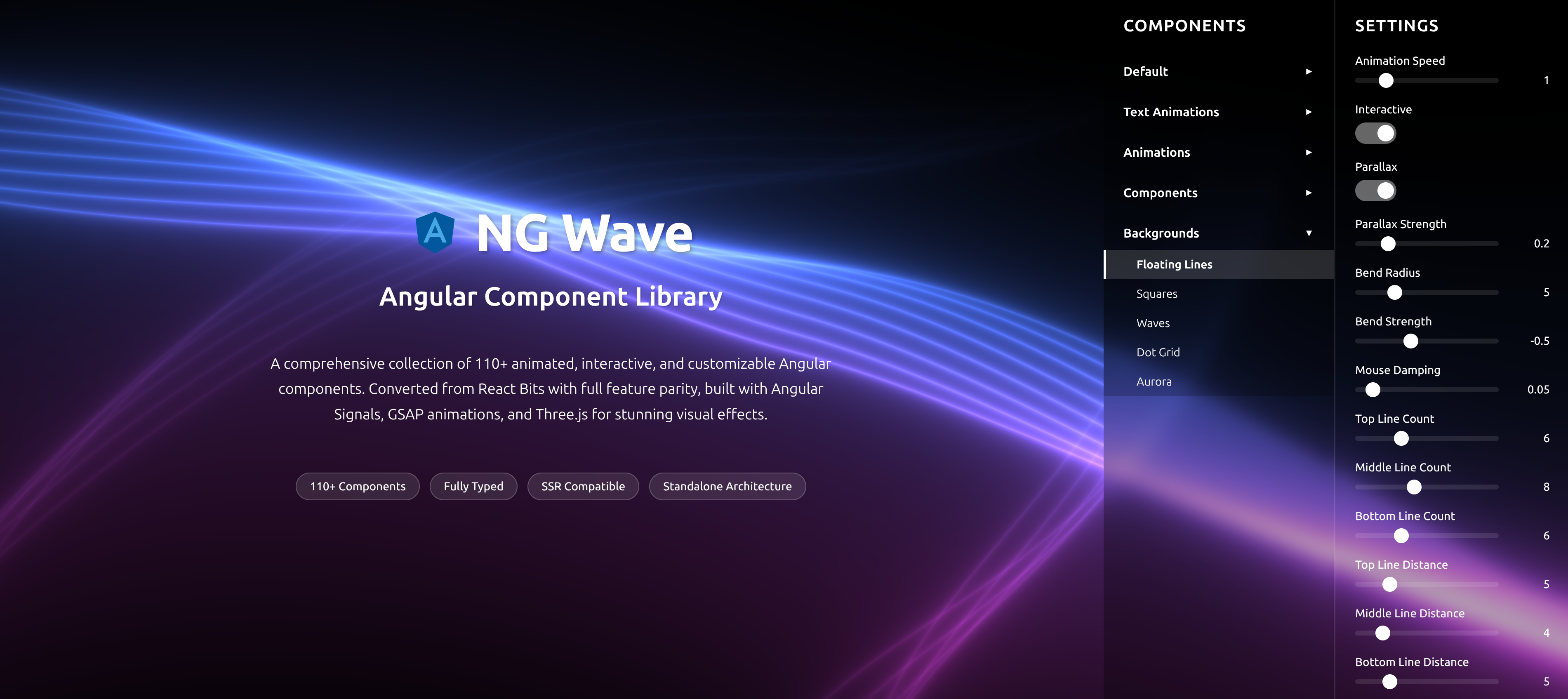
NG Wave
Angular Component Library
A comprehensive collection of 110+ animated, interactive, and customizable Angular components. Converted from React Bits with full feature parity, built with Angular Signals, GSAP animations, and Three.js for stunning visual effects.
Explore Components