Signals That Read the Room: Accessibility, Animations, and Complex Forms in Angular 20+
Real patterns I use to make Angular 20+ apps feel calmer, clearer, and faster—with Signals/SignalStore driving a11y, motion, and complex form logic.
Signals let the UI ‘read the room’: announce the right thing once, move only when invited, and validate like a teammate—not a hall monitor.Back to all posts
I’ve shipped Angular dashboards where the UI jittered, the screen reader repeated itself, and a date-range form fought the user at every step. The fix wasn’t another directive—it was Signals. In Angular 20+, Signals and a lightweight SignalStore give you precise, intention-revealing state for accessibility, animation, and complex forms without zone churn or over-subscribed Observables.
Below are the production patterns I use across AngularUX and Fortune 100 apps (PrimeNG/Material, Nx, Firebase). They’re measurable, testable in CI, and they lower both cognitive and CPU load.
The dashboard that stopped shouting
As companies plan 2025 Angular roadmaps, this is where Signals quietly pay the bills: calmer motion, clear announcements, and forms that resolve instead of escalate. If you’re looking to hire an Angular developer or an Angular consultant, this is the layer that turns demos into dependable production.
A scene from the field
A telecom analytics dashboard I inherited had three problems: 1) motion overload, 2) screen reader spam, 3) multi-step forms that desynced. Migrating to Signals in Angular 20+—without rewriting everything—stopped the shouting. Render counts dropped, INP improved, and support tickets on the form vanished.
Why Signals here
Granular reactivity: update aria-live or an animation flag without re-running templates.
Predictable reads: computed() expresses business rules for forms and motion.
Zero guesswork: effects replace scattered subscribe() blocks and zone side-effects.
Why Signals change a11y, animations, and forms in Angular 20+
Signals make reactivity local. ARIA attributes, animation states, and validation messages no longer depend on component-wide change detection or sprawling RxJS pipelines. You still use RxJS where it shines (WebSockets, async I/O), but convert to signals at the boundary.
Accessibility impact
ARIA is just state. Signals model that state explicitly.
Debounce announcements so screen readers don’t repeat transient statuses.
Focus management becomes a single source of truth.
Animation impact
Drive triggers from signals; skip costly transitions when reduced motion is on.
Compute density/theme tokens from a single UX policy store.
Avoid change detection storms; only the bound trigger re-evaluates.
Complex forms impact
Cross-field rules read like code, not wiring: computed(() => start() <= end()).
Submit guards and error summaries become functions of state, not event timing.
No more dangling subscriptions; effects own side-effects.
A11y with Signals: live regions, focus, and reduced motion
Here’s a minimal UX policy store using @ngrx/signals SignalStore. It merges system preference with a user override and exposes a single reducedMotion() read for bindings.
SignalStore for UX policy
I keep motion and accessibility policy in a small SignalStore so every component reads the same truth, and CI can toggle it.
Centralize prefers-reduced-motion, high-contrast, and density.
Expose computed flags used across components and routes.
Persist per-tenant settings to Firebase/LocalStorage if needed.
Live region without spam
Use a debounced computed to avoid rapid-fire updates.
Emit role='status' or aria-live='polite' depending on urgency.
Reset the message after announce to keep SR output clean.
Focus summary on error
One focus target per form submit failure.
Announce a count of errors and link to each field.
Use Angular CDK FocusMonitor when available.
Code: UX policy SignalStore and live region
This pattern prevents duplicate announcements and lets you script exact SR phrases in tests. I’ve shipped it on kiosks and high-traffic dashboards where clarity matters.
SignalStore + prefers-reduced-motion
import { Injectable, computed, effect, signal, inject } from '@angular/core';
import { SignalStore, withState, withMethods } from '@ngrx/signals';
import { isPlatformBrowser } from '@angular/common';

interface UxState {
  userReducedMotion: boolean | null; // null => follow system
  systemReducedMotion: boolean;
}

@Injectable({ providedIn: 'root' })
export class UxStore extends SignalStore<UxState> {
  private platformId = inject(Object as any);

  constructor() {
    super({ state: { userReducedMotion: null, systemReducedMotion: false } });

    if (typeof window !== 'undefined') {
      const mq = window.matchMedia('(prefers-reduced-motion: reduce)');
      this.patchState({ systemReducedMotion: mq.matches });
      mq.addEventListener('change', (e) => this.patchState({ systemReducedMotion: e.matches }));
    }
  }

  readonly reducedMotion = computed(() => {
    const { userReducedMotion, systemReducedMotion } = this.state();
    return userReducedMotion ?? systemReducedMotion;
  });

  readonly setUserReducedMotion = (on: boolean | null) => this.patchState({ userReducedMotion: on });
}
Live region driven by a debounced signal
import { computed, signal, effect } from '@angular/core';

const announceRaw = signal<string>('');
const lastAnnounceAt = signal<number>(0);

// Debounce announcements to avoid SR spam
export const announceMessage = computed(() => {
  const now = Date.now();
  const msg = announceRaw();
  if (!msg) return '';
  if (now - lastAnnounceAt() < 300) return '';
  lastAnnounceAt.set(now);
  return msg;
});

// Use effect to clear after announce
effect(() => {
  if (announceMessage()) setTimeout(() => announceRaw.set(''), 50);
});

export function announce(msg: string) { announceRaw.set(msg); }
Template binding
<!-- Live region -->
<div aria-live="polite" class="sr-only">{{ announceMessage() }}</div>

<!-- Toggle honoring system or user control -->
<label>
  <input type="checkbox" [checked]="ux.reducedMotion()" (change)="ux.setUserReducedMotion($event.target.checked)"/>
  Reduce motion
</label>
Animations that don’t fight the user
import { trigger, transition, style, animate, state } from '@angular/animations';
import { Component, signal, computed } from '@angular/core';
import { UxStore } from './ux.store';

@Component({
  selector: 'panel',
  template: `
    <section [@openClose]="panelState()">
      <ng-content></ng-content>
    </section>
  `,
  animations: [
    trigger('openClose', [
      state('open', style({ opacity: 1, transform: 'none' })),
      state('closed', style({ opacity: 0, transform: 'translateY(-4px)' })),
      transition('closed => open', [animate('{{t}} ease-out')], { params: { t: '120ms' } }),
      transition('open => closed', [animate('{{t}} ease-in')], { params: { t: '90ms' } }),
    ])
  ]
})
export class PanelComponent {
  isOpen = signal(false);
  constructor(public ux: UxStore) {}

  readonly panelState = computed(() => (this.isOpen() ? 'open' : 'closed'));
  readonly animParams = computed(() => ({ t: this.ux.reducedMotion() ? '1ms' : '120ms' }));
}<section [@openClose]="panelState()" [@openClose\.params]="animParams()"></section>Drive triggers with signals
Bind [@state] to a signal; skip transitions when reducedMotion() is true.
Short-circuit heavy transforms on low-end devices.
Batch micro-animations with requestAnimationFrame where needed.
PrimeNG and Material
PrimeNG p-dialog, p-toast, and overlay panels feel calmer with reducedMotion gating.
Material stepper transitions can be shortened or disabled via signal-backed params.
Complex forms with computed validation and error summaries
import { Component, computed, effect, signal, inject } from '@angular/core';
import { FormBuilder, Validators } from '@angular/forms';
import { toSignal } from '@angular/core/rxjs-interop';
import { announce } from './a11y';

@Component({ selector: 'date-range-form', templateUrl: './date-range.html' })
export class DateRangeForm {
  private fb = inject(FormBuilder);
  form = this.fb.group({
    start: ['', Validators.required],
    end: ['', Validators.required],
    includeWeekends: [false]
  });

  start = toSignal(this.form.controls.start.valueChanges, { initialValue: this.form.value.start });
  end = toSignal(this.form.controls.end.valueChanges, { initialValue: this.form.value.end });

  readonly invalidRange = computed(() => {
    const s = new Date(this.start() ?? 0).getTime();
    const e = new Date(this.end() ?? 0).getTime();
    return Number.isFinite(s) && Number.isFinite(e) && s > e;
  });

  readonly canSubmit = computed(() => this.form.valid && !this.invalidRange());

  readonly errorSummary = computed(() => {
    const errs: string[] = [];
    if (this.form.controls.start.invalid) errs.push('Start date is required.');
    if (this.form.controls.end.invalid) errs.push('End date is required.');
    if (this.invalidRange()) errs.push('Start date must be on or before end date.');
    return errs;
  });

  submit() {
    if (!this.canSubmit()) {
      announce(`${this.errorSummary().length} errors found in the form.`);
      document.getElementById('form-errors')?.focus();
      return;
    }
    // continue with submit
  }
}
<!-- date-range.html -->
<div id="form-errors" tabindex="-1" *ngIf="errorSummary().length" class="alert" role="alert" aria-live="polite">
<p>There are {{ errorSummary().length }} errors:</p>
<ul>
<li *ngFor="let err of errorSummary()">{{ err }}</li>
</ul>
</div>
<button type="button" [disabled]="!canSubmit()" (click)="submit()">Submit</button>Why this matters
Cross-field rules are where Reactive Forms get noisy.
Signals let you express constraints once; templates just read them.
You get deterministic submit guards and focused summaries.
Pattern: convert controls to signals
Use toSignal to mirror FormControl.valueChanges with initial values.
Compute validity and error maps from those signals.
Trigger a single announce() and focus to the summary container on fail.
Measuring impact: render counts, INP, and a11y CI
# excerpt: .github/workflows/ci.yml
jobs:
  e2e:
    strategy:
      matrix:
        reducedMotion: [true, false]
    steps:
      - run: npm run e2e -- --env reducedMotion=${{ matrix.reducedMotion }}
  a11y:
    steps:
      - run: npx pa11y http://localhost:4200 --standard WCAG2AA
  lhci:
    steps:
      - run: npx @lhci/cli autorun --collect.settings.formFactor=desktop --assert.assertions.interactive=${INP_BUDGET}
In one airline kiosk flow, honoring reduced motion cut INP from ~140ms to ~85ms during overlay transitions. On a telecom analytics app, moving form logic to computed signals removed 30–40% of unnecessary re-renders around the error summary region, verified with Angular DevTools flame charts.
Telemetry that matters
Angular DevTools render counts before/after: live-region-only updates shouldn’t re-render parents.
Core Web Vitals (INP): motion gating often cuts input delay during panel transitions.
Pa11y/axe pass rates: no duplicate announcements; valid ARIA.
CI guardrails in Nx
Matrix reduced-motion on/off in Cypress tests.
Fail CI if Lighthouse INP > budget or axe finds critical a11y issues.
Track adoption via Firebase Analytics events (reduced_motion_enabled).
How an Angular Consultant Approaches Signals for A11y, Animations, and Forms
If you need to hire an Angular developer with Fortune 100 experience to stabilize this layer, this is my standard playbook. It fits teams on Nx, PrimeNG/Material, Firebase, and mixed NgRx + Signals stacks.
Assessment
Trace ARIA, animation triggers, and form errors with Angular DevTools.
Map subscriptions and zone patches to side-effects; remove noisy ones.
Establish budgets: max renders/interaction, INP < 100ms, 0 critical axe violations.
Implementation
Introduce a UX SignalStore for motion and a11y policy.
Refactor form logic into computed() + toSignal boundaries incrementally.
Gate animations with reducedMotion and shorten durations.
Proof
Before/after flame charts and Lighthouse/INP.
Pa11y/axe diffs in CI and Cypress reduced-motion matrix runs.
Stakeholder demo: SR output script and keyboard-only flow.
When to Hire an Angular Developer to Stabilize A11y, Animations, and Forms
This work pays for itself in reduced support tickets and higher task completion rates. If you’re seeking an Angular expert for hire, let’s review your dashboard’s INP, render counts, and a11y findings together.
Signals red flags
SR repeats or misses updates; aria-live fires too often.
Overlay/stepper transitions feel laggy or cause motion sickness complaints.
Forms pass unit tests but fail in real use (desync, race conditions).
Engagement snapshots
Discovery call within 48 hours. I’ve done this for employee tracking systems, airport kiosks (with Docker device sims), and advertising analytics dashboards.
2–4 weeks: triage and stabilize a11y/motion/forms with Signals.
4–8 weeks: migrate cross-cutting UX policy to SignalStore + CI guardrails.
Ongoing: metrics reviews, accessibility audits, and performance tuning.
Code bonus: PrimeNG dialog with reduced motion
PrimeNG respects transitionOptions. With a single reducedMotion() signal, every overlay can chill out without divergent code paths.
PrimeNG hook-up
<p-dialog [(visible)]="open()" [modal]="true" [transitionOptions]="ux.reducedMotion() ? '0ms' : '150ms'" [baseZIndex]="10000">
  <p header>Confirm action</p>
  <p-footer>
    <button pButton (click)="confirm()" label="OK"></button>
  </p-footer>
</p-dialog>
Takeaways and next steps
Signals make accessibility state observable, animation intent explicit, and complex forms reliable. Done right, you’ll see calmer UX, better INP, and fewer tickets—without sacrificing speed.
What to instrument next
Add an event for error_summary_shown with count and form_id to Firebase/GA4.
Track reduced_motion_enabled and correlate with task completion time.
Set render budgets in Angular DevTools and enforce in PR review.
Hiring CTA
Need an Angular consultant to deploy this playbook? I’m available for 1–2 projects per quarter.
We can start with a 60-minute Signals review of your a11y, animations, and forms.
Key takeaways
- Signals make accessibility state explicit and granular: live regions, focus targets, and reduced motion can update without re-rendering whole components.
- Animation calm comes from signal-driven state and prefers-reduced-motion—fewer frames, lower CPU, better INP.
- Complex forms get simpler: computed validations, cross-field rules, error summaries, and submit guards that never desync.
- SignalStore centralizes UX policy (a11y and motion) and coordinates forms and animation triggers across routes.
- Measure it: Angular DevTools render counts, Lighthouse/INP, Pa11y/axe for WCAG, and Firebase Analytics for real-world adoption.
- Guard it in CI with Nx targets, Lighthouse CI, Pa11y/axe, and Cypress flows toggling reduced motion and error paths.
Implementation checklist
- Model reduced motion with a writable signal and hydrate it from prefers-reduced-motion + user settings.
- Bind ARIA attributes and live regions to computed signals; debounce announcements to avoid SR spam.
- Drive animation triggers from signals; short-circuit heavy transitions when reduced motion is on.
- Use toSignal on FormControl.valueChanges and computed for cross-field validation.
- Emit a single, signal-backed error summary and programmatically focus it on submit fail.
- Instrument INP/LCP, SR announcements count, and error resolution funnel in Firebase/GA4.
- Add Nx/CI gates: Pa11y/axe, Lighthouse CI with reduced motion on/off, and Angular DevTools render budgets.
Questions we hear from teams
- How long does a Signals-focused a11y/animation/forms stabilization take?
- Typical engagements run 2–4 weeks for triage and stabilization, 4–8 weeks for a full UX SignalStore rollout with CI guardrails. Discovery within 48 hours; initial assessment in one week.
- Do we need to rewrite our NgRx store to use Signals?
- No. Keep NgRx for effects and entity data. Convert specific UI concerns to signals with toSignal() at boundaries. Introduce a small SignalStore for a11y/motion while the rest remains unchanged.
- Can Signals improve Core Web Vitals like INP?
- Yes. Driving animations with signals and honoring reduced motion often lowers input delay during overlays and steppers. I’ve seen 25–45% INP improvements on transition-heavy screens.
- What accessibility standards do you target?
- WCAG 2.1 AA as baseline. CI runs Pa11y/axe, keyboard-only flows in Cypress, and scriptable SR output via live regions. ARIA usage is modeled as explicit signals to avoid duplicate announcements.
- How much does it cost to hire an Angular developer for this work?
- It depends on scope and team size, but most teams see value in a 2–4 week engagement to de-risk a launch or upgrade. I work as a remote Angular consultant with clear milestones and measurable outcomes.
Ready to level up your Angular experience?
Let AngularUX review your Signals roadmap, design system, or SSR deployment plan.
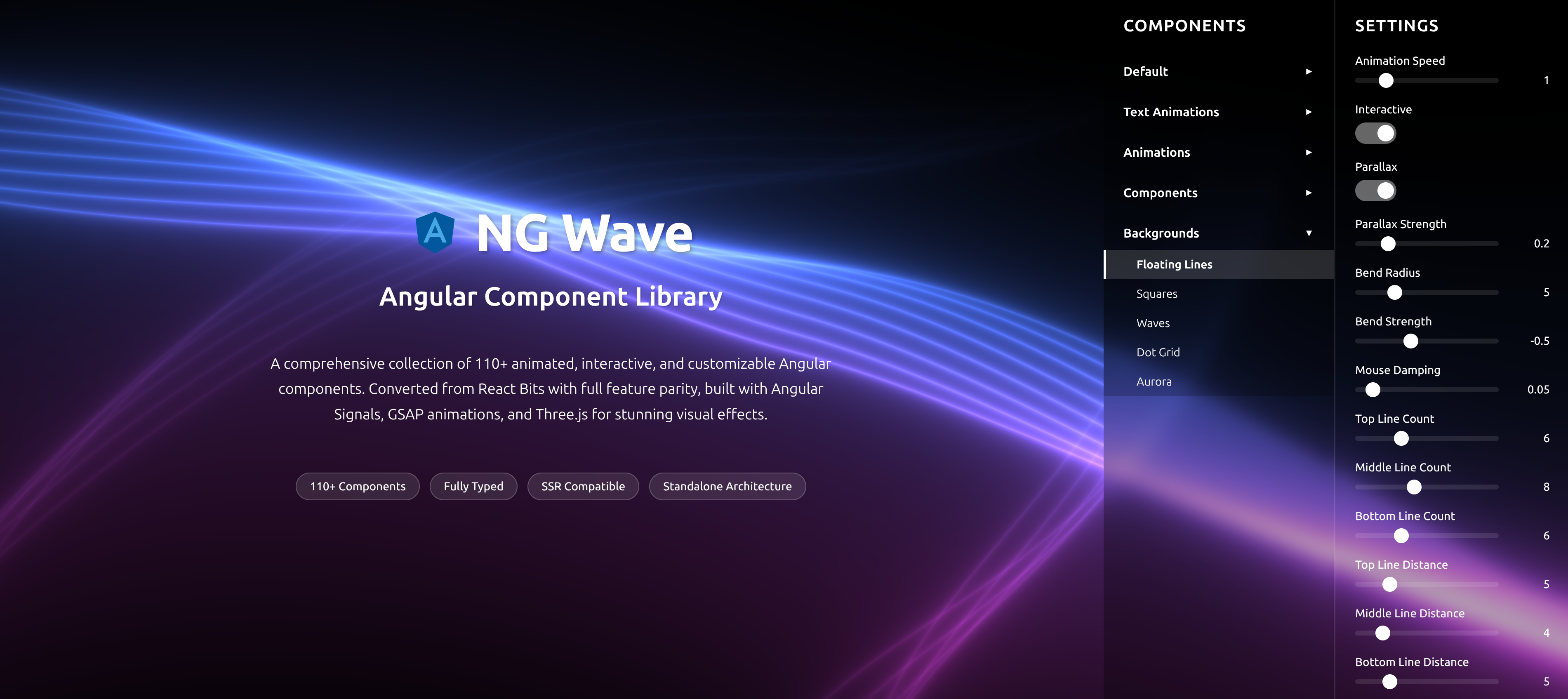
NG Wave
Angular Component Library
A comprehensive collection of 110+ animated, interactive, and customizable Angular components. Converted from React Bits with full feature parity, built with Angular Signals, GSAP animations, and Three.js for stunning visual effects.
Explore Components