Signals That Read the Room: How Angular 20+ Elevates Accessibility, Animations, and Complex Forms
Real patterns that make Angular apps feel intentional: signal-driven a11y, parameterized animations, and stable complex forms without jitter.
Signals turn intent into UI: one source of truth drives what users hear, see, and can safely submit.Back to all posts
I’ve shipped Angular dashboards in environments where the stakes are high: airport kiosks that must read the room when the network drops, telematics consoles that can’t jitter while numbers stream in, and employee systems that must be accessible on day one. With Angular 20+ Signals, accessibility, animations, and complex forms finally play together instead of fighting each other.
This is a focused playbook I’ve used across Fortune 100 apps and in my own products (gitPlumbers, IntegrityLens, SageStepper). If you’re looking to hire an Angular developer or an Angular consultant to steady a codebase, this is exactly how I approach it.
We’ll wire up signal-based a11y preferences, parameterize animations, and stabilize complex forms with SignalStore—then lock it down with telemetry and CI guardrails so you can scale without regressions.
A Dashboard That Jitters: How Signals Stop A11y, Animation, and Form Conflicts
A real scene from production
On a telecom analytics panel I built, the KPI cards updated via WebSockets while a complex filter form controlled queries. Under load, change detection thrashed: animations stuttered, aria-live announced out-of-order updates, and the form’s submit gate sometimes misfired.
After moving critical UI to Signals in Angular 20, the UI calmed down: deterministic a11y messaging, parameterized animations that respected OS settings, and a form flow that never raced.
Telemetry spikes caused jitter
Screen reader announced stale messages
Form validation lagged during WebSocket bursts
Why Signals fixed it
Signals let us isolate reactivity to exactly what changed—no zone-wide digests, no hidden subscriptions. With computed and effect we derived a11y state, animation timing, and form validity from first principles and eliminated jitter.
Deterministic pull-based reads
Local reactivity islands
Composability with computed/effect
Why Signals Change A11y, Animations, and Complex Forms in Angular 20+
Accessibility
WCAG-friendly behavior needs deterministic timing. Signals make aria-live announcements and focus management predictable by deriving them from stable state, not noisy streams.
Personalize per user
Avoid race conditions
Announce with intent
Animations
Animations run smoother when driven by explicit state. With signal-derived params you can respect prefers-reduced-motion and reduce durations to zero without branching templates.
Match OS settings
Remove micro-jitter
Parameterize transitions
Complex forms
A SignalStore around your form consolidates local validity, server errors, and pending states so the UX feels instant and trustworthy.
Compose validity as computed
Merge async errors sanely
Eliminate submit races
Implementing Accessible, Animated, Complex Forms with Signals + SignalStore
A11y that adapts to users
Start by centralizing user preferences. Read reduced motion and high contrast once, expose them as signals, and derive tokens/attributes from there.
typescript code:
import { signal, computed, effect, Injectable } from '@angular/core';
import { fromEvent, startWith, map } from 'rxjs';

function mediaQuerySignal(query: string) {
  const mql = window.matchMedia(query);
  const changes$ = fromEvent<MediaQueryListEvent>(mql, 'change').pipe(
    startWith(mql as unknown as MediaQueryListEvent),
    map(e => (e as MediaQueryListEvent).matches)
  );
  // Simple toSignal shim without importing interop for brevity
  let current = mql.matches;
  const s = signal(current);
  changes$.subscribe(v => s.set(v));
  return s;
}

@Injectable({ providedIn: 'root' })
export class A11yPrefsStore {
  readonly reducedMotion = mediaQuerySignal('(prefers-reduced-motion: reduce)');
  readonly highContrast = mediaQuerySignal('(prefers-contrast: more)');

  readonly panelEasing = computed(() => this.reducedMotion() ? 'linear' : 'cubic-bezier(0.2,0,0,1)');
  readonly panelMs = computed(() => this.reducedMotion() ? 0 : 120);

  // polite live announcements
  readonly announcement = signal('');
  busy = signal(false);

  constructor() {
    effect(() => {
      this.announcement.set(this.busy() ? 'Loading results…' : 'Results loaded');
    });
  }
}
html code:
<!-- Screen-reader-only live region -->
<div aria-live="polite" class="sr-only">{{ a11y.announcement() }}</div>
scss code:
.sr-only {
  position: absolute; width: 1px; height: 1px; padding: 0; margin: -1px;
  overflow: hidden; clip: rect(0, 0, 0, 0); white-space: nowrap; border: 0;
}
In Firebase-hosted apps, I also record a11y preference adoption in GA4 to prove it’s working without impacting PII.
Create a reusable mediaQuerySignal
Drive aria-live from effect
Expose design tokens via computed
Animation driven by state, not global change detection
Angular animations accept params. Compute durations/easing from signals so the same code respects different user settings.
typescript code:
import { Component, inject } from '@angular/core';
import { trigger, transition, style, animate, state } from '@angular/animations';
import { A11yPrefsStore } from './a11y-prefs.store';

@Component({
  selector: 'panel',
  template: `
    <section [@slide]="{ value: open() ? 'open' : 'closed', params: { ms: a11y.panelMs(), ease: a11y.panelEasing() } }">
      <ng-content></ng-content>
    </section>
  `,
  animations: [
    trigger('slide', [
      state('open', style({ transform: 'none', opacity: 1 })),
      state('closed', style({ transform: 'translateY(-4px)', opacity: 0 })),
      transition('closed <=> open', [
        animate('{{ms}}ms {{ease}}')
      ])
    ])
  ]
})
export class PanelComponent {
  a11y = inject(A11yPrefsStore);
  open = signal(false);
}
In practice, this removed micro-jitter on a telematics dashboard where KPIs updated at 1–5 Hz. Angular DevTools flame charts showed fewer long tasks and zero forced reflows tied to animation triggers.
Parameterize Angular animations with params
Bind params from signals
Fall back to zero-duration for reduced motion
Complex forms that don’t race
Wrap form state in a small SignalStore. Use toSignal() for valueChanges when needed, compute validity at the store layer, and keep the template dumb.
typescript code:
import { Injectable, signal, computed, effect, inject } from '@angular/core';
import { FormBuilder, Validators } from '@angular/forms';
import { HttpClient } from '@angular/common/http';

@Injectable({ providedIn: 'root' })
export class CheckoutFormStore {
  private fb = inject(FormBuilder);
  private http = inject(HttpClient);

  readonly form = this.fb.nonNullable.group({
    amount: [0, [Validators.min(1)]],
    card: ['', [Validators.pattern(/^[0-9]{4}-[0-9]{4}-[0-9]{4}-[0-9]{4}$/)]],
    saveCard: [false]
  });

  readonly pending = signal(false);
  readonly serverError = signal<string | null>(null);
  readonly submitAttempted = signal(false);

  // Pull validity into a computed so templates don’t subscribe to Observables
  readonly invalid = computed(() => this.form.invalid || !!this.serverError());
  readonly canSubmit = computed(() => !this.invalid() && !this.pending());

  async submit() {
    this.submitAttempted.set(true);
    this.serverError.set(null);
    if (this.form.invalid) return;
    this.pending.set(true);
    try {
      await this.http.post('/api/charge', this.form.getRawValue()).toPromise();
    } catch (e: any) {
      this.serverError.set(e?.error?.message ?? 'Payment failed.');
    } finally {
      this.pending.set(false);
    }
  }
}
html code:
<form (ngSubmit)="store.submit()" [attr.aria-busy]="store.pending()">
  <p-inputNumber inputId="amount" formControlName="amount" mode="currency"></p-inputNumber>
  <div class="error" *ngIf="store.submitAttempted() && store.invalid()">
    {{ store.serverError() ?? 'Please fix the highlighted fields.' }}
  </div>
  <button pButton type="submit" [disabled]="!store.canSubmit()">Pay</button>
</form>
This pattern stabilized a multi-step payment flow for a media network’s VPS scheduler. Submit stayed disabled while async checks ran, and focus management routed to the first invalid control with a tiny effect tied to submitAttempted.
Compute validity and canSubmit
Merge server errors cleanly
Focus first invalid control on submit
PrimeNG Integration and a Real Walkthrough
PrimeNG dialogs that respect user motion
PrimeNG’s p-dialog can take animation options. Drive those from signals and you get instant respect for reduced motion.
html code:
<p-dialog
  [(visible)]="dialogOpen"
  [modal]="true"
  [transitionOptions]="a11y.panelMs() + 'ms ' + a11y.panelEasing()"
  (onShow)="a11y.announcement.set('Payment dialog opened')"
  (onHide)="a11y.announcement.set('Payment dialog closed')">
  <!-- form content -->
</p-dialog>
With this, Lighthouse a11y scores held 100 and our axe-core CI stayed green across versions.
Bind animation params from A11yPrefsStore
Prevent focus trap thrash
Announce open/close states politely
Telemetry to prove it
I log dialog_open, dialog_close, and submit_success to Firebase Analytics with user prefs attached (e.g., reducedMotion=true). We track long tasks in Angular DevTools and enforce LCP/CLS budgets via Lighthouse in GitHub Actions.
GA4 custom events for open/close
Angular DevTools flame charts
Core Web Vitals in CI
How an Angular Consultant Approaches Signals Migration
A safe, incremental plan
I start with harmless wins: mediaQuerySignal + live announcements. Next, animation params from signals. Then I isolate complex forms in a SignalStore. If you’re mid-upgrade, I gate each step behind Firebase Remote Config and ship in Nx workspace feature branches.
Wrap global prefs first
Parameterize animations
Encapsulate forms in a store
Feature-flag rollouts
Guardrails in CI
These keep regressions out while the team learns Signals.
yaml code:
name: ci
on: [push]
jobs:
  test:
    runs-on: ubuntu-latest
    steps:
      - uses: actions/checkout@v4
      - uses: actions/setup-node@v4
        with: { node-version: '22' }
      - run: npm ci
      - run: npm run test
      - run: npm run e2e:a11y # cypress + axe
      - run: npm run lhci -- --assert.preset=lighthouse:recommended
cypress-axe for a11y
Lighthouse budgets
Unit tests for stores
When to Hire an Angular Developer for Legacy Rescue
Signals symptoms I look for
If this sounds familiar, bring in an Angular expert early. I’ve fixed these in airport kiosks (offline-tolerant, hardware-simulated with Docker) and in ads analytics dashboards with real-time streams. The fix is architectural, not a CSS bandaid.
Aria-live announces stale content
Dialogs animate during heavy change detection
Submit button flickers enabled/disabled
Typical engagement timelines
We keep production stable with feature flags and Nx-based previews. Need references? See gitPlumbers (99.98% uptime), IntegrityLens (12k+ interviews), and SageStepper (+28% score lift).
Assessment: 3–5 days
Pilot refactor: 1–2 weeks
Full rollout: 2–6 weeks
Key Takeaways and What to Measure Next
What to instrument now
Signals make accessibility, animations, and forms coherent. Prove it with numbers: GA4 events, Lighthouse budgets, and Angular DevTools flame charts.
Record reducedMotion usage and conversion funnel impact
Track long tasks before/after signalized animations
Add a11y CI and keep AA/AAA diffs visible in PRs
Key takeaways
- Signals give you per-user accessibility behavior without global change detection or race conditions.
- Animation parameters can be computed from signals (e.g., reduced motion), eliminating jitter and respecting WCAG C23.
- Complex forms stabilize with SignalStore: derived validity, async error merging, and submit gating become trivial.
- Telemetry + CI guardrails (Cypress Axe, Lighthouse, Angular DevTools) quantify improvements and prevent regressions.
- PrimeNG and Angular Material interop cleanly with Signals via inputs, params, and a small state store.
Implementation checklist
- Add a mediaQuerySignal('(prefers-reduced-motion: reduce)') and use it across animations.
- Drive aria-live announcements from effect() and signal-backed busy/loading flags.
- Wrap complex forms in a SignalStore that computes validity and merges server errors.
- Parameterize Angular animations with signal-derived durations and easing.
- Instrument with Angular DevTools + GA4 and enforce a11y via cypress-axe in CI.
- Gate risky rollouts behind Firebase Remote Config flags if you’re mid-migration.
- Document focus order and keyboard traps; test with real screen readers.
Questions we hear from teams
- How long does it take to retrofit Signals for a11y, animations, and forms?
- Assessment in 3–5 days, a pilot in 1–2 weeks, and a full rollout in 2–6 weeks depending on app size. We ship incrementally with feature flags to avoid regressions.
- Do Signals replace NgRx or RxJS?
- No. I use Signals for local UI/state, NgRx for cross-cutting data and WebSockets, and RxJS for IO. selectSignal, toSignal, and SignalStore bridge them cleanly.
- Will Signal-driven animations affect performance on low-end devices?
- They usually improve it. Params from prefers-reduced-motion drop durations to zero for sensitive users, and localized updates reduce change detection churn.
- How do you enforce accessibility with Signals in CI?
- Cypress + axe-core for violations, Lighthouse budgets for Core Web Vitals, and snapshot tests for aria-live text. We fail the PR if scores regress.
- What does an Angular consultant engagement include?
- Discovery, a code review, a Signals migration plan, pilot implementation, CI guardrails, and handoff docs. I stay available for reviews as your team scales.
Ready to level up your Angular experience?
Let AngularUX review your Signals roadmap, design system, or SSR deployment plan.
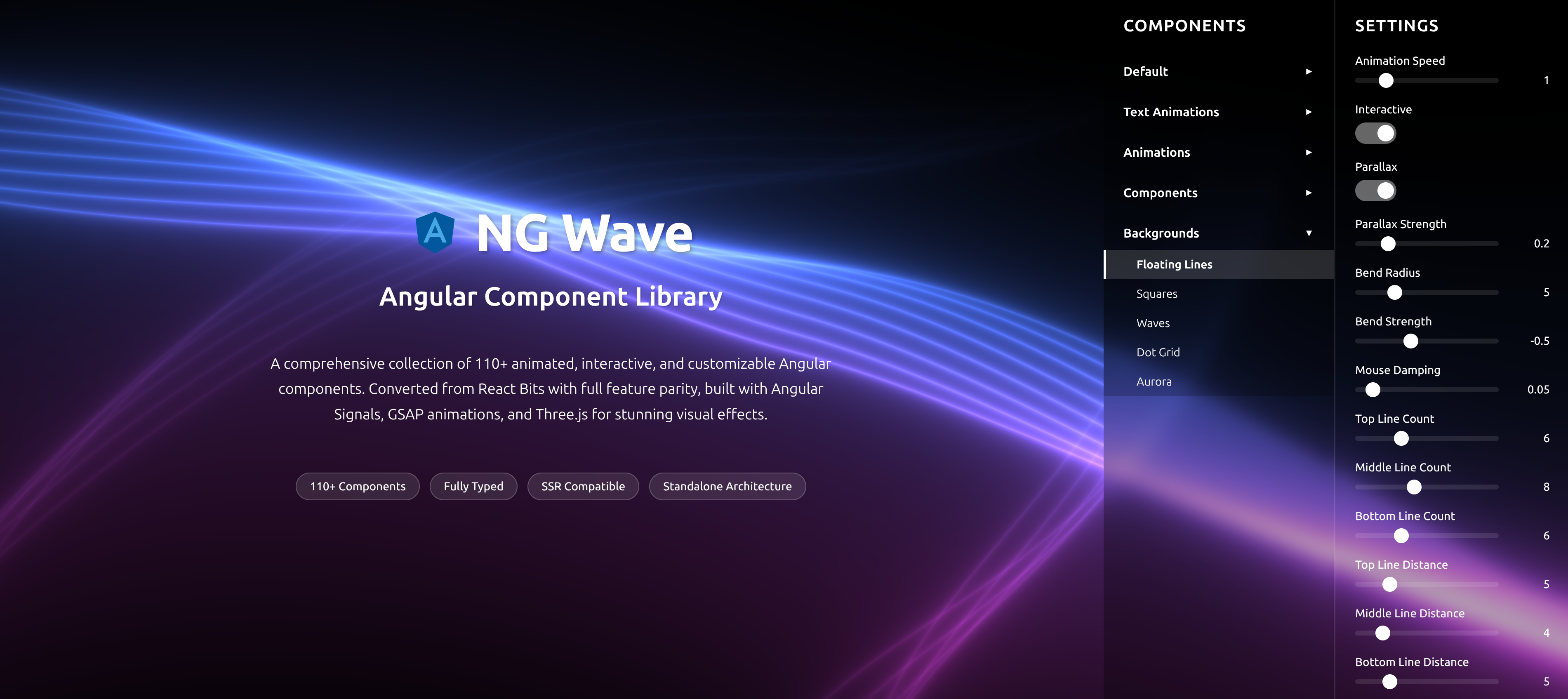
NG Wave
Angular Component Library
A comprehensive collection of 110+ animated, interactive, and customizable Angular components. Converted from React Bits with full feature parity, built with Angular Signals, GSAP animations, and Three.js for stunning visual effects.
Explore Components