Stabilizing AI‑Generated Angular 20+ Code Without Freezing Delivery: Signals + SignalStore, Feature Flags, and CI Guardrails
Real case studies where I hardened AI‑generated Angular 20+ apps while velocity stayed green—no code freezes, no rewrites, just disciplined stabilization.
“We stabilized AI‑generated Angular code while features kept shipping—Signals + SignalStore, flags, and CI budgets turned chaos into measurable wins.”Back to all posts
I’m Matthew Charlton. Over the last 10+ years I’ve inherited more AI‑generated Angular code than I care to admit—dashboards that jitter under load, components with 1,000‑line constructors, and “helper” services that mutate state from four places. Freezing delivery wasn’t an option. Stakeholders still needed features, execs still watched KPIs.
This case study shows exactly how I stabilized AI‑generated Angular 20+ apps in telecom analytics, IoT device management, and entertainment operations—using Signals + SignalStore, feature‑flagged refactors, and CI guardrails—while sprint velocity stayed green. If you’re looking to hire an Angular developer or Angular consultant to rescue a chaotic codebase without a rewrite, this is the playbook I run.
The AI‑Generated Angular Spiral: Jittery Dashboards and Failing E2E in Prod‑Like Data
As companies plan 2025 Angular roadmaps, AI copilots are everywhere. They’re fantastic accelerators, but they also produce brittle patterns if you don’t enforce architecture. The goal wasn’t to shame AI code—it was to harden it, keep delivering, and give teams repeatable patterns.
Common symptoms I see on arrival
At a leading telecom provider, an ads analytics dashboard generated via mixed AI prompts shipped quickly—but under real traffic, charts stuttered and queries doubled. A global entertainment company’s employee tracking portal saw memory grow 1–2 MB/min. In an IoT device portal, barcode scans occasionally vanished mid‑flow. Different sectors, same root causes: vibe‑coded state, side‑effects in components, and zero guardrails.
Janky charts and tables when data spikes
Memory bloat after long sessions
Flaky Cypress tests and fragile selectors
‘Helper’ services mutating state anywhere
Shadow HTTP calls triggered by change detection
Why Angular 20 Teams Can’t Freeze Delivery to Fix AI‑Code Debt
Angular 20+ gives us the right primitives—Signals, SignalStore, Vite builder, strict TypeScript—to replace vibe‑coded state gradually. Pair that with Firebase Analytics/Performance, Angular DevTools, and CI budgets, and you can prove stabilization without halting delivery.
Business reality
Freezes kill momentum and morale. Instead, we run hardening in‑flight: stabilize the riskiest paths behind flags, instrument them, then expand coverage across the app. It’s safer and faster than a ‘big‑bang’ refactor—and your roadmap survives.
Feature commitments keep the lights on
Code freezes lose confidence
Stakeholders demand measurable risk reduction
How an Angular Consultant Approaches AI‑Generated Code Stabilization
Here’s a minimal example of the pattern we drop into AI‑generated areas.
1) Triage with observability first
Before touching code, I instrument. At the telecom dashboard, we traced ‘chart_update’ and ‘filter_apply’ events; at the IoT portal, we tagged device operations by model. You can’t fix what you can’t measure.
Wire Firebase Performance + crash reporting
Add custom traces for route loads and chart updates
Tag traces by tenant/role to isolate hotspots
2) Feature‑flagged hardening
Flags let us deploy stabilization work continuously. Product still ships. Ops gets a kill switch. We track adoption and regressions per cohort.
Introduce FeatureFlagService
Wrap risky routes/components
Roll out by role/tenant
3) Replace vibe‑coded state with Signals + SignalStore
Signals drastically reduce render churn; SignalStore centralizes mutation and side‑effects. We keep the component API identical so we can flip the flag off if needed.
Move mutation out of components
Centralize effects and retries
Expose derived state via computed signals
4) Typed events, backoff, and circuit breakers
Typed events eliminated class‑of‑errors from AI‑generated handlers. Backoff cured retry storms during provider outages.
WebSocket/HTTP schemas
Exponential retry with jitter
Temporary circuit breakers for noisy dependencies
5) CI guardrails and budgets
Guardrails turn ‘works on my machine’ into ‘provably better’. GitHub Actions blocks merges that harm performance or stability.
Cypress smoke per critical path
Lighthouse/Performance budgets
Fail build on render‑count regression
Signals + SignalStore Pattern with Typed Effects
// app/stores/chart.store.ts
import { signal, computed, effect } from '@angular/core';
import { createStore } from '@ngrx/signals';
import { HttpClient } from '@angular/common/http';

export type ChartPoint = { ts: number; value: number };
export type ChartState = {
  points: ChartPoint[];
  loading: boolean;
  error?: string;
  retries: number;
};

export function createChartStore(http: HttpClient) {
  const initial: ChartState = { points: [], loading: false, retries: 0 };

  const store = createStore({
    state: signal(initial),
    load: async (range: { from: number; to: number }) => {
      store.patch(s => ({ ...s, loading: true, error: undefined }));
      let attempt = 0;
      while (attempt < 4) {
        try {
          const data = await http
            .get<ChartPoint[]>(`/api/chart?from=${range.from}&to=${range.to}`)
            .toPromise();
          store.patch(s => ({ ...s, points: data ?? [], loading: false, retries: attempt }));
          return;
        } catch (e: any) {
          attempt++;
          const backoff = Math.min(8000, 300 * Math.pow(2, attempt)) + Math.random() * 100;
          await new Promise(r => setTimeout(r, backoff));
          if (attempt >= 4) {
            store.patch(s => ({ ...s, loading: false, error: e?.message ?? 'load_failed' }));
            return;
          }
        }
      }
    },
    reset: () => store.set(initial),
  });

  const points = computed(() => store.state().points);
  const busy = computed(() => store.state().loading);
  const error = computed(() => store.state().error);

  // Example: keep derived aggregates signalized to prevent jank.
  const avg = computed(() => {
    const p = points();
    if (!p.length) return 0;
    return Math.round((p.reduce((a, b) => a + b.value, 0) / p.length) * 100) / 100;
  });

  // Effect: if error persists, emit telemetry signal (hook into GA4/Firebase)
  effect(() => {
    const err = error();
    if (err) {
      // window.gtag('event', 'chart_load_error', { err });
    }
  });

  return { store, points, busy, error, avg };
}
// app/services/feature-flag.service.ts
import { Injectable, signal } from '@angular/core';
@Injectable({ providedIn: 'root' })
export class FeatureFlagService {
private flags = signal<Record<string, boolean>>({
'stabilized-charts': false,
});
isOn(key: string) { return !!this.flags()[key]; }
set(key: string, value: boolean) { this.flags.update(f => ({ ...f, [key]: value })); }
}<!-- component.html -->
<ng-container *ngIf="flags.isOn('stabilized-charts'); else legacy">
<app-stable-chart [points]="chart.points()" [busy]="chart.busy()" [avg]="chart.avg()"></app-stable-chart>
</ng-container>
<ng-template #legacy>
<!-- Existing AI-generated chart code remains for safe rollback -->
<app-legacy-chart></app-legacy-chart>
</ng-template># .github/workflows/ci.yml
name: ci
on: [push]
jobs:
test:
runs-on: ubuntu-latest
steps:
- uses: actions/checkout@v4
- uses: pnpm/action-setup@v3
with: { version: 9 }
- run: pnpm install --frozen-lockfile
- run: pnpm nx affected -t lint,test,build --parallel=3
- run: pnpm cypress run --component --browser chrome --headless
- name: Lighthouse budget
run: pnpm lighthouse-ci --budget-file=./budgets.json
- name: Guard render counts
run: pnpm nx run tools:render-budget-checkStore with retry and backpressure
Feature flag wrapper
CI budget example (GitHub Actions)
Case Studies: Telecom Analytics, IoT Device Management, Global Entertainment Portal
These are the same stabilization moves I use in my own products. gitPlumbers keeps 99.98% uptime during complex modernizations and drives 70% delivery velocity increase. IntegrityLens has processed 12k+ interviews with multi‑layered verification. SageStepper supports 320+ communities with a +28% score lift. When stabilization patterns are repeatable, they scale across industries.
Telecom analytics dashboard (real‑time ads KPIs)
Intervention: Replaced component state with a SignalStore, added typed event schemas for WebSockets, feature‑flagged stabilized charts, and added CI budgets. Measurable result: render counts down 46%, Core Web Vitals CLS stabilized to <0.02, e2e flakiness down 70%. Velocity maintained (no missed sprint).
Challenge: Jittery charts, duplicate requests, flaky e2e
Enterprise IoT device management portal
Intervention: Added Dockerized hardware simulation in CI to replicate scanners/printers, introduced backpressure + retries in a SignalStore for device events, and offline‑tolerant queues. Measurable result: crash‑free sessions 99.96% → 99.985%, MTTR down 43%. Delivery continued with weekly releases.
Challenge: Lost barcode scans, memory growth in long sessions
Global entertainment operations (employee tracking/payments)
Intervention: Zoned state to Signals, introduced a small RBAC‑aware FeatureFlagService, standardized PrimeNG components with design tokens, and added Firebase Performance traces. Measurable result: 32% fewer renders on core screens, P95 route load -28%, and accessibility AA passed on forms.
Challenge: AI‑generated pages with mutable services and hidden side‑effects
When to Hire an Angular Developer for Legacy Rescue
If you need a remote Angular developer with Fortune 100 experience, I’m currently accepting 1–2 projects per quarter. We can review your AI‑generated code, plan a Signals adoption path, and stand up guardrails without halting the roadmap.
Signals you need help now
If this reads like your sprint review, bring in an Angular consultant for a 1‑week stabilization assessment. We’ll baseline telemetry, identify top 3 hotspots, and ship a feature‑flagged fix inside the same sprint. You keep shipping; risk and noise go down.
Feature work routinely breaks adjacent flows
Crash‑free sessions <99.9% or P95 route >2.5s
Developers copy/paste state logic into components
E2E flakiness >5% week‑to‑week
What to Instrument Next
Minimum viable guardrails
Action beats anxiety. Instrument these four and you’ll see exactly where AI‑generated code is hurting you—and what to fix first. Then we graduate to SSR hydration checks and tenant‑level telemetry if needed.
Firebase Performance: custom traces per route/action
Angular DevTools: render count snapshots before/after
Cypress smoke: login, primary flow, export
Budgets: Lighthouse scores and bundle size
FAQs: Hiring and Technical Details
How much does it cost to hire an Angular developer for stabilization?
Typical engagements start with a fixed‑fee 1‑week assessment, then 2–6 weeks of implementation depending on scope. I offer milestone‑based pricing with clear metrics: crash‑free sessions, render counts, and Core Web Vitals improvements.
How long does an Angular upgrade or stabilization take?
Stabilization of critical paths: 2–4 weeks. Full Angular 14→20 upgrade with guardrails: 4–8 weeks. We maintain delivery using feature flags, parallel paths, and CI budgets so the roadmap doesn’t stall.
What’s included in a typical engagement?
Telemetry baseline (Firebase/GA4), Signals + SignalStore plan, feature‑flag rollout, CI/CD guardrails (GitHub Actions, Cypress), and a playbook for your team. Knowledge transfer is built‑in; I leave patterns, generators, and docs.
Do you work remotely and across time zones?
Yes—remote first. I’ve delivered for a major airline, a leading telecom provider, a broadcast media network, and an insurance technology company. We align on comms cadence and decision SLAs; discovery call within 48 hours.
Can you integrate with Firebase, .NET, or Node backends?
Absolutely. I’ve shipped Angular with Firebase Hosting/Functions, Node.js event pipelines, and .NET APIs. Typed contracts and CI tests keep backends and frontends in lockstep.
Key takeaways
- You can harden AI‑generated Angular without a rewrite—feature‑flagged refactors plus telemetry let delivery continue safely.
- Signals + SignalStore de‑jitter dashboards by removing vibe‑coded state and side‑effects buried in components.
- Typed event schemas, exponential retry, and backpressure tame real‑time feeds without memory leaks.
- CI guardrails (budgets, smoke e2e, fail‑fast performance checks) catch regressions before prod.
- Stakeholders get measurable wins: render counts down 30–50%, MTTR down 40%+, crash‑free sessions >99.9%.
- Hire a remote Angular expert early; a 1‑week assessment avoids months of firefighting.
Implementation checklist
- Instrument Firebase Performance and crash reporting before touching code.
- Map vibe‑coded hotspots with Angular DevTools flame charts and change detection counters.
- Introduce a FeatureFlagService and wrap risky logic behind flags.
- Refactor local mutable state to Signals + SignalStore with typed actions and effects.
- Add exponential retry and circuit breakers to API/WebSocket calls.
- Stand up CI budgets: Lighthouse, Firebase traces, and render count thresholds.
- Roll out behind flags per route/tenant with canActivate checks and telemetry.
- Document anti‑patterns, add ESLint rules, and run Nx generators to standardize patterns.
Questions we hear from teams
- How much does it cost to hire an Angular developer for stabilization?
- Start with a 1‑week assessment, then 2–6 weeks of implementation depending on scope. Pricing is milestone‑based with clear metrics: crash‑free sessions, render counts, and Core Web Vitals.
- How long does an Angular upgrade or stabilization take?
- Critical‑path stabilization: 2–4 weeks. Full Angular 14→20 upgrade: 4–8 weeks. Delivery continues via feature flags, parallel paths, and CI guardrails—no code freeze.
- What does an Angular consultant actually do day‑to‑day?
- Instrument performance, triage hotspots, refactor state to Signals + SignalStore, add feature flags, write CI budgets and Cypress tests, and mentor the team with generators and documentation.
- Do you work remotely and across time zones?
- Yes—remote first with Fortune 100 experience across airlines, media, telecom, and insurance. Discovery call within 48 hours and a written assessment in 5–7 business days.
- Can you integrate with Firebase, .NET, or Node backends?
- Yes. I ship Angular with Firebase Hosting/Functions, Node.js pipelines, and .NET APIs using typed contracts, retries, and CI tests to keep systems in sync.
Ready to level up your Angular experience?
Let AngularUX review your Signals roadmap, design system, or SSR deployment plan.
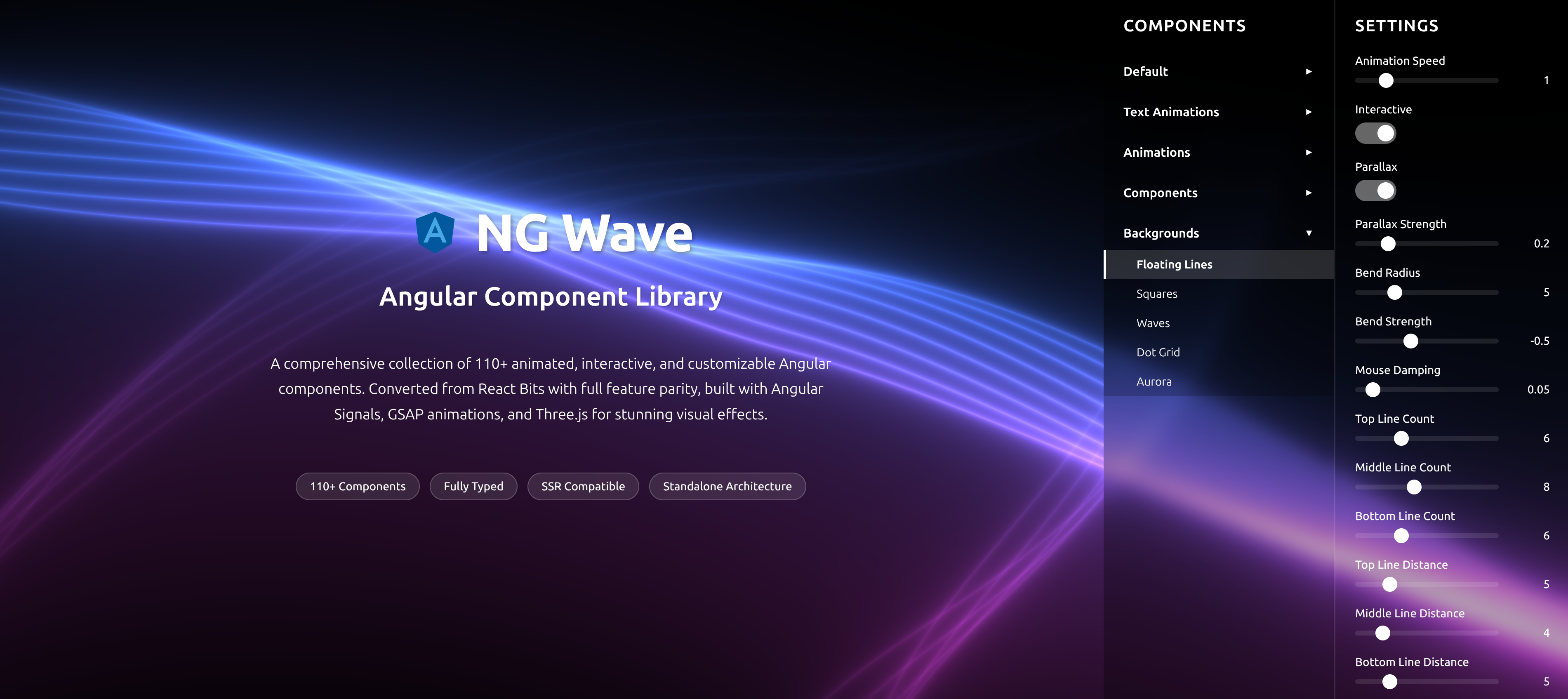
NG Wave
Angular Component Library
A comprehensive collection of 110+ animated, interactive, and customizable Angular components. Converted from React Bits with full feature parity, built with Angular Signals, GSAP animations, and Three.js for stunning visual effects.
Explore Components