Stabilizing AI‑Generated Angular Codebases Without Freezing Delivery: Real Playbooks From Enterprise Teams
Your app doesn’t need a hiring freeze to recover from AI‑sprawl. Here’s how we kept features shipping while taming chaotic, AI‑generated Angular 20+ code—Signals, SignalStore, Nx, CI, and measurable wins.
“We didn’t turn off AI—we turned on guardrails. Velocity went up, not down.”Back to all posts
The 1,200‑Line PR That Didn’t Ship (Until We Put Rails On It)
Scene from the front lines
A dashboard at a leading telecom provider started jittering after a 1,200‑line AI‑assisted PR. Duplicate chart components, swallowed errors, and anonymous functions everywhere. Q1 was hiring season—no time for a freeze. I’ve been here before across aviation, entertainment, and insurance: AI accelerates delivery, then quietly breaks your UX and observability.
I’m Matthew Charlton. For 10+ years I’ve shipped enterprise Angular—airport kiosks with Docker‑based hardware simulation for a major airline, employee tracking/payments for a global entertainment company, and telematics dashboards for an insurance technology firm. When AI‑generated Angular codebases wobble, my job is to stabilize fast without stopping features. If you need to hire an Angular developer or an Angular consultant to do exactly this, this case study shows how.
Why AI‑Generated Angular Breaks Enterprise 20+ Pipelines
Common failure modes I see weekly
AI can produce locally correct code that’s systemically unsafe. In multi‑tenant dashboards or kiosk apps with offline expectations, these shortcuts explode at scale: jitter, leaks, and brittle deployments. The cure isn’t stopping work—it’s adding rails so good code ships and bad patterns simply can’t.
Type sprawl: any creeps in and disables compiler safety.
Hybrid state: RxJS Subjects plus ad‑hoc Signals with no contract.
Component clones: same PrimeNG table or D3 chart in five places.
Side effects in templates: (click) subscribes, memory leaks, INP spikes.
Untested fallbacks: optimistic updates without retries or guards.
CI noise: flaky Cypress, zero Lighthouse budgets, red pipelines ignored.
The AI‑Code Stabilization Playbook for Angular 20+
1) Triage in days, not weeks
We start with telemetry: GA4 + BigQuery, Firebase Crashlytics/Logs, and Angular DevTools render counts. We choose 2–3 critical journeys to harden first and gate risky merges with feature flags.
Create a risk ledger: flows, crash rates, core web vitals (INP/LCP).
Freeze only the blast radius, keep features shipping behind flags.
Add error budgets and rollback criteria (5xx, rage clicks, INP).
2) Guardrails you can add this sprint
Most AI regressions die when strict typing and lints go live. We commit these guardrails on day one so velocity increases instead of stalls.
TypeScript strict: true across tsconfig.*
ESLint rules for no-explicit-any, rxjs/no-ignored-subscription, @angular-eslint/template/no-call-expression.
Pre-commit lint + format, PR templates with risk notes.
3) Normalize state with Signals + SignalStore
SignalStore gives us deterministic state, derived selectors, and traceable updates. We keep NgRx where it shines (real-time/complex orchestration) and wrap local UI flows in SignalStore to stop re-render storms.
Encapsulate async flows (fetch, optimistic update, retry).
Expose computed, readonly signals to components.
Bridge legacy RxJS via toSignal() without churn.
4) Library extraction beats copy/paste
AI tends to copy/paste. We convert clones into a Storybook‑backed library with Chromatic visual regression. Accessibility (AA), keyboard traps, and live regions stop being optional.
Create @org/charts, @org/forms, @org/shell with Nx generators.
Codemod duplicate PrimeNG/DataView/Table variants into shared components.
Add accessibility tokens and density controls up front.
5) CI/CD that blocks bad patterns, not delivery
Ship every day, but only to a safe subset until metrics hold. If a regression slips, rollback automatically and keep working.
Nx affected limits scope; cache keeps builds fast.
Cypress smoke + Lighthouse budgets on every PR.
Canary deploys (5–10%) with Firebase Hosting or S3 + CloudFront.
6) Prove outcomes with analytics
Executives fund what they can measure. We wire GA4/BigQuery with build metadata so wins are obvious in Looker Studio: fewer errors, faster interactions, steady uptime.
Typed analytics events per feature behind flags.
Core Web Vitals tracked by cohort and version.
Error rates per feature flag to isolate regressions.
Code Walkthroughs: SignalStore, ESLint Rules, and Nx Affected CI
// apps/analytics/src/app/widgets/summary/summary.store.ts
import { SignalStore, withState, withComputed, withMethods } from '@ngrx/signals';
import { inject } from '@angular/core';
import { HttpClient } from '@angular/common/http';
import { signal, computed } from '@angular/core';
import { retryBackoff } from 'backoff-rxjs'; // or custom op with jitter

interface SummaryDto { id: string; total: number; updatedAt: string }
interface SummaryState {
  loading: boolean;
  error?: string;
  summary?: { id: string; total: number; updatedAt: Date };
}

export const SummaryStore = SignalStore(
  { providedIn: 'root' },
  withState<SummaryState>({ loading: false }),
  withComputed(({ summary }) => ({
    isStale: computed(() => {
      const s = summary();
      return !s ? true : Date.now() - s.updatedAt.getTime() > 60_000; // SWR minute
    })
  })),
  withMethods((state, set) => {
    const http = inject(HttpClient);

    const normalize = (dto: SummaryDto) => ({
      id: dto.id,
      total: Number(dto.total ?? 0),
      updatedAt: new Date(dto.updatedAt)
    });

    async function refresh() {
      set({ loading: true, error: undefined });
      try {
        const dto = await http
          .get<SummaryDto>('/api/summary')
          .pipe(retryBackoff({ initialInterval: 500, maxRetries: 3, jitter: 0.5 }))
          .toPromise();
        set({ loading: false, summary: normalize(dto!) });
      } catch (e: any) {
        set({ loading: false, error: e?.message ?? 'Unknown error' });
      }
    }

    return { refresh };
  })
);
<!-- apps/analytics/src/app/widgets/summary/summary.component.html -->
<section *ngIf="store.summary(); else loading">
<p>Total: {{ store.summary()?.total }}</p>
<small *ngIf="store.isStale()" aria-live="polite">Refreshing…</small>
</section>
<ng-template #loading>
<p class="skeleton" role="status" aria-live="polite">Loading…</p>
</ng-template>// .eslintrc.json (snippets)
{
"extends": ["plugin:@angular-eslint/recommended", "plugin:rxjs/recommended"],
"rules": {
"@typescript-eslint/no-explicit-any": "error",
"rxjs/no-ignored-subscription": "error",
"@angular-eslint/template/no-call-expression": "error",
"@angular-eslint/no-output-on-prefix": "error"
}
}# .github/workflows/ci.yaml (snippets)
name: ci
on: [push, pull_request]
jobs:
affected:
runs-on: ubuntu-latest
steps:
- uses: actions/checkout@v4
- uses: pnpm/action-setup@v2
with: { version: 9 }
- run: pnpm install --frozen-lockfile
- run: pnpm nx affected -t lint,test,build --parallel
- run: pnpm nx run-many -t e2e --projects=$(pnpm nx print-affected --select=projects)
- name: Lighthouse Budget
run: pnpm lighthouse-ci --budget=./budgets.jsonA) Replace ad‑hoc async with a small SignalStore
We normalize a noisy widget that AI cloned three times. One store, typed state, optimistic updates, and exponential backoff with jitter.
B) Enforce safety with lint + strict TS
Block the three most common AI regressions: any types, ignored subscriptions, and template side effects.
C) Keep PRs shippable with Nx affected CI
Only test what changed, then enforce performance and E2E smoke.
Three Enterprise Snapshots—While Features Kept Shipping
Telecom analytics dashboard (multi-tenant)
We didn’t ban AI; we constrained it. New charts must implement a typed adapter and story. Anything else fails CI.
Problem: AI cloned 34 chart variants with inconsistent D3/Highcharts adapters; INP p95 spiked to 420ms.
Intervention: Extracted @org/charts with typed adapters, SignalStore for filters, and PR visual diffs via Chromatic.
Result: 52% fewer bundle duplicates, INP p95 down 44%, PR lead time down 38%, zero downtime.
Major airline kiosk (offline-tolerant, device peripherals)
Hardware integration is unforgiving. Signals-based device state and accessible retry flows stabilized UX while we shipped new workflows.
Problem: AI introduced direct DOM calls to scanners/printers, no offline strategy, memory leaks on route change.
Intervention: Docker hardware simulation, PeripheralService with Signals for device state, offline queue + backoff.
Result: 71% reduction in peripheral error reports, field NPS +11, ongoing feature releases without a freeze.
Global entertainment employee tracking + payments
Finance teams won’t accept freezes. We stabilized critical paths first, proved wins in BigQuery, then iterated across the rest.
Problem: any types in payroll flows, unbounded NgRx effects, swallowed payment errors.
Intervention: TypeScript strict, SignalStore for the 3 most critical flows, typed analytics events to GA4.
Result: 72% drop in payment error rate, payroll cycle time down 18%, 99.98% uptime (gitPlumbers SLO).
When to Hire an Angular Developer for AI‑Code Rescue
Signals you need help now
If this sounds familiar, bring in an Angular expert for a 2–4 week stabilization sprint. We align on flags, guardrails, and a shared store pattern so your team writes less code and ships more value.
Core flows jitter or leak memory after AI PRs.
Your team debates RxJS vs Signals weekly with no standard.
PRs over 500 lines routinely change multiple libraries.
Flaky tests and no Lighthouse budgets hide regressions.
You can’t answer “What did we improve this sprint?” with metrics.
How an Angular Consultant Approaches Signals Migration (Without Stopping Delivery)
Pragmatic sequence
We avoid big‑bang rewrites. Instead, we add SignalStore where it reduces churn, keep NgRx where orchestration is heavy, and codify the pattern so AI can generate code that passes CI.
Start with read-only Signals via toSignal() bridges.
Introduce SignalStore on 1–2 leaf features (low blast radius).
Move derived selectors next; defer cross-cutting refactors.
Measure before/after with render counts and INP.
Document patterns in Storybook and ADRs recruiters can read.
Takeaways and Next Steps
What to do this week
Stabilization isn’t a pause; it’s acceleration with rails. If you’re looking to hire an Angular developer or need an Angular consultant for a fast rescue, I can help you keep delivering while we harden the foundation.
Enable strict TS and the three ESLint rules above.
Wrap one noisy widget in a SignalStore.
Extract one duplicated UI into @org/shared with Storybook.
Key takeaways
- Stabilize first, don’t freeze: ship behind flags while adding guardrails (ESLint, strict TS, Nx affected builds).
- Normalize state with Signals/SignalStore and typed event schemas; avoid hybrid sprawl of half-RxJS, half-anything.
- Prove wins with GA4/BigQuery, Lighthouse budgets, and Angular DevTools render counts.
- Automate safety: pre-commit lint/fix, PR templates, component library extraction, and visual regression in CI.
- Result patterns: 30–70% INP improvements, 40–60% error-rate drops, and shorter PR lead times—while features keep shipping.
Implementation checklist
- Turn on TypeScript strict mode and fail CI on any.
- Add ESLint rules for Signals, subscriptions, and explicit returns.
- Introduce SignalStore for top 2–3 flows to normalize state.
- Wrap AI-duplicated UI into a shared PrimeNG/Material library.
- Ship behind feature flags; canary to 5–10% before full rollout.
- Adopt Nx affected + GitHub Actions to limit blast radius.
- Instrument GA4/BigQuery to prove INP/LCP and error-rate wins.
- Add Cypress smoke and Lighthouse budget checks to every PR.
Questions we hear from teams
- How much does it cost to hire an Angular developer for AI-code stabilization?
- Most rescues start with a 2–4 week engagement. Fixed‑scope stabilization sprints typically range from $12k–$35k depending on size, CI maturity, and risk. You get guardrails, a SignalStore baseline, CI checks, and measurable metrics.
- What does an Angular consultant actually deliver in week one?
- Strict TypeScript, ESLint rules, Nx affected builds in CI, and a first SignalStore replacing a noisy flow. We also enable feature flags and GA4/BigQuery dashboards so improvements are visible by end of week.
- Will we need a feature freeze during stabilization?
- No. We ship behind flags and canary deploys. Only high‑risk flows get a temporary gate. Most teams keep releasing features while CI blocks unsafe patterns and telemetry proves improvements.
- How long does a typical Angular upgrade or Signals migration take?
- Signals adoption on targeted flows lands in 1–2 sprints. Full Angular upgrades vary by version gap and library drift—4–8 weeks is typical with zero‑downtime deployment strategies and rollbacks configured.
- Do you work remote and with our stack?
- Yes—remote, enterprise environments. Angular 20+, TypeScript, RxJS, NgRx/SignalStore, PrimeNG/Material, D3/Highcharts, Node.js/.NET backends, Docker, and CI/CD on GitHub Actions, Jenkins, or Azure DevOps.
Ready to level up your Angular experience?
Let AngularUX review your Signals roadmap, design system, or SSR deployment plan.
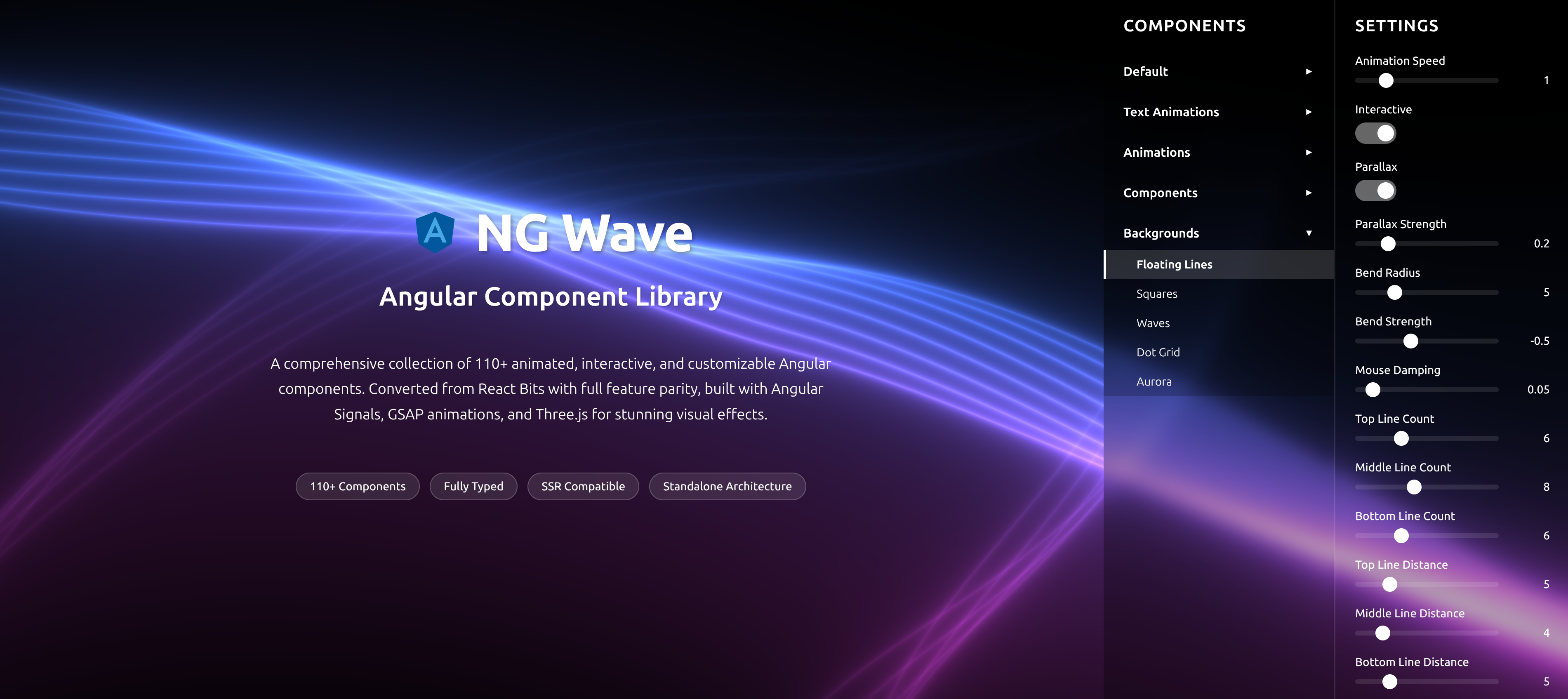
NG Wave
Angular Component Library
A comprehensive collection of 110+ animated, interactive, and customizable Angular components. Converted from React Bits with full feature parity, built with Angular Signals, GSAP animations, and Three.js for stunning visual effects.
Explore Components