Typed RxJS→Signals Adapters in Angular 20+: Deterministic SSR and Tests Without Jank
Make streams transport, signals consumption. Typed adapters keep Angular Universal SSR and unit tests deterministic across environments.
Streams are for transport, Signals are for consumption. Typed adapters make SSR and tests deterministic.Back to all posts
If you’ve ever watched a dashboard jitter after hydration or had a green test suite turn flaky on CI, you’ve felt RxJS streams leaking into the presentation layer. I’ve been there on telematics dashboards, airport kiosks, and ad analytics. The fix isn’t abandoning streams—it’s separating concerns: RxJS for transport, Signals for consumption, bound by typed adapters that keep SSR and tests deterministic.
This is the Signals & Statecraft pattern I use on Angular 20+ projects (often inside Nx) with SignalStore, PrimeNG, Firebase, and real‑time websockets. It’s the same approach I use when teams hire me as an Angular consultant to stabilize production without feature freeze.
The Jitter That Started This Pattern
As companies plan 2025 Angular roadmaps, the teams that ship cleanly with Signals are the ones that treat streams and signals differently and connect them with a small, typed layer.
A real scene from production
On a telecom advertising analytics dashboard, our first Signals rollout looked good locally. In production behind Angular Universal, the hero chart flashed twice after hydration. The cause: cold Observables re‑subscribing on navigation and firing late on the client; SSR rendered with default state, then the client replayed another initial value before the real data arrived.
Two changes fixed it: a typed RxJS→Signals adapter with a seeded initial value for SSR and a TransferState hydration for the first emission. Tests stopped flaking when we injected a deterministic scheduler.
Why Angular Streams Need Typed Adapters
Determinism across environments
Signals excel at deterministic read/write dependencies. RxJS excels at transport—WebSockets, HTTP, Firebase, device events. Typed adapters let us keep each strength while eliminating re‑subscription jank and non‑deterministic timing.
SSR: server must render the same initial snapshot every time.
Client hydration: avoid double “initial” emissions.
Unit tests: no timer races; reproducible ordering.
What the adapter guarantees
This is small code with big impact. You’ll feel it in Angular DevTools flame charts, Lighthouse stability, and your CI tests.
Typed state: value, loading, error.
Seeded initialValue for SSR.
Optional TransferState hydration of first emission.
shareReplay(1) to avoid resubscribe storms.
Injectable SchedulerLike to control ordering in SSR/tests.
Implementation: Typed RxJS→Signals Adapter
// filter.store.ts
import { signalStore, withState, withMethods, withComputed } from '@ngrx/signals';
import { inject } from '@angular/core';
import { HttpClient } from '@angular/common/http';
import { rxToSignalState } from './rx-to-signal-state';

interface FilterState { selected: string | null; }

export const FilterStore = signalStore(
  withState<FilterState>({ selected: null }),
  withMethods((store) => {
    const http = inject(HttpClient);
    // Transport: RxJS
    const categories$ = http.get<string[]>('/api/categories');

    // Consumption: Signals via typed adapter
    const categories = rxToSignalState(categories$, {
      initial: [],
      key: 'categories',
      ssr: 'seed-only'
    });

    return {
      categories: categories.value,
      categoriesLoading: categories.loading,
      select: (id: string | null) => store.patchState({ selected: id })
    };
  }),
  withComputed((store) => ({
    canSubmit: () => !!store.selected(),
  }))
);
Define types and options
We expose typed value/loading/error signals and a few SSR/test knobs.
Adapter code
// rx-to-signal-state.ts
import { inject, PLATFORM_ID, Signal, signal } from '@angular/core';
import { isPlatformServer } from '@angular/common';
import { TransferState, makeStateKey } from '@angular/platform-browser';
import { toSignal } from '@angular/core/rxjs-interop';
import { Observable, SchedulerLike, EMPTY, queueScheduler } from 'rxjs';
import { catchError, finalize, observeOn, shareReplay, take, tap } from 'rxjs/operators';

export interface RxToSignalOptions<T> {
  initial: T;                            // deterministic SSR snapshot
  key?: string;                          // optional TransferState key
  ssr?: 'seed-only' | 'transfer-first';  // server strategy
  scheduler?: SchedulerLike;             // deterministic ordering
}

export interface SignalState<T> {
  value: Signal<T>;
  loading: Signal<boolean>;
  error: Signal<unknown | null>;
}

export function rxToSignalState<T>(
  source$: Observable<T>,
  opts: RxToSignalOptions<T>
): SignalState<T> {
  const platformId = inject(PLATFORM_ID);
  const transfer = inject(TransferState, { optional: true });
  const server = isPlatformServer(platformId);

  const loading = signal(true);
  const error = signal<unknown | null>(null);

  const key = opts.key ? makeStateKey<T>(opts.key) : null;
  const scheduler = opts.scheduler ?? queueScheduler; // queue: deterministic in SSR/tests

  let seed = opts.initial;
  if (server && key && transfer?.hasKey(key)) {
    // Rare, but if upstream set it earlier in the render chain
    seed = transfer.get(key, seed);
  }

  const materialized$ = source$.pipe(
    observeOn(scheduler),
    server && opts.ssr === 'transfer-first' ? take(1) : tap(() => {}),
    tap(v => key && transfer?.set(key, v)),
    shareReplay({ bufferSize: 1, refCount: true }),
    tap({ next: () => loading.set(false) }),
    catchError(err => { error.set(err); loading.set(false); return EMPTY; }),
    finalize(() => loading.set(false))
  );

  const value = toSignal(materialized$, { initialValue: seed });
  return { value, loading, error } as const;
}
Why these choices?
Most apps are fine with ssr: 'seed-only' so the server renders a stable initial snapshot. For fast HTTP calls or pre‑resolved data, 'transfer-first' can hydrate the real first emission and avoid a second “initial” blip.
queueScheduler ensures source notifications are delivered in a deterministic order for SSR/tests.
transfer-first (optional) lets the server capture the first value and hydrate it on the client.
shareReplay(1) prevents resubscribe storms after hydration or route changes.
SignalStore interop
SignalStore plays great with this pattern—use the adapter inside a feature store and expose only Signals to components.
Component and Template Usage (with PrimeNG)
Component setup
// filter.component.ts
import { Component, inject } from '@angular/core';
import { FilterStore } from './filter.store';

@Component({
  selector: 'app-filter',
  templateUrl: './filter.component.html'
})
export class FilterComponent {
  store = inject(FilterStore);
}
Template with Signals
<!-- filter.component.html -->
<p-dropdown
  [options]="store.categories()"
  [loading]="store.categoriesLoading()"
  placeholder="Choose category"
  (onChange)="store.select($event.value)">
</p-dropdown>
<button pButton label="Apply" [disabled]="!store.canSubmit()"></button>
UX effect
Signals keep templates clean and deterministic; streams stay in services/stores.
No resubscribe flashes during hydration.
Angular DevTools shows fewer change detection passes.
PrimeNG stays reactive via Signals without async pipes everywhere.
SSR and Test Determinism Strategies
SSR seeding and hydration
// server.app.config.ts (excerpt)
import { provideClientHydration } from '@angular/platform-browser';

export const appConfig = {
  providers: [
    provideClientHydration(), // keeps HTML stable during hydration
  ]
};
Seed with a stable initial snapshot for consistent HTML.
Optionally hydrate the first emission via TransferState.
Avoid blocking SSR; use resolvers if you must wait for data.
Deterministic tests
// rx-to-signal-state.spec.ts
import { TestBed } from '@angular/core/testing';
import { rxToSignalState } from './rx-to-signal-state';
import { TestScheduler } from 'rxjs/testing';
import { of, throwError } from 'rxjs';

describe('rxToSignalState', () => {
  let ts: TestScheduler;
  beforeEach(() => {
    ts = new TestScheduler((a, e) => expect(a).toEqual(e));
  });

  it('emits deterministically and clears loading', () => {
    ts.run(({ cold, flush }) => {
      const src$ = cold('a-b-c|', { a: 1, b: 2, c: 3 });
      const state = rxToSignalState(src$, { initial: 0 });
      expect(state.value()).toBe(0); // seeded
      flush();
      expect(state.value()).toBe(3);
      expect(state.loading()).toBeFalse();
      expect(state.error()).toBeNull();
    });
  });

  it('captures errors without throwing into templates', () => {
    const state = rxToSignalState(throwError(() => new Error('boom')), { initial: 0 });
    expect(state.value()).toBe(0);
    expect(state.loading()).toBeFalse();
    expect(state.error()).toBeTruthy();
  });
});
Drive the adapter with marble streams.
Use queueScheduler in tests to avoid timer drift.
Assert value/loading/error transitions.
Typed Events and WebSocket Transport
Discriminated unions for transport
// events.ts
export type TelemetryEvent =
  | { type: 'metric'; id: string; rpm: number; ts: number }
  | { type: 'status'; id: string; online: boolean; ts: number };

// transport$ is RxJS (websocket or SSE)
// const transport$: Observable<TelemetryEvent> = ...

const latestById$ = transport$.pipe(
  // group/switch/scan as needed, then
  shareReplay({ bufferSize: 1, refCount: true })
);

// UI boundary
const state = rxToSignalState(latestById$, { initial: { } as Record<string, TelemetryEvent> });
Typed events are non‑negotiable in real‑time systems. In my insurance telematics and airline kiosk work, typed event schemas (and backpressure handling) are what keep dashboards smooth and debuggable.
Keep event schemas typed and versioned.
Only convert to Signals at the boundary.
When to Hire an Angular Developer for Legacy Rescue
Good indicators
This adapter pattern is one of the fastest ways to stabilize a chaotic codebase without a rewrite. If you need an Angular consultant to triage quickly, I can usually deliver an assessment within a week and a step‑by‑step plan to land Signals safely. See how I can help you stabilize your Angular codebase at gitPlumbers: https://gitplumbers.com (rescue chaotic code).
SSR mismatch warnings and flicker after hydration.
Async pipes everywhere and still jitter on navigation.
Flaky tests tied to timers/intervals.
Unclear ownership of transport vs. consumption layers.
End‑to‑End Example with Query Params and HTTP
Wire query params to HTTP with a typed adapter
// search.service.ts
import { inject, Injectable } from '@angular/core';
import { HttpClient } from '@angular/common/http';
import { ActivatedRoute } from '@angular/router';
import { rxToSignalState } from './rx-to-signal-state';
import { combineLatest, map, switchMap } from 'rxjs';

@Injectable({ providedIn: 'root' })
export class SearchService {
  private http = inject(HttpClient);
  private route = inject(ActivatedRoute);

  private params$ = this.route.queryParamMap.pipe(
    map(mapper => ({ q: mapper.get('q') ?? '', page: Number(mapper.get('p') ?? 1) }))
  );

  private results$ = this.params$.pipe(
    switchMap(p => this.http.get<{ items: any[]; total: number }>(`/api/search`, { params: { q: p.q, p: p.page } }))
  );

  results = rxToSignalState(this.results$, {
    initial: { items: [], total: 0 },
    key: 'search-results',
    ssr: 'seed-only'
  });
}
Consume in a component
<section *ngIf="!search.results.loading()">
  <app-results [items]="search.results.value().items"></app-results>
</section>
<p *ngIf="search.results.error()" class="p-error">Failed to load. Please retry.</p>
That’s production‑grade determinism: SSR renders a stable shell; hydration doesn’t double‑fire; tests don’t race.
Takeaways and Next Steps
Numbers and instrumentation
I instrument these adapters using GA4 + BigQuery to prove improvements. If you want to see a Signals‑first component kit, explore NG Wave: https://ngwave.angularux.com (Angular Signals UI kit). For AI + Angular examples, check the AI-powered verification system at https://getintegritylens.com (Angular AI integration example).
Angular DevTools: fewer change detection cycles after hydration.
Lighthouse: CLS and INP improve when flicker is removed.
Telemetry: log adapter errors and loading durations via GA4/BigQuery.
Ready to blend streams with Signals safely?
If you need a remote senior Angular engineer to implement this pattern, upgrade to Angular 20+, or stabilize a legacy app, let’s talk. I’m available for 1–2 select projects per quarter. You can hire an Angular developer today at https://angularux.com/pages/contact.
Key takeaways
- Treat RxJS as transport and Signals as consumption. Bridge with typed adapters.
- SSR determinism comes from seeded initial values and optional TransferState hydration.
- Inject a scheduler to keep order deterministic in SSR and unit tests.
- Surface loading/error alongside value in a typed Signal state object.
- Wrap adapters into a SignalStore to isolate side‑effects and simplify templates.
Implementation checklist
- Define a typed adapter API: value, loading, error.
- Seed SSR with initial values; optionally hydrate with TransferState.
- Inject a SchedulerLike to control ordering in SSR/tests.
- Share and cache last value with shareReplay(1).
- Guard side‑effects with feature flags and effects.
- Write marble tests for edge cases (errors, retries, cancellations).
Questions we hear from teams
- What does an Angular consultant do on a Signals migration?
- I assess your state flow, separate transport from consumption, add typed RxJS→Signals adapters, and layer SignalStore. You get SSR‑safe initial states, deterministic tests, and a rollout plan that doesn’t pause feature delivery.
- How long does an Angular upgrade or Signals adoption take?
- Typical engagements: 2–4 weeks for a stabilization/rescue, 4–8 weeks for a full Angular 20+ upgrade with CI guardrails. Discovery call within 48 hours and an assessment delivered within 1 week.
- Do I still need NgRx if I use Signals?
- For complex domains (real‑time dashboards, multi‑tenant apps), yes—use NgRx or SignalStore for structure and side‑effects, with Signals as the read layer. The adapter keeps Observables at the edges and Signals in the UI.
- How much does it cost to hire an Angular developer for this work?
- Pricing depends on scope. Most adapter-driven stabilizations land in a fixed 2–4 week package. Contact me with your repo and goals; I’ll provide a proposal after an assessment.
- Will this help with Firebase/Firestore, WebSockets, or SSE?
- Yes. The adapter pattern shines with real‑time transports. Keep the stream hot and typed, then expose a Signal value/loading/error to components for deterministic SSR and testing.
Ready to level up your Angular experience?
Let AngularUX review your Signals roadmap, design system, or SSR deployment plan.
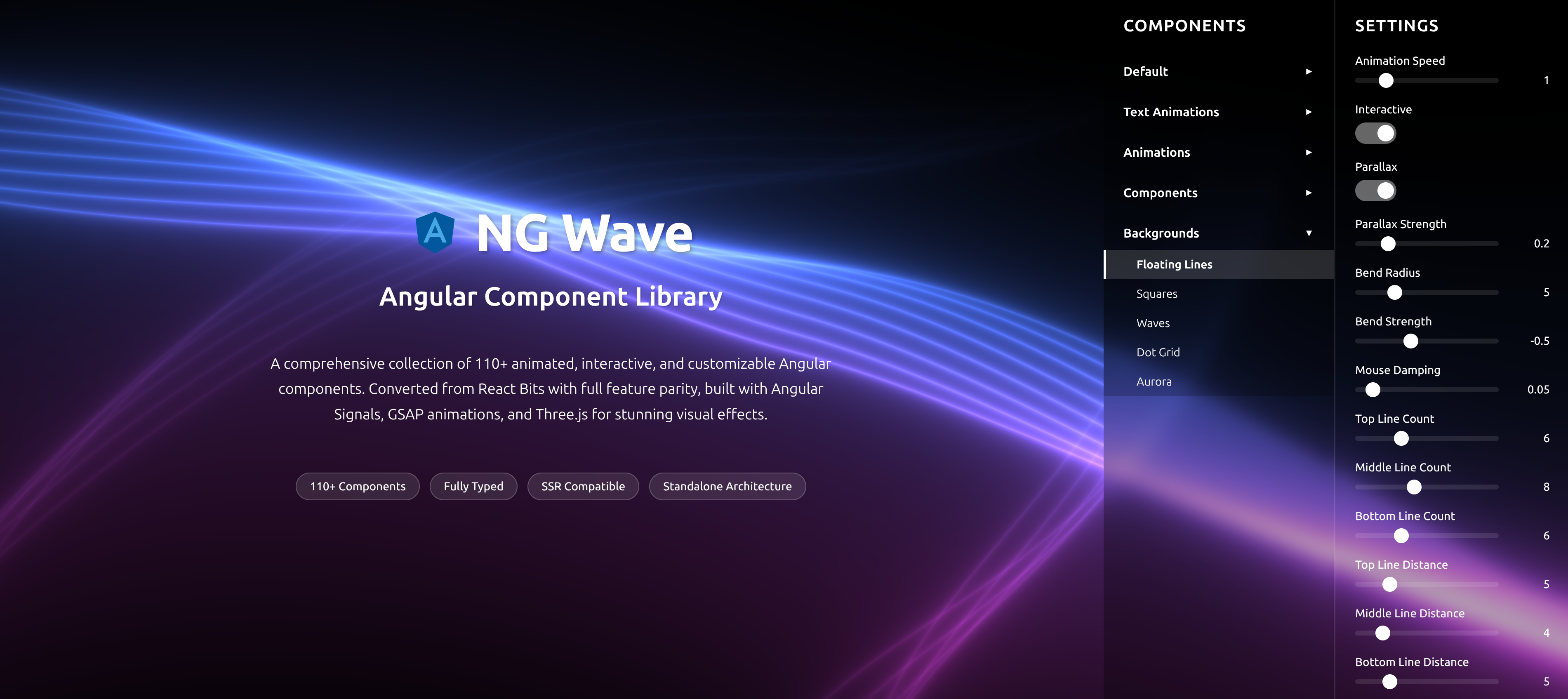
NG Wave
Angular Component Library
A comprehensive collection of 110+ animated, interactive, and customizable Angular components. Converted from React Bits with full feature parity, built with Angular Signals, GSAP animations, and Three.js for stunning visual effects.
Explore Components