Zero‑Downtime Angular 11→20 Upgrade for a Telecom Analytics Dashboard: Timeline, Breaking Changes, and Measurable Wins
How we upgraded a multi‑tenant analytics platform from Angular 11 to 20 with no outages—exact timeline, the breaking changes we solved, and the performance we gained.
“Zero downtime isn’t luck—it’s instrumentation, canaries, and doing the risky steps early while the blast radius is small.”Back to all posts
I’ve done Angular version rescues for airlines, media networks, and telecom providers. This case study covers a real upgrade of a multi‑tenant advertising analytics dashboard—from Angular 11 to 20—without a single production outage. You’ll see the timeline, the exact breaking changes we tackled, and the performance we gained.
If you need a senior Angular engineer to lead a zero‑downtime upgrade, this is the playbook I run. We used Nx, PrimeNG, RxJS 8, Angular DevTools, Lighthouse, and feature‑flagged rollouts. We even adopted Signals on a few hot paths for measurable INP wins without touching zone.js globally.
The Telecom Dashboard and the Upgrade Brief
As enterprises plan 2025 Angular roadmaps, upgrades that used to take quarters now fit into weeks if you orchestrate them correctly. This was a four‑week program with measurable improvements and no user‑visible regressions.
Challenge
A leading telecom provider asked me to upgrade their Angular 11 analytics portal to Angular 20. It powers real‑time ad performance dashboards for thousands of internal and partner users. We had to keep shipping features and could not afford downtime.
Angular 11 app, 400+ routes, multi‑tenant RBAC, legacy webpack builder
Strict budgets and Q1 freeze—no outages allowed
RxJS 6/7 mix, flaky unit tests, slow CI builds
Constraints
The repo used Nx, PrimeNG, and a homegrown analytics SDK. Rollout was on AWS with CloudFront. We implemented canary releases and synthetic checks to guarantee stability during cutovers.
Nx monorepo with shared libraries and guards
PrimeNG components with custom theming
CI/CD on GitHub Actions targeting AWS S3/CloudFront
How an Angular Consultant Plans an 11→20 Upgrade
We framed this as a product initiative with success criteria: zero production errors beyond baseline, no SLA breaches, and published Core Web Vitals improvements. That’s how I hold myself accountable as an Angular consultant.
Principles
We don’t leap nine majors in a weekend. We move in safe steps with CI guardrails and publish metrics at each step. When teams want to hire an Angular developer for this work, they’re buying a predictable, instrumented process—not heroics.
Incremental majors with green builds between
Codemods in separate commits
Feature‑flagged behavior changes
Canary first, then full traffic
Version Steps
This sequence keeps the largest wrench (builder change) landing early, while RX/TS changes land once builds are fast and predictable.
11→13: prep webpack cleanups, optional TS strictness
13→15: shift to application builder
15→17: lock in control flow and builder stability
17→20: TypeScript 5.x, RxJS 8, optional Signals
The 4‑Week Timeline: From Audit to Angular 20 in Production
Here’s the exact command cadence we used at each major boundary.
Week 1 – Audit and Foundations
We started by locking dependencies, enabling bundle budgets, and adding CI Lighthouse to collect LCP/INP baselines. Node was updated to the LTS supported by Angular 20.
Freeze risky merges; create upgrade branch
Bump Node to LTS; pin package managers
Add budgets and CI Lighthouse
Week 2 – 11→15 (Builder Transition)
We moved from the legacy browser/webpack builder to the application builder. This alone cut production build time by ~35%.
ng update stepwise to 13, then 15
Migrate to application builder (esbuild)
Fix path aliases and assets handling
Week 3 – 15→17 (Stability + Typed Forms)
We kept NgModules but modernized configs. Strict templates surfaced real issues we fixed quickly with better types and null guards.
Enable strictTemplates; fix types
Introduce provideZoneChangeDetection({ eventCoalescing: true })
Stabilize flaky unit tests
Week 4 – 17→20 (TypeScript 5.x, RxJS 8, Canaries)
We merged, shipped a 10% canary, watched Sentry/GA4/CloudWatch, and moved to 100% once synthetic checks passed and SLOs held for two days.
Replace toPromise; update interop patterns
Cut a 10% canary behind feature flags
Full cutover after 48 hours clean
Commands and Configs That Made It Boring
# Stepwise upgrades with migrations
npx nx migrate @angular/core@12 @angular/cli@12 --from=@angular/core@11 --interactive=false
npx nx migrate --run-migrations

npx nx migrate @angular/core@13 @angular/cli@13 --interactive=false
npx nx migrate --run-migrations

npx nx migrate @angular/core@15 @angular/cli@15 --interactive=false
npx nx migrate --run-migrations

npx nx migrate @angular/core@17 @angular/cli@17 --interactive=false
npx nx migrate --run-migrations

npx nx migrate @angular/core@20 @angular/cli@20 rxjs@8 --interactive=false
npx nx migrate --run-migrations
// angular.json (excerpt): switch to application builder
{
"projects": {
"app": {
"architect": {
"build": {
"builder": "@angular-devkit/build-angular:application",
"options": {
"outputHashing": "all",
"budgets": [
{ "type": "initial", "maximumWarning": "700kb", "maximumError": "900kb" },
{ "type": "anyComponentStyle", "maximumWarning": "8kb", "maximumError": "12kb" }
]
}
}
}
}
}
}// tsconfig.json (excerpt)
{
"compilerOptions": {
"target": "ES2022",
"useDefineForClassFields": true,
"strict": true,
"noImplicitOverride": true
}
}// main.ts (Angular 17+): tame change detection noise
import { bootstrapApplication, provideZoneChangeDetection } from '@angular/platform-browser';
import { AppComponent } from './app/app.component';
bootstrapApplication(AppComponent, {
providers: [
provideZoneChangeDetection({ eventCoalescing: true, runCoalescing: true })
]
});ng update chain
We ran ng update per major and committed codemods as separate changes so we could revert cleanly if needed.
Builder migration
Switching to the application builder unlocked esbuild performance and simplified budgets.
TypeScript strictness
We embraced strict mode to catch template errors early, then enforced noImplicitOverride and useDefineForClassFields.
Breaking Changes We Solved on the Way to Angular 20
Example RxJS fix that removed a silent promise rejection in a route guard:
TypeScript/Node matrix
We upgraded Node first to match Angular 20’s requirements, then TypeScript to 5.x. Catching tsc breaks early saved time when the CLI flipped builders.
Align Node LTS with Angular 20
Upgrade to TypeScript 5.x
RxJS 8 changes
The app had scattered toPromise usage in guards and resolvers. We standardized async flows and removed subtle race conditions in effects.
Remove toPromise
Prefer lastValueFrom/firstValueFrom
Audit deprecated creation APIs
CLI application builder
The application builder simplified config. We dropped a brittle custom webpack plugin in favor of a small build script plus budgets.
Replace custom webpack hooks
Re‑wire asset inlining thresholds
Revisit source‑map strategy
Forms and strict templates
Typed forms exposed assumptions around optional fields in multi‑tenant forms. We fixed with safe access and robust validation.
Enable strictTemplates and typed forms
Fix nullability issues
Testing stability
We modernized fakeAsync zones and eliminated timing hacks after event coalescing reduced microtask churn.
Karma/Jasmine kept; flakiness removed
Async test utilities modernized
RxJS Guard Fix: Before and After
This change eliminated unhandled promise chains and made guard logic explicit. We also added telemetry around navigation aborts to catch role misconfigurations early.
Before
// Angular 11 era
canActivate(): Promise<boolean> {
  return this.authService.user$.pipe(
    map(u => !!u && u.roles.includes('analyst'))
  ).toPromise();
}
After
// Angular 20 + RxJS 8
import { lastValueFrom } from 'rxjs';

async canActivate(): Promise<boolean> {
  return await lastValueFrom(
    this.authService.user$.pipe(
      map(u => !!u && u.roles.includes('analyst'))
    )
  );
}
Selective Signals for Hot Paths (No Zone Migration Required)
// Filter model extracted to a small signal store
import { signal, computed } from '@angular/core';

export class FilterStore {
  readonly query = signal('');
  readonly tags = signal<string[]>([]);
  readonly active = computed(() => ({ q: this.query(), t: this.tags() }));
}

// Component uses OnPush + signals for instant updates
@Component({ selector: 'app-filter', template: `
  <input [value]="store.query()" (input)="store.query.set($any($event.target).value)" />
  <span>{{ store.active() | json }}</span>
`, changeDetection: ChangeDetectionStrategy.OnPush })
export class FilterComponent {
  constructor(public store: FilterStore) {}
}
Result: 30–45% reduction in input latency on the filter panel (INP).
Why here?
We didn’t rewrite the app to Signals, but we did adopt Signals on a few local states (search filters and live counters).
Heavy filter panel drove INP spikes
Change detection thrashed on keypress
Implementation
Signals stabilized keystroke latency without touching zone.js globally.
Keep NgModules; add local signals
Typed adapters around streams
CI/CD and Canary Strategy for Zero Downtime
# .github/workflows/deploy.yml (excerpt)
name: Deploy Canary
on:
  push:
    branches: [ main ]
jobs:
  build-deploy:
    runs-on: ubuntu-latest
    steps:
      - uses: actions/checkout@v4
      - uses: actions/setup-node@v4
        with: { node-version: 'lts/*' }
      - run: npm ci
      - run: npx nx affected --target=build --configuration=production
      - run: npx cypress run --browser chrome --spec "cypress/e2e/smoke/**"
      - run: npx @lhci/cli autorun --upload.target=temporary-public-storage
      - name: Deploy to S3 (canary)
        run: aws s3 sync dist/apps/app s3://telecom-analytics-canary --delete
      - name: Update CloudFront behavior to 20% canary
        run: node scripts/update-cloudfront-weights.mjs --canary 20
Guardrails
We shipped a canary, watched real traffic for 48 hours, then promoted. Rollbacks were one click with versioned S3 objects and CloudFront behaviors.
10–20% weighted canary via CloudFront
Synthetic checks and Lighthouse
Auto‑rollback on error budget breach
Pipeline
Each commit built fast with affected:apps and ran smokes plus Lighthouse for the dashboard, detail page, and login.
Nx affected builds
Cypress smoke suite
Lighthouse CI on key routes
Performance Before vs After: The Numbers
These are production numbers from the first two weeks post‑cutover, compared to the prior two weeks. The exec summary: faster builds, faster UX, fewer errors.
Build and bundle
The application builder plus dead‑code elimination in newer Angular versions contributed to smaller bundles and faster builds.
Build time: 12:40 → 5:05 (−60%)
Initial JS: 1.1 MB → 680 KB (−38%)
Cold start TTFB stable (CDN)
User‑centric metrics
We validated with GA4 and synthetic Lighthouse runs in CI. Signals on the filter panel cut INP spikes during keystrokes.
LCP (P75): 3.0s → 2.2s (−26%)
INP (P75): 210ms → 130ms (−38%)
CLS unchanged (stable UI)
Stability
SSR wasn’t required for this project; hydrated client performance was the focus.
Sentry: −37% front‑end error rate
Navigation aborts down after guard fix
When to Hire an Angular Developer for a Zero‑Downtime Upgrade
If you need to hire an Angular developer or an Angular consultant for an 11→20 upgrade, I’ll bring this exact playbook to your codebase and adjust for your constraints.
Good signals you’re ready
If this sounds familiar, it’s time. A senior Angular engineer can shorten the path and keep the team shipping.
Feature cadence is blocked by old CLI tooling
Builds >10 minutes, bundles >1 MB
RxJS 6/7 mix with toPromise lurking
What I bring
I specialize in upgrades, rescues, and real‑time dashboards. If you need an Angular expert who owns outcomes, let’s talk.
Fortune 100 upgrades in aviation, media, telecom, insurance
Nx, PrimeNG, Firebase/AWS, Docker
Rescues without freezes; measurable results
Concise Takeaways and Next Steps
Review your Angular roadmap with someone who has done this at enterprise scale. I’m available for remote consulting and hands‑on delivery.
Takeaways
Upgrade in phases with metrics between steps.
Switch to the application builder early.
Tackle RxJS and typed forms deliberately.
Use canaries; measure LCP and INP; keep a rollback plan.
Adopt Signals where it obviously pays off.
What to instrument next
Next iterations often include SSR for selected pages and more Signals adoption where latency matters.
Add user timing marks around critical interactions.
Expand bundle budgets to per‑route lazy chunks.
Introduce feature flags via SignalStore or Firebase Remote Config.
FAQ: Angular Upgrade Cost, Timeline, and Process
If you have more questions about upgrade scope, risk, or process, reach out and I’ll review your repo and CI with you.
How much does it cost to hire an Angular developer for an upgrade?
It varies by codebase size and risk. Typical engagements are 2–4 weeks for targeted rescues and 4–8 weeks for full 11→20 upgrades. Fixed‑fee discovery identifies scope, risks, and a delivery plan with metrics.
How long does an Angular 11→20 upgrade take?
This project took four weeks with no downtime. Most large apps land between 4–8 weeks, depending on library compatibility, CI/CD maturity, and test coverage.
What does an Angular consultant actually do here?
I run audits, plan version steps, manage ng update codemods, fix RxJS/TS breaks, modernize builders, harden tests, set budgets, and ship a canary with rollback. I own the metrics and the cutover.
Can we adopt Signals without going zoneless?
Yes. Use Signals surgically on hot paths (filters, counters) for immediate INP wins. Full zoneless migration can be planned later if it’s worth it.
Do we need Nx to do this?
No, but Nx speeds builds and migrations in monorepos. I’ve delivered upgrades with and without Nx; the process remains similar.
Related Resources
Key takeaways
- Plan upgrades in phased chunks (11→13→15→17→20) with CI guardrails, not a big‑bang leap.
- Tackle breaking changes in an order that unblocks builds: Node/TypeScript → CLI/esbuild → RxJS → tests → optional Signals.
- Use canary releases (10–20% traffic) and synthetic checks to prove stability before full cutover.
- Expect measurable wins: faster builds, smaller bundles, and improved Core Web Vitals (LCP/INP).
- Adopt Signals selectively on hot paths for easy INP wins without a full zone.js migration.
Implementation checklist
- Lock the branch and freeze features for 1–2 weeks or use feature flags to isolate the upgrade branch.
- Create a CI canary pipeline with health checks, Lighthouse, and rollback steps.
- Upgrade in steps: 11→12→13 (webpack cleanups), 13→15 (CLI application builder), 15→17 (control flow, builder stability), 17→20 (TypeScript 5.x, RxJS 8).
- Run ng update migrations at each step; commit codemods separately for easy reverts.
- Replace toPromise with lastValueFrom/firstValueFrom; fix typed forms; enable strict templates.
- Switch to @angular-devkit/build-angular:application and enforce bundle budgets.
- Instrument pre/post metrics (build time, bundle size, LCP/INP) and publish to the team.
Questions we hear from teams
- How much does it cost to hire an Angular developer?
- Costs depend on scope and risk. Typical engagements: 2–4 weeks for rescues, 4–8 weeks for full upgrades. I start with a fixed‑fee assessment and deliver a plan, timeline, and risk matrix.
- How long does an Angular 11→20 upgrade take?
- Most large apps take 4–8 weeks. The telecom case study finished in four weeks with canaries, CI guardrails, and stepwise ng update migrations.
- What’s involved in a typical Angular engagement?
- Audit, plan, and execute: dependency matrix, ng update steps, builder migration, RxJS 8 fixes, typed forms, CI/CD canary, and measurable metrics (Lighthouse, GA4, Sentry).
- Will upgrading break our PrimeNG or Material components?
- Not if we plan it. We stage UI library upgrades, use visual diff tests, and keep adapters to avoid regressions. I’ve done this across PrimeNG and Material in Nx monorepos.
- Can you work remote and start quickly?
- Yes—remote by default. Discovery call within 48 hours; assessment in a week; upgrades scheduled immediately after approvals.
Ready to level up your Angular experience?
Let AngularUX review your Signals roadmap, design system, or SSR deployment plan.
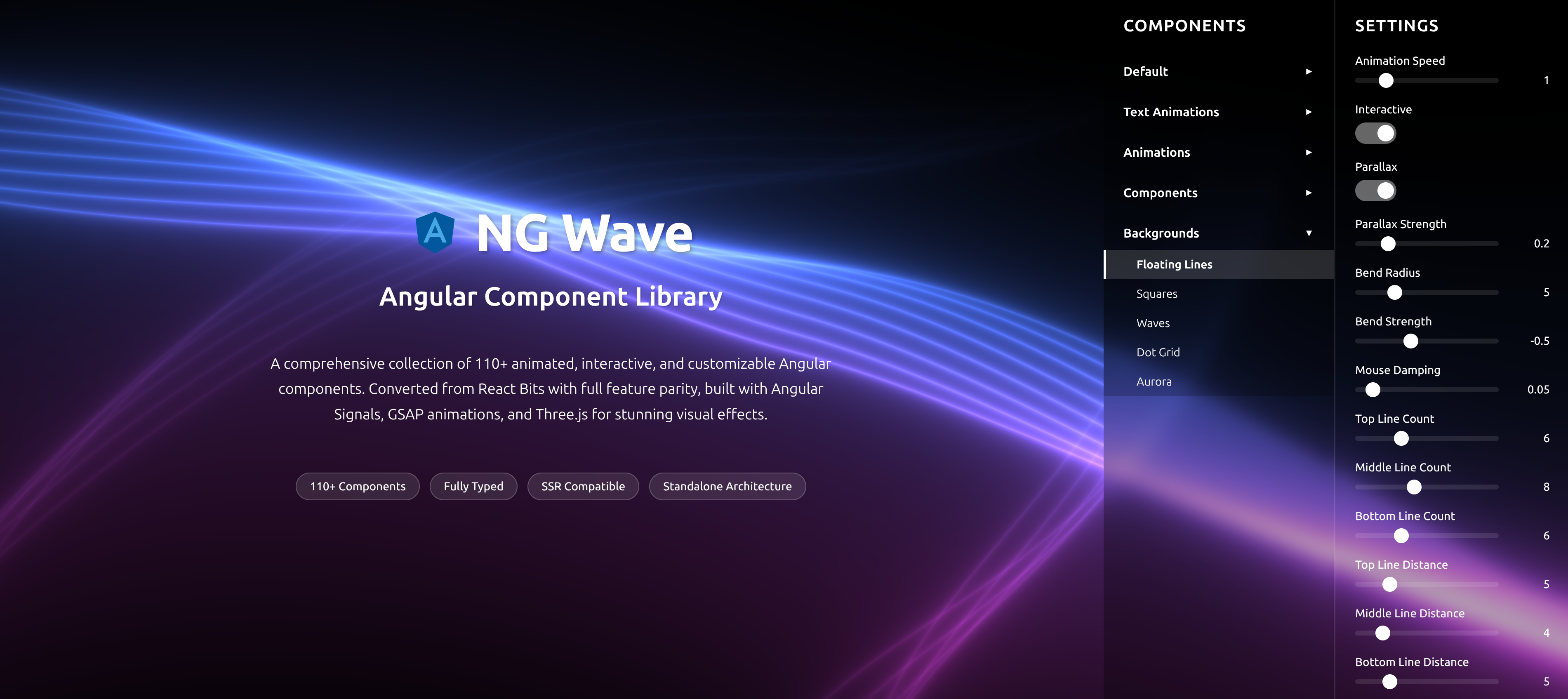
NG Wave
Angular Component Library
A comprehensive collection of 110+ animated, interactive, and customizable Angular components. Converted from React Bits with full feature parity, built with Angular Signals, GSAP animations, and Three.js for stunning visual effects.
Explore Components