Audit and Refactor a Chaotic Angular 20+ Codebase: Tech‑Debt Hotspots and Incremental Improvements that Ship
A field-proven audit and refactor playbook for Angular 20+: find the heat, reduce risk, and deliver measurable wins every sprint—without halting feature work.
You don’t need a rewrite. You need a map, a method, and measurable wins—delivered weekly without breaking prod.Back to all posts
I’ve been pulled into enough chaotic Angular repos—from airport kiosks to ad analytics dashboards—to know the pattern: a tight deadline, a few “temporary” hacks, and six months later every PR feels like defusing a bomb. You don’t need a rewrite. You need a map, a method, and measurable wins.
This is the lightweight audit and refactor framework I use as a remote Angular consultant to stabilize teams fast. It relies on Angular 20+, Signals + SignalStore where they reduce complexity, Nx graphs for visibility, and CI gates so you ship improvements without breaking production.
The Front Line: Audit Before You Touch a Line of Code
- Lock the toolchain and surface facts before opinions. Use graphs, churn, and runtime traces to select targets instead of gut feelings.
# Lock versions and ensure reproducible installs
corepack enable
pnpm -v && node -v

# If Nx is present, show affected and graph
npx nx graph --file=graph.html
npx nx affected:apps --base=origin/main --head=HEAD

# If no Nx, generate a quick dependency map
npx madge src --image dep-graph.svg
A scene from the trenches
On a telecom advertising analytics platform, the main dashboard jittered every few seconds. Nested subscribes, duplicate HTTP calls, and components doing work on every change detection tick. We mapped the system in a day, prioritized the true hotspots, and delivered visible stability in the next release—without pausing feature work.
Why a map matters
As Q1 hiring ramps and Angular 21 beta nears, an audit gives you a defendable plan and lets you hire an Angular developer or bring in an Angular consultant with clarity on scope and outcomes.
Avoids whack‑a‑mole fixes
Focuses effort on high‑impact modules
Creates shared language with PMs and recruiters evaluating scope
Why Chaotic Angular Apps Stay Chaotic (and How to Break the Cycle)
- The outcome we’re buying: fewer production fires, faster reviews, predictable releases.
The debt loop
Chaos persists because teams can’t see where risk lives. They lack a dependency map, velocity drains into detective work, and every regression trains the org to fear change. Break the loop with lightweight visibility and safety rails.
Unowned modules balloon in complexity
Tooling drift causes flaky builds
Runtime issues are invisible without telemetry
What changes in Angular 20+
These tools make incremental refactors practical: you can modernize edges without ripping out the center. Use them surgically.
Signals + SignalStore trim state complexity
Vite builder + modern TS speed up CI
Standalone APIs reduce module tangles
The Audit Playbook: Mapping Heat, Risk, and Runtime
# Churn: top 20 most-edited files in the last 90 days
git log --since="90 days ago" --name-only --pretty=format: | \
  sort | uniq -c | sort -nr | head -20

# ESLint complexity guardrail (excerpt)
# .eslintrc.json
{
  "rules": {
    "complexity": ["warn", { "max": 12 }],
    "max-lines-per-function": ["warn", { "max": 75, "skipComments": true }]
  }
}

# Route chunk sizes
npx source-map-explorer dist/app/browser/*.js --html route-bundle-report.html
1) Toolchain and repo triage
Lock the toolchain to stop drift. In Nx, enable remote cache; in vanilla, use package-lock/pnpm-lock and CI caching.
Pin Node and package manager
Freeze Angular CLI and builder
Enable caching
2) Dependency graph and ownership
Use Nx graph or madge to find cycles and oversized feature areas. Create a simple ownership doc so PRs route to domain owners.
Visualize imports
Flag cycles and god-modules
Assign maintainers
3) Complexity × churn heatmap
High complexity plus high churn is where bugs breed. Target those first.
Cyclomatic complexity caps (ESLint)
Git churn (files modified most often)
Intersect for hotspots
4) Bundle and route analysis
Aim for <200–250 KB gz per critical route on first load; defer everything else with lazy routes and standalone components.
source-map-explorer per route
Identify duplicate libraries
Split vendor chonks
5) Runtime profiling and telemetry
Profile actual user paths, not just local dev. Capture baseline numbers you can report to leadership.
Angular DevTools flame charts
Lighthouse + Core Web Vitals
Firebase Logs/Sentry error trends
Incremental Refactor Strategy: Small, Reversible Slices
# .github/workflows/ci.yml
name: ci
on: [pull_request]
jobs:
  build-test:
    runs-on: ubuntu-latest
    steps:
      - uses: actions/checkout@v4
      - uses: actions/setup-node@v4
        with: { node-version: 20 }
      - run: corepack enable && pnpm i --frozen-lockfile
      - run: npx nx affected -t lint,test,build --parallel=3
      - name: Deploy preview (web)
        if: ${{ success() }}
        run: |
          npx firebase deploy --only hosting:pr-${{ github.event.number }} --token $FIREBASE_TOKEN
// Example: replacing nested subscribes with a small SignalStore
import { signalStore, withState, withMethods, withHooks } from '@ngrx/signals';
import { inject } from '@angular/core';
import { HttpClient } from '@angular/common/http';
interface DashboardState { rows: any[]; loading: boolean; error?: string; }
export const DashboardStore = signalStore(
{ providedIn: 'root' },
withState<DashboardState>({ rows: [], loading: false }),
withMethods((store) => {
const http = inject(HttpClient);
return {
load: async () => {
store.loading.set(true);
try {
const data = await http.get<any[]>('/api/rows').toPromise();
store.rows.set(data ?? []);
} catch (e: any) {
store.error.set(e?.message ?? 'Unknown error');
} finally {
store.loading.set(false);
}
}
};
}),
withHooks({
onInit(store) { store.load(); }
})
);// tsconfig.strict.json (opt-in per lib)
{
"extends": "./tsconfig.json",
"compilerOptions": {
"strict": true,
"noImplicitOverride": true,
"exactOptionalPropertyTypes": true
}
}Create safety rails first
I like Firebase Hosting previews for fast review loops and GitHub Actions for affected builds.
Feature flags (env or LaunchDarkly)
Preview deployments per PR
Canary users or internal rings
Refactor the top 1–3 hotspots weekly
Keep the scope small enough to revert without ceremony.
One owner, one measurable goal
Ship behind a flag
Document the diff and impact
Introduce Signals + SignalStore at boundaries
Start with UI or feature state where you see selector bloat or subscribe pyramids.
Collapse scattered state into stores
Replace nested subscribes with effects
Derive UI from signals, not imperative code
Gradual TypeScript strictness
Strictness is a defect killer; roll it out by library to avoid blocking product work.
Enable strict per tsconfig for a lib
Raise the floor each sprint
Measure bug classes that disappear
Centralize error handling
Production apps need predictable failure modes—especially for kiosks and offline flows.
GlobalErrorHandler + user-friendly toasts
Typed error categories
Retry/backoff utilities
Performance and UX Quick Wins that Reduce Risk
<!-- Lazy route example with a chart feature -->
<Route path="/reports" loadComponent={() => import('./reports/reports.component').then(m => m.ReportsComponent)} />
:root {
--space-2: 0.5rem;
--space-3: 0.75rem;
--brand-600: #2563eb;
}
.p-button.p-button-primary { background: var(--brand-600); }- Target metrics: LCP < 2.5s, TBT < 200ms on typical analyst machines; 10–20% bundle reduction per high-traffic route within two sprints.
Route-level code splitting and prefetch
Keep initial route lean; load heavy charts (D3/Highcharts) only when needed.
Lazy standalone routes
Lightweight guards/resolvers
Prefetch next-likely routes
Change detection predictability
Aim for steady 60fps during interactions; fix hotspots before chasing micro-optimizations.
Prefer signals for derived values
Contain expensive components
Use Angular DevTools to verify idle frames
Design system hygiene
I retrofit tokens so we don’t chase style bugs in every component. See the NG Wave component library for examples.
Tokenize spacing/color/typography
PrimeNG theming with CSS vars
Density controls for data-dense screens
Mini-Case: Airport Kiosk Refactor—Docker Simulation and Offline Flows
# Spin up hardware simulators locally or in CI
docker compose -f docker-compose.kiosk.yml up -d
// Pseudocode: device state with signals
export class DeviceStore {
status = signal<'ready'|'busy'|'error'>('ready');
lastError = signal<string|undefined>(undefined);
startJob() { this.status.set('busy'); }
fail(message: string) { this.lastError.set(message); this.status.set('error'); }
}Problem
An airline kiosk app tied to hardware APIs had intermittent failures. Regressions took days to reproduce.
Peripheral flakiness (scanners/printers)
Offline edge cases caused stalls
Hard-to-reproduce defects
Approach
We containerized scanner/printer emulators to replay failure modes, added a DeviceStore using signals, and codified backoff logic with typed schemas.
Docker-based hardware simulation in CI
Signal-driven device state store
Exponential retry with typed events
Outcome
Telemetry confirmed the drop in error rates. CI minutes decreased and releases became boring (the good kind).
10x faster defect reproduction
90% drop in kiosk lock-ups
Zero customer-visible rollbacks
When to Hire an Angular Developer for Legacy Rescue
- If you need a remote Angular developer with Fortune 100 experience across kiosks, analytics, and multi-tenant apps, I’m available for select engagements.
Common triggers
If this is your week, bring in an Angular consultant to run a 1–2 week audit and set the refactor cadence. I’ll deliver the map, the metrics, and the first set of wins.
PRs routinely take 3–5 days to review
Production incidents >1/week
Unowned modules or shared utils becoming god-objects
What I deliver in week one
Stakeholders see progress immediately and engineering gets a steady, low-risk path forward.
Heatmap (churn × complexity)
Dependency graph with owners
Top-5 risk list and first two refactor PRs
How an Angular Consultant Approaches Signals Migration (Without Rewrites)
// Bridging an RxJS stream to signals for render
const updates$ = webSocket<MyEvent>('/ws');
const updates = toSignal(updates$, { initialValue: { type: 'init' } });
const latest = computed(() => normalize(updates()));
Start at the edges
Replace fragile subscribe chains with SignalStore in a couple of leaf features to prove the pattern.
UI state and ephemeral cache first
Selector-heavy components next
Avoid core domain rewires initially
Bridge patterns
Signals and RxJS complement each other. WebSocket updates, exponential retries, and typed event schemas still belong in RxJS; use signals to bind UI deterministically.
toSignal/fromSignal helpers
Effects for side effects
Keep RxJS for streams where it shines
Takeaways and What to Instrument Next
- Audit, don’t guess: graphs, churn, and runtime traces reveal true hotspots.
- Refactor in slices behind flags; measure every change.
- Use Signals + SignalStore where they reduce complexity the most—usually UI and feature state first.
- Track outcomes: bundle size per route, LCP/TBT, error rate, CI time, and defect reproduction speed.
Next: automate weekly reports from GA4/Firebase Logs and CI to keep leadership aligned on progress.
FAQ: Auditing and Refactoring Chaotic Angular Apps
- See common questions below.
Key takeaways
- Map the codebase before touching it: graph dependencies, measure churn, and profile runtime.
- Prioritize by risk and reach: fix hotspots that impact performance, stability, or developer velocity.
- Refactor in slices with feature flags and canary releases to avoid production fires.
- Adopt Signals + SignalStore gradually at the boundaries where it reduces complexity the most.
- Instrument outcomes: bundle size, Core Web Vitals, error rate, CI duration, and defect reproduction speed.
Implementation checklist
- Lock the toolchain (Node, pnpm/npm, Angular CLI) and enable CI cache.
- Generate a dependency graph (Nx or madge) and identify risky tangles.
- Compute churn x complexity to find tech-debt hotspots.
- Profile runtime with Angular DevTools and Lighthouse; capture Firebase Logs/Sentry errors.
- Run source-map-explorer per route to locate oversized chunks.
- Create a weekly refactor budget (10–20%) and track impact on metrics.
- Introduce feature flags and preview channels for safe rollouts.
- Refactor the top 1–3 hotspots weekly; ship small, reversible changes.
- Gradually enable TypeScript strictness and ESLint complexity caps.
- Automate canaries and rollbacks with GitHub Actions and Firebase Hosting previews.
Questions we hear from teams
- How long does an Angular codebase audit take?
- Typically 5–10 business days. I deliver a dependency graph, churn × complexity heatmap, top-5 risk list, and the first refactor PRs with measurable targets (bundle, LCP, error rate).
- What does an Angular refactor engagement include?
- Audit, refactor plan, CI gates, and incremental PRs. We introduce feature flags, preview channels, and canaries to ship safely while maintaining feature velocity. Expect weekly wins you can demo.
- How much does it cost to hire an Angular developer for this work?
- For audits and stabilization, I offer fixed-fee packages and short retainers. Pricing depends on repo size and urgency. Typical engagements are 2–6 weeks; request a scoping call for a precise estimate.
- Will Signals + SignalStore force a rewrite?
- No. We adopt Signals at the edges first—UI and feature state—bridging with toSignal/fromSignal and effects. Core domain code remains intact until we have proof and capacity to modernize safely.
- How do you avoid production incidents during refactors?
- Feature flags, Firebase Hosting previews, canary users, and automated rollbacks. CI runs Nx affected targets, Cypress tests, and Lighthouse checks to block risky merges.
Ready to level up your Angular experience?
Let AngularUX review your Signals roadmap, design system, or SSR deployment plan.
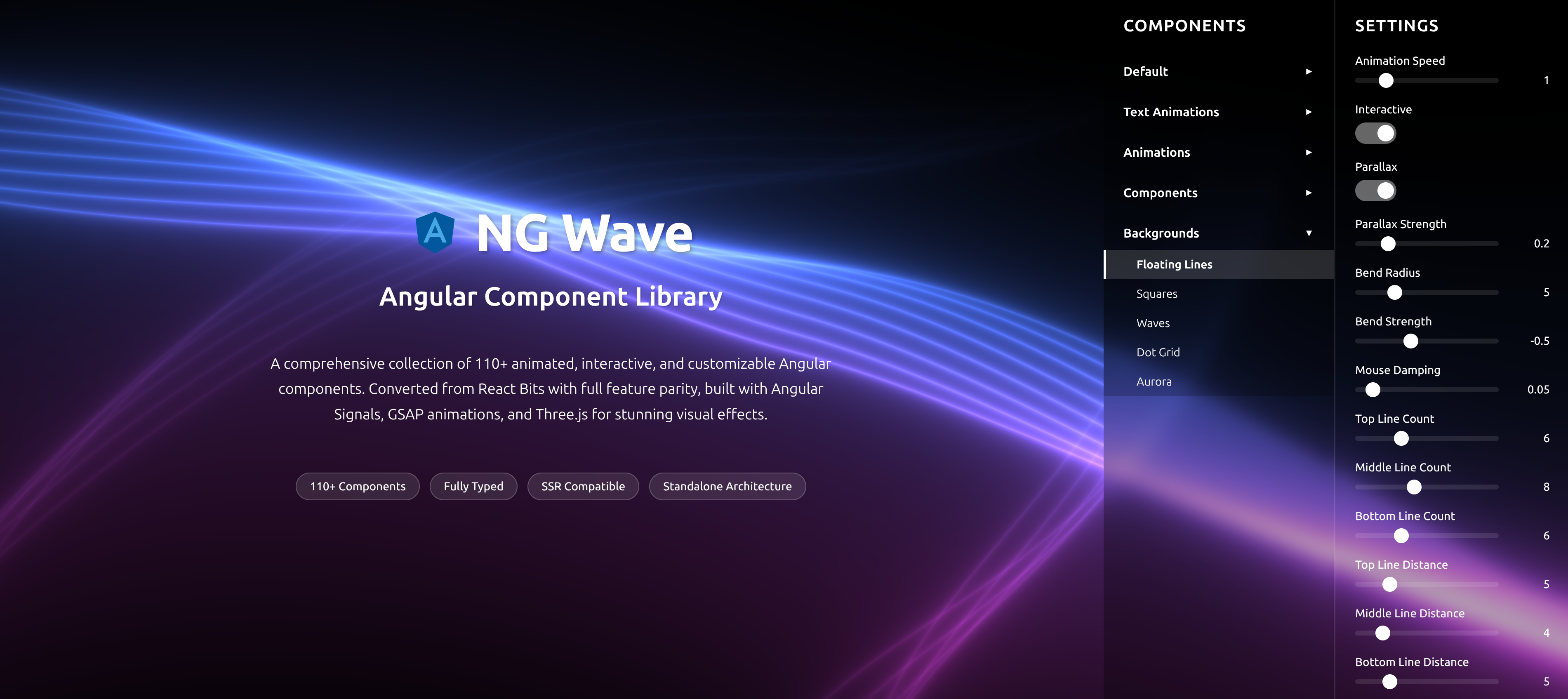
NG Wave
Angular Component Library
A comprehensive collection of 110+ animated, interactive, and customizable Angular components. Converted from React Bits with full feature parity, built with Angular Signals, GSAP animations, and Three.js for stunning visual effects.
Explore Components