Connect Figma Tokens to PrimeNG/Angular Components with Storybook 8 and Chromatic in the Loop
A practical, performance‑safe pipeline to wire Figma tokens into PrimeNG with Angular 20+, Signals, Nx—guarded by Storybook + Chromatic for AA, typography, and density.
Design changes shouldn’t feel risky. Tokens + Storybook + Chromatic make visual updates boring—in the best way possible.Back to all posts
I’ve been on the receiving end of the 11pm brand-color change at a global entertainment company and the 7am density tweak for a leading telecom provider’s ad dashboards. The only reason those requests didn’t derail releases: a token-driven pipeline that flowed cleanly from Figma into Angular and PrimeNG—watched by Storybook and Chromatic so we caught regressions before users did.
This article is the exact loop I now set up on every Angular 20+ project: Figma tokens → Style Dictionary → CSS variables → PrimeNG bridge → Signals-driven toggles → Storybook a11y → Chromatic visual diffs. It scales to role-based dashboards (a broadcast media network), heavy tables and virtualized lists (United, an insurance technology company), and data viz (Highcharts/D3/Canvas) without blowing performance budgets.
If you’re looking to hire an Angular developer or bring in an Angular consultant for a design system rollout, this is the playbook I use to stabilize chaotic codebases and make visual changes boring—on purpose.
The Visual Jitters Are Real: Why This Pipeline Exists
Seen in the field
Each of these projects had design updates landing late in the sprint. Before tokens, we’d hotfix SCSS, miss a AA contrast edge case, and discover a jittery table in production. After tokens + Chromatic, we merged with confidence and zero drama.
a global entertainment company employee/payments admin: brand updates mid‑quarter
Charter ads analytics: density shifts for table-heavy views
a broadcast media network scheduling (VPS): accessibility audits at scale
What we want
The goal is a fast, measurable loop: design pushes tokens; Angular updates CSS variables; Storybook documents states; Chromatic prevents silent regressions; performance budgets keep us honest.
One source of truth (Figma tokens)
PrimeNG theming without forking
Automated a11y + visual guardrails in CI
Why Connecting Figma Tokens to PrimeNG Matters in Angular 20+
Lower coordination cost
Your design system becomes an API. Engineers aren’t hunting hard-coded hex values; they’re binding to semantic tokens like --color-brand-600 and --space-100.
Tokens reduce handoffs to merging a JSON diff
CSS variables swap at runtime—no rebuild needed
Guardrails that scale
Chromatic review comments replace subjective “looks good?” chats. If the diff is green, you ship. If it’s red, you either adjust tokens or annotate the change.
Storybook a11y catches AA failures early
Chromatic’s pixel diffs catch off-by-one paddings
Performance stays tight
In enterprise dashboards with Highcharts and virtualized tables, the theming layer must be effectively free. Variables and affected CI keep the budget intact.
CSS variables are cheap
Nx affected scopes work to changed libs
Figma Tokens → PrimeNG: Step-by-Step Pipeline
1) Export tokens from Figma
Keep tokens semantic: color.brand.600, font.size.100, space.100, radius.md. Include OKLCH values for perceptual consistency in the AngularUX palette.
Use Tokens Studio or Design Tokens plugin
Export per-mode (light/dark), include typography/density
2) Transform with Style Dictionary
Transform tokens to CSS variables at build time. Two files: tokens.css (light) and tokens-dark.css (dark).
Emit CSS variables per theme
Keep output tiny and cacheable
Config: Style Dictionary
// tools/style-dictionary.config.cjs
module.exports = {
  source: ['libs/design-tokens/src/tokens/**/*.json'],
  platforms: {
    css: {
      transformGroup: 'css',
      buildPath: 'libs/design-tokens/dist/',
      files: [
        { destination: 'tokens.css', format: 'css/variables', options: { selector: ':root' } },
        { destination: 'tokens-dark.css', format: 'css/variables', options: { selector: ':root[data-theme="dark"]' } }
      ]
    }
  }
};
3) Bridge tokens to PrimeNG variables
PrimeNG exposes CSS variables for theme colors, surfaces, typography, and radii. Create a bridge SCSS to map your tokens to those variables.
No forking PrimeNG
Map your tokens → PrimeNG CSS variables
SCSS: PrimeNG bridge
/* libs/ui-theme/src/_primeng-bridge.scss */
:root {
  --primary-color: var(--color-brand-600);
  --primary-color-text: var(--color-surface-0);
  --text-color: var(--color-ink-900);
  --text-color-secondary: var(--color-ink-600);
  --surface-ground: var(--color-surface-50);
  --surface-card: var(--color-surface-0);
  --border-radius: var(--radius-md);
  --focus-ring: 0 0 0 3px color-mix(in oklch, var(--color-brand-500), white 70%);
  --font-family: var(--font-family-sans);
  --font-size: var(--font-size-100);
  --spacing: var(--space-100);
}

:root[data-density="compact"] {
  --spacing: var(--space-075);
  --font-size: var(--font-size-090);
}
4) Wire runtime toggles with Signals
Use a tiny ThemeStore to flip dataset attributes on . No reloads. Works in Storybook and in app.
Signals avoid global mutation noise
Optional: read defaults from Firebase Remote Config
Theme Signals store
// libs/theme/src/lib/theme.store.ts
import { Injectable, signal, computed, effect } from '@angular/core';
import { RemoteConfig, getValue } from '@angular/fire/remote-config';

type Theme = 'light' | 'dark';
type Density = 'comfortable' | 'compact';

@Injectable({ providedIn: 'root' })
export class ThemeStore {
  private theme = signal<Theme>('light');
  private density = signal<Density>('comfortable');
  constructor(private rc?: RemoteConfig) {
    effect(() => {
      document.documentElement.dataset.theme = this.theme();
      document.documentElement.dataset.density = this.density();
    });
    if (rc) {
      this.theme.set((getValue(rc, 'theme').asString() as Theme) || 'light');
      this.density.set((getValue(rc, 'density').asString() as Density) || 'comfortable');
    }
  }
  themeSignal = computed(() => this.theme());
  densitySignal = computed(() => this.density());
  setTheme(v: Theme) { this.theme.set(v); }
  setDensity(v: Density) { this.density.set(v); }
}
5) Document in Storybook 8
Each component gets states for default/hover/focus/disabled and compact density. That documentation becomes living QA.
Add a11y addon for AA checks
Expose density/theme as toolbar controls
Story: PrimeNG button
// libs/ui-components/src/lib/button/button.stories.ts
import { Meta, StoryObj, moduleMetadata } from '@storybook/angular';
import { ButtonModule } from 'primeng/button';

const meta: Meta = {
  title: 'Primitives/Button',
  decorators: [moduleMetadata({ imports: [ButtonModule] })],
  parameters: {
    a11y: { element: '#root' },
    chromatic: { diffThreshold: 0.03 },
  },
};
export default meta;

type Story = StoryObj;
export const Primary: Story = {
  render: () => ({ template: `<button pButton type="button" label="Primary"></button>` }),
};
6) Chromatic in CI (Nx affected)
Integrate Chromatic in GitHub Actions; fail on unexpected visual drift.
Only run for changed UI/libs
Block merges on meaningful diffs
GitHub Action: Chromatic
# .github/workflows/chromatic.yml
name: Chromatic
on:
  pull_request:
    paths:
      - 'libs/ui-components/**'
      - 'libs/ui-theme/**'
      - 'libs/design-tokens/**'
jobs:
  test:
    runs-on: ubuntu-latest
    steps:
      - uses: actions/checkout@v4
      - uses: pnpm/action-setup@v4
        with: { version: 9 }
      - run: pnpm install --frozen-lockfile
      - run: pnpm nx run ui-components:build-storybook
      - uses: chromaui/action@v1
        with:
          projectToken: ${{ secrets.CHROMATIC_PROJECT_TOKEN }}
          storybookBuildDir: dist/storybook/ui-components
          onlyChanged: 'true'
          exitZeroOnChanges: 'false'
7) Performance + a11y guardrails
Keep a modest CLS/TTI budget; fail on regressions. For accessibility, verify focus rings, hit targets, and contrast via tokens—not ad-hoc fixes.
Lighthouse budgets in CI
addon-a11y with custom rules
Apply to Data‑Dense Dashboards: Highcharts, D3, Virtual Tables
PrimeNG + viz harmony
In Charter’s analytics work we used tokens to align legend swatches with table badges, reducing cognitive load. The same mapping works for D3 or Canvas/Three.js.”
Use tokens to colorize charts
Match density between table cells and legends
Example: table + chart with tokens
<!-- libs/dashboards/src/lib/sales/sales.component.html -->
<div class="toolbar">
  <p-button label="Light" (onClick)="theme.setTheme('light')"></p-button>
  <p-button label="Dark" (onClick)="theme.setTheme('dark')"></p-button>
  <p-selectButton [options]="densities" [(ngModel)]="density" (onChange)="theme.setDensity($event.value)"></p-selectButton>
</div>

<p-table [value]="rows" [scrollable]="true" scrollHeight="400px">
  <ng-template pTemplate="header">
    <tr>
      <th>Region</th>
      <th>Revenue</th>
      <th>Growth</th>
    </tr>
  </ng-template>
  <ng-template pTemplate="body" let-row>
    <tr>
      <td>{{row.region}}</td>
      <td>{{row.revenue | number}}</td>
      <td>
        <app-sparkline [data]="row.spark" [color]="'var(--primary-color)'"></app-sparkline>
      </td>
    </tr>
  </ng-template>
</p-table>

<app-highcharts [options]="chartOptions"></app-highcharts>
Density SCSS snippet
/* libs/ui-theme/src/_density.scss */
:root[data-density="compact"] .p-component,
:root[data-density="compact"] .p-inputtext,
:root[data-density="compact"] .p-button {
  --p-input-padding-y: 0.375rem;
  --p-input-padding-x: 0.5rem;
  --p-button-padding-y: 0.375rem;
  --p-button-padding-x: 0.625rem;
  --p-table-cell-padding: 0.375rem 0.5rem;
  font-size: calc(var(--font-size) * 0.93);
}
Measurable results
On recent dashboards, moving to tokens + Chromatic cut visual defect reports by >70% and made brand updates a configuration change instead of a sprint.
Chromatic kept visual defects to near zero
Theme swaps in minutes, not days
AA/AAA tracked in Storybook
When to Hire an Angular Developer for Design Token Integration Rescue
Symptoms you might see
If you recognize these patterns, you’re paying a “visual tax” every sprint. An Angular consultant can set up the token bridge, Storybook docs, and Chromatic guardrails in 2–4 weeks for most Nx monorepos.
Inconsistent paddings/line-heights across pages
Hard-coded hex values scattered in SCSS
Manual dark mode styles diverging from light mode
Accessibility bugs reopen repeatedly
What the engagement includes
I’ve done this in live systems (e.g., device management portals, analytics platforms) with zero downtime and clear before/after metrics. If you need a remote Angular developer with enterprise experience, let’s talk.
Audit of current styles and PrimeNG overrides
Token source mapping and Style Dictionary setup
Signals/SignalStore theme + density toggles
Storybook a11y + Chromatic CI with thresholds
Knowledge transfer and upgrade guide
Takeaways and Next Steps
- Use tokens as the source of truth; ship CSS variables, not ad-hoc SCSS.
- Let Signals drive theme/density at runtime to avoid rebuilds.
- Put Storybook a11y and Chromatic in CI so visual debt stays paid down.
What to instrument next
UX polish and engineering rigor aren’t opposites. Tokens make the polish cheap; Chromatic and budgets make it measurable. That’s how we kept United kiosk UIs stable even under offline/online state flips.
Add GA4/Firebase Performance to measure TTI/CLS post-theme swap
Adopt feature flags for gradual visual rollouts
Use data virtualization for tables >10k rows
FAQs: Hiring and Technical
How much does it cost to hire an Angular developer for this work?
Typical token integration and guardrails project lands in the low five figures depending on scope (number of components, themes, and libraries). Fixed‑fee assessments available; I’ll quote after a brief repo review.
How long does a PrimeNG token bridge take?
2–4 weeks for a focused library, 4–8 weeks for multi‑app Nx monorepos with complex overrides. Chromatic baselining usually happens in week one.
Will this add runtime overhead?
No meaningful overhead. CSS variables resolve in the cascade; Signals update dataset attributes without re-rendering full trees. Keep chart/virtual-scroll rendering efficient and you’re safe.
Does this work with SSR?
Yes. Prefer server-side default attributes (data-theme, data-density) and hydrate with Signals. Avoid layout shifts by loading tokens.css early and deferring dark.css behind a .
Key takeaways
- Export tokens once from Figma, transform with Style Dictionary, and expose as CSS variables for PrimeNG.
- Drive theme and density via Signals/SignalStore to avoid global state thrash and enable runtime toggles.
- Use Storybook a11y + Chromatic diffs to enforce AA, typography scale, and density budgets in CI.
- Map tokens directly to PrimeNG CSS variables for zero‑fork theming and safer upgrades.
- Keep performance tight: CSS variable theming + Nx affected + static Storybook builds = fast and cheap checks.
Implementation checklist
- Export Figma tokens (Tokens Studio/Design Tokens) to JSON
- Transform with Style Dictionary to CSS variables (light/dark)
- Bridge tokens to PrimeNG variables via a theme SCSS file
- Wire theme/density toggles with Angular Signals/SignalStore
- Add Storybook a11y + docs for component states
- Run Chromatic visual tests in CI with sensible thresholds
- Track UX performance with Lighthouse budgets and Firebase Performance
- Adopt Nx affected to scope Storybook/Chromatic runs
Questions we hear from teams
- How much does it cost to hire an Angular developer for token integration?
- Low five figures for most teams, depending on component count and themes. I provide a fixed-fee assessment with a detailed plan after a quick repo review.
- How long does an Angular token + Chromatic setup take?
- 2–4 weeks for a single UI library, 4–8 weeks for large Nx monorepos. Week one covers token export, Style Dictionary, and Chromatic baseline.
- Will PrimeNG upgrades break the theme bridge?
- Rarely. Because we map to PrimeNG’s public CSS variables, upgrades are safer. Visual diffs in Chromatic catch any variable contract changes.
- Can we control theme/density remotely?
- Yes. Use Signals to toggle locally and read defaults from Firebase Remote Config for gradual or role-based rollouts without redeploys.
- What does an Angular consultant deliver here?
- A token pipeline, PrimeNG bridge, Signals toggles, Storybook docs with a11y, Chromatic CI, and an upgrade guide—plus knowledge transfer to your team.
Ready to level up your Angular experience?
Let AngularUX review your Signals roadmap, design system, or SSR deployment plan.
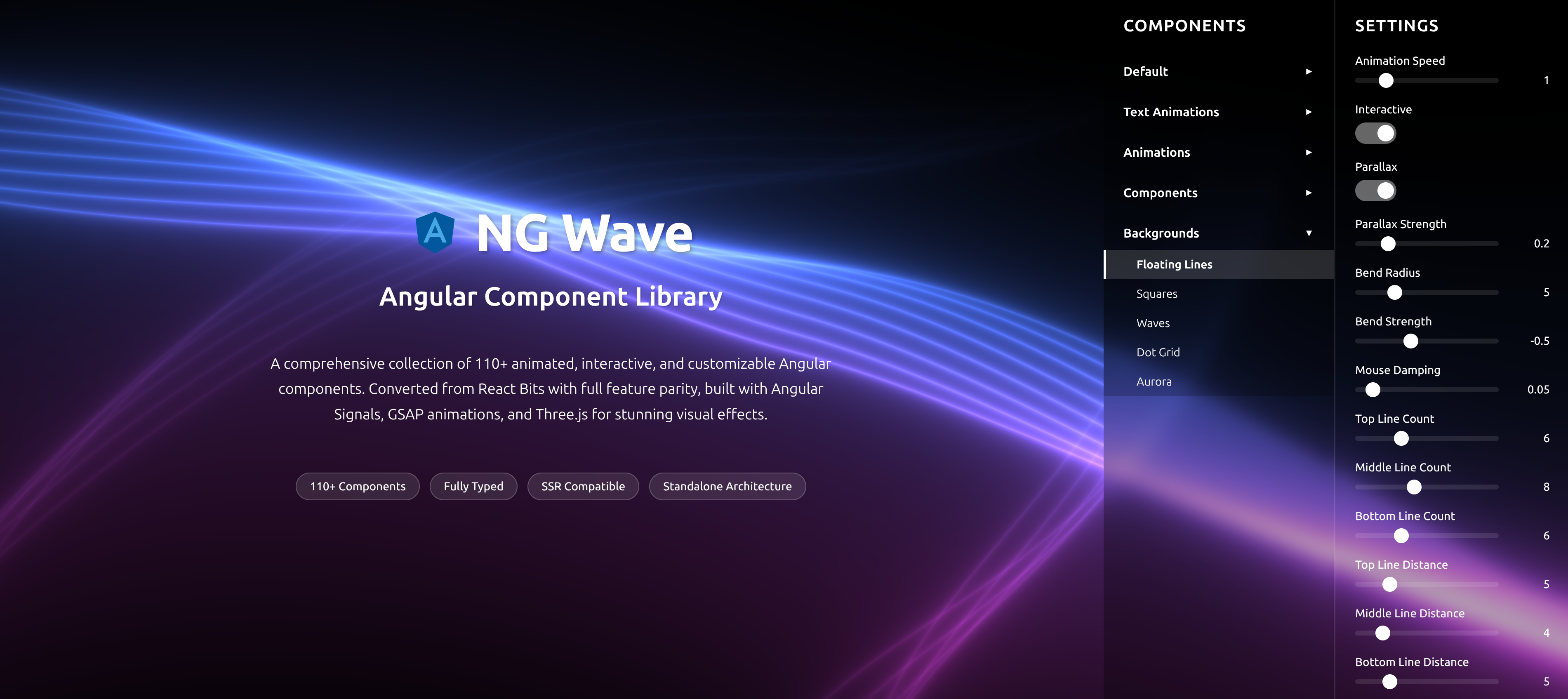
NG Wave
Angular Component Library
A comprehensive collection of 110+ animated, interactive, and customizable Angular components. Converted from React Bits with full feature parity, built with Angular Signals, GSAP animations, and Three.js for stunning visual effects.
Explore Components