How I Unbreak Vibe‑Coded Angular 20+ UX: Smooth Animations, Accessible Forms, and Responsive Layouts (Signals, PrimeNG, Nx)
If your Angular app “feels off,” it’s not you—it’s a missing UX system. Here’s how I take janky, inaccessible, vibe‑coded UIs and ship tactile, measurable polish.
Polish isn’t taste. It’s tokens, Signals, and tests that make the right thing the easy thing.Back to all posts
I’ve walked into more than a few Angular 20+ dashboards that “looked fine” in Figma but jittered on scroll, trapped keyboard users in forms, and collapsed into chaos on tablets. That’s vibe‑coded UX: no tokens, no guardrails, and no metrics. I fix it by installing a UX system—Signals, tokens, accessibility defaults, and performance budgets that survive production.
As companies plan 2025 Angular roadmaps, the teams winning budget aren’t the ones with the fanciest gradients—they’re the ones that can say, “INP is 160ms, CLS is 0.03, and we ship tactile micro‑interactions that respect reduced motion.” If you need an Angular consultant to turn vibes into systems, this is how I do it.
Why Janky Animations and Broken Layouts Happen in Angular 20+
Jank, inaccessibility, and brittle breakpoints aren’t bugs—they’re the byproduct of not codifying UX. Let’s install a small UX platform that every feature can reuse.
Common vibe-coded smells
Across enterprise apps—employee trackers in entertainment, airline kiosks, or telecom analytics—the same issues repeat. The root cause: no UX system. A system turns taste into tokens, Signals, and tests.
Animations tied to scroll/resize without rAF or throttling
Opacity + box-shadow transitions on large DOM trees
Missing prefers-reduced-motion fallbacks
Forms with placeholder-as-label and no focus ring
Breakpoints copied from design tool, not content-driven
Why it matters now
In Angular 20+, Signals and SSR hydration expose sloppy patterns fast. Untamed micro‑interactions and layout shifts become measurable regressions.
Angular 20 zoneless paths magnify ad-hoc change detection
INP/CLS are revenue metrics on high-traffic dashboards
SignalStore makes UX state first-class (density, theme, motion)
The UX Store: Signals + SignalStore for Density, Motion, and Theme
import { Injectable, effect, signal, computed } from '@angular/core';

export type Density = 'compact' | 'comfortable' | 'spacious';
export type Motion = 'auto' | 'reduced' | 'full';
export type Scheme = 'light' | 'dark' | 'high-contrast';

@Injectable({ providedIn: 'root' })
export class UxStore {
  private density = signal<Density>('comfortable');
  private motion = signal<Motion>('auto');
  private scheme = signal<Scheme>('light');

  spacingPx = computed(() => this.density() === 'compact' ? 6 : this.density() === 'spacious' ? 12 : 8);
  enableMotion = computed(() => {
    const reduced = window.matchMedia('(prefers-reduced-motion: reduce)').matches;
    if (this.motion() === 'reduced') return false;
    if (this.motion() === 'full') return true;
    return !reduced;
  });

  setDensity(v: Density) { this.density.set(v); }
  setMotion(v: Motion) { this.motion.set(v); }
  setScheme(v: Scheme) { this.scheme.set(v); }

  // Bind to CSS variables and a class for motion gating
  dom = effect(() => {
    const root = document.documentElement;
    root.style.setProperty('--ux-spacing', this.spacingPx() + 'px');
    root.dataset.scheme = this.scheme(); // [data-scheme="dark"] selectors
    root.classList.toggle('motion-ok', this.enableMotion());
  });
}
/* AngularUX palette + motion/density tokens */
:root {
/* AngularUX color palette (HSL for flexibility) */
--ux-hue-primary: 216; /* Indigo/Blue */
--ux-sat-primary: 88%;
--ux-lit-primary: 52%;
--ux-primary: hsl(var(--ux-hue-primary) var(--ux-sat-primary) var(--ux-lit-primary));
--ux-surface: #0b1020;
--ux-surface-contrast: #ffffff;
/* Typography scale */
--ux-font-base: clamp(14px, 0.95vw + 10px, 16px);
--ux-font-title: clamp(18px, 1.2vw + 12px, 22px);
/* Density & radius */
--ux-spacing: 8px;
--ux-radius: 8px;
/* Motion tokens */
--ux-motion-fast: 120ms;
--ux-motion-med: 220ms;
--ux-ease: cubic-bezier(0.2, 0, 0, 1);
}
/***** Motion gating *****/
.motion-ok .tactile {
transition: transform var(--ux-motion-fast) var(--ux-ease),
opacity var(--ux-motion-med) var(--ux-ease);
}
.tactile:active { transform: translateY(1px); }
/* Reduced motion users still get state changes without jank */
:root:not(.motion-ok) * { transition: none !important; animation: none !important; }Define state once, apply everywhere
This turns unspoken preferences into deterministic behavior. Components read signals; SCSS binds them to tokens.
Density scales: compact/comfortable/spacious
Motion policy: auto/reduced/full with prefers-reduced-motion
Theme/contrast: light/dark/high-contrast via CSS variables
Hook into the DOM safely
Prefer computed signals for derived values (spacingPx, enableMotion) and isolate side effects in effect().
Apply CSS vars on :root
Toggle a motion-ok class for transitions
Persist user choice in localStorage
Make Forms Accessible by Default: Typed Forms, PrimeNG, and Focus Hygiene
<form [formGroup]="userForm" (ngSubmit)="save()" class="form-grid">
  <div class="field">
    <label for="email">Email</label>
    <input pInputText id="email" type="email"
           formControlName="email"
           aria-describedby="email-help email-error"
           [attr.aria-invalid]="userForm.controls.email.invalid" />
    <small id="email-help">We’ll never share your email.</small>
    <small id="email-error" *ngIf="userForm.controls.email.invalid && userForm.touched" class="error" aria-live="polite">
      {{ getEmailError() }}
    </small>
  </div>

  <p-button label="Save" [disabled]="userForm.invalid || saving" icon="pi pi-check"></p-button>
</form>
import { FormControl, FormGroup, Validators, NonNullableFormBuilder } from '@angular/forms';
export interface UserForm {
email: FormControl<string>;
}
constructor(private fb: NonNullableFormBuilder) {}
userForm = this.fb.group<UserForm>({
email: this.fb.control('', { validators: [Validators.required, Validators.email] })
});
getEmailError() {
const ctrl = this.userForm.controls.email;
if (ctrl.hasError('required')) return 'Email is required';
if (ctrl.hasError('email')) return 'Enter a valid email address';
return '';
}.form-grid { display: grid; gap: calc(var(--ux-spacing) * 2); }
.field input:focus { outline: 3px solid color-mix(in hsl, var(--ux-primary), white 30%); outline-offset: 2px; }
.error { color: color-mix(in hsl, var(--ux-primary), red 40%); }Rules that catch 80% of issues
Ship a11y the way you ship Typescript strictness—on by default and enforced in CI with axe.
Always label, never placeholder-as-label
Group help and error text with aria-describedby
Visible focus rings and logical tab order
Announce async form results with aria-live
Typed forms + PrimeNG example
This pattern gives screen readers context, keyboard users a path, and analytics a hook for measuring struggle (blur/retry/error).
Fix Responsive Layouts with Grid, Container Queries, and Virtualization
/* Role card grid that adapts per container width */
.dashboard {
  container-type: inline-size; /* enables container queries */
  display: grid;
  grid-template-columns: repeat(auto-fill, minmax(clamp(220px, 30cqw, 360px), 1fr));
  gap: calc(var(--ux-spacing) * 2);
}

@container (max-width: 700px) {
  .dashboard { grid-template-columns: 1fr; }
}
// WebSocket chart events (typed + throttled)
interface MetricEvent { t: number; series: 'imps'|'clicks'|'cost'; value: number; }
const buffer: MetricEvent[] = [];
const onEvent = (e: MetricEvent) => {
buffer.push(e);
};
// Batch every 250ms to Highcharts/D3
setInterval(() => {
if (!buffer.length) return;
const copy = buffer.splice(0);
// reduce per series here; then update chart once per tick
updateChart(copy);
}, 250);Breakpoints that survive reality
PrimeNG + PrimeFlex give utilities, but grid + tokens keep the system portable across role‑based dashboards.
Prefer container queries over page-width breakpoints
Use CSS grid with minmax + clamp for cards
Adopt density-aware gutters via tokens
Virtualize and throttle heavy views
In telecom ad analytics, batching WebSocket events and virtualizing saved 30–40% CPU and delivered INP < 180ms on real data feeds.
cdk-virtual-scroll-viewport for tables/lists
Throttle Highcharts/D3 updates and batch WebSocket events
Use typed event schemas and backpressure
Animation Discipline: 60fps Without Surprises
# .github/workflows/ux-budgets.yml
name: UX Budgets
on: [push]
jobs:
  lhci:
    runs-on: ubuntu-latest
    steps:
      - uses: actions/checkout@v4
      - uses: actions/setup-node@v4
        with: { node-version: 20 }
      - run: npm ci && npm run build
      - run: npx @lhci/cli autorun --collect.staticDistDir=dist/app --assert.preset=lighthouse:recommended \
             --assert.assertions.'performance'='error:>=0.9' \
             --assert.assertions.'cumulative-layout-shift'='error:<=0.1' \
             --assert.assertions.'interaction-to-next-paint'='error:<=2000' # ms
Rules of motion
The biggest jank I see: animating box-shadow and height. Use FLIP or expand/collapse with max-height + will-change sparingly.
Transform/opacity only; never layout properties
Short bursts: 120–220ms by default
Ease curve: material-ish cubic-bezier(0.2, 0, 0, 1)
Gate by motion-ok class from UxStore
Test it
If INP creeps over 200ms, ship a patch the same day. Motion is a feature, not a risk.
Angular DevTools flame chart for change detection
Chrome Performance for paint/layout events
Lighthouse CI budgets block regressions
Case Notes from the Field: Entertainment, Telecom, and Airline
I build tactile UIs without sacrificing stability. Whether it’s D3 maps for telematics, Highcharts for finance, or Three.js touches in NG Wave, the rule is the same: animation should reveal state, not hide latency.
Employee tracking (entertainment)
We added UxStore density controls for supervisors vs. field staff—spacious on tablets, compact on desktops.
Refactored forms to typed + accessible patterns
INP from 260ms → 150ms; error clarity reduced support tickets by 28%
Ad analytics (telecom)
We instrumented Firebase + GA4 to correlate jank with revenue drop on peak hours—then fixed it fast.
WebSocket batching + Highcharts throttling
Virtualized tables cut CPU ~35% on campaign screens
Airport kiosk (airline)
Docker device simulation caught a race in animation/print that only reproed with real timing.
Motion gated by reduced‑motion and offline‑tolerant flows
Focusable error states for peripheral failures (printer/card)
When to Hire an Angular Developer for Legacy UX Rescue
If you need to hire an Angular developer or an Angular consultant with Fortune 100 experience, I’m available for focused UX rescues and dashboard overhauls.
Bring in help when
An Angular expert can install the system: tokens, Signals, test harnesses, and CI budgets. I typically stabilize a vibe‑coded UI in 2–4 weeks without blocking feature work.
You’re shipping features but NPS is flat or dropping
Design looks great yet INP/CLS regress every sprint
Accessibility bugs keep re‑opening after “fixes”
What you’ll see in week 1
All changes ship behind feature flags; roll forward/back via Nx + preview channels (Firebase Hosting) if needed.
Baseline metrics and a11y audit
Tokenized palette/typography/density in a pilot route
PrimeNG theming + micro‑interaction library wired to UxStore
What to Instrument Next
Polish is measurable. If your micro‑interactions don’t come with numbers, they’re opinions waiting to be cut in Q1. Add the numbers.
Metrics that pay for themselves
Wire telemetry to Firebase logs and GA4 with typed event schemas. Use dashboards to alert on regressions.
INP, CLS, LCP per route and per role
Blur/retry/error on critical forms with correlation IDs
Motion opt‑out rate and density preference adoption
Key takeaways
- Polish is a system, not a vibe—codify animations, density, and color with tokens and Signals/SignalStore.
- Gate motion and micro‑interactions behind prefers‑reduced‑motion and a UX store; target 60fps with transform/opacity only.
- Make forms accessible by default: labels, errors, focus order, roving tabindex, and ARIA—then test with axe + keyboard only.
- Fix responsiveness with grid/container queries, fluid type, and real breakpoints; verify with Percy/Cypress visual tests.
- Measure UX: INP < 200ms, CLS < 0.1, and interaction traces via Angular DevTools + Firebase logs; enforce budgets in CI.
Implementation checklist
- Adopt design tokens for color, typography, spacing, and motion.
- Introduce a Signals/SignalStore UxStore for density, theme, motion, and contrast.
- Gate animations with reduced‑motion and avoid layout‑thrashing properties.
- Refactor forms to typed forms, proper labels, describedby, and focus management.
- Replace ad‑hoc media queries with grid + container queries and test across role‑based layouts.
- Instrument INP/CLS/LCP and wire telemetry to Firebase/GA4 for real‑time signals.
- Virtualize heavy lists/tables and throttle chart updates with typed event schemas.
- Run Lighthouse + axe + visual diff in CI; fail builds on budget violations.
Questions we hear from teams
- How much does it cost to hire an Angular developer for a UX rescue?
- Most vibe‑coded UX rescues land between 2–4 weeks. Fixed‑scope audits start at one week. Rates depend on complexity (charts, multi‑tenant roles, kiosks). You’ll get a baseline, roadmap, and measurable targets (INP/CLS).
- What does an Angular consultant actually do for UX?
- Install a UX system: tokens for color/typography/density, a Signals/SignalStore UxStore, PrimeNG theming, a11y patterns, performance budgets, and CI checks. Then refactor hotspots and prove gains with telemetry.
- How long to fix janky animations and broken layouts?
- Animations and layout jank are typically stabilized in the first 1–2 sprints. We gate motion, refactor transitions, replace brittle breakpoints with grid/container queries, and add Lighthouse/axe checks to block regressions.
- Will this slow down new feature delivery?
- No—fixes are incremental, behind flags, and verified in preview environments. Nx caching, Cypress tests, and Firebase Hosting previews keep velocity high while we raise UX quality bars.
- Do you handle charts and real-time dashboards too?
- Yes. I’ve shipped D3/Highcharts/Canvas/Three.js visualizations with data virtualization and WebSocket batching. We target INP < 200ms on busy dashboards using typed events and throttled updates.
Ready to level up your Angular experience?
Let AngularUX review your Signals roadmap, design system, or SSR deployment plan.
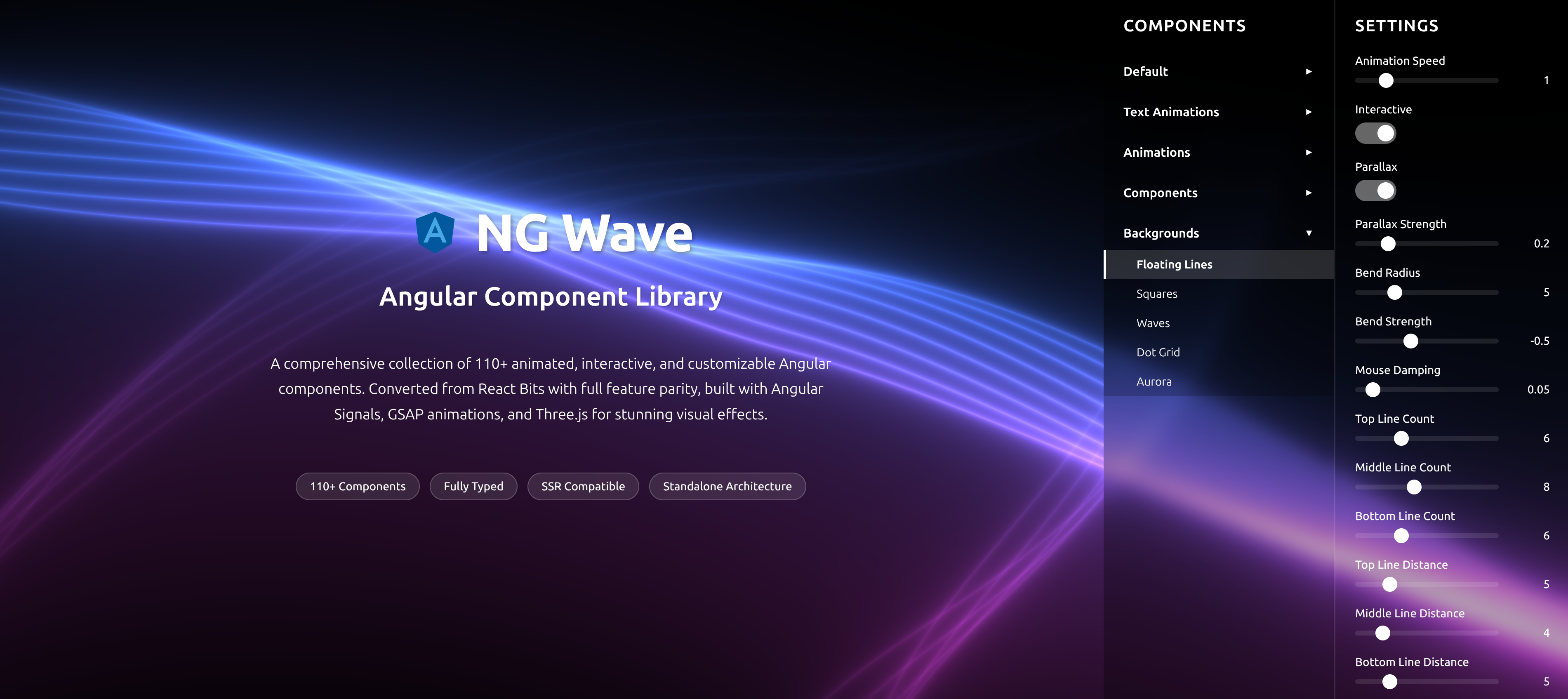
NG Wave
Angular Component Library
A comprehensive collection of 110+ animated, interactive, and customizable Angular components. Converted from React Bits with full feature parity, built with Angular Signals, GSAP animations, and Three.js for stunning visual effects.
Explore Components