Data Virtualization in Angular 20+ Tables: PrimeNG and Angular Material Patterns for 60fps Scroll and Low Memory
Enterprise-grade data virtualization for Angular tables: efficient rendering, smooth scroll, and memory-aware design without sacrificing accessibility or polish.
“Virtualization turns a 200k‑row liability into a 60fps brag slide—if you lock row height, cache smart, and keep cells dead simple.”Back to all posts
When your table jitters while a director stares at a 200,000‑row feed, you don’t talk theory—you ship a plan. I’ve been in that room at a leading telecom provider (ad logs), a broadcast media network (schedule grids), and a global entertainment company (employee events). The answer is almost always the same: data virtualization plus ruthless attention to row height, memory, and semantics.
This piece shows how I implement virtualization in Angular 20+ with PrimeNG and Angular Material, powered by Signals/SignalStore, all while honoring accessibility, typography, density, and the AngularUX color palette. If you need an Angular expert to steady a dashboard, this is the exact playbook I use.
Why Angular Tables Stutter with Large Datasets
at a leading telecom provider I inherited a mat-table rendering 50k rows. Hover lag was 300–500ms and memory crept over 700MB. After switching to CDK Virtual Scroll with a strict 36px row height and moving sparklines to Canvas, scroll hit 60fps and memory stabilized under 200MB. Similar wins repeated on a broadcast media network’s scheduling grid and a an enterprise IoT hardware company device fleet list.
Symptoms I see in audits
Jank after ~2k rows
1000s of detached DOM nodes
Memory climbs past 500MB
Row hover/selection lag
Root causes
Too many DOM nodes; each cell has change detection cost
Auto-height rows cause layout thrash
Complex cell templates (icons, chips, menus) re-render on scroll
Mutable arrays break trackBy and recycling
What worked at scale
Hard cap visible DOM with virtualization
Stable row height via density tokens
Signal-driven data windows with LRU cache
Canvas/WebGL for heavy visuals
How an Angular Consultant Approaches Data Virtualization
As companies plan 2025 Angular roadmaps with Angular 21 beta landing soon, this is low-risk, high-ROI polish. If you need to hire an Angular developer to triage a dashboard in Q1, start with virtualization.
Audit first
I profile scroll while toggling features (badges, tooltips, sticky columns) to find the worst offenders.
Angular DevTools render counts
Chrome Performance flame charts
Heap snapshots for leaks
Pick the primitive
If the team already uses PrimeNG, I lean on p-table virtualScroll. For custom grids (like a broadcast media network VPS), CDK gives me the knobs I need.
PrimeNG p-table: turnkey virtualScroll + lazy load
CDK: maximum control, Material-like styling
Signals pipeline
Signals remove zone churn and let me batch updates around scroll frames.
SignalStore caches pages
computed() slices visible window
Exponential backoff on load
PrimeNG Virtual Scroll + Lazy Loading with Signals/SignalStore
// table.store.ts (Angular 20+, @ngrx/signals)
import { inject, Injectable, signal, computed } from '@angular/core';
import { HttpClient } from '@angular/common/http';
import { SignalStore, withState, withMethods } from '@ngrx/signals';

interface Row { id: string; name: string; status: string; amount: number; }
interface TableState { total: number; pageSize: number; pages: Map<number, Row[]> }

@Injectable({ providedIn: 'root' })
export class TableStore extends SignalStore(
  { providedIn: 'root' },
  withState<TableState>({ total: 0, pageSize: 100, pages: new Map() }),
  withMethods((store, http = inject(HttpClient)) => {
    const lru: number[] = [];
    const maxPages = 12; // cap memory ~ 12 * 100 rows

    function remember(page: number) {
      const idx = lru.indexOf(page);
      if (idx !== -1) lru.splice(idx, 1);
      lru.unshift(page);
      while (lru.length > maxPages) {
        const evict = lru.pop();
        if (evict !== undefined) store.state().pages.delete(evict);
      }
    }

    return {
      loadPage: async (page: number) => {
        if (store.state().pages.has(page)) { remember(page); return; }
        const size = store.state().pageSize;
        const data = await http
          .get<Row[]>(`/api/rows?offset=${page * size}&limit=${size}`)
          .toPromise();
        store.state().pages.set(page, data || []);
        remember(page);
      },
      setTotal: (n: number) => store.patch({ total: n })
    };
  })
) {
  readonly pageSize = computed(() => this.state().pageSize);
  readonly total = computed(() => this.state().total);
  readonly window = signal({ first: 0, rows: 100 });

  readonly visible = computed(() => {
    const { first, rows } = this.window();
    const startPage = Math.floor(first / this.pageSize());
    const endPage = Math.floor((first + rows) / this.pageSize());
    const all: Row[] = [];
    for (let p = startPage; p <= endPage; p++) {
      const page = this.state().pages.get(p) || [];
      all.push(...page);
    }
    const start = first % this.pageSize();
    return all.slice(start, start + rows);
  });
}
<!-- table.component.html -->
<p-table
[value]="store.visible()"
[virtualScroll]="true"
[lazy]="true"
[rows]="store.pageSize()"
[virtualScrollItemSize]="36"
scrollHeight="600px"
[trackBy]="trackById"
(onLazyLoad)="onLazy($event)"
[styleClass]="'ax-table ax-density-' + density()"
[ariaRowCount]="store.total()">
<ng-template pTemplate="header">
<tr>
<th scope="col">Name</th>
<th scope="col">Status</th>
<th scope="col" class="text-right">Amount</th>
</tr>
</ng-template>
<ng-template pTemplate="body" let-row let-ri="rowIndex">
<tr role="row" [attr.aria-rowindex]="ri + 1">
<td>{{ row.name }}</td>
<td>
<p-tag [value]="row.status" severity="success"></p-tag>
</td>
<td class="text-right">{{ row.amount | number:'1.0-0' }}</td>
</tr>
</ng-template>
</p-table>// table.component.ts
import { Component, signal } from '@angular/core';
import { TableStore } from './table.store';
@Component({ selector: 'ax-table', templateUrl: './table.component.html' })
export class TableComponent {
density = signal<'compact' | 'cozy' | 'comfortable'>('compact');
constructor(public store: TableStore) {}
async onLazy(e: { first: number; rows: number }) {
this.store.window.set({ first: e.first, rows: e.rows });
const startPage = Math.floor(e.first / this.store.pageSize());
const endPage = Math.floor((e.first + e.rows) / this.store.pageSize());
for (let p = startPage; p <= endPage; p++) await this.store.loadPage(p);
}
trackById = (_: number, r: { id: string }) => r.id;
}SignalStore for paged data with LRU cache
p-table template with accessibility and density classes
Why this scales
Keeps DOM under ~150 rows
LRU caps memory growth
AA-friendly with aria-rowcount and proper roles
Material: CDK Virtual Scroll Styled Like mat-table
<!-- cdk-virtual-scroll with Material styles -->
<cdk-virtual-scroll-viewport class="ax-viewport mat-elevation-z1"
  [itemSize]="rowHeight" [minBufferPx]="360" [maxBufferPx]="720">
  <table class="mat-mdc-table ax-table ax-density-compact" role="table" aria-rowcount="{{ total }}">
    <thead class="mat-mdc-header-row" role="row">
      <th role="columnheader">Name</th>
      <th role="columnheader">Status</th>
      <th role="columnheader" class="text-right">Amount</th>
    </thead>
    <tbody>
      <tr class="mat-mdc-row" role="row"
          *cdkVirtualFor="let row of rows(); trackBy: trackById; let i = index"
          [attr.aria-rowindex]="i + 1">
        <td role="cell">{{ row.name }}</td>
        <td role="cell"><span class="ax-chip ax-chip--{{ row.status }}">{{ row.status }}</span></td>
        <td role="cell" class="text-right">{{ row.amount | number:'1.0-0' }}</td>
      </tr>
    </tbody>
  </table>
</cdk-virtual-scroll-viewport>
// density + color tokens (AngularUX palette)
:root {
--ax-row-height: 36px;
--ax-font-100: 14px;
--ax-surface: #0f172a;
--ax-surface-2: #111827;
--ax-text: #e5e7eb;
--ax-accent: #22d3ee; // AngularUX cyan accent
}
.ax-density-compact { --ax-row-height: 32px; --ax-font-100: 13px; }
.ax-density-cozy { --ax-row-height: 40px; --ax-font-100: 14px; }
.ax-density-comfortable { --ax-row-height: 48px; --ax-font-100: 16px; }
.ax-table {
font-size: var(--ax-font-100);
color: var(--ax-text);
background: var(--ax-surface);
th, td { height: var(--ax-row-height); }
.ax-chip { padding: 2px 8px; border-radius: 999px; background: var(--ax-surface-2); }
.ax-chip--success { background: #064e3b; color: #a7f3d0; }
}
@media (prefers-reduced-motion: reduce) {
.ax-table * { transition: none !important; animation: none !important; }
}Why not mat-table directly?
mat-table doesn’t natively virtualize rows; CDK template is simpler and faster.
Implementation
Accessibility notes
Use role=table/row/cell
Set aria-rowcount and aria-rowindex
Keep focus stable on recycling
Memory Optimization Tactics that Survive Production
// Pure row as a standalone component (fast re-use)
@Component({
  selector: 'ax-row',
  standalone: true,
  changeDetection: ChangeDetectionStrategy.OnPush,
  template: `
    <td>{{ row.name }}</td>
    <td><ax-status [value]="row.status"/></td>
    <td class="text-right">{{ row.amount | number:'1.0-0' }}</td>
  `
})
export class AxRowComponent { @Input({ required: true }) row!: Readonly<Row>; }

// trackBy to avoid DOM churn
trackById = (_: number, r: Row) => r.id;
Row component discipline
Make rows pure, OnPush
Avoid async pipes inside 1000s of rows
Use trackBy stable IDs
Keep data immutable at the row boundary
Freeze row objects; compute signals outside the row
Avoid spreading big objects in templates
Move heavy visuals off the DOM
at a major airline’s kiosk telemetry we rendered 24h event density as a Canvas heatmap—memory stayed <150MB even offline.
Use Canvas/WebGL for sparklines (D3 scales + Canvas path)
Use Highcharts Boost/WebGL for dense series
UX Polish Without Breaking Performance Budgets
Virtualization shouldn’t make the UI feel cheap. On SageStepper and my dashboard demos, density is a first-class control in the header. When density changes, I update itemSize for the viewport to keep FPS consistent and prevent layout thrash.
Typography and density controls
Expose compact/cozy/comfortable across the app
Lock row height per mode; update itemSize accordingly
AngularUX color palette
Dark-friendly contrasts
Accent tokens for readable tags
AA accessibility in virtualized grids
Test with NVDA/VoiceOver; verify row indices read correctly during scroll.
aria-rowcount + aria-rowindex
Sticky header semantic roles
Keyboard loops and focus restore
Instrumentation: Prove the Win to Execs
When we scaled IntegrityLens to 12,000+ interview artifacts, we added Firebase Performance marks around scroll start/stop and sent a summarized metric to GA4. That made it trivial to tell a VP: “60fps in 97% of sessions; median memory 180MB; 0 crashes.”
Metrics I ship
Mean FPS during scroll window
Heap size delta pre/post scroll
Render counts per 1k rows
Tools
Angular DevTools, Chrome Performance
Firebase Performance Traces + GA4 events
Nx CI budgets for bundle size
Guardrails
Feature flags to A/B density and cells
Budget checks in PR (Lighthouse, size-limit)
Real‑World Examples: D3, Highcharts, and Canvas
Data virtualization isn’t only for tables. The same principles apply to charts embedded inside rows: precompute, batch, and limit DOM nodes.
D3 scales + Canvas paths
Sparklines in tables should render via Canvas; DOM/SVG per row is too heavy past a few hundred rows.
Use D3 for math, Canvas for pixels
Highcharts Boost/WebGL
On a broadcast media network, pre-decimation + Boost yielded 30–60fps across hour-scale ranges.
Use Boost for >100k points
Pre-decimate server-side
Three.js for 3D density maps
For a an insurance technology company telematics prototype, WebGL heat volumes stayed smooth by streaming downsampled tiles.
Only for specialized dashboards
When to Hire an Angular Developer for Legacy Rescue
I’ve rescued legacy Angular at a global entertainment company, a broadcast media network, and Charter. If your table stutters or your memory grows without bound, bring me in to stabilize and instrument it—without breaking production.
Signs you need help
AngularJS/old Material table with lag
Zone churn and mystery GC pauses
SSR hydration breaks on large tables
What I deliver in 2–4 weeks
If you need an Angular consultant, I can usually ship an assessment in a week and a hardened plan in the next sprint.
Virtualized tables with AA accessibility
SignalStore caching + telemetry
CI guardrails via Nx + Firebase previews
Step‑by‑Step Virtualization Playbook (Summary)
You can roll this in a single sprint for one table. For multi-tenant dashboards, I templatize the store and viewport so every grid shares the same rigor.
Steps
Profile scroll; capture baseline metrics
Pick PrimeNG or CDK; fix row height and density tokens
Implement SignalStore window + LRU cache
Wire lazy loading with exponential backoff
Add trackBy + pure row components
Instrument FPS, memory, and render counts; set CI budgets
Key takeaways
- Use virtualization primitives (PrimeNG virtualScroll or CDK Virtual Scroll) and trackBy to keep DOM nodes under ~200.
- Drive table windows with Signals/SignalStore; cache pages with LRU to cap memory while keeping scroll smooth.
- Enforce row height tokens and density controls to stabilize itemSize and FPS.
- Keep cells simple; push heavy rendering to Canvas/WebGL (D3/Highcharts) and precompute values.
- Instrument scroll FPS, memory, and render counts with Angular DevTools and Firebase Performance.
Implementation checklist
- Choose a virtualization primitive: PrimeNG virtualScroll or CDK Virtual Scroll.
- Fix a stable row height and density tokens; avoid auto-height rows.
- Add trackBy and pure, OnPush row components; avoid mutable reference churn.
- Implement a paging SignalStore with LRU cache and lazy loading.
- Batch updates with requestAnimationFrame and computed signals.
- Instrument scroll FPS, memory, and render counts; set performance budgets in CI.
Questions we hear from teams
- How long does it take to virtualize a large Angular table?
- Typical engagement: 1 week for assessment, 1–2 weeks to implement PrimeNG or CDK virtualization with Signals/SignalStore, then a hardening pass for AA accessibility and telemetry. Complex role-based dashboards may take 3–4 weeks.
- Does virtualization break accessibility?
- It can if you skip semantics. Use role=table/row/cell, set aria-rowcount and aria-rowindex, and test with NVDA/VoiceOver. Keep focus stable as rows recycle and ensure keyboard navigation works end-to-end.
- PrimeNG or CDK Virtual Scroll—what should we choose?
- PrimeNG is fastest to ship if you’re already on PrimeNG. CDK gives maximum control and smaller footprint. I choose based on your component library, density/typography needs, and whether you need custom cell renderers or complex sticky columns.
- What about charts inside table rows?
- Use Canvas/WebGL. D3 for scales and math, Canvas for pixels. Highcharts Boost helps past 100k points. Avoid per-row SVG; precompute server-side and render tiny bitmaps or canvas paths.
- How much does it cost to hire an Angular developer for this work?
- I offer fixed-scope proofs starting at 2–3 weeks. After a free 30-minute assessment, I’ll propose a plan with deliverables, metrics, and a not-to-exceed budget. Remote, contractor-friendly, with Nx/Firebase previews each PR.
Ready to level up your Angular experience?
Let AngularUX review your Signals roadmap, design system, or SSR deployment plan.
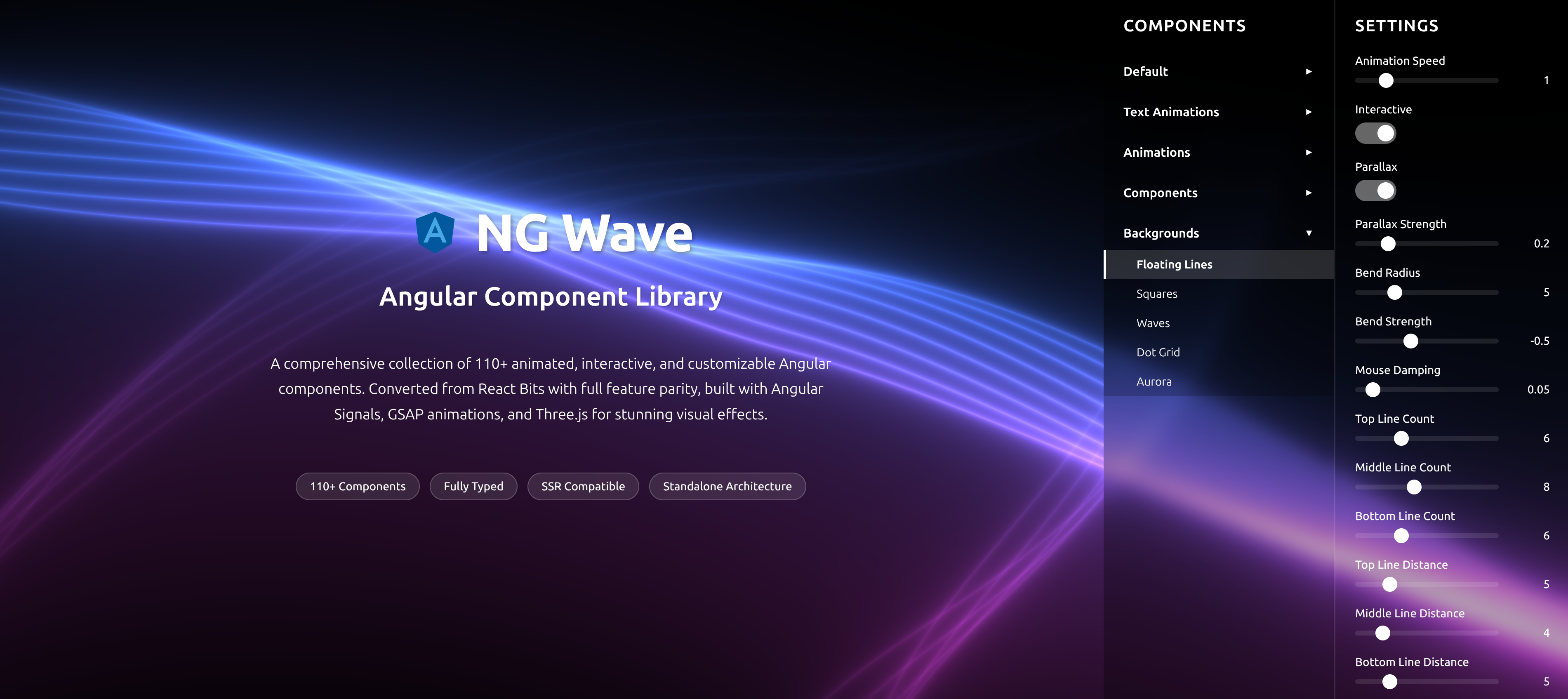
NG Wave
Angular Component Library
A comprehensive collection of 110+ animated, interactive, and customizable Angular components. Converted from React Bits with full feature parity, built with Angular Signals, GSAP animations, and Three.js for stunning visual effects.
Explore Components