Data‑Rich Visualizations in Angular 20+: D3/Highcharts, Canvas Schedulers, and Real‑Time RxJS Streams Without Jitter
What I ship on Fortune‑100 dashboards: D3 + Highcharts + Canvas, wired with Signals/SignalStore and RxJS streams, tuned for a11y, density, and performance budgets.
Data viz isn’t a chart—it’s a rendering pipeline with UX guardrails and performance budgets your stakeholders can defend.Back to all posts
I’ve shipped dashboards where frames matter: telecom analytics that can’t jitter during peaks, an airport kiosk with offline-tolerant charts, and a broadcast VPS scheduler that draws thousands of spans on Canvas. This is how I build data‑rich visualizations in Angular 20+ that look premium and stay fast.
A Jittery Dashboard and a Crowded Scheduler
From real incidents to repeatable patterns
Picture a Monday 9 AM dashboard: KPIs spike, charts jitter, and execs ask if the system’s broken. I’ve been paged into those rooms. The fix was never a single chart—it was a rendering pipeline with state discipline and UX guardrails.
On a broadcast VPS scheduler, we replaced a JSP app with an Angular 20 Canvas timeline, SignalStore for conflict detection, and RxJS for inbound schedule deltas. The result was a dense, navigable view that held 60 FPS while painting thousands of items.
Telecom dashboard calmed from spike‑induced jitter to smooth 60 FPS.
Broadcast scheduler moved from JSP to Angular 20 Canvas with Signals.
Why Data‑Rich Visualizations in Angular 20+ Demand a System, Not a One‑Off Chart
2025 context for Angular teams
As companies plan 2025 Angular roadmaps, the teams that win treat visualization as a system: rendering strategy, state topology, accessibility, tokens, and instrumentation. With Angular 20+ Signals and SignalStore, we can stabilize real-time updates and still ship premium visuals across roles and tenants.
Angular 20+ Signals reduce churn in data-heavy UIs.
Teams need measurable UX and performance budgets.
Outcomes you can defend
This approach delivers numbers your stakeholders can defend: fewer false alerts, stable frame times, and accessible, branded visuals that scale from wallboards to analyst laptops. If you need an Angular expert to set this up quickly, this is my wheelhouse.
Fewer false alerts via durable streams.
Predictable FPS during peaks.
Choosing D3 vs Highcharts vs Canvas/WebGL for Enterprise Dashboards
When I reach for Highcharts
Great for line/area/column/heatmap with export, zoom, and annotations. The official Angular wrapper integrates cleanly; theming is straightforward. I default to Highcharts when the shapes are standard, deadlines are tight, and we need reliable a11y.
Fast time-to-value with rich interactions.
Solid accessibility module out of the box.
When I reach for D3 (SVG)
D3 shines for custom visual grammars—sankey, chord, bespoke density plots. You own the DOM and the cost. Signals help here—compute once, patch surgically. Use for unique visuals where Highcharts would fight you.
Custom grammars and transforms.
Fine-grained control over scales and interactions.
When I reach for Canvas/Three.js
For schedulers, geospatial overlays, and heatmaps with huge point counts, Canvas (or WebGL via Three.js) keeps the frame budget predictable. Pair with a windowing strategy and draw only what the viewport can show.
Tens of thousands of objects at 60 FPS.
Hit-testing and virtualization for timelines.
Real-Time Chart Updates with RxJS, Signals, and SignalStore
import { Injectable, computed, effect, inject } from '@angular/core';
import { toSignal } from '@angular/core/rxjs-interop';
import { SignalStore, patchState, withState, withMethods } from '@ngrx/signals';
import { webSocket } from 'rxjs/webSocket';
import { scan, throttleTime, map, shareReplay } from 'rxjs/operators';

export type TelemetryEvent = { ts: number; metric: 'cpu'|'mem'; value: number };

const MAX_POINTS = 600; // ~2.5 minutes at 250ms cadence

@Injectable({ providedIn: 'root' })
export class TelemetryStore extends SignalStore(withState({ points: [] as TelemetryEvent[] })) {
  private socket$ = webSocket<TelemetryEvent>({ url: 'wss://example.com/telemetry' });

  private series$ = this.socket$.pipe(
    scan((acc, e) => {
      const next = [...acc, e];
      return next.length > MAX_POINTS ? next.slice(-MAX_POINTS) : next;
    }, [] as TelemetryEvent[]),
    throttleTime(250, undefined, { trailing: true, leading: false }),
    shareReplay({ bufferSize: 1, refCount: true })
  );

  points = toSignal(this.series$, { initialValue: [] as TelemetryEvent[] });

  cpuSeries = computed(() => this.points().filter(p => p.metric === 'cpu').map(p => [p.ts, p.value] as [number, number]));
  memSeries = computed(() => this.points().filter(p => p.metric === 'mem').map(p => [p.ts, p.value] as [number, number]));
}

// In a component using Highcharts
import * as Highcharts from 'highcharts';
import HCMore from 'highcharts/highcharts-more';
import HCA11y from 'highcharts/modules/accessibility';
HCMore(Highcharts); HCA11y(Highcharts);

@Component({
  selector: 'app-metrics-chart',
  template: `
  <highcharts-chart
    [Highcharts]="Highcharts"
    [options]="options()"
    aria-label="CPU and memory over time"
  ></highcharts-chart>
  `
})
export class MetricsChartComponent {
  Highcharts = Highcharts;
  private store = inject(TelemetryStore);

  options = computed<Highcharts.Options>(() => ({
    chart: { type: 'line', animation: false },
    time: { useUTC: true },
    title: { text: 'System Metrics' },
    accessibility: { enabled: true, description: 'Live CPU and memory usage' },
    series: [
      { name: 'CPU %', type: 'line', data: this.store.cpuSeries() },
      { name: 'Memory %', type: 'line', data: this.store.memSeries() }
    ]
  }));
}
Typed streams and stable redraw cadence
I standardize inbound events (TypeScript types) and keep a small, throttled redraw cadence (e.g., 250 ms). Capture every point, but paint predictably. Angular’s toSignal bridges RxJS to Signals without zone churn.
Typed event schemas stop downstream surprises.
Throttle redraws, not data capture.
Code: WebSocket → RxJS → toSignal → Highcharts
Here’s a compact example that’s powered several production dashboards.
Canvas-Based Scheduling UIs: Virtualization, Hit-Testing, and Density Controls
class SchedulerRenderer {
  private raf = 0;
  private last = performance.now();
  constructor(private ctx: CanvasRenderingContext2D, private model: SchedulerModel) {}

  start() { this.loop(); }
  stop() { cancelAnimationFrame(this.raf); }

  private loop = () => {
    this.raf = requestAnimationFrame(this.loop);
    const now = performance.now();
    if (now - this.last < 16) return; // ~60 FPS
    this.last = now;

    const { startTs, endTs, firstRow, lastRow } = this.model.viewport();

    this.clear();
    this.drawGrid(startTs, endTs); // offscreen buffer blitted here

    // Draw only visible items
    for (let r = firstRow; r <= lastRow; r++) {
      const items = this.model.itemsForRow(r, startTs, endTs);
      for (const it of items) this.drawItem(it);
    }
  };

  private clear() { this.ctx.clearRect(0, 0, this.ctx.canvas.width, this.ctx.canvas.height); }
  private drawGrid(start: number, end: number) {/* ... */}
  private drawItem(it: ScheduleItem) {/* ... */}
}
Virtualization and layers
For broadcast-style VPS schedulers, I render grid lines once to an offscreen canvas and blit on scroll. Items draw in a second layer with a windowed range of visible rows and time.
Draw only visible rows/columns.
Separate static grid from dynamic items.
Code: Frame loop with windowing
A simplified frame loop showing windowed drawing and 60 FPS targets:
Input and selection
Hit-testing maps mouse/touch to row/time; focus management mirrors selection for keyboard parity.
Keyboard navigation with roving tabindex.
Accessible selection state with ARIA.
UX Systems: Typography Scale, Color Palette, and Accessibility
:root {
  /* AngularUX palette */
  --ux-bg: #0b1020;
  --ux-surface: #121832;
  --ux-text: #e6e9f2;
  --ux-muted: #b6bdd2;
  --ux-blue-500: #3b82f6;
  --ux-green-500: #22c55e;
  --ux-amber-500: #f59e0b;
  --ux-red-500: #ef4444;

  /* density tokens */
  --ux-space-1: 4px;  /* compact */
  --ux-space-2: 8px;  /* cozy */
  --ux-space-3: 12px; /* comfortable */

  /* type tokens */
  --ux-font-body: Inter, system-ui, -apple-system, Segoe UI, Roboto, Arial, sans-serif;
  --ux-font-mono: ui-monospace, SFMono-Regular, Menlo, Consolas, monospace;
  --ux-fs-12: 12px; --ux-fs-14: 14px; --ux-fs-16: 16px; --ux-fs-20: 20px; --ux-fs-24: 24px; --ux-fs-32: 32px;
}

.app {
  color: var(--ux-text);
  background: var(--ux-bg);
  font-family: var(--ux-font-body);
}

.chart-title { font-size: var(--ux-fs-20); margin-bottom: var(--ux-space-2); }
.compact .chart-title { margin-bottom: var(--ux-space-1); }

/**** a11y focus ring ****/
:focus-visible { outline: 2px solid var(--ux-blue-500); outline-offset: 2px; }
AngularUX color and density tokens
I ship design tokens as CSS variables and wire them to Signals so density and theme can change without repainting everything.
Contrast-first palette with semantic roles.
Density toggles for laptop vs wallboard.
SCSS tokens you can drop in
Typography and motion restraint
Use a consistent type scale and line-height. Respect prefers-reduced-motion for chart transitions; keep interaction cues without disorienting motion.
Type scale: 12/14/16/20/24/32.
Prefers-reduced-motion respected.
Accessibility specifics for charts
Every chart gets a clear aria-label/description, keyboard focus handling for tooltips/series, and color contrast ≥ 4.5:1 for text over fills.
Highcharts a11y module with descriptions.
D3 aria-labels and focusable overlays.
Highcharts in Angular: A11y, Themes, and SSR Gotchas
import * as Highcharts from 'highcharts';
Highcharts.setOptions({
  chart: { backgroundColor: 'transparent' },
  colors: ['var(--ux-blue-500)', 'var(--ux-green-500)', 'var(--ux-amber-500)', 'var(--ux-red-500)'],
  title: { style: { color: 'var(--ux-text)', fontSize: 'var(--ux-fs-20)' } },
  xAxis: { gridLineColor: 'rgba(230,233,242,0.1)', labels: { style: { color: 'var(--ux-muted)' } } },
  yAxis: { gridLineColor: 'rgba(230,233,242,0.1)', labels: { style: { color: 'var(--ux-muted)' } } },
});
Setup and theming
Highcharts’ Angular wrapper is reliable. I theme using CSS variables and map them to Highcharts setOptions. Avoid heavy animations in SSR contexts; defer transitions to hydration.
Use official wrapper for stability.
Theme via setOptions and tokens.
Code: theming with tokens
SSR notes
On Angular 20+ SSR/Firebase Hosting, lazy-load chart modules client-side. Use isPlatformBrowser guards before touching window/document.
Gate browser-only imports.
Guard window references.
When to Hire an Angular Developer for Data‑Rich Dashboards
Signals you should bring in help
If this reads like your current state, hire an Angular developer who’s shipped enterprise dashboards. I come in as a remote Angular consultant to stabilize streams, refactor change detection with Signals, and ship a branded, accessible visual language that sticks.
Charts jitter under load or leak memory.
Your scheduler/heatmap can’t hold 60 FPS.
Accessibility audits fail contrast or keyboard.
You need real-time RxJS streams without outages.
How an Angular Consultant Approaches Real‑Time Visualization Migrations
Week 1: Assess and instrument
I benchmark current FPS, memory, and update cadence, stand up telemetry (GA4/Firebase logs), and map your event schemas.
Angular DevTools, Lighthouse, Firebase Performance.
Trace stream tops (RxJS) and render hotspots.
Weeks 2–3: Stabilize streams and visuals
We cap series length, throttle redraw cadence, and move hot paths to Canvas/WebGL when necessary.
Typed events, toSignal bridges, SignalStore.
Renderer choice per chart (Highcharts/D3/Canvas).
Weeks 4+: Polish and handoff
We document selectors/mutators, ship tokens, and add Cypress + image diffs for critical charts. Typical engagement: 2–4 weeks for rescue, 4–8 weeks for full systemization.
A11y fixes, density/typography tokens, documentation.
CI guardrails with visual regression.
Key Takeaways for Angular Visualization Teams
- Pick your renderer by data density and interaction model; don’t force one tool everywhere.
- Bridge RxJS → Signals/SignalStore for predictable updates and fewer CD cycles.
- Make a11y and tokens first-class: color contrast, keyboard, type scale, density.
- Enforce performance budgets: FPS ≥ 55, redraw cadence ≤ 250 ms, memory stable.
- Instrument everything; let charts prove their value with metrics, not vibes.
Common Questions on Angular Data Visualization
What about role-based, multi-tenant dashboards?
I partition data by tenant/role and expose a visual language per role: exec (rolled-up KPIs), analyst (drill-down interactions), ops (wallboard density). Feature flags map capabilities to RBAC, and Signals keep each view reactive without cross-tenant bleed.
Key takeaways
- Pick the right renderer: Highcharts for speed-to-value, D3 for custom grammars, Canvas/WebGL for dense schedulers and 60 FPS timelines.
- Bridge RxJS streams to Signals/SignalStore to eliminate jitter and reduce change detection churn in Angular 20+.
- Bake in a11y: Highcharts accessibility module, ARIA labels for D3, keyboard focus rings, and color-contrast-aware palettes.
- Use density and typography tokens to scale UIs from wallboard to laptop without rewrites.
- Instrument budget-driven rendering: FPS, memory, and chart update cadence with Angular DevTools, GA4/Firebase, and custom timers.
Implementation checklist
- Define renderer per use case (SVG/Highcharts vs D3 vs Canvas/WebGL).
- Model stream types (typed events) and bridge with toSignal for real-time charts.
- Introduce SignalStore for shared series state and computed selectors.
- Add a11y: aria-labels, focus order, Highcharts a11y module, color contrast checks.
- Implement density and typography tokens; connect to user preferences.
- Virtualize data and drawing (windowing) for lists and canvas timelines.
- Cap series length and throttle redraws to maintain FPS and memory budgets.
- Verify with Angular DevTools, Lighthouse, Core Web Vitals, and Firebase Performance.
Questions we hear from teams
- How much does it cost to hire an Angular developer for visualization work?
- Most rescues start at a 2–4 week engagement; full dashboard systems land in 4–8 weeks. Pricing depends on scope, data sources, and compliance. I work as a remote Angular consultant with clear milestones and measurable outcomes.
- D3 or Highcharts for an enterprise Angular app?
- Use Highcharts when you need speed-to-value and solid a11y out of the box. Choose D3 for custom visual grammars. For massive timelines or heatmaps, use Canvas/WebGL. Many teams run a hybrid: Highcharts for KPIs, D3/Canvas for bespoke visuals.
- Can Angular handle real-time charts at high event rates?
- Yes—bridge RxJS streams to Signals, cap series length, and throttle redraw cadence (e.g., 200–300 ms). Use data virtualization and Canvas/WebGL for heavy scenes. We’ve delivered stable 60 FPS views during peak loads with typed event schemas.
- What’s included in a typical engagement?
- Assessment, renderer selection, RxJS/Signals wiring, a11y and tokenization, and performance budgets with CI guardrails. Deliverables include code, docs, and telemetry dashboards so your team can maintain and extend confidently.
- Do you support Firebase, Nx, and PrimeNG stacks?
- Yes. I’ve shipped Firebase Hosting + Functions with Angular 20 SSR, Nx monorepos, and PrimeNG components. I align charts with PrimeNG themes and add SSR guards for Highcharts/D3 where needed.
Ready to level up your Angular experience?
Let AngularUX review your Signals roadmap, design system, or SSR deployment plan.
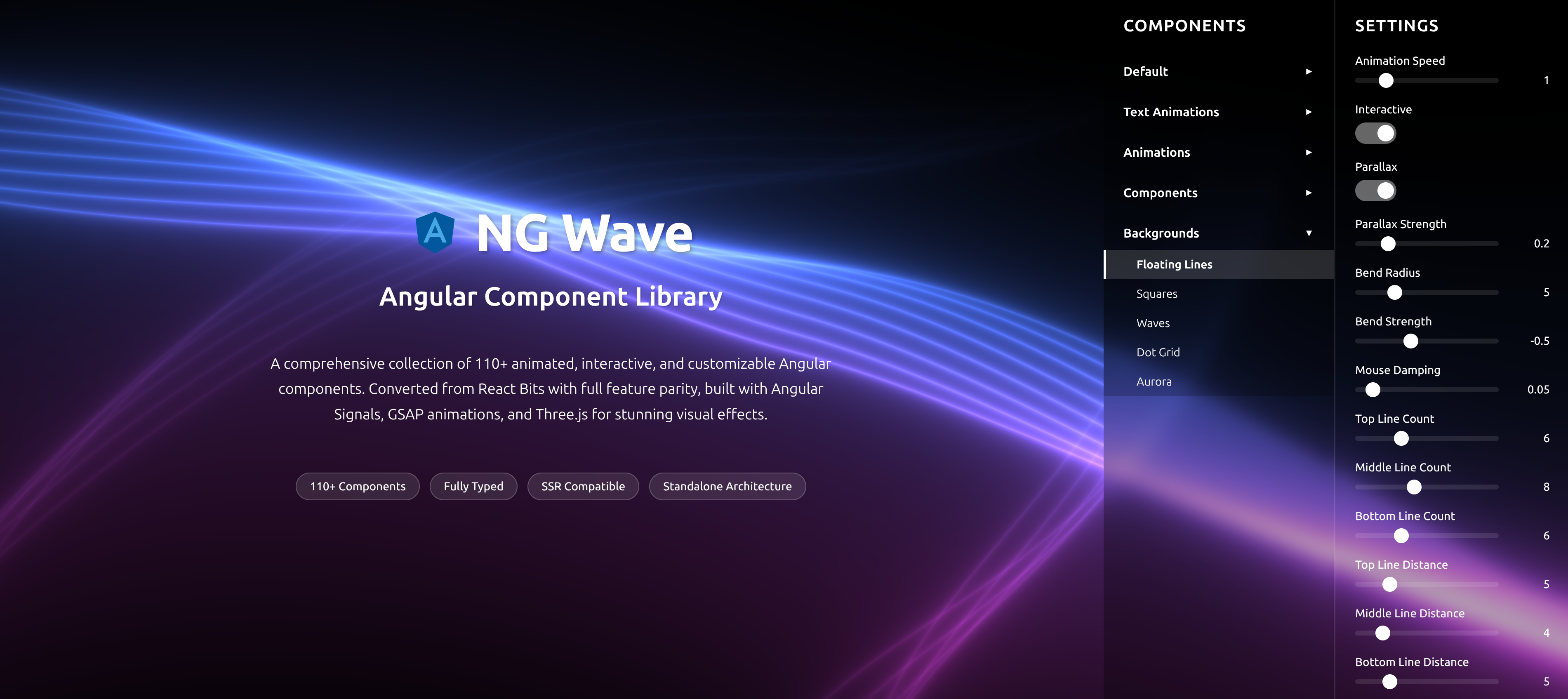
NG Wave
Angular Component Library
A comprehensive collection of 110+ animated, interactive, and customizable Angular components. Converted from React Bits with full feature parity, built with Angular Signals, GSAP animations, and Three.js for stunning visual effects.
Explore Components