Designing Premium Motion in Angular 20+: Timeline Systems, Easing Tokens, and prefers-reduced-motion Fallbacks
A practical motion system for Angular 20+ that feels premium, respects accessibility, and stays within performance budgets—grounded in real dashboards.
Polish isn’t pixels—it’s timing. Premium motion clarifies intent without stealing time from the user.Back to all posts
When a dashboard jitters, execs feel it before they see it. I learned that the hard way on a a global entertainment company employee tracking panel where a subtle list slide caused CPU spikes during batch updates. Premium motion is less about eye candy and more about intention, timing, and respect for users who opt out.
As companies plan 2025 Angular roadmaps, I’m getting the same brief: keep the product feeling premium, don’t blow AA or performance budgets, and prove it with metrics. Below is the motion system I ship on Angular 20+ with Signals, SignalStore, PrimeNG, D3/Highcharts, and Firebase.
This isn’t theory. I’ve used these patterns on United’s airport kiosks (offline-tolerant, hardware-driven), Charter’s ads analytics dashboards (real-time charts), and a broadcast media network scheduling (dense grid UIs). The playbook works under load, in production, and during audits.
When Motion Feels Premium (Not Distracting)
Anecdote from the field
On a a broadcast media network VPS scheduler, a 300ms ease-out on row insertions felt snappy at 10 rows, but jittered on 300. We reworked it to a 120ms crossfade + FLIP translation and virtualized offscreen rows. Perceived performance improved and INP stabilized under 150ms.
Principles I ship
Motion clarifies hierarchy, never obscures it.
Consistency beats creativity: tokens over one-offs.
Accessibility is default; flair is opt-in.
Measure everything: Core Web Vitals, flame charts, Firebase traces.
Why Motion Systems Matter for Angular 20+ Dashboards
Performance and clarity
Reduce cognitive load: motion previews spatial change.
Prevent layout thrash: animate transform/opacity, not layout properties.
Keep INP < 200ms; avoid long main-thread tasks on animation start.
Accessibility and brand
Respect prefers-reduced-motion by default.
Use easing that matches brand voice: confident ≠ bouncy.
Tie durations to density and type rhythm (AngularUX tokens).
Easing Tokens, Timing Scales, and Density-Aware Durations
SCSS/CSS variables as a motion contract
Motion tokens live with your design tokens. They’re the contract between designers and engineers. We define base easings, duration steps, and a motionScale multiplier that we can dial down globally or per-surface.
Token snippet (SCSS)
/* motion.tokens.scss */
:root {
  /* Easings */
  --ease-standard: cubic-bezier(0.20, 0.00, 0.00, 1.00);
  --ease-emphasized: cubic-bezier(0.30, 0.00, 0.00, 1.00);
  --ease-entrance: cubic-bezier(0.16, 1.00, 0.30, 1.00); /* overshoot-free */
  --ease-exit: cubic-bezier(0.40, 0.00, 1.00, 1.00);

  /* Duration steps aligned to type rhythm (ms) */
  --dur-1: 90ms;  /* micro */
  --dur-2: 140ms; /* small */
  --dur-3: 200ms; /* medium */
  --dur-4: 280ms; /* large */

  /* Density-aware scale: compact UIs move faster */
  --motion-scale: 1; /* 0..1 */
}

[data-density="compact"] {
  --motion-scale: 0.85;
}

/***** Accessibility *****/
@media (prefers-reduced-motion: reduce) {
  :root {
    --motion-scale: 0; /* disable where possible */
  }
  .animatable { animation: none !important; transition: none !important; }
}

/* Helper mixins */
@mixin motion($dur, $ease: var(--ease-standard)) {
  transition-duration: calc(#{$dur} * var(--motion-scale));
  transition-timing-function: #{$ease};
}

.button {
  transition-property: transform, box-shadow;
  @include motion(var(--dur-2));
}
Visual language alignment
Durations snapped to the typography scale (AngularUX 4/6/8 rhythm).
Easing choices complement the AngularUX color palette: confident, not playful.
Density controls accelerate micro-interactions without feeling twitchy.
prefers-reduced-motion with Signals + SSR-Safe Defaults
SignalStore for motion preferences
// motion.store.ts (Angular 20+)
import { Injectable, inject, PLATFORM_ID, signal, computed, effect } from '@angular/core';
import { isPlatformBrowser } from '@angular/common';
import { SignalStore } from '@ngrx/signals';

interface MotionState { reduced: boolean; }

@Injectable({ providedIn: 'root' })
export class MotionStore extends SignalStore<MotionState> {
  private platformId = inject(PLATFORM_ID);
  private browser = isPlatformBrowser(this.platformId);

  constructor() {
    super({ reduced: false }); // SSR-safe default (no DOM access)

    if (this.browser) {
      const mq = window.matchMedia('(prefers-reduced-motion: reduce)');
      const set = (v: boolean) => this.setState({ reduced: v });
      set(mq.matches);
      mq.addEventListener('change', (e) => set(e.matches));
    }
  }

  reduced = computed(() => this.state().reduced);
  duration = (ms: number) => (this.reduced() ? 1 : ms);
  ease = (name: 'standard'|'emphasized'|'entrance'|'exit' = 'standard') =>
    this.reduced() ? 'linear' : (
      {
        standard: 'cubic-bezier(0.20,0,0,1)',
        emphasized: 'cubic-bezier(0.30,0,0,1)',
        entrance: 'cubic-bezier(0.16,1,0.30,1)',
        exit: 'cubic-bezier(0.40,0,1,1)'
      }[name]
    );
}
Route transition factory
// route-animations.ts
import { trigger, transition, style, animate, query, group } from '@angular/animations';
import { MotionStore } from './motion.store';

export const buildRouteAnimations = (motion: MotionStore) =>
  trigger('routeAnimations', [
    transition('* <=> *', [
      group([
        query(':enter', [
          style({ opacity: 0, transform: 'translateY(8px)' }),
          animate(
            `${motion.duration(160)}ms ${motion.ease('entrance')}`,
            style({ opacity: 1, transform: 'translateY(0)' })
          )
        ], { optional: true }),
        query(':leave', [
          style({ opacity: 1, transform: 'translateY(0)' }),
          animate(
            `${motion.duration(120)}ms ${motion.ease('exit')}`,
            style({ opacity: 0, transform: 'translateY(-4px)' })
          )
        ], { optional: true })
      ])
    ])
  ]);
Template usage
<main [@routeAnimations]></main>Timeline Choreography That Feels Expensive, Not Slow
Choreography patterns
Stagger children by 15–30ms for dense lists.
Group entrance/exit; keep overlap under 25% to avoid muddiness.
Use FLIP for position changes to avoid layout jitter.
Angular timeline example
import { trigger, transition, query, style, animate, stagger } from '@angular/animations';
import { MotionStore } from './motion.store';

export const listTimeline = (motion: MotionStore) =>
  trigger('listTimeline', [
    transition(':enter', [
      query('.row', [
        style({ opacity: 0, transform: 'translateY(6px)' }),
        stagger(15, [
          animate(`${motion.duration(140)}ms ${motion.ease('standard')}`,
            style({ opacity: 1, transform: 'none' }))
        ])
      ], { optional: true })
    ])
  ]);
Apply to PrimeNG Overlays and Charts (D3/Highcharts)
PrimeNG overlays (Dialog, OverlayPanel)
/* PrimeNG overrides using tokens */
.p-dialog-enter, .p-overlaypanel-enter {
  transition: transform var(--dur-2) var(--ease-entrance),
              opacity   var(--dur-2) var(--ease-entrance);
}
.p-dialog-exit, .p-overlaypanel-exit {
  transition: transform var(--dur-1) var(--ease-exit),
              opacity   var(--dur-1) var(--ease-exit);
}
D3 transitions with reduced-motion fallback
import * as d3 from 'd3';
import { MotionStore } from './motion.store';

function updateBars(svg: d3.Selection<SVGGElement, unknown, null, undefined>, motion: MotionStore) {
  const dur = motion.duration(300);
  const ease = d3.easeCubicOut;

  const bars = svg.selectAll<SVGRectElement, number>('rect').data([10,20,30,25,18]);
  bars.join(
    enter => enter.append('rect').attr('height', 0).attr('y', 100)
      .call(sel => sel.transition().duration(dur).ease(ease)
        .attr('height', d => d).attr('y', d => 100 - d)),
    update => update
      .call(sel => sel.transition().duration(dur).ease(ease)
        .attr('height', d => d).attr('y', d => 100 - d)),
    exit => exit
      .call(sel => sel.transition().duration(motion.duration(120)).ease(d3.easeCubicIn)
        .attr('height', 0).remove())
  );
}
Highcharts boost/canvas pipelines
Use Highcharts Boost for large series; animate only accented series.
Fade opacity on updates; avoid reflow animations on 50k+ points.
For Canvas/Three.js, batch frame updates and prefer linear fade-ins.
Kiosks, Hardware, and Offline: Degrade Gracefully
United airport kiosk lessons
On United’s kiosks, we bound motion intensity to device state. If a printer error surfaced, we stopped celebratory transitions and used a micro-shake (12ms, 2px) to indicate actionable error boundaries. Offline modes reduced durations to near-zero to preserve responsiveness.
Simulated hardware via Docker meant we could test motion offline.
We disabled non-essential animations when peripheral states were erroring.
Card readers, printers, barcode scanners: animate feedback, not process.
When to Hire an Angular Developer for Motion & A11y Rescue
Signals you need help
If this sounds familiar, bring in an Angular expert to systematize motion. I audit tokens, Angular animations, and chart transitions; then implement Signals-driven reduced-motion and CI checks in 2–4 weeks without breaking production.
Users complain about “laggy” but Lighthouse looks fine.
Animations look inconsistent across PrimeNG/Material/custom comps.
Reduced-motion is ignored or only partly implemented.
Charts jitter during real-time updates or role-based view switches.
How an Angular Consultant Implements prefers-reduced-motion in a Week
Day-by-day plan
I’ve run this plan for a leading telecom provider and internal AngularUX products (SageStepper, gitPlumbers). It ships fast because the system is modular: tokens + MotionStore + factory animations + instrumentation.
Day 1: audit tokens, surfaces, metrics; add MotionStore.
Day 2: route transitions + overlays standardized.
Day 3: charts (D3/Highcharts) aligned; virtualization strategy.
Day 4: Firebase Perf traces; Lighthouse/INP baselines.
Day 5: Cypress scenarios, visual diffs, docs and handoff.
Instrument and Iterate: Measure the Difference
Firebase Performance trace example
// perf.instrumentation.ts
import { inject } from '@angular/core';
import { MotionStore } from './motion.store';
import { Performance, trace } from '@angular/fire/performance';

export function traceRouteTransition(perf: Performance, motion: MotionStore) {
  const t = trace(perf, 'route_transition');
  t.putAttribute('reducedMotion', String(motion.reduced()));
  t.start();
  return () => t.stop(); // call after transition end
}
Nx + Cypress reduced-motion CI
# project.json (Nx) – fragment
"targets": {
  "e2e": {
    "executor": "@nx/cypress:cypress",
    "options": { "env": { "PREFER_REDUCED_MOTION": "true" } }
  }
}
// cypress/support/e2e.ts
Cypress.on('window:before:load', (win) => {
if (Cypress.env('PREFER_REDUCED_MOTION')) {
const style = win.document.createElement('style');
style.innerHTML = '@media (prefers-reduced-motion: reduce){:root{--motion-scale:0}}';
win.document.head.appendChild(style);
}
});What to watch
INP before/after, FPS during heavy transitions.
Render counts via Angular DevTools flame charts.
User opt-out rates for motion; correlate with task success.
Key takeaways
- Premium motion is timing + choreography: consistent tokens, not ad-hoc values.
- Respect prefers-reduced-motion with SSR-safe Signals; default to safe, opt into flair.
- Choreograph timelines with Angular animations; measure with Firebase Performance + DevTools.
- Keep motion within budgets: INP under 200ms, 60fps target, minimal layout thrash.
- Make motion systemic: tokens tied to density, typography rhythm, and brand palette.
Implementation checklist
- Define motion tokens: durations, easings, and scale multipliers tied to density.
- Implement prefers-reduced-motion using Signals/SignalStore with SSR-safe defaults.
- Build reusable Angular animation factories that read motion tokens.
- Apply motion to key surfaces: route transitions, overlays, toasts, and charts.
- Guard performance: requestAnimationFrame, FLIP, and virtualization for large DOM diffs.
- Instrument: Firebase Performance traces + Lighthouse; compare reduced vs standard flows.
- Add CI checks: Cypress tests with reduced motion and visual snapshots for animations.
Questions we hear from teams
- How much motion is too much in enterprise Angular dashboards?
- If motion consistently pushes INP over 200ms or obscures task flow, it’s too much. Keep durations under 200–280ms for most surfaces, animate transform/opacity, and reserve longer timelines for infrequent, celebratory moments.
- How do you implement prefers-reduced-motion in Angular 20+?
- Use a SignalStore to read matchMedia, default safely on SSR, and provide factories for animations that switch to 1ms linear when reduced is true. Mirror the behavior with CSS variables so PrimeNG and custom CSS respect the same contract.
- Will premium motion hurt performance in real-time dashboards?
- Not if you respect budgets. Use data virtualization, animate only opacity/transform, and avoid reflow animations. For D3/Highcharts, reduce duration on massive updates and use fades for clarity. Measure with Firebase Performance and Angular DevTools.
- How long does a motion & accessibility rescue take?
- Typically 2–4 weeks for an enterprise dashboard: audit, tokens, reduced-motion Signals, route/overlay timelines, chart transitions, and CI instrumentation. Complex multi-tenant apps or kiosk hardware states may add a week.
- What’s included in a typical engagement with an Angular consultant?
- Discovery, audit report, token system, MotionStore, animation factories, integration across PrimeNG/Material/custom comps, Firebase instrumentation, CI tests, and a handoff playbook. Optional: training session and roadmap for future components.
Ready to level up your Angular experience?
Let AngularUX review your Signals roadmap, design system, or SSR deployment plan.
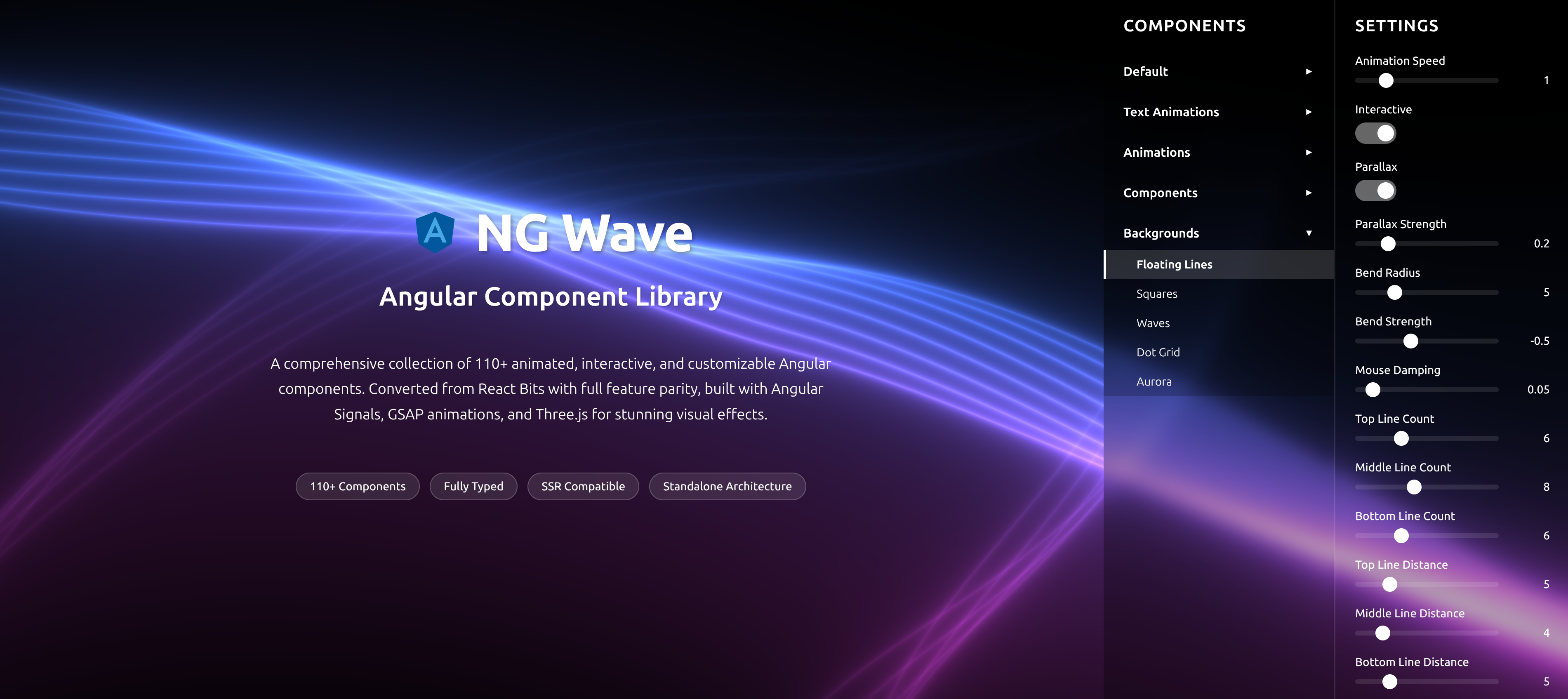
NG Wave
Angular Component Library
A comprehensive collection of 110+ animated, interactive, and customizable Angular components. Converted from React Bits with full feature parity, built with Angular Signals, GSAP animations, and Three.js for stunning visual effects.
Explore Components