Designing Premium Motion in Angular 20+: Timelines, Easing, and Reduced‑Motion Fallbacks That Respect Performance Budgets
A practical motion system for Angular 20+ that feels premium, respects prefers‑reduced‑motion, and ships with measurable guardrails—tokens, Signals, and CI.
Premium motion is predictable, measurable, and inclusive. If it can’t survive reduced-motion, it wasn’t a system—it was a vibe.Back to all posts
I’ve spent a decade building Angular dashboards where motion can either earn trust or expose chaos. The best systems I’ve shipped—from airline kiosks to telecom analytics—treat motion as a first-class design token. In Angular 20+, that means Signals-powered preferences, reduced-motion fallbacks, and CI guardrails that prevent regressions.
This article outlines the motion tokens I use at AngularUX, how they connect to typography/density and our color palette, and how to wire them into Angular animations, D3/Highcharts, and PrimeNG—without breaking accessibility or performance budgets.
The Dashboard Jitter Test: Motion That Earns Trust
A real scene from enterprise
On a telecom analytics dashboard I inherited, every panel animated with different timings. Cards staggered inconsistently, charts eased linearly, and the mobile drawer snapped. QA called it “jitter.” Execs felt it as distrust. We fixed it by replacing vibe-coded transitions with a motion system: tokens, timelines, prefers-reduced-motion fallbacks, and CI metrics.
Context for 2025 Angular teams
If you need to hire an Angular developer or Angular consultant to land this in your production app, this playbook is the path I use across Fortune 100 teams.
Angular 20+ and Signals let us drive animation from user/system preferences.
Recruiters and directors ask for measurable UX—INP, accessibility, GA4 telemetry.
Q1 roadmaps are locking—motion polish must coexist with performance budgets.
Why Angular 20+ Teams Need a Motion System, Not Ad‑Hoc Animations
Accessibility and trust
Premium motion is predictable: durations scale by distance, easing matches intent (enter vs exit), and density controls change how far things move. Accessibility is built-in, not bolted on.
Prefer-reduced-motion isn’t optional; it’s table stakes.
Consistent easing communicates hierarchy and intent.
Performance budgets and telemetry
On IntegrityLens (12k+ interviews), micro-interactions are measured: we log drawer open latency, chart transition duration, and reduced-motion usage. That’s how you justify motion to leadership.
We track INP, LCP, and animation FPS in Lighthouse/DevTools.
GA4/Firebase log typed motion events to validate choices.
Design cohesion with typography, density, palette
At AngularUX, headings use tighter ease and shorter durations than body interactions; dense layouts cut distances and timings by 10–20%; focus/hover states maintain AA contrast throughout motion.
Typography rhythm aligns with motion rhythm.
Density tokens adjust distance and timing together.
Color palette dictates contrast during animated states.
Motion Tokens: Easing, Durations, and Density as a Shared Language
/* tokens.motion.scss */
:root {
  /* AngularUX color palette (AA contrast on light/dark) */
  --ux-surface: #0f1115;         /* dark surface */
  --ux-surface-alt: #161a22;
  --ux-primary: #5aa9e6;         /* accessible on dark */
  --ux-accent: #ffd166;
  --ux-success: #00c48c;
  --ux-danger: #ff5c5c;
  --ux-text: #e6e8ee;

  /* Typography rhythm (paired with motion) */
  --ux-font-size-100: 12px; /* caption */
  --ux-font-size-200: 14px; /* body */
  --ux-font-size-300: 18px; /* h6 */

  /* Density scale (affects distance + duration) */
  --ux-density: 0; /* -1=compact, 0=cozy, 1=comfortable */
  --ux-space-100: clamp(4px, 4px + var(--ux-density)*2px, 8px);
  --ux-space-200: clamp(8px, 8px + var(--ux-density)*4px, 16px);

  /* Motion duration scale */
  --ux-dur-quick: 120ms;
  --ux-dur-std: 180ms;
  --ux-dur-slow: 280ms;
  --ux-dur-emph: 360ms; /* modal/drawer */

  /* Easing curves */
  --ux-ease-in: cubic-bezier(0.32, 0, 0.67, 0);
  --ux-ease-out: cubic-bezier(0.33, 1, 0.68, 1);
  --ux-ease-in-out: cubic-bezier(0.65, 0, 0.35, 1);
  --ux-ease-emph: cubic-bezier(0.2, 0, 0, 1);

  /* Reduced motion switch */
  --ux-motion-enabled: 1;
}

@media (prefers-reduced-motion: reduce) {
  :root {
    --ux-motion-enabled: 0;
    --ux-dur-quick: 1ms; /* near-zero but renderable */
    --ux-dur-std: 1ms;
    --ux-dur-slow: 1ms;
    --ux-dur-emph: 1ms;
  }
}
SCSS tokens (AngularUX palette + timings)
We define easing, duration, and distance tokens alongside typography and color. This keeps timelines consistent across PrimeNG, Material, D3, and custom components.
Signals‑Driven Preferences and Angular Animations
// user-prefs.store.ts
import { SignalStore, withState, withComputed, patchState } from '@ngrx/signals';
import { computed, inject, signal } from '@angular/core';

interface MotionPrefsState {
  reduced: boolean;        // effective preference
  userOverride?: 'reduce' | 'no-preference';
}

export class MotionPrefsStore extends SignalStore<MotionPrefsState> {
  private media = window.matchMedia('(prefers-reduced-motion: reduce)');
  private reducedSys = signal(this.media.matches);

  constructor() {
    super(withState<MotionPrefsState>({ reduced: this.media.matches }));
    this.media.addEventListener('change', e => {
      this.reducedSys.set(e.matches);
      this.recompute();
    });
    const saved = localStorage.getItem('ux.motion.pref');
    if (saved) patchState(this, { userOverride: saved as any });
    this.recompute();
  }

  setOverride(v?: 'reduce' | 'no-preference') {
    if (v) localStorage.setItem('ux.motion.pref', v);
    else localStorage.removeItem('ux.motion.pref');
    patchState(this, { userOverride: v });
    this.recompute();
  }

  readonly reduced = computed(() =>
    this.state().userOverride ? this.state().userOverride === 'reduce' : this.reducedSys()
  );

  readonly timings = computed(() => ({
    quick: getVar('--ux-dur-quick'),
    std: getVar('--ux-dur-std'),
    slow: getVar('--ux-dur-slow'),
    emph: getVar('--ux-dur-emph'),
    easeOut: getVar('--ux-ease-out'),
    easeEmph: getVar('--ux-ease-emph'),
    enabled: !this.reduced()
  }));
}

function getVar(name: string): string {
  return getComputedStyle(document.documentElement).getPropertyValue(name).trim();
}
// drawer.component.ts
import { Component, HostBinding, inject } from '@angular/core';
import { trigger, state, style, transition, animate } from '@angular/animations';
import { MotionPrefsStore } from './user-prefs.store';
@Component({
selector: 'ux-drawer',
template: `<ng-content></ng-content>`,
animations: [
trigger('openClose', [
state('open', style({ transform: 'translateX(0)', opacity: 1 })),
state('closed', style({ transform: 'translateX(8%)', opacity: .96 })),
transition('closed => open', []),
transition('open => closed', [])
])
]
})
export class DrawerComponent {
private prefs = inject(MotionPrefsStore);
opened = false;
@HostBinding('@openClose') get motion() {
const t = this.prefs.timings();
const enter = `${t.emph} ${t.easeEmph}`;
const exit = `${t.std} ${t.easeOut}`;
// Build transitions at runtime using Web Animations API fallback if needed
(this as any).__proto__.animations[0].definitions[2].animations = [animate(enter)];
(this as any).__proto__.animations[0].definitions[3].animations = [animate(exit)];
return this.opened ? 'open' : 'closed';
}
}SignalStore for user motion preference
We use SignalStore to unify system prefers-reduced-motion with user settings and produce a single source of truth for animation timings.
Respect system setting and allow explicit user override.
Persist in localStorage/Firestore and expose computed timings.
Consume tokens in components
Below: a trimmed store and a drawer animation that reads timings from Signals.
Bind dynamic timings to Angular animations.
Fallback to opacity/crossfade for charts when reduced.
Charts and 3D Fallbacks: D3, Highcharts, Three.js
// charts.motion.ts (D3 example)
import * as d3 from 'd3';
import { inject } from '@angular/core';
import { MotionPrefsStore } from './user-prefs.store';

export function barTransition(selection: d3.Selection<any, any, any, any>) {
  const prefs = inject(MotionPrefsStore);
  const t = prefs.timings();
  const dur = t.enabled ? parseInt(t.std) : 0;
  const ease = t.enabled ? d3.easeCubicOut : d3.easeLinear;
  selection
    .transition()
    .duration(dur)
    .ease(ease)
    .attr('width', (d: any) => d.w)
    .attr('x', (d: any) => d.x);
}
<!-- Highcharts/PrimeNG Card micro-animations (opacity-only under reduced motion) -->
<p-card class="kpi" [style.transition]="prefs.timings().enabled ? 'opacity var(--ux-dur-quick) var(--ux-ease-out)' : 'none'">
<div class="kpi-value" [style.opacity]="valueChanged ? 0 : 1"></div>
</p-card>Data viz without jitter
On the telecom ads analytics platform, we crossfaded dataset swaps and halted spring animations under reduced-motion. For 3D, we paused camera easing and used instant focus jumps.
Use opacity crossfades over complex transforms for reduced-motion.
Virtualize heavy lists and throttle reflows with Signals/NgRx.
D3 example with reduced-motion
Instrumented Motion: Measure, Test, and Guardrail
# .lighthouseci/lighthouserc.json
{
  "ci": {
    "collect": { "numberOfRuns": 3, "url": ["https://preview.yourapp.web.app/"] },
    "assert": {
      "assertions": {
        "performance": ["error", {"minScore": 0.9}],
        "interactive": ["error", {"maxValue": 3500}],
        "total-byte-weight": ["warn", {"maxNumericValue": 350000}],
        "unused-javascript": ["warn", {"maxNumericValue": 150000}]
      }
    }
  }
}
// cypress/e2e/reduced-motion.cy.ts
it('respects reduced motion', () => {
cy.visit('/', {
onBeforeLoad(win) {
cy.stub(win, 'matchMedia').callsFake((q: string) => ({
matches: q.includes('prefers-reduced-motion'),
addEventListener: () => {}, removeEventListener: () => {}
} as any));
}
});
cy.get('ux-drawer').invoke('css', 'transition-duration').should('match', /1ms|0ms/);
});// analytics.motion.ts (Firebase GA4)
import { getAnalytics, logEvent } from 'firebase/analytics';
type MotionEvent = {
component: string;
action: 'open' | 'close' | 'transition';
reduced: boolean;
duration_ms: number;
};
export function trackMotion(e: MotionEvent) {
const analytics = getAnalytics();
logEvent(analytics, 'motion_event', e);
}Lighthouse CI budgets (INP, FPS proxy)
We enforce performance budgets alongside motion. While Lighthouse doesn’t expose FPS directly, keeping INP low and JS execution small protects animation smoothness.
Cypress reduced-motion test
Automate reduced-motion verification by stubbing matchMedia.
Typed GA4 motion events
We log motion use to Firebase/GA4 to prove adoption and catch regressions.
Role‑Based Dashboard Micro‑Interactions: Drawer, Cards, Charts
Drawer timeline
For operations roles on a multi-tenant dashboard, the drawer is a frequent action. We emphasize the enter to feel confident and shorten exit to keep workflows snappy.
Enter: 360ms emphasized curve; Exit: 180ms ease-out.
Reduced motion: opacity-only 1ms.
Card hover and focus
Our palette preserves contrast during hover/pressed. Typography weights stay stable to avoid layout shift.
Hover: 120ms color/scale under 1.015.
Focus: 180ms outline/box-shadow within AA contrast.
Reduced motion: color-only, no scale.
Charts and tables
For high-frequency WebSocket updates (telemetry, ads analytics), we debounce animation triggers, batch DOM writes, and use Signals to coalesce changes.
D3 bars easeOut 180ms; virtualized tables avoid reflow storms.
Highcharts updates crossfade at 120ms under reduced motion.
When to Hire an Angular Developer for Motion Systems and Accessibility
Bring in help when…
I’ve stabilized motion across Angular Material, PrimeNG, D3/Highcharts, and Three.js in Nx monorepos. If you need an Angular expert to align motion with typography/density and prove results with GA4, let’s talk.
Animations feel inconsistent across modules or libraries.
Accessibility audits flag motion issues or seizures risk.
INP regresses after micro-interactions land.
Multi-tenant themes lack coherent timelines or easing.
Charts feel jittery during real-time updates.
Expected outcomes in 2–4 weeks
See how we stabilize and modernize chaotic code at gitPlumbers—used to rescue Angular codebases without freezing delivery.
Motion token set and reduced-motion coverage at >95%.
Drawer/card/chart timelines unified across the app.
CI guardrails (Lighthouse/Cypress) preventing regressions.
Telemetry dashboards in GA4/BigQuery to prove wins.
Implementation Notes: PrimeNG, Material, and Density
PrimeNG + tokens
PrimeNG surfaces and overlays adopt our color and motion tokens; density toggles shrink paddings and reduce distances to cut durations proportionally.
Map tokens to PrimeNG CSS vars and component classes.
Avoid scale >1.02 to prevent rasterization on low-end devices.
Typography and density pairing
Use a Motion x Density matrix in Storybook. Chromatic catches visual regressions; Pa11y validates contrast in animated states.
Dense pages: smaller headings, shorter durations.
Comfortable pages: longer distances, slightly slower ease-out.
Takeaways: Premium Motion Without Breaking Budgets
- Motion is a system: tokens + timelines + accessibility.
- Signals/SignalStore unify user/system preferences and drive timings.
- Reduced-motion isn’t a second-class experience—use opacity, crossfades, and instant focus jumps.
- Guardrails matter: Lighthouse budgets, Cypress tests, GA4 telemetry.
- Align motion with typography, density, and the AngularUX color palette for a cohesive visual language.
Questions to Ask Your Team This Week
- Do we have a documented duration/easing scale and density-adjusted timelines?
- Can we toggle reduced-motion and see near-zero durations across the app?
- Are motion choices measured in GA4 and enforced in CI?
- Do charts and real-time updates avoid jitter with virtualization and debounced transitions?
Key takeaways
- Motion is a system: tokens for duration/ease, density-aware timelines, and component patterns—not ad-hoc CSS.
- Respect prefers-reduced-motion with token overrides and zero-duration paths; never ship separate code paths.
- Use Signals/SignalStore to persist user motion preferences and expose dynamic timings to animations.
- Guardrail motion with Lighthouse CI thresholds, Cypress reduced-motion tests, and GA4/Firebase motion telemetry.
- Premium motion complements typography, density, and palette—maintain AA contrast and FPS under load.
Implementation checklist
- Define motion tokens: duration scale, easing curves, and z-axis/opacity guidelines.
- Implement prefers-reduced-motion overrides via CSS and runtime Signals.
- Wire component timelines (drawers, cards, charts) to tokens—not literals.
- Test reduced-motion in Cypress and log motion events to GA4/Firebase.
- Protect performance budgets via Lighthouse CI and monitor INP/FPS on real devices.
- Document density and typography pairings alongside motion timelines.
- Validate color contrast on animated states (focus/hover/pressed).
Questions we hear from teams
- How long does it take to implement a motion system in an Angular 20+ app?
- For a mid-size dashboard, 2–4 weeks: tokens, reduced-motion coverage, drawer/card/chart timelines, and CI guardrails. Complex data viz or kiosk flows may extend to 6–8 weeks with real device testing.
- What does an Angular consultant do for motion and accessibility?
- Define motion tokens, wire Signals-based preferences, refactor animations in components and charts, add CI tests and Lighthouse budgets, and instrument GA4/Firebase events to prove outcomes across roles and tenants.
- Will animations hurt performance on our real-time dashboards?
- Not if budgeted. Use virtualization, batch updates, and short, eased transitions. Under reduced motion, switch to opacity or instant updates. We track INP and animation latency to ensure smoothness.
- How much does it cost to hire an Angular developer for this work?
- Typical engagements start with a 1-week assessment, then 2–4 weeks of implementation. Pricing depends on scope and team size. Book a discovery call to get a fixed proposal and an outcomes-based plan.
- Can you integrate this with PrimeNG, Material, D3, and Firebase?
- Yes. I’ve shipped this stack across Fortune 100 teams—PrimeNG overlays, Material focus states, D3/Highcharts transitions, and Firebase Analytics/Hosting with Nx-driven CI guardrails.
Ready to level up your Angular experience?
Let AngularUX review your Signals roadmap, design system, or SSR deployment plan.
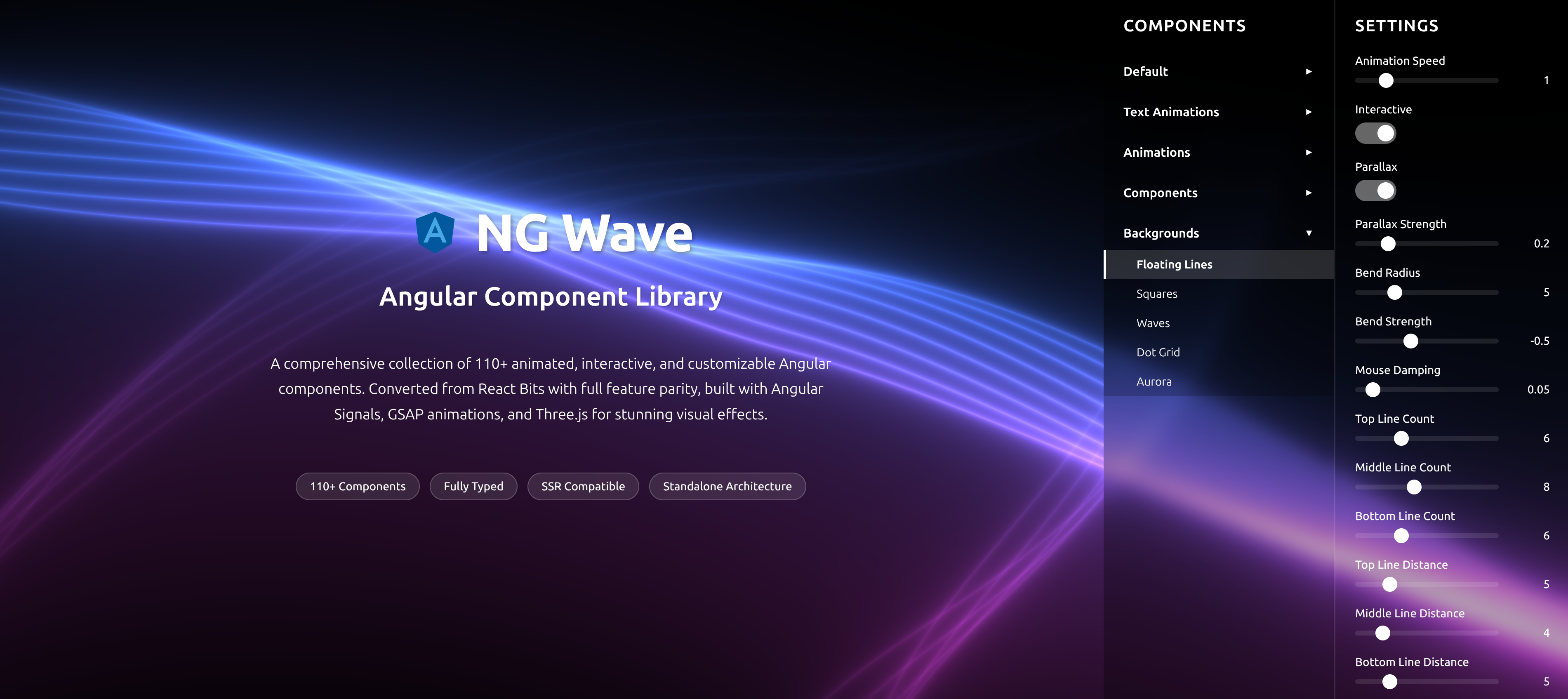
NG Wave
Angular Component Library
A comprehensive collection of 110+ animated, interactive, and customizable Angular components. Converted from React Bits with full feature parity, built with Angular Signals, GSAP animations, and Three.js for stunning visual effects.
Explore Components