Figma Tokens to PrimeNG in Angular 20: Storybook + Chromatic as Your Visual Guardrails (Accessibility, Typography, Density)
A practical, production-grade pipeline for connecting Figma tokens to PrimeNG/Angular components—validated in Storybook and enforced by Chromatic, with accessibility, performance budgets, and telemetry baked in.
Design tokens make your UI predictable; Chromatic makes it enforceable.Back to all posts
Your Dashboard Shouldn’t Jitter: Figma Tokens to PrimeNG with CI Visual Diffs
I’ve shipped dashboards at a global entertainment company, a broadcast media network, a major airline, a leading telecom provider, an insurance technology company, and an enterprise IoT hardware company. The teams that sleep well do one thing right: connect design tokens to the component library and keep Chromatic watching. Whether it’s a United airport kiosk with offline-tolerant flows or a Charter ads analytics board rendering millions of points with D3/Highcharts, the UI never “jitters” because tokens drive the visuals and Storybook guards changes. If you need to hire an Angular developer or bring in an Angular consultant for this pipeline, here’s exactly how I wire it in Angular 20+ with PrimeNG, Signals/SignalStore, Nx, and Chromatic.
Why Angular 20 Teams Need Token-Driven UI with Measurable Rigor
With Angular 20’s streamlined SSR/hydration and Signals, your component tree can react quickly to density or typography changes without zone churn. This matters on real-time dashboards where WebSockets push updates and we render charts using D3, Highcharts, or Canvas/Three.js.
Design-to-code loop that compiles
Design tokens from Figma (via Tokens Studio) become CSS variables and SCSS maps checked into your monorepo. PrimeNG consumes them; Storybook displays them; Chromatic enforces them. No more one-off overrides or mystery colors.
Single source of truth
Automated transforms
Fast feedback
Performance budgets and accessibility
Dashboards must hit responsive FPS and bundle budgets. We track CLS/LCP/INP in CI, use data virtualization for large tables, and verify AA/AAA ratios on key surfaces. Chromatic catches the visual drift; Lighthouse prevents regressions.
Core Web Vitals guardrails
Contrast and keyboard flows
Visual diff thresholds
End-to-End Pipeline: Figma Tokens → Style Dictionary → PrimeNG → Storybook/Chromatic
Example tokens exported from Figma (Tokens Studio):
{
  "color": {
    "brand": {"blue-600": {"value": "#1F4BFF"}},
    "role": {
      "primary": {"value": "{color.brand.blue-600}"},
      "success": {"value": "#00B8A9"},
      "warning": {"value": "#FFB020"},
      "danger": {"value": "#EF4444"},
      "bg": {"value": "#0F172A"},
      "surface": {"value": "#F1F5F9"}
    }
  },
  "typography": {
    "fontFamily": {"value": "InterVariable, system-ui, sans-serif"},
    "scale": {"base": {"value": 1}, "lg": {"value": 1.12}}
  },
  "density": {
    "comfortable": {"value": 8},
    "compact": {"value": 4}
  }
}
Style Dictionary config:
// tools/style-dictionary/config.js
module.exports = {
  source: ["libs/design-tokens/src/tokens/**/*.json"],
  platforms: {
    css: {
      transformGroup: "css",
      buildPath: "dist/design-tokens/",
      files: [{ destination: "tokens.css", format: "css/variables" }]
    },
    scss: {
      transformGroup: "scss",
      buildPath: "dist/design-tokens/",
      files: [{ destination: "_tokens.scss", format: "scss/variables" }]
    }
  }
}
Mapping tokens to PrimeNG:
/* src/styles/primeng-theme-bridge.scss */
@use "sass:meta";
@import "../dist/design-tokens/_tokens";

:root {
  --ux-color-primary: #{$color-role-primary};
  --ux-color-success: #{$color-role-success};
  --ux-color-warning: #{$color-role-warning};
  --ux-color-danger:  #{$color-role-danger};
  --ux-surface:       #{$color-role-surface};
  --ux-bg:            #{$color-role-bg};

  /* PrimeNG variables */
  --p-primary-color: var(--ux-color-primary);
  --p-content-padding: #{$density-comfortable * 1px};
  --p-font-family: #{$typography-fontFamily};
}

[data-density="compact"] {
  --p-content-padding: #{$density-compact * 1px};
}

[data-type-scale="lg"] {
  font-size: calc(1rem * #{$typography-scale-lg});
}
Signals + SignalStore for user prefs:
// libs/ui-state/src/lib/user-prefs.store.ts
import { signalStore, withState, withMethods, patchState } from '@ngrx/signals';

export type Density = 'comfortable' | 'compact';
export type TypeScale = 'base' | 'lg';

interface PrefsState { density: Density; typeScale: TypeScale; theme: 'light'|'dark'; }

const initial: PrefsState = { density: 'comfortable', typeScale: 'base', theme: 'light' };

export const UserPrefsStore = signalStore(
  { providedIn: 'root' },
  withState(initial),
  withMethods((store) => ({
    setDensity(density: Density) { patchState(store, { density }); document.documentElement.setAttribute('data-density', density); },
    setTypeScale(typeScale: TypeScale) { patchState(store, { typeScale }); document.documentElement.setAttribute('data-type-scale', typeScale); },
    setTheme(theme: 'light'|'dark') { patchState(store, { theme }); document.documentElement.dataset.theme = theme; }
  }))
);
Storybook preview toolbar + globals:
// .storybook/preview.ts
import type { Preview } from '@storybook/angular';

export const globalTypes = {
  density: { name: 'Density', defaultValue: 'comfortable', toolbar: { items: ['comfortable','compact'] } },
  typeScale: { name: 'Type', defaultValue: 'base', toolbar: { items: ['base','lg'] } },
  theme: { name: 'Theme', defaultValue: 'light', toolbar: { items: ['light','dark'] } }
};

const preview: Preview = {
  decorators: [ (story, ctx) => {
    const root = document.documentElement;
    root.setAttribute('data-density', ctx.globals['density']);
    root.setAttribute('data-type-scale', ctx.globals['typeScale']);
    root.dataset.theme = ctx.globals['theme'];
    return story();
  }]
};
export default preview;
Chromatic in GitHub Actions:
# .github/workflows/chromatic.yml
name: Chromatic
on: [pull_request]
jobs:
  visual:
    runs-on: ubuntu-latest
    steps:
      - uses: actions/checkout@v4
      - uses: actions/setup-node@v4
        with: { node-version: 20 }
      - run: npm ci
      - run: npm run build:tokens && npm run build:storybook
      - run: npx chromatic --project-token=${{ secrets.CHROMATIC_PROJECT_TOKEN }} --exit-zero-on-changes=false --auto-accept-changes=false
Nx target shortcuts:
{
  "targets": {
    "tokens": { "executor": "@nrwl/workspace:run-commands", "options": { "command": "node tools/style-dictionary/build.js" } },
    "storybook": { "executor": "@nrwl/storybook:storybook" },
    "chromatic": { "executor": "@nrwl/workspace:run-commands", "options": { "command": "npx chromatic --project-token=$CHROMATIC_PROJECT_TOKEN" } }
  }
}
That’s a complete loop: Figma → tokens → PrimeNG → Storybook → Chromatic.
1) Define tokens in Figma and sync to Git
Export your Figma tokens with semantic names mirroring product semantics (e.g., color.role.primary). Keep brand primitives separate from semantic roles, so rebrands don’t break app semantics.
Use Tokens Studio
Organize by color/typography/spacing/density
Commit JSON to libs/design-tokens
2) Transform tokens with Style Dictionary
Style Dictionary compiles design JSON into usable artifacts. We produce a tokens.css (CSS vars) and tokens.scss (mixins/maps) for PrimeNG and custom components.
Generate CSS variables
Emit SCSS maps
Create type/density utilities
3) Map tokens to PrimeNG variables
PrimeNG’s new design tokens make theming straightforward. We bridge Figma semantic tokens to PrimeNG variables like --p-primary-color, --p-content-padding, and --p-font-family.
PrimeNG v17+ uses CSS variables
Map semantic tokens to --p-* tokens
Keep dark/light parity
4) Runtime controls with Signals + SignalStore
A small SignalStore drives CSS vars at runtime—great for role-based dashboards where traders want compact density while execs prefer comfortable density and larger type.
Density (comfortable/compact)
Type scale (100–120%)
Persist with Firebase/localStorage
5) Storybook + Chromatic review gates
Design and engineering review the same stories. Chromatic blocks PRs when unintended diffs appear. We require AA contrast and keyboard coverage on core stories.
Global toolbar for theme/density/type
Accessibility add-ons (Axe)
Chromatic visual diffs on PR
6) Nx + CI
Nx orchestrates the pipeline so token changes recompile Storybook, run Chromatic, and publish design preview links for PM/Design/QA.
Nx cache speeds builds
Chromatic GitHub Action
Perf budgets and Lighthouse
Example: Button, Table, and Chart Consistency
<!-- Button.story.html -->
<p-button label="Primary" styleClass="mr-2" />
<p-button label="Success" class="p-button-success" />
/* Story styles ensure variables are active */
:root { color-scheme: light dark; }
.p-button { font-family: var(--p-font-family); }// Virtualized Table excerpt
<cdk-virtual-scroll-viewport [itemSize]="itemSize()" class="h-96 w-full">
<table pTable [value]="rows()" scrollable scrollHeight="flex">
<!-- columns -->
</table>
</cdk-virtual-scroll-viewport>
// component.ts
import { computed, signal } from '@angular/core';
const density = signal<'comfortable'|'compact'>('comfortable');
const itemSize = computed(() => density() === 'compact' ? 28 : 40);// Highcharts pulling tokens
import * as Highcharts from 'highcharts';
const styles = getComputedStyle(document.documentElement);
const primary = styles.getPropertyValue('--ux-color-primary').trim();
const surface = styles.getPropertyValue('--ux-surface').trim();
const options: Highcharts.Options = {
chart: { backgroundColor: surface },
series: [{ type: 'line', color: primary, data: [1,3,2,4] }],
accessibility: { enabled: true }
};On data-heavy boards, I budget for >12fps during WebSocket bursts, constrain series count, and prefer Canvas-rendered charts or Three.js when necessary. At a broadcast media network VPS and Charter, we used typed event schemas and exponential backoff to keep real-time visuals smooth while Chromatic guarded the UI polish.
PrimeNG Button using tokens
A p-button should pick up --p-primary-color and density/type controls automatically.
Virtualized Table with compact density
Compact density reduces padding and row height while keeping hit targets accessible.
CDK Virtual Scroll
Row height from density
Stable focus/keyboard
Highcharts/D3 using same tokens
Charts pull from the same token map, so role-based dashboards stay coherent across pages.
Semantic role colors
AA contrast lines/labels
12fps+ budget on busy boards
Accessibility, Typography, Density, and the AngularUX Color Palette
Note: Accessibility is a non-negotiable requirement. Storybook integrates Axe; Chromatic prevents low-contrast regressions. For kiosks (United), we added reduced-motion support and enlarged hit targets when peripheral state degraded (e.g., scanner fallback).
Color palette (AngularUX)
We validate AA on primary text and AAA for critical alerts. Neutral scales come from Slate 100–900; charts use distinct hues with ≥3:1 contrast against surfaces.
Primary: #1F4BFF
Success: #00B8A9
Warning: #FFB020
Danger: #EF4444
Surface/Background: #F1F5F9 / #0F172A
Typography
We set base 1.0 and LG 1.12 scales. PrimeNG inherits --p-font-family; headings/labels align to tokens so PDFs, kiosk screens, and dashboards read consistently.
Inter Variable
Type scale tokens
Line-height/letter spacing
Density controls
Compact reduces gaps but preserves accessibility. Focus rings use a dedicated token for visibility on dark and light surfaces.
Comfortable vs. Compact
Hit target ≥ 40px
Keyboard focus rings
When to Hire an Angular Developer for Legacy Design System Rescue
If you need an Angular expert to stabilize a chaotic codebase, bring me in for 2–4 weeks to build the token bridge, set up Storybook/Chromatic, and land accessibility/perf guardrails. For broader modernization, see how we stabilize your Angular codebase with gitPlumbers (99.98% uptime, 70% velocity boost).
Signals-heavy upgrades
I’ve rescued AngularJS and legacy JSP apps, introduced Signals gradually, and removed brittle zone hacks. The token pipeline is a predictable win that stabilizes visual behavior quickly.
AngularJS → Angular
Zone refactors
Strict TypeScript
PrimeNG theming consolidation
If your theme overrides are scattered, I consolidate into a single token bridge and enforce via Storybook/Chromatic. It’s the fastest path to consistency.
Kill ad-hoc CSS
Remove duplicated themes
Centralize stories
Measuring What Matters: UX Polish with Performance Budgets
Polish and rigor are not opposites. They reinforce each other when tokens, Stories, and budgets live in the same CI.
Budgets
We fail the build if budgets or Chromatic thresholds exceed limits. Telemetry flows into GA4/Firebase Logs so we see regressions within hours, not sprints.
Bundle < 200KB critical
LCP < 2.5s on 4G
INP < 200ms
Observability
I gate new visual features behind flags and measure real user impact. At an insurance technology company telematics, this trimmed interaction latency by double digits on stale devices.
Angular DevTools traces
Flame charts
Feature flags
Key Takeaways and Next Steps
- Figma tokens become a living contract. Style Dictionary compiles, PrimeNG consumes, Storybook displays, Chromatic enforces.
- Signals + SignalStore make density and type scale responsive without tearing the change detection fabric.
- Accessibility and performance budgets are automated gates, not promises.
- Charts (D3/Highcharts/Canvas/Three.js) should consume the same tokens for role-based dashboards.
Ready to connect your tokens and enforce visual quality at scale? Let’s review your Angular roadmap. If you’re looking to hire an Angular developer or an Angular consultant with enterprise dashboards, kiosks, and telemetry experience, I’m available for select projects.
Key takeaways
- Treat Figma tokens as your source of truth; autogenerate CSS variables and PrimeNG theme mappings.
- Use Storybook + Chromatic to catch visual regressions before they hit production.
- Manage runtime density and type scale with Signals + SignalStore; persist via Firebase or localStorage.
- Enforce accessibility (AA/AAA), performance budgets, and visual diff thresholds in CI.
- Drive D3/Highcharts/Canvas visuals from the same color tokens for consistent role-based dashboards.
Implementation checklist
- Export tokens from Figma (Tokens Studio) to your repo
- Transform tokens with Style Dictionary into CSS variables + SCSS maps
- Map tokens to PrimeNG CSS variables (e.g., --p-primary-color)
- Wire Storybook with global toolbar controls for theme, density, type scale
- Add Chromatic to CI for PR visual diffs and thresholds
- Build a SignalStore for user prefs and persist (Firebase/localStorage)
- Audit contrast (AA/AAA) and keyboard flows in Storybook with Axe
- Instrument performance budgets and track UX metrics in CI
Questions we hear from teams
- How long does it take to wire Figma tokens to PrimeNG with Storybook/Chromatic?
- Typical setup takes 1–2 weeks: day 1–3 for Style Dictionary + PrimeNG mapping, day 4–7 for Storybook stories and Chromatic, and the remainder for accessibility checks and density/type controls.
- What does an Angular consultant do in a token integration engagement?
- Audit tokens, map to PrimeNG variables, implement Style Dictionary, add Signals/SignalStore for runtime prefs, wire Storybook/Chromatic, and set budgets for performance/accessibility. Deliverables include docs, CI, and training.
- How much does it cost to hire an Angular developer for this?
- A focused 1–2 week engagement ranges based on scope and team size. I offer fixed-price packages for token bridges and CI visual guardrails. Contact me to scope your repo and provide a precise estimate.
- Will this work with our Nx monorepo and Firebase backend?
- Yes. Nx handles targets and caching; Chromatic runs in PR CI. User preferences can persist to Firebase (Firestore/Remote Config) or localStorage without changing the token pipeline.
- Does this support real-time charts and large tables?
- Yes. Charts read the same color tokens; tables use CDK virtual scroll and compact density. We keep FPS budgets, typed event schemas, and exponential retries for real-time pipelines.
Ready to level up your Angular experience?
Let AngularUX review your Signals roadmap, design system, or SSR deployment plan.
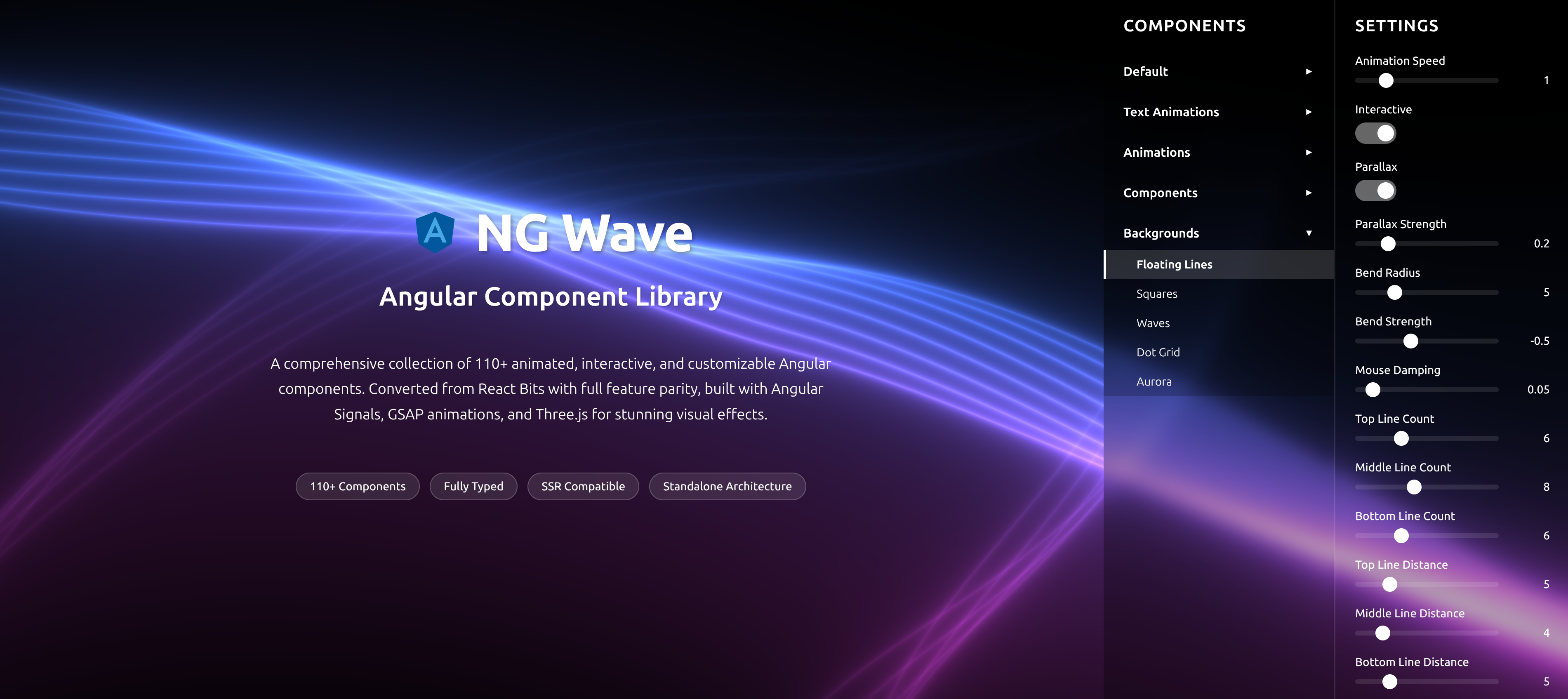
NG Wave
Angular Component Library
A comprehensive collection of 110+ animated, interactive, and customizable Angular components. Converted from React Bits with full feature parity, built with Angular Signals, GSAP animations, and Three.js for stunning visual effects.
Explore Components