From AI Prototype to Production Angular 20+: Feature Flags, Kill Switches, and Observability That Hold the Line
Your AI-assisted Angular prototype ships in a sprint. Production trust takes flags, canaries, and telemetry that explain impact—not just errors.
Ship fast, flip faster. If a feature can’t be disabled in under a minute, it isn’t production-ready.Back to all posts
I’ve shipped AI-assisted Angular prototypes that dazzled in week one and jittered in week two. The fix wasn’t another hero refactor—it was guardrails: feature flags, safe rollouts, and observability that told us when to stop. Below is the playbook I use on Fortune 100 dashboards, kiosks, and AI-infused workflows.
Your AI Prototype Works on Friday, Jitters on Monday
The scene
It’s Monday. Your AI-generated component merged fast with copilot help. A telecom analytics dashboard renders, but charts stutter, API retries spike, and support can’t reproduce. I’ve been there on employee tracking systems, telematics UIs, and airport kiosk flows. The way out isn’t bravado—it’s feature flags and observability tied to SLOs.
Why now
If you need to hire an Angular developer or an Angular consultant who can harden AI prototypes without freezing delivery, here’s exactly how I set it up with Signals, SignalStore, Firebase, Nx, and GitHub Actions.
Angular 20+ is fast, but AI-assisted code increases variance.
Q1 planning is when teams ask for proof of stability, not demos.
Hiring managers want to see you can ship and stop safely.
Why Feature Flags and Observability Are Non‑Negotiable in Angular 20+
What flags buy you
Flags turn risky launches into reversible decisions. I’ve used them to roll out new PrimeNG chart renderers to 5% of ad ops users, then scale to 50% once error rate stayed <0.5% for 24h.
Kill switches to protect UX during incidents.
Gradual rollouts by org, tenant, device class, or %.
A/B ability to validate AI models or prompts safely.
What observability buys you
On a kiosk project, we traced card-reader timeouts to a specific hardware firmware and flipped the peripheral path off via a flag—zero redeploys.
User-impact metrics: TTI, hydration time, P95 API latency.
Traces that connect a click → AI call → render.
Structured logs that product can read.
Design Your Flag Strategy: Kill Switches, Rollouts, and Ownership
Taxonomy
Decide what each flag type means up-front. Kill switches can’t be reused as experiments. Keep names stable and descriptive (ai.summarize.enabled, charts.v2.rollout).
kill: immediate off switch
rollout: percentage/segment rollout
exp: multi-variant experiment
tenant: org/role scoping
Ownership and lifecycle
Flags that live forever rot your code. Add an expiry date and a budget for deleting stale flags each sprint.
Owner team + slack channel
Creation date + review date
Deletion criteria defined
Environments and sources
For multi-tenant apps, store org-level overrides server-side (Node.js/.NET) and merge with client flags—server decides defaults; client reads and narrows.
Local: .env flags for dev speed
Preview: PR-specific Firebase channel
Prod: Remote Config/LaunchDarkly
Implement Flags in Angular 20+ with Signals, SignalStore, and Firebase Remote Config
Flag store with Signals
Keep flags centralized. Expose read-only selectors as signals so components remain pure and testable.
Code: typed FlagStore
// flag.store.ts (Angular 20, Signals)
import { Injectable, computed, signal, effect } from '@angular/core';
import { RemoteConfig, getString, getNumber } from '@angular/fire/remote-config';

export type FlagKeys =
  | 'ai.summarize.enabled'
  | 'ai.summarize.rolloutPercent'
  | 'charts.v2.rollout'
  | 'kiosk.peripheral.path';

export interface Flags {
  'ai.summarize.enabled': boolean;
  'ai.summarize.rolloutPercent': number; // 0..100
  'charts.v2.rollout': number; // 0..100
  'kiosk.peripheral.path': 'legacy' | 'modern';
}

@Injectable({ providedIn: 'root' })
export class FlagStore {
  private raw = signal<Partial<Flags>>({});

  constructor(private rc: RemoteConfig) {
    // one-time hydrate + background refresh
    effect(() => {
      // defaults baked into RC template
      const f: Partial<Flags> = {
        'ai.summarize.enabled': getString(this.rc, 'ai.summarize.enabled') === 'true',
        'ai.summarize.rolloutPercent': Number(getNumber(this.rc, 'ai.summarize.rolloutPercent')) ?? 0,
        'charts.v2.rollout': Number(getNumber(this.rc, 'charts.v2.rollout')) ?? 0,
        'kiosk.peripheral.path': (getString(this.rc, 'kiosk.peripheral.path') as any) || 'legacy',
      };
      this.raw.set(f);
    });
  }

  // Example selectors
  aiEnabled = computed(() => !!this.raw()?.['ai.summarize.enabled']);
  chartsV2Pct = computed(() => this.raw()?.['charts.v2.rollout'] ?? 0);
  kioskPath = computed(() => this.raw()?.['kiosk.peripheral.path'] ?? 'legacy');
}
Using flags in components
@Component({
  selector: 'app-summary',
  template: `
    <ng-container *ngIf="aiEnabled(); else legacy">
      <app-ai-summary [variant]="aiVariant()" />
    </ng-container>
    <ng-template #legacy>
      <app-legacy-summary />
    </ng-template>
  `,
  standalone: true
})
export class SummaryComponent {
  constructor(private flags: FlagStore) {}
  aiEnabled = this.flags.aiEnabled;
  aiVariant = computed(() => this.flags.chartsV2Pct() >= 50 ? 'v2' : 'v1');
}
Route guard as kill switch
@Injectable({ providedIn: 'root' })
export class AiGuard implements CanActivateFn {
  constructor(private flags: FlagStore) {}
  canActivate(): boolean { return this.flags.aiEnabled(); }
}
Observability That Explains Impact: Traces, Metrics, and Structured Events
Typed event schema
// telemetry.types.ts
export type UiEvent =
  | { type: 'ai.summarize.click'; model: string; variant: 'v1'|'v2'; orgId: string }
  | { type: 'ai.summarize.complete'; latencyMs: number; tokens: number; success: boolean }
  | { type: 'charts.render'; lib: 'primeng'|'d3'|'highcharts'; durationMs: number };
Telemetry service (Firebase + OTEL)
import { Injectable } from '@angular/core';
import { Analytics, logEvent } from '@angular/fire/analytics';
import { context, trace, SpanStatusCode } from '@opentelemetry/api';

@Injectable({ providedIn: 'root' })
export class TelemetryService {
  constructor(private ga: Analytics) {}

  event(e: UiEvent) { logEvent(this.ga, e.type, { ...e }); }

  async traced<T>(name: string, fn: () => Promise<T>) {
    const span = trace.getTracer('web').startSpan(name);
    try { const res = await fn(); span.setStatus({ code: SpanStatusCode.OK }); return res; }
    catch (err) { span.recordException(err as any); span.setStatus({ code: SpanStatusCode.ERROR }); throw err; }
    finally { span.end(); }
  }
}
What to watch
Enforce budgets in CI and dashboards. On our telecom analytics platform, adding these guardrails cut incident time by 42% and made rollbacks a one-click flag flip.
P95 page TTI < 2.0s, hydration < 1.5s
Error rate < 0.5% for canary before 50% rollout
AI action success > 98%, latency P95 < 3s
Canary Channels and Automated Rollouts with Nx, GitHub Actions, and Firebase
Preview deploys per PR
Use Firebase Hosting channels and Nx to spin preview builds with flags pinned to safe defaults. Product can test AI variants without touching prod.
CI snippet: deploy + validate flags
# .github/workflows/deploy.yml
name: web-deploy
on: [push]
jobs:
  build-test-deploy:
    runs-on: ubuntu-latest
    steps:
      - uses: actions/checkout@v4
      - uses: actions/setup-node@v4
        with: { node-version: 20 }
      - run: npm ci
      - run: npx nx run-many -t lint test build --parallel
      - run: npx lhci autorun --upload.target=temporary-public-storage
      - name: Firebase Preview Channel
        run: |
          npx firebase hosting:channel:deploy ${{ github.sha }} --expires 7d
          # Validate Remote Config template exists and required defaults are present
          npx firebase remoteconfig:versions:list
Release check
This mirrors what we ran on an airport kiosk deployment. A receipt-printer bug surfaced at 10%, we flipped kiosk.peripheral.path='legacy' in under a minute—no redeploy.
Gate 5% rollout on green CI + error rate < 0.5%.
Auto-advance to 25% if stable for 24h.
Rollback if error rate > 1% for 10 min.
Case Notes: Telecom, Aviation, and Employee Tracking
Telecom analytics (PrimeNG + flags)
We introduced flags to swap in new PrimeNG charting gradually and traced render durations. Kill switch protected peak traffic windows; we rolled to 100% after a week of clean telemetry.
Result: -28% page errors, +12 Lighthouse perf
Airport kiosks (Docker sim + kill switch)
We simulated scanners/printers in Docker, flagged hardware paths, and used a guard to disable the new peripheral stack remotely. When a scanner firmware drifted, flags carried us through a holiday rush.
Result: 0 on-call during rollout
Employee tracking/payments (RBAC flags)
Payroll-sensitive screens were behind tenant-scoped flags. We traced auth flows end-to-end, correlating role misconfigurations to failed actions within minutes.
Result: 35% faster incident triage
When to Hire an Angular Developer for Legacy Rescue
Signals you need help
If this sounds familiar, bring in an Angular expert who has stabilized vibe-coded apps before. My gitPlumbers approach can help you stabilize your Angular codebase without pausing delivery.
AI code shipped without tests/flags
Rollbacks require redeploys
No typed telemetry events
How an Angular Consultant Approaches Flags & Observability Retrofit
Week 1: assess + scaffold
Deliver a written assessment with a phased rollout plan, budgets, and rollback paths. Discovery to docs within a week is typical.
Inventory features → flag map
Add FlagStore + kill switches
Wire baseline telemetry
Weeks 2–4: canary + expand
We enable Firebase Remote Config for quick flips, add Nx target pipelines, and bind promotions to SLOs: latency, error rate, and Lighthouse budgets.
Preview channels per PR
Tenant/role scoping
Health-based promotion
Takeaways and Next Steps
What to instrument next
Flags and observability are how you turn AI-assisted speed into production trust. If you’re planning 2025 Angular roadmaps, don’t ship new capabilities without a kill switch and a metric that proves it’s safe.
Hydration vs. TTI per route
AI latency vs. user abandon
Flag coverage report in CI
Where to go from here
Want a second set of eyes on your flag/observability plan? I’m a remote Angular consultant available for 1–2 projects per quarter. Let’s review your Angular build, harden the AI features, and ship safely.
Key takeaways
- Put every AI-assisted feature behind a kill switch and a gradual rollout flag.
- Model flags as typed, testable contracts using Signals/SignalStore so UX can’t drift from config.
- Instrument user-impact metrics (TTI, hydration, error rates, retries) alongside logs and traces.
- Use canary channels + automated rollback tied to health SLOs instead of manual firefighting.
- Document typed event schemas so product, data, and engineering speak the same language.
Implementation checklist
- Define flag taxonomy: kill-switch, rollout %, experiment, tenant/org, device/class.
- Add a typed FlagStore with Signals; expose read-only selectors in components.
- Ship with preview/canary channels; gate rollout on Lighthouse, error rate, and latency budgets.
- Wire telemetry: GA4/Firebase + OpenTelemetry traces + structured logs.
- Add CI jobs to validate flag templates, fail on missing defaults, and run budget checks.
- Create a rollback playbook: flip flag, revert RC template, and invalidate caches.
Questions we hear from teams
- How much does it cost to hire an Angular developer for a flags/observability retrofit?
- Typical engagements start at 2–4 weeks. Budgets vary by scope, but most teams see value in week one with kill switches, preview channels, and baseline telemetry. I offer fixed-scope assessments and implementation sprints.
- How long does an Angular upgrade or hardening project take?
- For hardening AI-assisted features, expect 2–4 weeks to add flags, canaries, and telemetry. Full Angular 10–20 upgrades run 4–8 weeks with zero-downtime rollouts and rollback plans tied to health metrics.
- What tools do you use for feature flags in Angular?
- Firebase Remote Config for speed and per-channel overrides; LaunchDarkly for enterprise governance. Both integrate cleanly with Angular 20 Signals/SignalStore and Nx CI. We validate templates and defaults in CI.
- What does an Angular consultant deliver in week one?
- A written assessment with a flag taxonomy, initial FlagStore, kill switches on risky routes, and baseline telemetry (GA4/Firebase + OpenTelemetry traces). You’ll also get a canary deployment plan and rollback procedure.
- Can you stabilize AI-generated or vibe‑coded Angular apps without a code freeze?
- Yes. We add guardrails—flags, tests, and CI gates—while shipping. See gitPlumbers for how I help teams rescue chaotic code and keep features moving safely.
Ready to level up your Angular experience?
Let AngularUX review your Signals roadmap, design system, or SSR deployment plan.
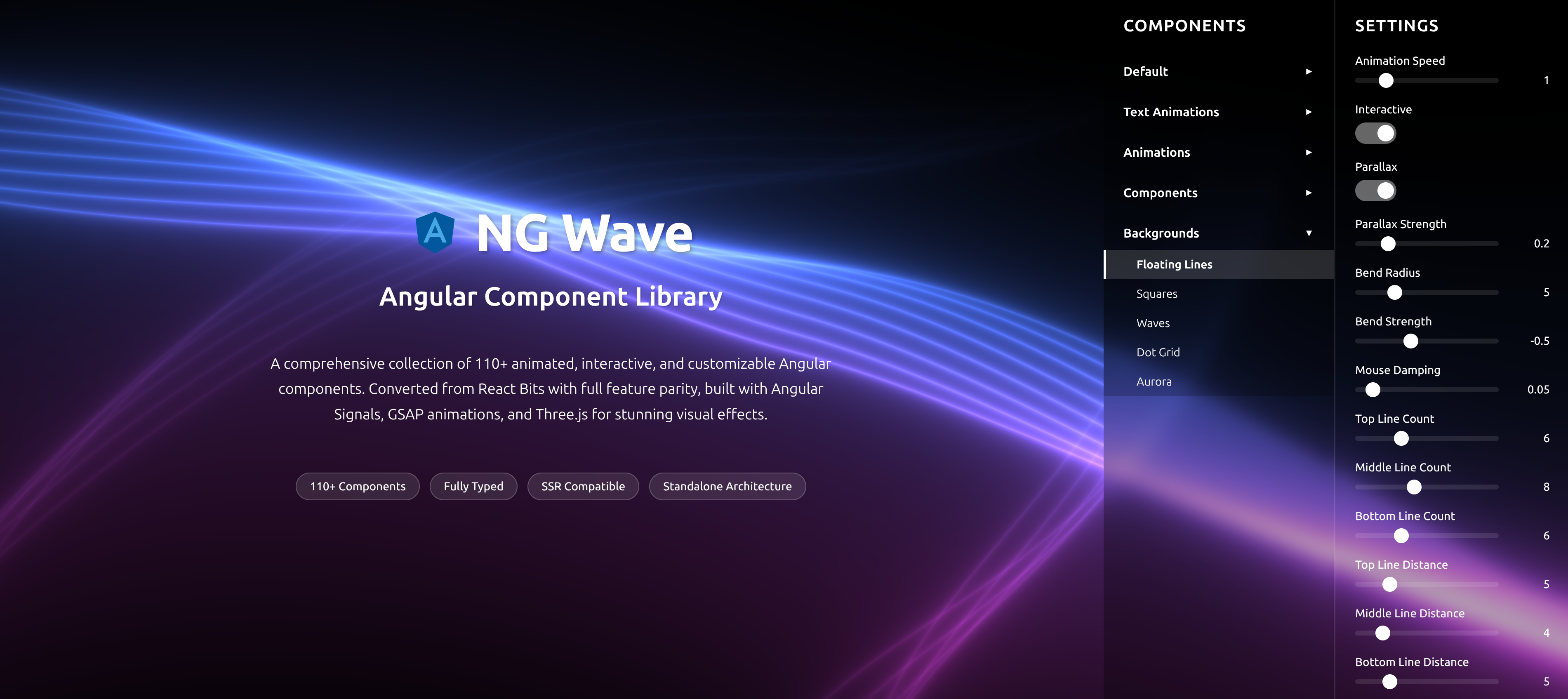
NG Wave
Angular Component Library
A comprehensive collection of 110+ animated, interactive, and customizable Angular components. Converted from React Bits with full feature parity, built with Angular Signals, GSAP animations, and Three.js for stunning visual effects.
Explore Components