Harden AI‑Assisted Angular 20+ Prototypes: Feature Flags, Guarded Rollouts, and Observability You Can Ship This Week
Your LLM demo is great—until 10k users hit it. Here’s how I harden AI‑assisted Angular prototypes with feature flags, guarded releases, and telemetry that keeps pagers quiet.
Ship the flags before you ship the feature. That’s how you move fast without breaking production.Back to all posts
I’ve shipped enough “works on my machine” AI demos to know what breaks first: fan‑out costs, retries, and jittery UIs the moment real users pile in. As a remote Angular consultant, my job is to turn that prototype into production code by Friday without waking on‑call. This is the platform and delivery playbook I use across Angular 20+ apps with Signals, SignalStore, Nx, Firebase, and OpenTelemetry.
Why now? As 2025 roadmaps lock, teams want LLM‑assisted summarizers, copilots, and anomaly detectors live in Q1. You can ship safely—if you gate, measure, and roll out methodically.
The Friday demo that will page you by Sunday
As a senior Angular engineer, I start by assuming the AI feature will misbehave in prod. We build rails so it can’t take the entire app down.
What actually breaks first
I’ve seen this across industries—airport kiosks, telecom analytics dashboards, and AI‑assisted verification in IntegrityLens. The fix isn’t heroic refactors; it’s disciplined delivery: feature flags, guarded rollouts, and observability stitched into Angular 20+ with Signals so the UI stays truthful under load.
Unbounded fan‑out: every keypress calls your LLM proxy.
Jittery UI: optimistic updates without backpressure.
Silent failures: no correlation IDs, no error taxonomy.
Expensive rollbacks: no flags, so deploys become all‑or‑nothing.
Why ship AI with flags and telemetry in Angular 20+
Angular‑native reasons
Signals + SignalStore give you observable state with minimal ceremony and high performance. Flags bind to view logic (disable buttons, show skeletons) and data logic (route guards, service gates) without excessive change detection.
Signals let flags propagate without zone churn.
SignalStore centralizes reads/writes for clarity and testability.
SSR/Vite builds make canary channels cheap and fast.
PrimeNG/Material provide accessible fallbacks and skeletons.
Business outcomes you can measure
This is how we kept 99.98% uptime on gitPlumbers during modernization and processed 12k+ interviews on IntegrityLens while iterating on AI features.
Reduce incident scope via instant kill switches.
Cut MTTR by 30–50% with traceable, typed errors.
Ship faster: gate risky code and iterate on canaries.
Control cloud spend by sampling and rate‑limiting at the edge.
Flag architecture you can trust
// flags.store.ts (Angular 20+, Signals)
import { Injectable, computed, effect, inject, signal } from '@angular/core';
import { RemoteConfig, getValue, fetchAndActivate } from '@angular/fire/remote-config';
import { interval } from 'rxjs';

export type FlagKey = 'ai.summarize.enabled' | 'ai.summarize.rolloutPct' | 'ai.summarize.killswitch' | 'telemetry.samplePct';

@Injectable({ providedIn: 'root' })
export class FlagsStore {
  private rc = inject(RemoteConfig);

  private loaded = signal(false);
  readonly enabled = signal(false);
  readonly rolloutPct = signal(0);
  readonly kill = signal(false);
  readonly telemetrySamplePct = signal(10);

  readonly aiActive = computed(() => this.loaded() && !this.kill() && this.enabled());

  constructor() {
    this.refresh();
    // Refresh periodically; RC fetch is cheap when not stale
    interval(60_000).subscribe(() => this.refresh());

    // Optional: log local changes
    effect(() => {
      if (!this.loaded()) return;
      console.debug('[flags] aiActive=%o pct=%o kill=%o', this.aiActive(), this.rolloutPct(), this.kill());
    });
  }

  async refresh() {
    await fetchAndActivate(this.rc).catch(() => void 0);
    this.enabled.set(this.bool('ai.summarize.enabled', false));
    this.rolloutPct.set(this.num('ai.summarize.rolloutPct', 0));
    this.kill.set(this.bool('ai.summarize.killswitch', false));
    this.telemetrySamplePct.set(this.num('telemetry.samplePct', 10));
    this.loaded.set(true);
  }

  private bool(k: FlagKey, d=false) { return this.val(k).asBoolean() ?? d; }
  private num(k: FlagKey, d=0) { return this.val(k).asNumber() ?? d; }
  private val(k: FlagKey) { return getValue(this.rc, k); }
}
<!-- In template: disable risky UI; show skeletons when flag off -->
<button pButton label="Summarize" [disabled]="!flags.aiActive()" (click)="summarize()"></button>
<p-skeleton *ngIf="!flags.aiActive()" width="12rem" height="2rem"></p-skeleton>Define the flag taxonomy
Keep names stable and semantic. Scope by audience (qa, staff, tenant) using Firebase Remote Config conditions or your flag provider’s targeting. Safe defaults matter: production boot should assume off until config arrives.
ai.summarize.enabled: boolean, defaults to false.
ai.summarize.rolloutPct: 0–100, per‑audience.
ai.summarize.killswitch: overrides everything.
telemetry.samplePct: event sampling guard.
Wire flags into a Signals‑backed store
Use AngularFire Remote Config or LaunchDarkly SDK. Convert flag values into Signals so templates and services react instantly without noisy Rx chains.
Typed FlagsStore example (Angular 20, Signals, SignalStore)
Observability that catches issues before users do
// telemetry.service.ts
import { Injectable } from '@angular/core';
import { trace } from '@opentelemetry/api';
import { FlagsStore } from './flags.store';

@Injectable({ providedIn: 'root' })
export class TelemetryService {
  private tracer = trace.getTracer('angularux-app');
  constructor(private flags: FlagsStore) {}

  summarizeRequested(id: string, model: string, tokens: number) {
    const span = this.tracer.startSpan('ai.summarize.request');
    span.setAttributes({ id, model, tokens, flag_enabled: this.flags.aiActive() });
    span.end();

    // Optionally forward to GA4/Firebase
    window.gtag?.('event', 'ai_summarize_request', { id, model, tokens });
  }

  summarizeCompleted(id: string, latencyMs: number, outTokens: number) {
    const span = this.tracer.startSpan('ai.summarize.complete');
    span.setAttributes({ id, latencyMs, outTokens });
    span.end();
  }

  summarizeError(id: string, code: string, stage: 'prompt'|'stream'|'render', http?: number) {
    const span = this.tracer.startSpan('ai.summarize.error');
    span.setAttributes({ id, code, stage, http, retried: false });
    span.end();
  }
}
Typed event schema
A consistent schema makes dashboards actionable and cuts MTTR. We correlate UI events with API traces via a requestId threaded through headers and logs.
ai.summarize.request: {id, model, tokens, tenantId}
ai.summarize.complete: {id, latencyMs, tokensOut}
ai.summarize.error: {id, code, stage, http, retried}
flag.evaluated: {key, value, user, tenantId}
OpenTelemetry in Angular 20+
Use the OTel API for spans and attributes. Export to your backend (OTLP/HTTP to Grafana Tempo, Honeycomb, or Azure Monitor). Complement with GA4 and Firebase Logs for funnels and field errors.
Instrumentation example
Guarded rollouts with Nx CI and Firebase
# .github/workflows/canary.yml
name: canary-rollout
on:
  workflow_dispatch:
    inputs:
      rolloutPct:
        description: 'AI summarize rollout percentage (0-100)'
        required: true
        default: '5'
jobs:
  build-deploy:
    runs-on: ubuntu-latest
    steps:
      - uses: actions/checkout@v4
      - uses: actions/setup-node@v4
        with: { node-version: 20 }
      - run: npm ci
      - run: npx nx build web --configuration=production
      - name: Deploy preview
        run: npx firebase hosting:channel:deploy canary-$GITHUB_RUN_ID --expires 7d --project ${{ secrets.FB_PROJECT }}
        env:
          FIREBASE_TOKEN: ${{ secrets.FIREBASE_TOKEN }}
      - name: Upload Remote Config
        env:
          FIREBASE_TOKEN: ${{ secrets.FIREBASE_TOKEN }}
          FB_PROJECT: ${{ secrets.FB_PROJECT }}
        run: |
          jq \
            --argjson pct "${{ github.event.inputs.rolloutPct }}" \
            '.parameters["ai.summarize.rolloutPct"].defaultValue.numberValue = $pct' \
            rc-template.json > rc.json
          npx firebase remoteconfig:set rc.json --project $FB_PROJECT
      - name: E2E + Lighthouse
        run: |
          npx nx run web-e2e:e2e --baseUrl "$CANARY_URL"
          npx lhci autorun --collect.url="$CANARY_URL"
// rc-template.json (excerpt)
{
"parameters": {
"ai.summarize.enabled": { "defaultValue": { "value": "false" } },
"ai.summarize.rolloutPct": { "defaultValue": { "numberValue": 0 } },
"ai.summarize.killswitch": { "defaultValue": { "value": "false" } },
"telemetry.samplePct": { "defaultValue": { "numberValue": 10 } }
},
"parameterGroups": {},
"conditions": [
{ "name": "Staff", "expression": "auth.uid in [\"u_123\",\"u_456\"]" },
{ "name": "Canary5", "expression": "percent <= 5" }
]
}Strategy
I’ve used this flow with GitHub Actions and Azure DevOps. Same idea: every merge deploys to a safe channel; flags gate activation so UI code can ship dark.
Preview channels per PR for QA and performance baselines.
Promote to canary (1–5%) with audience targeting.
Automate remote config uploads with environment presets.
Smoke tests + Lighthouse CI + e2e before promotion.
CI pipeline sketch (GitHub Actions + Nx + Firebase)
Remote Config template
Example: Flagged LLM Summarizer component
// summarize.component.ts
import { Component, inject, signal } from '@angular/core';
import { FlagsStore } from '../flags.store';
import { TelemetryService } from '../telemetry.service';

@Component({
  selector: 'app-summarize',
  templateUrl: './summarize.component.html'
})
export class SummarizeComponent {
  flags = inject(FlagsStore);
  t = inject(TelemetryService);

  loading = signal(false);
  output = signal('');

  async summarize() {
    if (!this.flags.aiActive()) return;
    const id = crypto.randomUUID();
    this.loading.set(true);
    this.t.summarizeRequested(id, 'gpt-4o-mini', 1500);
    try {
      const res = await fetch('/api/summary', { method: 'POST', body: JSON.stringify({ text: '...' }) });
      const start = performance.now();
      const data = await res.json();
      this.output.set(data.summary);
      this.t.summarizeCompleted(id, performance.now() - start, data.tokensOut ?? 0);
    } catch (e: any) {
      this.t.summarizeError(id, e?.code ?? 'unknown', 'render');
    } finally { this.loading.set(false); }
  }
}
<!-- summarize.component.html -->
<div class="panel">
<button pButton label="Summarize" [disabled]="!flags.aiActive() || loading()" (click)="summarize()"></button>
<p-skeleton *ngIf="!flags.aiActive()" width="16rem" height="2rem"></p-skeleton>
<p-toast *ngIf="!flags.aiActive()" severity="info" text="AI in limited preview" life="4000"></p-toast>
<pre *ngIf="output()">{{ output() }}</pre>
</div>Guarded UI and traced calls
This component disables risky actions when flags are off, surfaces skeletons, and emits typed telemetry. Swap the API call for your Node.js/.NET/Firebase proxy with exponential backoff and timeouts.
Rollback and SLOs you can defend
# One‑liner rollback to last good RC version (Firebase CLI)
LAST=$(firebase remoteconfig:versions:list --project $FB_PROJECT --limit 2 | awk 'NR==3{print $1}')
firebase remoteconfig:rollback $LAST --project $FB_PROJECT
Set explicit budgets
Tie your flags to these thresholds. If p95 or error rate breaches for 10 minutes, CI triggers an automatic rollback of the Remote Config version or flips the kill switch.
p95 end‑to‑end < 1.8s, error rate < 1.5%.
Core Web Vitals: LCP < 2.5s, INP < 200ms, CLS < 0.1.
Spend cap: tokens/day per tenant; reject beyond cap with a friendly UX.
Pre‑script the rollback
Rollbacks should be a button, not a war room. For kiosks and offline‑tolerant flows, prefer kill switches combined with queued retries to avoid bricking devices.
remoteconfig:versions:list and rollback API calls ready.
Revert hosting channel alias if necessary.
Notify Slack/Teams with the reason code and trace links.
When to Hire an Angular Developer to Harden AI Prototypes
Bring in an Angular consultant if
I’ve done this across telecom analytics, airport kiosks with Docker hardware simulation, enterprise IoT portals, and AI verification systems. If you need a remote Angular developer with Fortune 100 experience, let’s talk through your roadmap.
You need a production‑safe rollout in 2–4 weeks.
You’re jumping from a demo to multi‑tenant RBAC quickly.
You lack feature flag/observability plumbing or a rollback plan.
Your AI feature needs offline‑tolerant UX or kiosk hardware support.
Closing notes: measurable outcomes and next steps
What to instrument next
Ship flags first, then the feature. Measure p95 latency, error rate, and Core Web Vitals per audience. If metrics hold, dial rollout from 1% to 5% to 25%. If not, rollback in seconds and iterate. That’s how we keep delivery velocity without chaos.
Distinct canary vs. GA audience segments to compare conversion.
Sampling guards for expensive trace exports.
Contract tests for flagged components to prevent regressions.
Key takeaways
- Gate AI features behind typed, server‑controlled feature flags with safe defaults.
- Use Signals/SignalStore to bind flags to UI/logic without change‑detection churn.
- Roll out with canaries and environment‑segmented flags; keep a global kill switch.
- Instrument with OpenTelemetry + GA4/Firebase Logs using a typed event schema.
- Automate rollout/rollback via Nx + CI; verify with Lighthouse/DevTools and alert budgets.
Implementation checklist
- Define a flag taxonomy: enable, percentage rollout, kill switch, sampling rate.
- Wire Firebase Remote Config (or your provider) to a FlagsStore using Signals.
- Add typed telemetry events: request, completion, latency, failure reason.
- Deploy a 1–5% canary behind auth/role targeting; verify Core Web Vitals and errors.
- Set SLOs and alert thresholds; pre‑script rollback and kill‑switch playbooks.
- Add contract tests for flagged surfaces; run Lighthouse CI and e2e on each channel.
- Log correlation IDs from browser to API; retain traces for at least 14 days.
- Document safe fallbacks and skeleton states; protect a11y with proper roles/ARIA.
Questions we hear from teams
- How long does it take to harden an AI‑assisted Angular feature?
- Typical engagement is 2–4 weeks: week 1 flags + telemetry, week 2 canary + CI + dashboards, and weeks 3–4 iteration and scale‑out. Larger multi‑tenant or kiosk deployments may extend to 6–8 weeks.
- Do I need Firebase for feature flags?
- No. Firebase Remote Config is quick for Angular, but LaunchDarkly, ConfigCat, or a homegrown service also work. The key is typed access, safe defaults, and Signals‑driven bindings so the UI reflects flag changes instantly.
- What does observability look like for AI features?
- OpenTelemetry spans for request/complete/error with a correlation ID, GA4 funnels for UX, and Firebase/Log Analytics for field errors. Track p95 latency, error rate, and cost metrics (tokens) per tenant and per rollout cohort.
- How much does it cost to hire an Angular developer for this?
- I offer fixed‑scope hardening packages for prototypes, and time‑and‑materials for complex estates. Most teams see value in under a month. Book a discovery call to scope your rollout and budget precisely.
- Will this slow feature delivery?
- No—flags let you merge dark and iterate safely. With Nx, GitHub Actions, and canary channels, you keep shipping while containing risk. Teams typically gain velocity once rollbacks and metrics are one click away.
Ready to level up your Angular experience?
Let AngularUX review your Signals roadmap, design system, or SSR deployment plan.
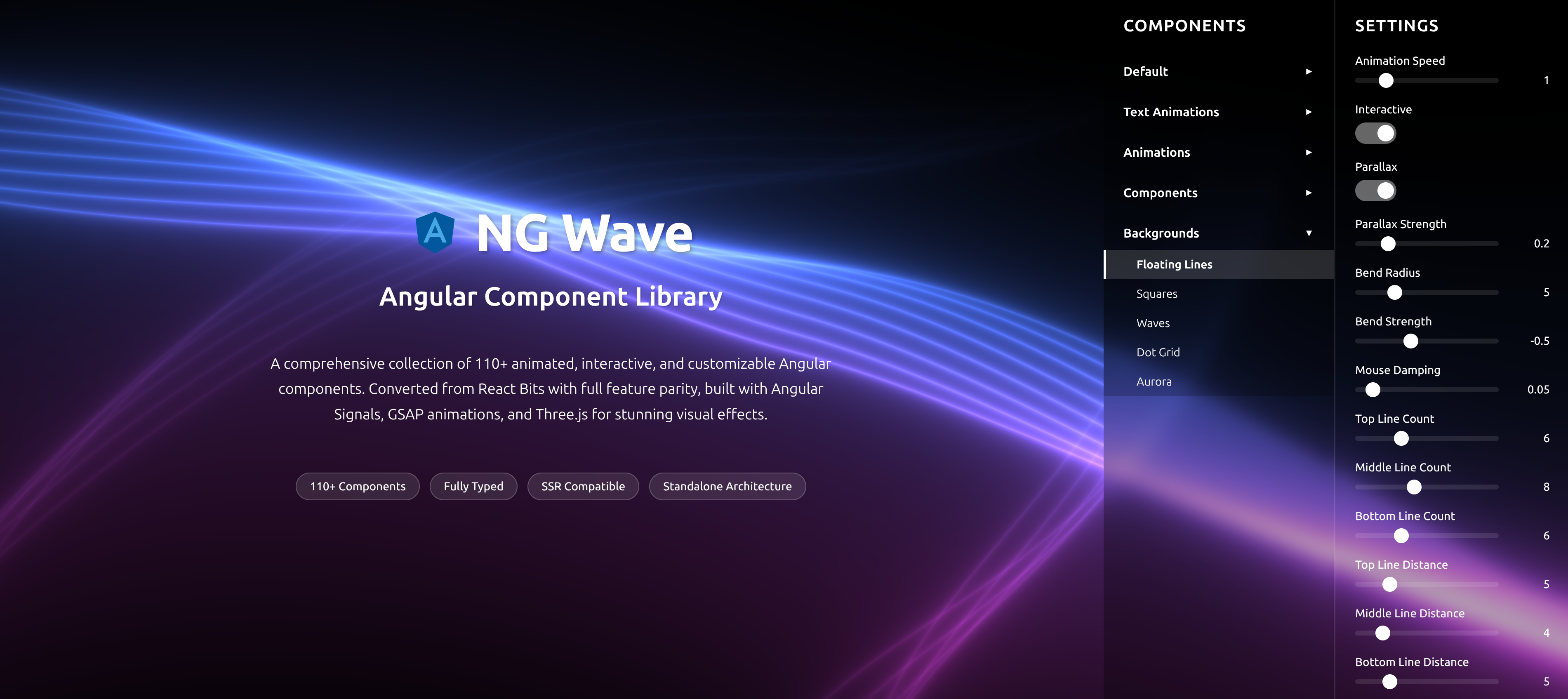
NG Wave
Angular Component Library
A comprehensive collection of 110+ animated, interactive, and customizable Angular components. Converted from React Bits with full feature parity, built with Angular Signals, GSAP animations, and Three.js for stunning visual effects.
Explore Components