How I Ship Angular 10–15 → 20 Upgrades With Zero Downtime: Deprecations, CI Tests, Vite/SSR, and Rollback You Can Trust
A field-tested, stepwise plan for upgrading Angular 10–15 apps to 20 without waking on‑call—deprecations checklist, CI testing, feature flags, canaries, and instant rollbacks.
Zero downtime isn’t magic. It’s flags, canaries, and a rollback you can run half‑asleep.Back to all posts
I’ve shipped Angular upgrades in environments where “downtime” means missed ad impressions, blocked check-ins at airport kiosks, or a broken payment flow for an entertainment workforce. Zero downtime isn’t magic; it’s discipline—feature flags, canaries, and a rollback you can run half‑asleep. If you need an Angular expert to plan this, I’m a remote Angular consultant who can help your team upgrade safely.
How I Shipped an Angular 12 → 20 Upgrade With Zero Downtime
As companies plan 2025 Angular roadmaps, upgrades from 10–15 to 20 are on every CTO’s list. This is the playbook I use across telecom analytics, airline kiosks, and insurance telematics dashboards to keep revenue pages alive while modernizing.
The scene
We established a canary lane (5% traffic) behind a feature flag and wired GitHub Actions + Nx to run smoke, a11y, and Lighthouse checks on every canary deploy. Rollback was a single CLI command. We upgraded in slices: builders/SSR first, RxJS/typed forms next, PrimeNG last. On-call slept just fine.
Broadcast media network’s VPS scheduler (Angular 12) needed Angular 20 for Vite/SSR and library support
No code freeze allowed—daily features continued
On‑call had a hard SLO: no visible downtime
Tooling used
Telemetry caught a hydration regression in canary (SSR route with heavy charts). We reverted, patched a Highcharts lazy-load, and re‑canaried within 20 minutes—users never noticed.
Angular 20, Nx, GitHub Actions, Firebase Hosting preview channels
Cypress, Jest, Angular Component Harnesses, Lighthouse CI, axe-core
Node.js services + .NET APIs, OpenTelemetry + GA4 dashboards
Why Angular 10–15 Apps Break During Upgrades—and How to Prevent It
Common failure points
Each of these looks small but compounds fast when you ship at scale. The fix is to split the upgrade into measurable phases with flags and canaries—treat each risk as a separate release, not a giant bang cutover.
Builder shift to the application (Vite) builder and SSR/hydration changes
Typed forms strictness and control.value now typed
RxJS 7.8+ changes (toPromise removal, scheduler differences)
ESLint migration and stricter TypeScript configs
Third-party mismatches (PrimeNG, Material, chart libs)
What zero-downtime really means
If your rollback takes a meeting, it will never happen in time. Script it. Practice it. Measure it.
No 500s/blank screens during deploys
Instant rollbacks with traffic control
Objective gates in CI (perf/a11y/UX)
Step-by-Step Plan: Zero-Downtime Upgrade from Angular 10–15 to 20
Example builder migration snippet:
{
  "projects": {
    "app": {
      "architect": {
        "build": {
          "builder": "@angular-devkit/build-angular:application",
          "options": {
            "outputPath": "dist/app",
            "assets": ["src/favicon.ico", "src/assets"],
            "index": "src/index.html",
            "polyfills": ["zone.js"],
            "scripts": []
          }
        },
        "serve": {
          "builder": "@angular-devkit/build-angular:dev-server"
        },
        "ssr": {
          "builder": "@angular-devkit/build-angular:ssr",
          "options": {
            "serverEntryPoint": "src/main.server.ts"
          }
        }
      }
    }
  }
}
CLI + Nx upgrade commands I actually run:
# lock Node, pnpm/npm versions in CI first
node -v && npm -v

# update Angular core + CLI
ng update @angular/core@20 @angular/cli@20 --force=false

# update workspace + generators
nx migrate latest
pnpm install  # or npm ci
nx migrate --run-migrations

# add SSR if missing (Angular 17+ style)
ng add @angular/ssr
Typed forms/RxJS sample fixes:
// BEFORE (Angular 12)
this.form = new FormGroup({ amount: new FormControl('') });
const data = await http.get('/api').toPromise();

// AFTER (Angular 20)
this.form = new FormGroup<{ amount: FormControl<number|null> }>({
  amount: new FormControl<number|null>(null, { nonNullable: false })
});
const data = await firstValueFrom(this.http.get<MyDto>('/api'));
1) Pre-flight inventory and deprecation audit
This is your risk register. I add owners and acceptance criteria for each line item.
ng version; capture Node/PNPM/NPM versions; lockfile snapshot
List builders, SSR state, and dev-server usage
Scan for untyped forms and custom RxJS operators
Audit PrimeNG/Material versions and breaking changes
Enable OpenTelemetry/GA4 to baseline KPIs (LCP, TBT, hydration)
2) Branching, flags, and canary channels
All risky toggles (SSR, hydration, charts) sit behind flags. On canary deploy, we run smoke + perf + a11y checks before allowing promotion.
GitFlow or trunk with short-lived upgrade branches
Feature flags via Firebase Remote Config (or LaunchDarkly)
Firebase Hosting preview channels or CloudFront blue/green for canaries
3) CLI/Nx updates and Vite/SSR migration
Move builders first; functionality changes later. Keep a flag to disable SSR per route until verified.
ng update @angular/core@20 @angular/cli@20
Migrate to the application (Vite) builder
SSR: adopt the @angular/ssr setup and validate hydration
Example: angular.json application builder
4) RxJS 7.8+, typed forms, and ESLint fixes
Typed forms and ESLint strictness find real bugs. Gate merges with Nx affected tests + lint to avoid regressions.
Replace toPromise with firstValueFrom/lastValueFrom
Convert untyped forms incrementally (or suppress with migration comments, then fix files you touch)
Migrate from TSLint to @angular-eslint with recommended rules
5) Library alignment: PrimeNG/Material/Charts
In a telecom analytics upgrade, we shaved 18% bundle size by deferring Highcharts modules until users open the charts panel.
Upgrade PrimeNG to a version compatible with Angular 20
Replace deprecated Material APIs; use Harnesses for smoke tests
Lazy-load charts; prefer data virtualization for large tables
6) Contract tests and API compatibility
Telemetry pipelines should carry typed payloads. Contract tests prevented a timestamp format change from breaking live KPI cards.
Define typed event/data schemas for WebSocket/REST
Add pact/contract tests for Node/.NET endpoints used by critical routes
7) CI gates: unit, harness, E2E, a11y, performance
Make perf/a11y failures block promotion of the canary. Your pager will thank you.
Jest unit + component harnesses for PrimeNG/Material
Cypress E2E with smoke tags; axe-core a11y checks
Lighthouse budgets: LCP, CLS, TBT; bundle size diffs
8) Release, monitor, rollback
In airport kiosk software, offline-tolerant flows hid network blips during canary. We validated device state indicators before promoting.
Ship canary (5–10% traffic), watch GA4 + logs
Promote to 100% only if KPIs hold
Rehearse rollback weekly until go‑live
Rollback Playbooks You Can Run Half-Asleep
Firebase CI snippet that deploys canary and can roll back instantly:
name: web-canary
on:
  workflow_dispatch:
  push:
    branches: [ upgrade/angular20 ]

jobs:
  canary:
    runs-on: ubuntu-latest
    steps:
      - uses: actions/checkout@v4
      - uses: actions/setup-node@v4
        with: { node-version: 20 }
      - run: npm ci
      - run: npx nx run-many -t build test lint --all --parallel
      - run: npx cypress run --config-file cypress.canary.config.ts
      - run: npx lhci autorun --upload.target=temporary-public-storage
      - name: Deploy preview
        run: npx firebase hosting:channel:deploy canary-$GITHUB_SHA --expires 7d
      - name: Promote to live (manual)
        if: ${{ github.event_name == 'workflow_dispatch' }}
        run: npx firebase deploy --only hosting:live
AWS rollback (conceptual) in one command:
aws cloudfront update-distribution \
  --id E123456789 \
  --distribution-config file://blue-green.json \
  --if-match $(aws cloudfront get-distribution-config --id E123456789 --query ETag --output text)
Firebase Hosting canary → rollback
We pair this with GA4 dashboards and Firebase logs to spot regressions early.
Deploy to preview channel; promote if healthy
Rollback by promoting the previous release
AWS S3/CloudFront blue/green
Test the green stack with synthetic monitoring before switching.
Upload to a versioned S3 bucket (green)
Flip CloudFront origin or path via CodeDeploy/CLI
When to Hire an Angular Developer for Legacy Rescue
If you need a remote Angular developer with Fortune 100 experience, let’s discuss your Angular 20 upgrade plan. I’ll assess your repo in a week and give you a phased roadmap with risk, effort, and measurable outcomes.
Signals you should bring in an expert
This is where I come in. I’ve rescued AngularJS→Angular migrations, rewritten JSP frontends to Angular, and refactored zone.js anti‑patterns. See my code rescue system at gitPlumbers for how we stabilize chaotic apps without freezing delivery.
Multiple Angular major versions behind and no SSR/Vite
CI is flaky or missing; rollbacks aren’t scripted
Third-party libraries pin you to old builders
Production has intermittent hydration or change-detection glitches
How an Angular Consultant Approaches Signals During Version Upgrades
You can still hit Angular 20 without going zoneless on day one. Sequence matters more than novelty.
Defer risky migrations
Keep the upgrade focused. Add Signals/SignalStore behind feature flags after the platform is stable. This limits blast radius and keeps on-call safe.
Do not mix Signals migration with the builder/SSR jump unless staffed for it
Adopt SignalStore in new code paths only; adapt existing NgRx via facades
Measure change detection wins
In our insurance telematics dashboards, selective Signals adoption cut CPU by ~12% on real-time KPI updates—but only after the upgrade landed cleanly.
Use Angular DevTools flame charts pre/post Signals adoption
Track LCP/TBT and interaction-to-next-paint (INP) in GA4
Practical Outcomes and Next Steps
I care about observable outcomes: bundle size deltas, hydration times, a11y scores, and defect reproduction speed. Those move the business needle.
What success looks like
Track these in a shared dashboard. If any drifts, stop the promotion and fix with canaries.
No downtime during the upgrade window
Hydration time within ±5% of baseline or better
Bundle size and error rate trending down
Rollback rehearsal completed in <5 minutes
Instrument next
These are the levers that keep dashboards fast as they grow.
OpenTelemetry for API timings and errors
Feature-flag analytics for kill switch usage
Data virtualization for heavy tables (Material/PrimeNG)
Key takeaways
- Zero-downtime Angular upgrades hinge on pre-flight audits, feature flags, canary releases, and fast rollbacks.
- Migrate builders to the Angular application (Vite) builder and validate SSR hydration with CI checks.
- Handle deprecations early: typed forms, RxJS 7.8+ changes, ESLint, and third‑party library alignment (PrimeNG/Material).
- Automate guardrails: unit + contract tests, component harnesses, Cypress E2E, Lighthouse/A11y budgets in CI.
- Rollback isn’t a meeting—it’s a command. Script it and rehearse it before the first canary.
Implementation checklist
- Inventory deprecations (typed forms, RxJS 7.8+, @angular-eslint, builder changes, PrimeNG/Material).
- Add feature flags and kill switches (Firebase Remote Config or LaunchDarkly).
- Create a canary environment (5–10% traffic) and wire CI smoke/perf/a11y checks.
- Upgrade Angular CLI/core in a branch; migrate to application (Vite) builder and SSR.
- Fix typed forms and RxJS changes; enable TypeScript strict mode where feasible.
- Update third-party libs (PrimeNG/Material/Charts) and run component harness tests.
- Add contract tests around APIs with typed schemas; verify Node/.NET compatibility.
- Automate rollbacks (Firebase Hosting channels or blue/green S3+CloudFront).
- Monitor Core Web Vitals, hydration time, error rate, and bundle deltas in release.
- Rehearse rollback with on-call; document a 5-minute playbook.
Questions we hear from teams
- How long does an Angular 10–15 to 20 upgrade take?
- Typical timeline: 4–8 weeks for medium apps, 2–4 weeks for smaller dashboards. Phase 1 handles builders/SSR; Phase 2 addresses typed forms/RxJS; Phase 3 upgrades PrimeNG/Material. Canary runs in parallel so you keep shipping features.
- What does an Angular consultant do during an upgrade?
- I audit deprecations, design a phased plan, wire CI gates (tests, a11y, performance), implement builder/SSR changes, align libraries, and script rollbacks. I mentor your team, leave playbooks, and stay on-call for the first promotions.
- How much does it cost to hire an Angular developer for this?
- Engagements vary by scope. Fixed-price assessments start at one week. Implementation is time-and-materials with weekly milestones and measurable KPIs (bundle size, hydration time, error rate). Book a discovery call for a precise estimate.
- Can we migrate to Signals during the version upgrade?
- Yes, but sequence it. Land Angular 20 + Vite/SSR first. Then adopt Signals/SignalStore behind flags and measure with Angular DevTools and GA4. Mixing both increases risk and complicates rollbacks.
- What’s the rollback plan in production?
- For Firebase Hosting: promote the previous release or channel. For AWS: blue/green S3 buckets with CloudFront origin switch. Both approaches are automated via CI so rollback is a command, not a meeting.
Ready to level up your Angular experience?
Let AngularUX review your Signals roadmap, design system, or SSR deployment plan.
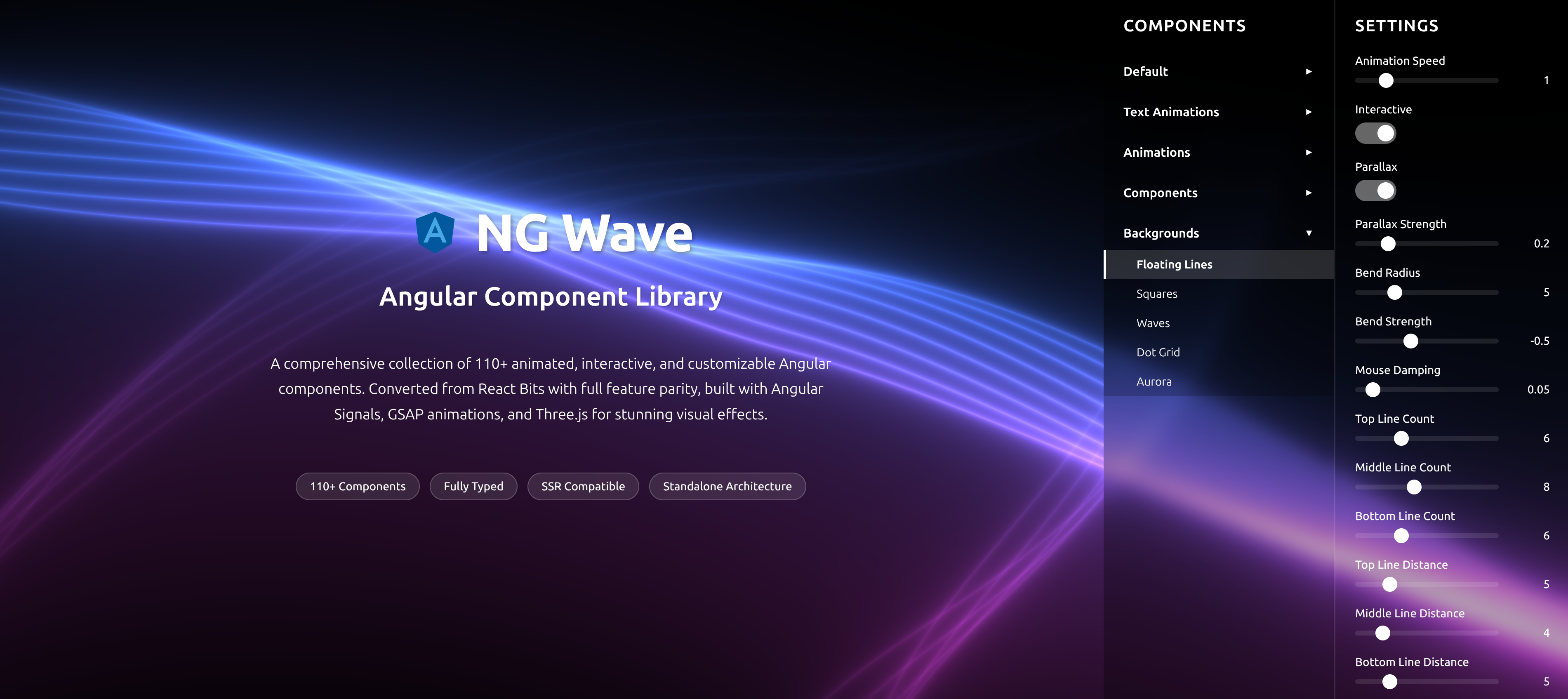
NG Wave
Angular Component Library
A comprehensive collection of 110+ animated, interactive, and customizable Angular components. Converted from React Bits with full feature parity, built with Angular Signals, GSAP animations, and Three.js for stunning visual effects.
Explore Components