Incremental Angular 20 Upgrades with Feature Flags: Ship Signals, SSR, and UI Refactors Without Breaking Prod
A practical playbook to decouple deploy from release in Angular 20+: typed flags, SignalStore, Firebase Remote Config, and CI-driven rollouts.
Ship on Fridays without fear: merge now, release when the metrics agree.Back to all posts
I’ve shipped Angular upgrades at a global entertainment company, a broadcast media network, a leading telecom provider, a major airline, an insurance technology company, and an enterprise IoT hardware company. The pattern that consistently saves releases—and reputations—is feature flags. With Angular 20+ (Signals, Vite, SSR hydration), flags let us merge early, learn quickly, and protect production.
Below is how I implement typed, SSR-safe flags with SignalStore, Firebase Remote Config, and CI guardrails—plus the exact directives, guards, and telemetry I use to make rollouts measurable and reversible.
The Friday dashboard that didn’t catch fire
As companies plan 2025 Angular roadmaps, Q1 is hiring season and pressure is high to adopt Angular 20+ features (Signals, Vite builder, SSR hydration) without regressions. Feature flags let you upgrade incrementally and prove each change with data before broad release.
A real scene from enterprise delivery
at a leading telecom provider, we pushed a PrimeNG upgrade and a new Highcharts module to a single market, Friday afternoon—because it was behind a flag. We monitored Core Web Vitals and error rates, then expanded to 10% by Monday.
at a major airline, kiosk offline flows for barcode scanners and printers were enabled per airport with a device cohort flag. If hardware simulation (Docker) showed risk, we flipped the flag off remotely—no redeploy needed.
Charter ads analytics with market-by-market rollout
United kiosks with offline hardware paths toggled per airport
a broadcast media network VPS scheduler features enabled per team
Why Angular 20 teams need feature flags
Without flags, upgrades become all-or-nothing events. With flags, they become controlled experiments that harden your system before full launch.
The stakes and the metrics
Flags decouple deploy from release, so you can merge Angular 20 updates early—while controlling exposure. You get measurable deltas: FID/INP changes, error rates, and session depth by cohort.
If you’re looking to hire an Angular developer or Angular consultant to lead the upgrade, insist on a flag-first plan with CI ownership and GA4/OpenTelemetry instrumentation.
Core Web Vitals and hydration time can regress with SSR changes
Signals/SignalStore migrations need cohort testing
UI library upgrades (Material/PrimeNG) risk accessibility regressions
Build a typed flag system with SignalStore (SSR-safe)
// feature-flags.model.ts
export type FeatureKey =
  | 'signalsStore'
  | 'viteSsrHydration'
  | 'primeNgDensityV2'
  | 'kioskOfflineFlow'
  | 'adsMarketRollout'
  | 'telemetryV2';

export interface FlagMeta {
  default: boolean;
  owner: string; // team or person
  description: string;
}

export const FLAG_REGISTRY: Record<FeatureKey, FlagMeta> = {
  signalsStore: { default: false, owner: 'platform', description: 'Enable SignalStore slices' },
  viteSsrHydration: { default: false, owner: 'platform', description: 'SSR + hydration via Vite' },
  primeNgDensityV2: { default: false, owner: 'design', description: 'New density + tokens' },
  kioskOfflineFlow: { default: true, owner: 'devices', description: 'Offline-first kiosk flows' },
  adsMarketRollout: { default: false, owner: 'ads', description: 'Enable new charts by market' },
  telemetryV2: { default: false, owner: 'ops', description: 'OTel event schema v2' },
};
// feature-flags.store.ts (Angular 20, @ngrx/signals)
import { Injectable, inject, TransferState, makeStateKey, effect, signal } from '@angular/core';
import { SignalStore, withState } from '@ngrx/signals';
import { FLAG_REGISTRY, FeatureKey } from './feature-flags.model';
import { RemoteConfig } from '@angular/fire/remote-config';
interface FlagsState { values: Record<FeatureKey, boolean>; loaded: boolean; }
const FLAG_SSR_KEY = makeStateKey<Record<FeatureKey, boolean>>('flags');
@Injectable({ providedIn: 'root' })
export class FeatureFlagsStore extends SignalStore(withState<FlagsState>({
values: Object.fromEntries(Object.entries(FLAG_REGISTRY).map(([k, v]) => [k, v.default])) as Record<FeatureKey, boolean>,
loaded: false,
})) {
private ts = inject(TransferState);
private rc = inject(RemoteConfig);
readonly isLoaded = this.select(s => s.loaded);
readonly get = (k: FeatureKey) => this.select(s => s.values[k]);
constructor() {
super();
const ssrSnapshot = this.ts.get(FLAG_SSR_KEY, null as any);
if (ssrSnapshot) {
this.patchState({ values: ssrSnapshot, loaded: true });
} else {
// Client: fetch remote config, then patch deterministically.
// map RC values to typed flags
fetchFlagsFromRemote(this.rc).then(remote => {
const merged = { ...this.state().values, ...remote } as Record<FeatureKey, boolean>;
this.patchState({ values: merged, loaded: true });
}).catch(() => this.patchState({ loaded: true }));
}
// Telemetry impression per flag once loaded
effect(() => {
if (this.isLoaded()) {
const v = this.state().values;
sendFlagImpressions(v); // GA4/Otel
}
});
}
}
async function fetchFlagsFromRemote(rc: RemoteConfig): Promise<Partial<Record<FeatureKey, boolean>>> {
// map rc.getBoolean('flag_key') by convention
return {
signalsStore: getBoolean(rc, 'signalsStore'),
viteSsrHydration: getBoolean(rc, 'viteSsrHydration'),
primeNgDensityV2: getBoolean(rc, 'primeNgDensityV2'),
kioskOfflineFlow: getBoolean(rc, 'kioskOfflineFlow'),
adsMarketRollout: getBoolean(rc, 'adsMarketRollout'),
telemetryV2: getBoolean(rc, 'telemetryV2'),
};
}// if-flag.directive.ts
import { Directive, Input, TemplateRef, ViewContainerRef, inject } from '@angular/core';
import { FeatureFlagsStore } from './feature-flags.store';
import { FeatureKey } from './feature-flags.model';
@Directive({ selector: '[ifFlag]' })
export class IfFlagDirective {
private tpl = inject(TemplateRef<any>);
private vcr = inject(ViewContainerRef);
private flags = inject(FeatureFlagsStore);
private hasView = false;
@Input({ required: true }) set ifFlag(key: FeatureKey) {
this.flags.get(key)(); // touch signal
this.flags.effect(() => {
const enabled = this.flags.get(key)();
if (enabled && !this.hasView) { this.vcr.createEmbeddedView(this.tpl); this.hasView = true; }
else if (!enabled && this.hasView) { this.vcr.clear(); this.hasView = false; }
});
}
}// route guard (Angular 20 standalone)
import { CanMatchFn } from '@angular/router';
import { inject } from '@angular/core';
import { FeatureFlagsStore } from './feature-flags.store';
export const featureFlagGuard = (key: FeatureKey): CanMatchFn => () => {
const flags = inject(FeatureFlagsStore);
return flags.get(key)(); // boolean signal
};<!-- Template usage -->
<button pButton *ifFlag="'primeNgDensityV2'" label="Try new density"></button>1) Define your registry
Start with a typed registry so every flag has an owner, default, and description.
Typed keys prevent typos and enable discoverability
Defaults allow server rendering without network calls
2) Implement FeatureFlagsStore
Use a SignalStore that sources remote config but renders deterministically on first paint.
SignalStore ensures reactive, testable flags
SSR via TransferState avoids hydration mismatches
3) Expose flags in templates and routes
Guard entire routes or hide UI affordances—same typed flags, same source of truth.
Structural directive for components
CanMatch guard for routes
Drive flags from CI with auditable history
# .github/workflows/flags-promote.yml
name: Promote Flags
on:
  workflow_dispatch:
    inputs:
      env:
        type: choice
        options: [staging, prod]
      flag:
        description: 'Feature key'
      value:
        description: 'true|false'
jobs:
  promote:
    runs-on: ubuntu-latest
    steps:
      - name: Set Firebase Remote Config
        env:
          GOOGLE_APPLICATION_CREDENTIALS: ${{ secrets.GCP_SA_JSON }}
          ENV: ${{ github.event.inputs.env }}
          FLAG: ${{ github.event.inputs.flag }}
          VALUE: ${{ github.event.inputs.value }}
        run: |
          echo "$GCP_SA_JSON" > sa.json
          gcloud auth activate-service-account --key-file=sa.json
          # Pseudo: call RC REST to set boolean
          curl -X PUT "https://firebaseremoteconfig.googleapis.com/v1/projects/$PROJECT/remoteConfig" \
            -H "Authorization: Bearer $(gcloud auth print-access-token)" \
            -H "Content-Type: application/json; charset=UTF-8" \
            -d @<(cat <<JSON
          { "parameters": { "$FLAG": { "defaultValue": { "value": "$VALUE" } } } }
          JSON
          )
GitHub Actions example
I prefer CI to own flag changes for regulated clients. Use a service account to update Firebase Remote Config as part of a release.
Promote flags on release branches
Audit who toggled what, when
Roll forward and back in seconds
This turns incident response into a configuration change, with full logs.
Flip a flag to revert behavior instantly
Code rollback becomes a plan B, not plan A
Instrumentation: A/B tests and UX metrics
// telemetry.ts
type FlagImpression = { key: FeatureKey; value: boolean; userRole?: string; tenant?: string };

export function sendFlagImpressions(values: Record<FeatureKey, boolean>) {
  Object.entries(values).forEach(([key, value]) => {
    gtag('event', 'flag_impression', { key, value }); // or OTel
  });
}- Measure: Core Web Vitals deltas (INP, CLS), hydration time, error rate per 1k sessions.
- Decide: expand flag when metrics are flat or improved for at least 24–48 hours.
Telemetry you should capture
At a broadcast media network VPS scheduling, we moved to typed event schemas so dashboards didn’t lie. In Angular, emit a structured event when a flag is read, then key UX metrics to the same cohort.
Flag impression per session
Conversion or success events
Error rates, retries, and INP/CLS deltas
Typed events example
Keep payloads small and typed to avoid cardinality explosions.
OpenTelemetry/GA4 friendly
Consistent across FE/BE
Real-world upgrade patterns I’ve used
Feature flags weren’t “nice-to-have”—they were the difference between smooth upgrades and late-night rollbacks.
Signals + SignalStore migration
At an insurance technology company telematics, we dual-wrote to NgRx and SignalStore for a sprint, then flipped reads by cohort. With flags, we could revert instantly if selectors misbehaved.
Gate new store behind 'signalsStore' flag
Run dual-write/dual-read during migration window
SSR hydration and Vite builder
At a cloud accounting platform dashboards, we enabled SSR page-by-page under a flag and watched hydration timing via Angular DevTools + Lighthouse. Expansion only happened when metrics beat SPA baselines.
Flag SSR path for sensitive pages
Track hydration time + error rate
UI library refinements (PrimeNG/Material)
Design could preview new density in production for internal roles while we ran visual tests in CI. No surprise regressions for customers.
Flag density tokens and component batches
Automate visual diffs per flag state
How an Angular Consultant Approaches Signals Migration with Flags
This is the fastest way to stabilize a chaotic codebase without freezing delivery—and why teams bring me in for Angular modernization.
The 5-step engagement
If you need a remote Angular developer with enterprise experience, I’ll set this up in your Nx monorepo, wire Firebase, and leave you with dashboards and runbooks your team can own.
1-week assessment with flag map
Pilot one high-value feature behind a flag
CI wiring + telemetry dashboards
Cohort rollout plan + guardrails
Knowledge transfer + flag retirement
When to Hire an Angular Developer for Legacy Rescue
I’ve rescued legacy JSP-to-Angular rewrites, AngularJS migrations, and zone.js-heavy apps by wrapping upgrades in typed flags, then peeling back risk one cohort at a time.
Clear triggers
Flags plus a disciplined rollout plan de-risk these moves. If your app jitters under load, or you’re dreading the upgrade, it’s time to talk to an Angular expert.
AngularJS/Angular 8–12 migration risk is blocking new features
SSR or Vite migration needs cohort testing
Hardware/peripheral flows need safe toggles
Tests, guardrails, and retiring flags
# Example: run e2e twice, toggling local flags
npx cypress run --env flags=primeNgDensityV2:on
npx cypress run --env flags=primeNgDensityV2:off
Cypress matrix runs
This catches edge cases before customers do.
At least one happy-path per critical flag ON/OFF
Record failures against flag state
Retirement discipline
Fewer flags = less cognitive load. Bake cleanup into your Definition of Done.
Delete flags within 2 sprints post-rollout
Keep live flags below 30 in prod
Key takeaways
- Decouple deploy from release: ship Angular 20 changes behind typed, testable flags.
- Use SignalStore for deterministic flags that work with SSR + hydration.
- Back flags with Firebase Remote Config (or similar) and cache via TransferState.
- Gate routes, components, and data fetches with structural directives and guards.
- Instrument flag impressions and outcomes with GA4/OpenTelemetry for objective go/no-go.
- Drive flag changes from CI (GitHub Actions/Azure DevOps) for auditable, reversible releases.
- Run canary-by-tenant, role, or market—no Friday fires, faster learn cycles.
Implementation checklist
- Define a typed flag registry with sensible defaults and owners.
- Implement a SignalStore-backed FeatureFlagsStore with SSR-safe hydration.
- Add an *ifFlag structural directive and a CanMatch guard.
- Wire Firebase Remote Config (or LaunchDarkly/ConfigCat) with TransferState cache.
- Instrument analytics for flag impressions, conversions, and UX metrics.
- Create a CI job to promote flags per environment and record change history.
- Write Cypress smoke tests per critical flag state (on/off).
- Roll out by cohort (role/tenant/market) and monitor error rates + Core Web Vitals.
- Retire stale flags quickly; keep < 30 live flags in production.
- Document rollback playbook: flip flags first, revert code second.
Questions we hear from teams
- How much does it cost to hire an Angular developer for a feature-flag rollout?
- Typical engagements start at 2–4 weeks for a pilot with typed flags, CI wiring, and telemetry. Budget ranges from $12k–$35k depending on scope and environments. I provide a fixed-fee discovery and a clear rollout plan before implementation.
- How long does an Angular 20 upgrade take with flags?
- For Angular 12–15 to 20, the average is 4–8 weeks including Signals/SignalStore adoption and SSR pilots—rolled out by cohort using flags. Canary to full rollout is driven by metrics, not calendar dates.
- Do feature flags impact performance or SEO for SSR?
- Done correctly with TransferState, flags render deterministically on the server and hydrate cleanly on the client. The overhead is negligible; the risk reduction and A/B clarity more than pay for it.
- What tools do you use to manage flags?
- Firebase Remote Config for speed and cost, or LaunchDarkly/ConfigCat for enterprise governance. Flags are surfaced via SignalStore, instrumented with GA4/OpenTelemetry, and promoted via GitHub Actions or Azure DevOps.
- What’s involved in a typical Angular engagement with you?
- Discovery call in 48 hours, assessment in 1 week, pilot flag within 2 weeks, and a cohort rollout plan. We use Nx, GitHub Actions/Jenkins, Firebase/AWS, and measurable goals—Core Web Vitals, error rates, and adoption KPIs.
Ready to level up your Angular experience?
Let AngularUX review your Signals roadmap, design system, or SSR deployment plan.
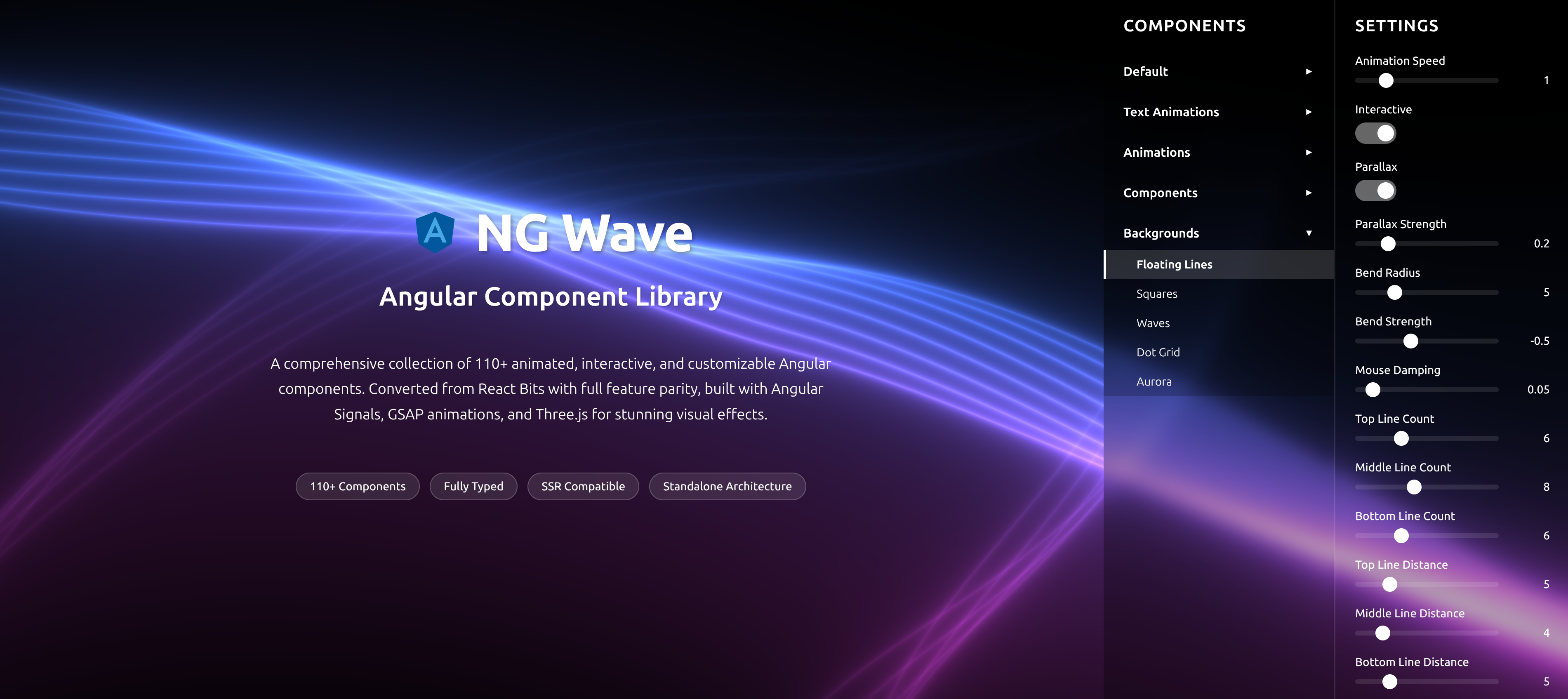
NG Wave
Angular Component Library
A comprehensive collection of 110+ animated, interactive, and customizable Angular components. Converted from React Bits with full feature parity, built with Angular Signals, GSAP animations, and Three.js for stunning visual effects.
Explore Components