Leading Offshore Angular Teams That Ship: Reviews, Rituals, Tests, and a Standard Architecture Playbook for Angular 20+
How I run distributed Angular teams across time zones—tight code reviews, pragmatic ceremonies, test strategy that scales, and an Nx-based architecture that makes quality repeatable.
Distributed doesn’t have to mean unpredictable—standardize architecture, automate reviews, and let the metrics steer.Back to all posts
When I pick up an offshore Angular team, the pattern is familiar: brilliant engineers, inconsistent output. The fix isn’t heroics—it’s a playbook that turns good developers into a reliable system. Below is how I’ve led distributed teams to ship fast without breaking production.
A late PR, KPIs, and a playbook
The scene
It’s 11:40pm in Seattle. A dashboard PR from the offshore team pings me—charts jitter, bundle size jumped 120 KB, and tests are red on Firefox. I’ve been here before on enterprise employee tracking, telecom analytics, and airport kiosks. The fix isn’t to work later. It’s process plus architecture that make good work inevitable.
What we instrument
As companies plan 2025 Angular roadmaps, offshore leadership wins or loses on these numbers. This article shows the exact review guardrails, ceremonies, test strategy, and Nx architecture I use to hit targets without micromanagement. Yes, it’s Angular 20+, Signals/SignalStore, PrimeNG, and Firebase where it helps—not buzzwords, just tools. And if you need to hire an Angular developer or Angular consultant to implement this playbook, I’m available.
PR cycle time
Change failure rate (rollbacks/hotfixes)
Flaky test rate
Lighthouse and a11y scores
CI minutes per PR
Why offshore Angular teams slip—and how to stop it
Common failure modes
Distributed teams multiply variance. Without a standard architecture and codified reviews, quality depends on who touched the code last. That’s not a scaling strategy.
Architecture drift across squads
Slow PRs with subjective feedback
Ceremonies that punish one time zone
E2E-heavy test suites that flake
Untracked regressions (a11y, bundle, hydration)
Principles that work
These principles stabilized a broadcast media VPS scheduler, a telecom advertising analytics portal, and an airline kiosk estate—with teams in India, Eastern Europe, and LATAM.
One standard architecture per org
Automate what humans forget
Async-first ceremonies with crisp artifacts
Small, testable increments with feature flags
Metrics-driven iteration, not debates
Standardizing architecture with Nx, SignalStore, and tokens
{
  "overrides": [
    {
      "files": ["*.ts"],
      "extends": ["plugin:@nx/typescript"],
      "rules": {
        "@nx/enforce-module-boundaries": [
          "error",
          {
            "enforceBuildableLibDependency": true,
            "allow": [],
            "depConstraints": [
              { "sourceTag": "type:app", "onlyDependOnLibsWithTags": ["type:ui", "type:domain", "type:shared"] },
              { "sourceTag": "type:domain", "onlyDependOnLibsWithTags": ["type:domain", "type:shared"] },
              { "sourceTag": "type:ui", "onlyDependOnLibsWithTags": ["type:ui", "type:shared"] }
            ]
          }
        ]
      }
    }
  ]
}
SignalStore baseline for state keeps components simple and predictable.
Workspace layout
Start with Nx and enforce boundaries so libraries don’t depend on apps and domains don’t depend on UI. This prevents the “everything imports everything” trap that kills reusability and testability.
apps/portal (shell, routes, guards)
libs/domain/* (entities, facades, stores)
libs/ui/* (PrimeNG components, styles, tokens)
libs/shared/* (utilities, interceptors, models)
Enforce boundaries with ESLint
I block merges if boundaries break:
SignalStore baseline: state and facade pattern
import { signal, computed, inject } from '@angular/core';
import { HttpClient } from '@angular/common/http';
import { toSignal } from '@angular/core/rxjs-interop';
import { retryBackoff } from 'backoff-rxjs';

export class EmployeesStore {
  private http = inject(HttpClient);
  private employees = signal<Employee[]>([]);
  private loading = signal(false);
  private error = signal<string | null>(null);

  count = computed(() => this.employees().length);
  list = computed(() => this.employees());
  isLoading = computed(() => this.loading());

  load() {
    this.loading.set(true);
    toSignal(
      this.http.get<Employee[]>('/api/employees').pipe(
        retryBackoff({ initialInterval: 500, maxRetries: 3 })
      ),
      { initialValue: [] }
    , { requireSync: true });

    this.http.get<Employee[]>('/api/employees').pipe(
      retryBackoff({ initialInterval: 500, maxRetries: 3 })
    ).subscribe({
      next: (res) => { this.employees.set(res); this.loading.set(false); },
      error: (e) => { this.error.set(String(e)); this.loading.set(false); }
    });
  }
}
Store per domain
Teams new to Signals need a reference. I provide a domain Store with typed actions/effects and a thin facade so components bind to signals without knowledge of implementation.
Selectors as computed signals
Effects via RxJS + toSignal
Co-locate API services with domain
Example store
Typed events and exponential retry belong in the store, not components.
Codifying code reviews for speed and safety
# PR Title

## Changes
-

## Screenshots / Video (mobile + desktop)

## Lighthouse & a11y
- Performance: __
- Accessibility: __ (target ≥ 95)

## Test Plan
- Unit: cases added/updated
- Component harness: added
- E2E: scenario

## Risks & Rollback
- Feature flag: yes/no
- Migration/DB impact:
# .github/workflows/ci.yml
name: CI
on: [pull_request]
jobs:
build-test:
runs-on: ubuntu-latest
strategy:
matrix: { browser: [chrome, firefox] }
steps:
- uses: actions/checkout@v4
- uses: actions/setup-node@v4
with: { node-version: 20 }
- run: npm ci
- run: npx nx run-many -t lint,test --parallel
- run: npx nx build portal --configuration=production
- run: npx lighthouse-ci https://localhost --budgets-path=./budgets.json
required:
needs: build-test
runs-on: ubuntu-latest
steps:
- run: echo "All checks passed"Two-tier reviewers
We assign two specialties per PR. Offshore devs know exactly who approves what; reviews go faster with fewer subjective surprises.
Domain reviewer: logic, data contracts
UI reviewer: a11y, tokens, responsiveness
PR template and required checks
Make the definition of done unskippable.
Sprint ceremonies that work across time zones
Async-first cadence
Offshore teams shouldn’t wait for a single time slot. We do written updates, plus 5–7 minute Loom demos before live sessions. The meeting becomes decision time, not status theater.
Standup: 3 bullets in Slack + blockers
Planning: stories pre-sized, demo videos recorded
Retro: data-first (metrics shared 24h earlier)
Board policies
These policies cut cycle time on a media network VPS scheduler by 42% and halved carryover work in two sprints.
Definition of Ready: API contract, mock, a11y notes
Definition of Done: tests, budget checks, docs
WIP limits to avoid spread-thin sprints
A test strategy that scales with offshore teams
# jest or karma coverage gate in CI
- run: npx nx test domain-employees --code-coverage
- run: npx nyc check-coverage --lines=80 --functions=80 --branches=75

# Cypress flake control
- run: npx cypress run --browser chrome --retries 2
For hardware-adjacent flows (kiosks, scanners, printers), we containerize device sims in CI to reproduce defects in minutes—used at a major airline to prevent field regressions.
The balanced pyramid
I’ve seen teams drown in flaky E2E suites. Keep E2E to sign-in, happy-path checkout, and one critical dashboard flow. Push complexity into harness tests with Angular Testbed + Material/PrimeNG test harnesses.
70% unit (fast, isolated)
20% component harness / integration
10% E2E critical paths
Flake control and coverage gates
Gate merges on coverage and flake rate. Store reports in GA4/Firebase Logs or DataDog so we can trend regressions over time.
Standardize UI with PrimeNG and design tokens
:root {
  --spacing-1: 4px;
  --spacing-2: 8px;
  --brand-primary: #3b82f6;
  --elevation-1: 0 1px 2px rgba(0,0,0,.08);
}

.p-button {
  border-radius: 6px;
  box-shadow: var(--elevation-1);
}

.app-section { padding: var(--spacing-2); }
Token-driven theming
Lock down a visual system so distributed teams don’t invent new spacing on every page.
Spacing, color, elevation tokens
PrimeNG + CSS variables
Dark mode baked in
Snippet
PrimeNG + tokens example:
Real outcomes from the field
Telecom advertising analytics
PR cycle time dropped from 2.3 days to 0.9 days. Accessibility went from 82 to 97. We shipped WebSocket-powered dashboards with typed schemas and zero hotfixes across two releases.
Nx + SignalStore + typed events
PR template + a11y budgets
Airport kiosks (Docker sims)
With Dockerized device simulation in CI, defect reproduction time fell 5x. The team shipped safely despite time zones because tests and sims ran on every PR.
Offline-tolerant flows
Device-state handling
Peripheral APIs
Employee tracking for a global entertainment company
We standardized on PrimeNG components, data-virtualized lists, and SignalStore slices. Bundle size fell 14%, Core Web Vitals improved, and on-call pages decreased by 38%.
Role-based views
Data virtualization
Bundle budgets
When to Hire an Angular Developer for Legacy Rescue
Signals you need help now
Legacy rescue benefits from a crisp playbook. I’ve migrated AngularJS/JSP to Angular 20, tightened TypeScript strictness, and delivered zero-downtime deployments with feature flags. If you need an Angular expert to stabilize while shipping, let’s talk.
AngularJS or Angular <14 with no tests
Zone.js leaks, change detection thrash
PRs >3 days with frequent rollbacks
How an Angular Consultant Approaches Offshore Leadership
First 7 days
Discovery, baseline metrics, and immediate guardrails.
Assess architecture and CI
Instrument metrics
Ship PR template + checks
Weeks 2–4
Incremental changes behind flags so production stays calm.
Refactor to Nx boundaries
Adopt SignalStore
Right-size the test pyramid
Ongoing
Keep momentum with data, not anecdotes.
Async ceremonies
Quarterly architecture review
Budget and a11y audits
Concise takeaways and next steps
What to instrument next
This is the heartbeat I watch on distributed teams. With an Nx baseline, SignalStore, codified reviews, and async ceremonies, offshore doesn’t mean off-course.
PR cycle time < 1 day
Change failure rate < 5%
Flaky test rate < 2%
Accessibility ≥ 95
Bundle size budgets enforced
Key takeaways
- Set a standard architecture with Nx, feature libraries, and a SignalStore pattern to prevent drift across offshore squads.
- Codify reviews with PR templates, automated checks, and a two-tier reviewer model to cut cycle time without risking quality.
- Run ceremonies async-first with shared artifacts (demo videos, Definition of Ready/Done) so time zones don’t block delivery.
- Adopt a layered test strategy: fast unit tests, component harness tests, API contract tests, and a slim E2E slice—tracked with flake metrics.
- Instrument everything: PR cycle time, change failure rate, flaky test rate, and accessibility scores. Optimize with data, not opinions.
Implementation checklist
- Create an Nx workspace with app shells and domain-driven libraries; enforce boundaries with @nx/eslint-plugin.
- Adopt a SignalStore baseline for state; publish a reference app shell with routing, auth, and role-based guards.
- Ship a PR template that requires screenshots, Lighthouse scores, and a test plan; block merges on failing checks.
- Run async-first ceremonies: written updates + 5–7 minute demo videos before live review to protect time zones.
- Define a sprint testing budget: 70% unit, 20% component, 10% E2E; measure flake rate weekly.
- Enable pre-commit lint, format, and unit tests; gate PR merges with GitHub Actions matrix and bundle budgets.
- Standardize UI/UX with PrimeNG + tokens; commit a theming guide and Storybook with accessibility notes.
- Track delivery metrics: PR cycle time (<1 day), change failure rate (<5%), and accessibility score (≥95).
Questions we hear from teams
- How much does it cost to hire an Angular developer for offshore leadership?
- Engagements start with a fixed assessment, then weekly rates for implementation. Typical rescue or rollout runs 4–8 weeks. I’ll scope in a 30‑minute call and provide a clear, capped plan.
- What does an Angular consultant do for a distributed team?
- I set the architecture (Nx + SignalStore), codify reviews, right‑size tests, and tune CI/CD. I also run async ceremonies, define budgets, and instrument metrics so your offshore team ships predictably.
- How long does an Angular upgrade or stabilization take?
- Rescues land in 2–4 weeks; full upgrades (e.g., Angular 14→20) in 4–8 weeks with feature flags and zero‑downtime deploys. Timelines depend on test coverage and external dependencies.
- Do you work with our existing CI/CD and cloud?
- Yes. I’ve shipped on GitHub Actions, Jenkins, Azure DevOps, AWS, Azure, GCP, and Firebase. I bring guardrails—bundle budgets, a11y checks, and flake control—without disrupting your pipeline.
- Can you provide references or live products?
- See gitPlumbers (70% delivery velocity increase, 99.98% uptime), IntegrityLens (12k+ interviews), and SageStepper (+28% score lift across 320 communities). Live demos available.
Ready to level up your Angular experience?
Let AngularUX review your Signals roadmap, design system, or SSR deployment plan.
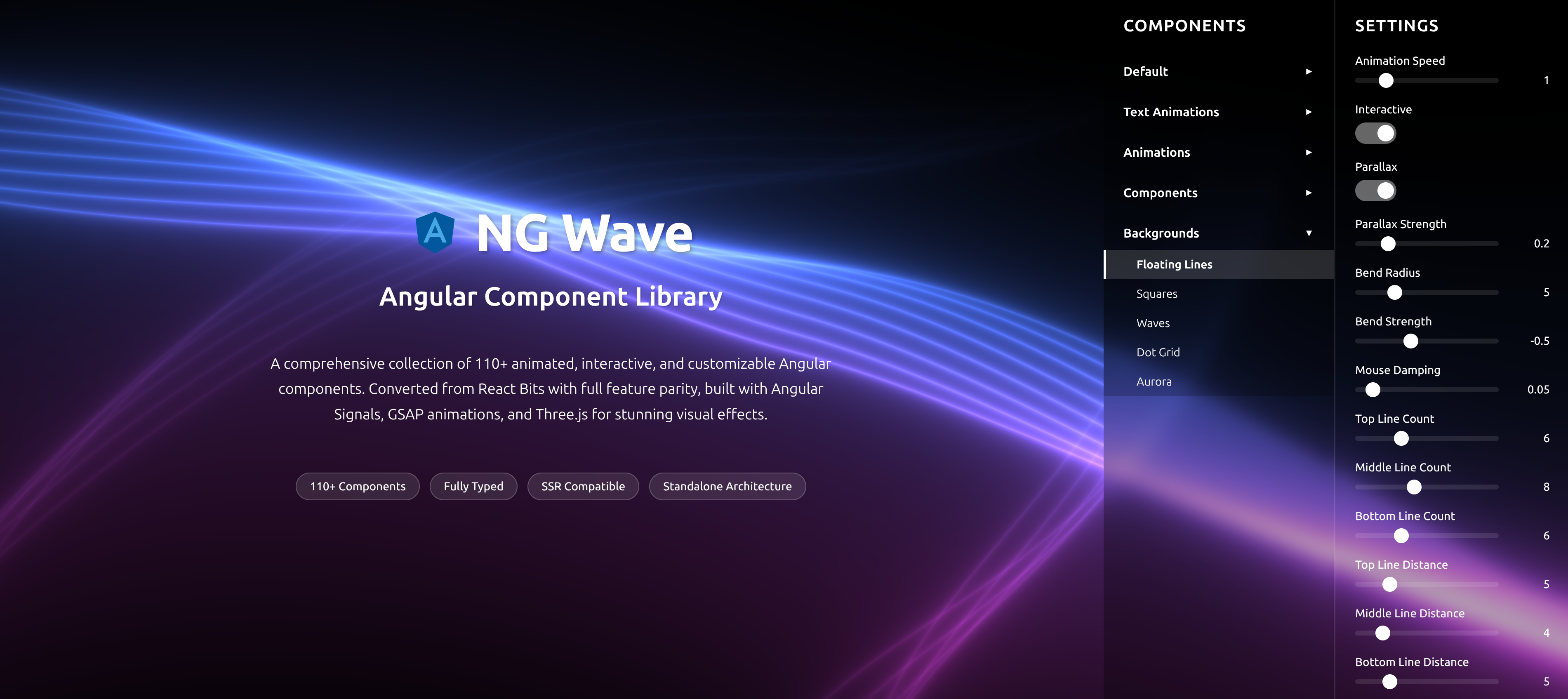
NG Wave
Angular Component Library
A comprehensive collection of 110+ animated, interactive, and customizable Angular components. Converted from React Bits with full feature parity, built with Angular Signals, GSAP animations, and Three.js for stunning visual effects.
Explore Components