Plan and Execute Zero‑Downtime Angular 10–15 ➜ 20 Upgrades: Deprecations Map, Test Matrix, and One‑Command Rollbacks
A field‑tested upgrade plan for Angular 20: map deprecations, lock a test matrix, ship canaries, and roll back in seconds—without pausing delivery.
Upgrades should be boring. If your rollback is faster than your incident bridge, you’re ready.Back to all posts
I’ve shipped Angular upgrades that couldn’t blink—a global entertainment company employee tracking during payroll cutoffs, United’s airport kiosks running offline with Docker-simulated hardware, and Charter’s ad analytics where a jitter meant real dollars. Zero downtime isn’t a slogan; it’s a plan you practice.
As companies plan 2025 Angular roadmaps, the jump from 10–15 to 20 is where good teams make avoidable mistakes: missing deprecations, flakey SSR hydration, and untested rollbacks. Here’s the playbook I use as a remote Angular consultant and the guardrails that keep release nights boring.
A Real‑World Hook: Upgrade Like a Feature, Not a Fire Drill
Ship the upgrade behind flags, validate with a canary, and keep a rollback that’s faster than an incident bridge.
Scene from the field
On a broadcast media network’s VPS scheduler, we shipped a major Angular upgrade the week before pilot season. Our rule: treat the upgrade like a feature with acceptance criteria, UX metrics, and a rollback button. That mindset took us from risky weekend cutovers to mid‑day deploys with sub‑minute rollbacks.
Why this matters now
Angular 20 expects modern builders (Vite), SSR hydration, and RxJS 7 conformance.
Your UI libraries (Material/PrimeNG) and test rigs often lag; don’t let them drive the timeline.
Execs care about risk. A rehearsed rollback and clear metrics reduces upgrade fear.
Plan the Upgrade: Inventory and Branch Strategy
If you’re in an Nx monorepo, scope work to affected apps and keep delivery moving.
Create the upgrade inventory
Freeze third‑party versions during the upgrade. Capture your current state in a doc and pin everything in package.json.
Angular CLI/Core target and current
RxJS, TypeScript, Node runtime (Node 18/20 for Angular 20)
Material/PrimeNG versions and theme tokens
Nx version and generators
SSR usage (provideClientHydration, TransferState)
Test stack (Karma/Jasmine ➜ Jest/Vitest/Playwright)
Branch per major step
Big clients (e.g., an insurance technology company telematics) kept delivering while we advanced an upgrade branch per major and flipped flags only when metrics were green.
10 ➜ 11 ➜ … ➜ 15 ➜ 20 in separate branches if you have heavy legacy APIs.
Small app or green CI? You can jump farther, but stepwise branches isolate risk.
Keep main shipping; upgrade branches merge back via feature flags.
Map Deprecations and Run Migrations with Guardrails
# Nx-based workspace
npx nx migrate @angular/core@20 @angular/cli@20
pnpm install  # or npm/yarn
npx nx migrate --run-migrations

# Non-Nx
ng update @angular/cli@20 @angular/core@20 --allow-dirty=false

# Material/PrimeNG after Angular core
ng update @angular/material@20
pnpm add primeng@^17 primeicons@latest  # match Angular 20 peer range

# RxJS 7+ if not already
ng update rxjs@7
Key deprecations to plan for:
- Standalone APIs: You can keep NgModules, but move providers to provideX() and adopt inject() gradually.
- Vite builder: Webpack builders are replaced; expect faster builds and slightly different env handling.
- SSR hydration: Switch to provideClientHydration() and ensure stable initial states for deterministic hydration.
- Router changes: Prefer functional guards/resolvers; audit initialNavigation and scrollPositionRestoration.
- HttpClient events: Ensure typed responses and interceptors are compatible; fix deprecated options.
- Material MDC + tokens: Align density/typography tokens; PrimeNG themes may need remap for AA.
- RxJS 7: audit toPromise removals, scheduler differences, and stricter typings.
Run official migrations
Use the toolchain to do the heavy lifting, then commit after each migration.
Commands I actually run
Test Matrix That Prevents Midnight Rollbacks
// app.config.ts
import { ApplicationConfig, isDevMode } from '@angular/core';
import { provideRouter } from '@angular/router';
import { provideHttpClient } from '@angular/common/http';
import { provideClientHydration } from '@angular/platform-browser';
import { routes } from './app.routes';
import { remoteFlag } from './flags'; // your Firebase Remote Config or env-backed flag

export const appConfig: ApplicationConfig = {
  providers: [
    provideRouter(routes),
    provideHttpClient(),
    ...(remoteFlag('enableHydration') ? [provideClientHydration()] : [])
  ],
};
This lets you roll the hydration switch separately from the Angular upgrade—vital when SSR bugs appear only under real traffic.
Deterministic SSR hydration tests
Assert identical DOM before/after hydration.
Control time and network; no randoms in initial render.
Use feature flags to toggle SSR path in tests.
Unit + component + e2e layers
Unit: strict TS and observable marble tests.
Component: render tests for tokens/density changes (Material/PrimeNG).
E2E: Playwright or Cypress against a canary URL with WebSocket/REST fixtures.
Example hydration guard
CI/CD Pipeline: Canaries, Health Checks, and a Real Rollback
name: ci-upgrade
on:
  push:
    branches: ["upgrade/angular20", "main"]

jobs:
  build-test:
    runs-on: ubuntu-latest
    strategy:
      matrix:
        node: [20]
    steps:
      - uses: actions/checkout@v4
      - uses: pnpm/action-setup@v3
        with: { version: 9 }
      - uses: actions/setup-node@v4
        with:
          node-version: ${{ matrix.node }}
          cache: 'pnpm'
      - run: pnpm install --frozen-lockfile
      - run: pnpm nx affected -t lint,test,build --parallel=3
      - run: pnpm nx run app:e2e --configuration=canary
      - name: Upload artifact
        uses: actions/upload-artifact@v4
        with:
          name: web-dist
          path: dist/apps/app

  deploy-canary:
    needs: build-test
    runs-on: ubuntu-latest
    steps:
      - uses: actions/download-artifact@v4
        with: { name: web-dist, path: dist/apps/app }
      - uses: FirebaseExtended/action-hosting-deploy@v0
        with:
          repoToken: '${{ secrets.GITHUB_TOKEN }}'
          firebaseServiceAccount: '${{ secrets.FIREBASE_SERVICE_ACCOUNT }}'
          channelId: canary
          projectId: my-firebase-project
          entryPoint: ./

  promote-prod:
    if: github.ref == 'refs/heads/main'
    needs: deploy-canary
    runs-on: ubuntu-latest
    steps:
      - name: Promote canary to prod after manual approval
        uses: FirebaseExtended/action-hosting-deploy@v0
        with:
          repoToken: '${{ secrets.GITHUB_TOKEN }}'
          firebaseServiceAccount: '${{ secrets.FIREBASE_SERVICE_ACCOUNT }}'
          channelId: live
          projectId: my-firebase-project
          entryPoint: ./
Rollback script (keep it next to your runbook):
#!/usr/bin/env bash
set -euo pipefail
# Roll back Firebase Hosting to a previously known-good version id
# You can capture version ids in a release artifact or query the API
GOOD_VERSION="$1" # e.g., 1234567890
SITE="my-firebase-site"

# Clone the old version to live instantly
firebase hosting:clone ${SITE}:versions/${GOOD_VERSION} ${SITE}:live --force

# Optional: flip hydration flag off if SSR contributed to the issue
firebase remoteconfig:versions:list # or call your config service
# then set enableHydration=false via API
If you’re on AWS, do blue‑green with two S3 buckets/CloudFront origins and a Lambda@Edge switch, or on Kubernetes use two versions behind a Service and flip weights. The principle is the same: promotion is a pointer move, and rollback is a pointer reset.
Guardrails in CI
Matrix Node 18/20 until you lock Node 20.
Nx affected to keep pipelines fast.
Block merge on SSR hydration smoke and visual diffs.
GitHub Actions blueprint
Rollback you can run half-asleep
On United’s kiosks, we never shipped without a rollback that ops could run from a runbook. Same rule here.
Keep a registry of released artifacts/versions.
Automate rollback to a known-good build.
Rehearse on staging with traffic replay.
Handling UI Libraries Without UX Regression
No one wants an upgrade that feels different. Guard tokens, run visual diffs, and keep AA intact.
Material + PrimeNG
at a leading telecom provider’s ads analytics, density changes doubled visible rows without breaking AA. Lock tokens early, screenshot diff the rest.
Audit tokens: density, typography, color; map to design tokens.
Visual regression tests for critical journeys.
Upgrade UI libraries after core; fix AA early.
Accessibility budget
Polish matters—recruiters notice the finish.
Use axe in CI; block regressions.
Screen reader smoke on most used flows.
Focus management after hydration.
When to Hire an Angular Developer for Legacy Rescue
If the mandate is “don’t break production,” bring someone who has broken it in staging enough times to know how not to.
Bring in help when
I’ve rescued AngularJS ➜ Angular rewrites, zone.js melt‑downs, and JSP ➜ Angular migrations. The pattern is always the same: stabilize, measure, then ship.
Your app spans Angular 10–14 with custom builders or brittle SSR.
You rely on kiosk/offline flows or hardware integration (card/printer/scanner).
You can’t freeze delivery; you need upgrade + features in parallel.
What I deliver fast
Looking to hire an Angular expert? I’m a remote Angular consultant who’s done this at a global entertainment company, United, a broadcast media network, an insurance technology company, an enterprise IoT hardware company, and a cloud accounting platform.
Assessment in 5 business days with a deprecations map.
CI pipeline with canary + rollback within 1 week.
First production cut with feature flags in 2–4 weeks depending on scope.
Example Upgrade Path with Nx and Feature Flags
Feature flags via Firebase Remote Config or a thin Node/.NET config service keep risky toggles independent of deploys.
Week 1: Prep and migrations
Pin deps, snapshot bundle/Perf budgets, run Nx/Angular migrations.
Stand up canary channel and SSR smoke tests.
Flag-gate hydration and any Material density changes.
Week 2–3: Refactors and test hardening
Fix RxJS 7 breaks; replace toPromise with firstValueFrom.
Move to provideHttpClient/provideRouter; keep NgModules if needed.
Replace brittle guards with functional versions; add data/test ids for visual diffs.
Week 4+: Canary, promote, and rehearse rollback
At a broadcast media network, this pattern cut upgrade cycle time by 40% and kept error rates flat during promotion.
Ship canary to 5–10% traffic, validate metrics (GA4, Sentry, OpenTelemetry).
Promote with a pointer move; keep artifacts.
Run the rollback once post‑go‑live to prove it.
Measure Success: What to Instrument Next
Tie every recommendation to a measurable outcome or it won’t stick with stakeholders.
Metrics that matter
Use Angular DevTools and Lighthouse locally; ship GA4 custom metrics and Sentry traces to see real user deltas.
Build time (expect 20–40% faster with Vite builder).
LCP/CLS (watch post‑upgrade deltas).
Hydration time and client errors (% of sessions).
Defect reproduction time via telemetry breadcrumbs.
From here to Signals
I’ve moved large apps (e.g., IntegrityLens’ verification flows) to Signals after lock‑in, saving 100+ hours per role with fewer state bugs. One step at a time.
Adopt Signals/SignalStore after stability, not during the upgrade.
Add typed RxJS→Signal adapters only when tests are deterministic.
Key takeaways
- Treat upgrades as product features: plan, gate, and measure.
- Run Nx/CLI migrations incrementally and freeze third‑party versions while you refactor deprecations.
- Adopt a deterministic test matrix: unit, SSR hydration, e2e with canary targets, and visual diffing.
- Deploy behind feature flags and canary channels; keep a ready rollback script with tested artifacts.
- Instrument real metrics: build time, LCP/CLS, error rates, and rollout health.
- Practice the rollback: automate it and rehearse before production.
Implementation checklist
- Capture inventory: Angular, RxJS, TS, Material/PrimeNG, Node, CI runners.
- Pin versions; run ng update/Nx migrate per major step with a branch per step.
- Enable strict TypeScript in CI (at least --noImplicitAny and --strictNullChecks).
- Refactor deprecations (HttpClient events, Router opts, material tokens) behind toggles.
- Stand up SSR hydration smoke tests; gate SSR switches via feature flags.
- Deploy to a canary channel; compare GA4/Sentry error rates before 100% traffic.
- Maintain an artifact registry for instant rollbacks.
- Document and rehearse rollback in staging with real traffic replay.
Questions we hear from teams
- How long does an Angular 10–15 to 20 upgrade take?
- For a medium app, plan 4–8 weeks: 1 for assessment/migrations, 2–3 for refactors and tests, and 1–2 for canary and promotion. Complex monorepos or SSR-heavy apps may span a quarter—still shipping features in parallel.
- What does zero‑downtime mean for Angular upgrades?
- Users never see an outage or broken flow. We deploy to a canary, compare telemetry, then promote via a pointer switch. A scripted rollback returns the prior version in seconds without a redeploy.
- Do we need to migrate to Signals during the upgrade?
- No. Keep zone.js and your current state management to reduce risk. Migrate to Signals/SignalStore after Angular 20 is stable under real traffic and tests are deterministic.
- Which CI/CD tools work best?
- I’ve shipped this with GitHub Actions, Jenkins, and Azure DevOps. The must‑haves are: artifact registry, environment promotion, visibility on GA4/Sentry, and a one‑command rollback tested in staging.
- How much does it cost to hire an Angular developer for this work?
- Engagements vary by scope. Typical ranges: 2–4 weeks for rescue assessments and pipelines, 4–8 weeks for full upgrades. I offer fixed‑fee assessments and sprint‑based delivery for upgrades—book a discovery call within 48 hours.
Ready to level up your Angular experience?
Let AngularUX review your Signals roadmap, design system, or SSR deployment plan.
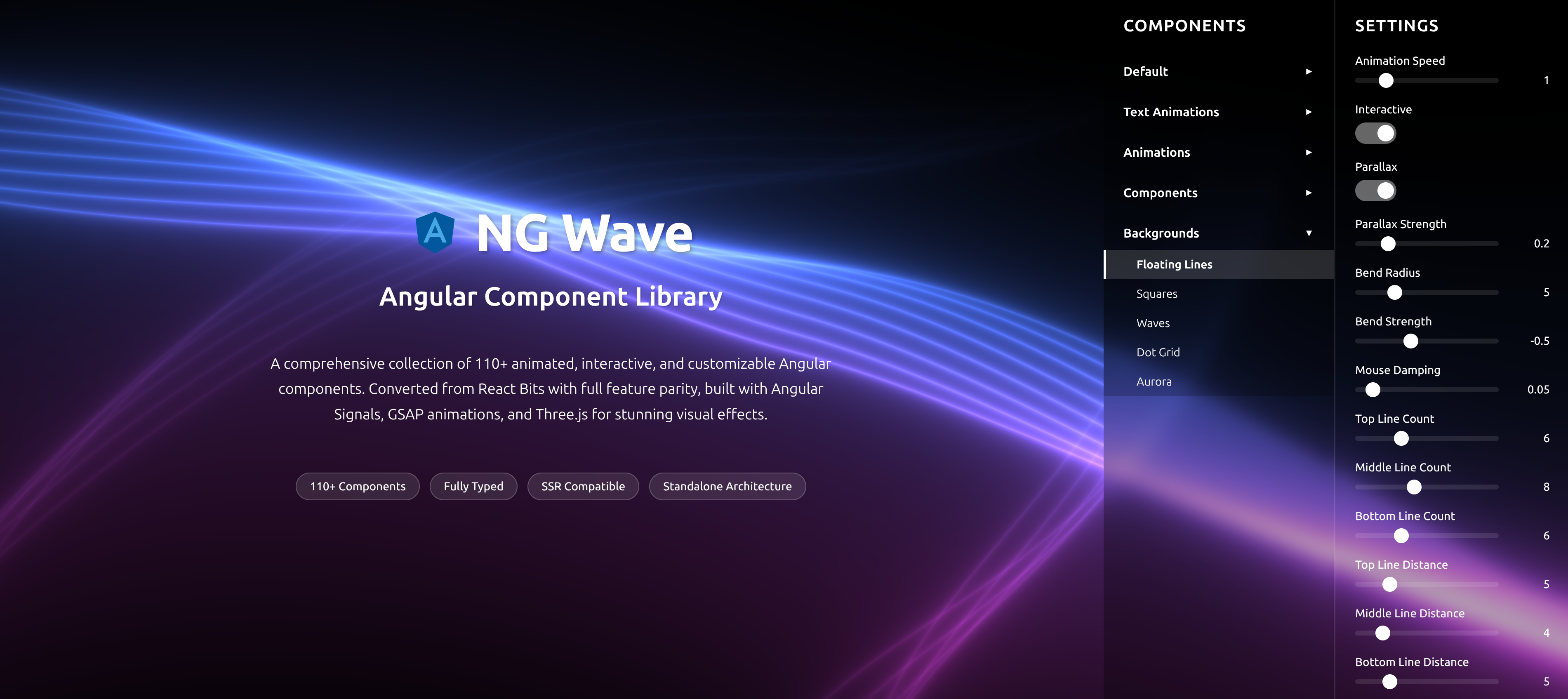
NG Wave
Angular Component Library
A comprehensive collection of 110+ animated, interactive, and customizable Angular components. Converted from React Bits with full feature parity, built with Angular Signals, GSAP animations, and Three.js for stunning visual effects.
Explore Components