Premium Motion in Angular 20+: Animation Timelines, Easing Curves, and prefers-reduced-motion Fallbacks You Can Ship
A field-tested motion system for Angular 20+ dashboards—durations, easing, tokens, and accessible fallbacks—built to feel premium without blowing performance budgets.
Motion isn’t decoration—it’s a contract with your user’s attention. Make it fast, consistent, and accessible, or don’t ship it.Back to all posts
I’ve shipped motion systems into high-traffic Angular dashboards and kiosk flows where jitter gets you paged. From airline kiosks that need tactile, offline-tolerant feedback to ads analytics charts that stream via WebSockets, premium motion is about restraint, consistency, and accessibility—not fireworks. Here’s how I implement timelines, easing, and prefers-reduced-motion in Angular 20+ with Signals and tokens you can measure in CI.
As companies plan 2025 Angular roadmaps, teams ask me to make their UI feel premium without tanking performance. If you’re looking to hire an Angular expert for motion polish, this is the exact system I bring into PrimeNG/Material apps in Nx monorepos with Firebase telemetry.
Premium Motion That Doesn’t Jitter: A Front-Line View
Where motion pays for itself
In a telecom ads dashboard I built, card expand/collapse jittered during live WebSocket updates. We tuned durations to 160ms and moved from box-shadow animation to opacity + transform. Jank disappeared, and user task time dropped 12% measured in GA4.
Reduce cognitive load during state changes
Guide attention in data-dense dashboards
Signal system reliability via consistent easing
Angular 20+ stack I use for motion
The motion system below plugs into this stack. If you need an Angular consultant to integrate it into a legacy codebase, I’ve done this mid-flight without downtime.
Angular 20 + Signals/SignalStore
PrimeNG + custom tokens
Nx for scale and CI
Firebase Performance traces
Angular DevTools + Lighthouse
Why Angular 20+ Dashboards Need Intentional Motion and Accessible Fallbacks
Motion is semantic, not decorative
When your telematics map updates or a schedule row moves, motion affirms the what and where. Done right, it’s invisible; done wrong, it’s nausea.
Status change
Hierarchy shift
System continuity
Accessibility requirements
We ship to regulated environments (finance/healthcare). Animation must pass audits: visible focus, no motion-only feedback, and a clear reduced-motion path.
Respect prefers-reduced-motion
Maintain focus visibility during transitions
Keep AA contrast while animating
Build a Reusable Motion System in Angular: Tokens, Easing Curves, and Signals
/* tokens.motion.scss */
:root {
  /* Durations */
  --ax-motion-quick: 120ms;
  --ax-motion-standard: 160ms;
  --ax-motion-emphasized: 240ms;
  --ax-motion-sequence: 320ms;

  /* Easing */
  --ax-ease-standard: cubic-bezier(0.2, 0, 0, 1);
  --ax-ease-emphasized: cubic-bezier(0.2, 0, 0, 1);
  --ax-ease-in: cubic-bezier(0.4, 0, 1, 1);
  --ax-ease-out: cubic-bezier(0, 0, 0.2, 1);

  /* Color palette (AngularUX) */
  --ax-surface-0: #0f1216;
  --ax-surface-1: #171b22;
  --ax-brand-500: #4b8cff;
  --ax-accent-500: #7ce3a1;
  --ax-text-0: #e9eef5;
}

/* Density pairing: adjust motion slightly with density */
html[data-density="compact"] {
  --ax-motion-standard: 140ms;
}
// motion-pref.service.ts (Angular 20, Signals)
import { Injectable, effect, signal, computed, inject } from '@angular/core';
@Injectable({ providedIn: 'root' })
export class MotionPrefService {
private reduced = signal<boolean>(false);
private userOverride = signal<boolean | null>(null); // null = follow system
constructor() {
const mq = window.matchMedia('(prefers-reduced-motion: reduce)');
const apply = () => this.reduced.set(mq.matches);
apply();
mq.addEventListener('change', apply);
}
readonly reduceMotion = computed(() => {
const u = this.userOverride();
return u === null ? this.reduced() : u;
});
setUserPreference(reduce: boolean | null) {
this.userOverride.set(reduce);
}
// Derived durations using tokens as defaults
readonly durations = {
quick: computed(() => this.reduceMotion() ? 0 : 120),
standard: computed(() => this.reduceMotion() ? 0 : 160),
emphasized: computed(() => this.reduceMotion() ? 80 : 240),
};
}// card.component.ts - apply durations via Angular animations
import { Component, signal } from '@angular/core';
import { trigger, state, style, transition, animate } from '@angular/animations';
import { MotionPrefService } from './motion-pref.service';
@Component({
selector: 'ax-card',
templateUrl: './card.component.html',
styleUrls: ['./card.component.scss'],
animations: [
trigger('expand', [
state('collapsed', style({ height: '*', transform: 'scale(1)', opacity: 0.96 })),
state('expanded', style({ height: '*', transform: 'scale(1)', opacity: 1 })),
transition('collapsed <=> expanded', [
animate('{{ms}}ms cubic-bezier(0,0,0.2,1)')
], { params: { ms: 160 } })
])
]
})
export class CardComponent {
open = signal(false);
ms = this.motion.durations.standard; // signal<number>
constructor(private motion: MotionPrefService) {}
}<!-- card.component.html -->
<section [@expand]="open() ? 'expanded' : 'collapsed'" [@expand].params="{ ms: ms() }" class="ax-card">
<header>
<button type="button" (click)="open.set(!open())">Toggle</button>
</header>
<div class="body">
<ng-content></ng-content>
</div>
</section>/* card.component.scss */
.ax-card {
background: var(--ax-surface-1);
color: var(--ax-text-0);
border-radius: 12px;
box-shadow: 0 1px 2px rgba(0,0,0,0.2);
}
.ax-card .body {
transition: opacity var(--ax-motion-standard) var(--ax-ease-out),
transform var(--ax-motion-standard) var(--ax-ease-out);
will-change: transform, opacity;
}1) Define motion tokens (SCSS/CSS variables)
Centralize durations and easing so your timeline is consistent across PrimeNG, Material, and custom components.
2) Wire prefers-reduced-motion with Signals
Expose a signal for reduced motion and compute durations based on user/system preferences.
3) Apply tokens in CSS transitions and Angular animations
Use GPU-friendly transforms. For Angular animations, keep params flexible and read from a central service.
4) Integrate with density controls
Higher density increases perceptual speed; pair tighter spacing with slightly shorter durations.
prefers-reduced-motion: Cut the Motion, Keep the Meaning
/* Global reduced-motion override */
@media (prefers-reduced-motion: reduce) {
  * {
    animation-duration: 0.001ms !important;
    animation-iteration-count: 1 !important;
    transition-duration: 0.001ms !important;
    scroll-behavior: auto !important;
  }
}
// example of disabling chart animations in reduced motion
import Highcharts from 'highcharts';
import { inject } from '@angular/core';
import { MotionPrefService } from './motion-pref.service';
export function chartOptions(): Highcharts.Options {
const motion = inject(MotionPrefService);
const noAnim = motion.reduceMotion();
return {
chart: { animation: !noAnim },
plotOptions: { series: { animation: { duration: noAnim ? 0 : 200 } } },
};
}Respect system setting and provide an app toggle
I ship both: system detection and a user-accessible toggle. In kiosks, we force reduced motion for certain flows to avoid vestibular triggers.
Follow system by default
User override for accessibility
Persist in localStorage if needed
Use opacity and instant state changes
If reduced motion is on, use opacity-only transitions or hard state swaps. Keep focus rings visible and stable.
No parallax
No large scale transforms
Short opacity ramps only
Timeline Patterns: Stagger, Enter/Exit, and Skeletal Loading
// example stagger using Angular animations
import { trigger, transition, query, style, stagger, animate } from '@angular/animations';

export const listStagger = trigger('listStagger', [
  transition(':enter', [
    query(':enter', [
      style({ opacity: 0, transform: 'translateY(6px)' }),
      stagger(30, [
        animate('160ms cubic-bezier(0,0,0.2,1)',
          style({ opacity: 1, transform: 'translateY(0)' }))
      ])
    ], { optional: true })
  ])
]);
Stagger lists without jank
Data-virtualized tables (Material CDK/PrimeNG) should animate only visible rows. IntersectionObserver + virtualization avoids animating items you’ll recycle anyway.
Use transform/opacity
Stagger 20–40ms per item
Cap total at ~240ms
Enter/exit transitions
For role-based dashboards, keep enter/exit consistent so switching tenants doesn’t feel erratic.
Enter: ease-out
Exit: ease-in
Match durations across components
Skeletal loading
In a broadcast VPS scheduler, we faded shimmer on reduced motion and fixed a 30% CPU spike by switching to a CSS gradient rather than JS timers.
Fade shimmer if reduced motion
Keep shimmer under 160ms cycle
Stop when real data arrives
Real-World Visualizations Without Jank: D3, Highcharts, and Canvas
// Canvas timeline pattern
let last = performance.now();
function tick(now: number) {
  const dt = Math.min(32, now - last); // clamp
  last = now;
  // update positions with dt-based easing
  requestAnimationFrame(tick);
}
requestAnimationFrame(tick);
D3 transitions
In telematics dashboards, we constrain D3 transitions to opacity/transform. Anything layout-based (x/y attributes that relayout) is throttled or removed.
Use requestAnimationFrame
Batch style changes
Avoid layout-triggering props
Highcharts in Angular
For 100k points, enable Highcharts boost. We cap animation at 200ms and skip on reduced motion.
Disable motion for large datasets
Use boost/canvas modes
Respect reduced motion
Canvas/Three.js
Airport kiosk 3D boarding flows used RAF with deltas; we paused scenes when tabs were hidden, saving battery and heat in the field.
RAF-driven timelines
Time-based deltas, not frames
Pause offscreen
Performance Budgets for Motion: 60fps, Memory, and Telemetry
// Firebase Performance trace around an interaction
import { getPerformance, trace } from 'firebase/performance';
const perf = getPerformance();
const t = trace(perf, 'card_expand_anim');
t.start();
// ... start animation
requestAnimationFrame(() => {
  // stop after next frame or on transitionend
  t.stop();
});
# CI snippet (GitHub Actions) asserting web vitals
- name: Lighthouse CI
run: |
lhci autorun --config=./lighthouserc.json// lighthouserc.json excerpt
{
"assert": {
"assertions": {
"categories:performance": ["error", {"minScore": 0.9}],
"max-potential-fid": ["warn", {"threshold": 200}],
"cumulative-layout-shift": ["error", {"maxNumericValue": 0.1}]
}
}
}Budgets
We audit with Chrome Performance and Angular DevTools flame charts. Long tasks during motion are a smell—defer data work outside the animation window.
Frame time < 16.7ms
Animation <= 320ms (sequences)
No layout thrash during animations
Firebase traces for motion
In IntegrityLens (an AI-powered verification system), traces caught a regress when a dialog added blur. We replaced it with a subtle overlay and saved 18ms per frame.
Trace critical interactions
Compare reduced vs standard
Alert on regressions
CI guardrails
Motion should never blow Core Web Vitals. We budget CLS < 0.1 and check INP p75.
Lighthouse budgets
CLS/INP thresholds
Block on regression
PrimeNG, Typography, Density Controls, and the AngularUX Palette
/* PrimeNG + palette alignment */
.p-dialog .p-dialog-content {
  transition: transform var(--ax-motion-standard) var(--ax-ease-out),
              opacity var(--ax-motion-standard) var(--ax-ease-out);
}

:root[data-theme='dark'] {
  --ax-surface-0: #0f1216;
  --ax-surface-1: #171b22;
  --ax-brand-500: #4b8cff; /* meets AA on surface-1 */
}
PrimeNG integration
PrimeNG panels/dialogs pick up tokenized durations/easing. Favor translateY/opacity over box-shadow animation.
Override with CSS vars
Disable heavy shadows
Consistent panel/drawer motion
Typography + color
AngularUX palette values above keep contrast stable across animated states. Keep line-height static during transitions to prevent layout jumps.
AA contrast during motion
Readable at 90–110% zoom
Stabilize line-height
Density controls
In media scheduling UIs, compact density paired with 140ms transitions made the grid feel snappier without feeling rushed.
Compact/comfortable modes
Motion shortens with compact
Expose user setting
When to Hire an Angular Developer for Legacy Rescue
- Stabilize your Angular codebase with measurable motion improvements: https://gitplumbers.com/
Signals that motion needs an expert
I fix these quickly: replace layout animations, unify tokens, instrument traces, and gate heavy effects. See how I stabilize chaotic code at gitPlumbers to rescue chaotic code.
Animations stutter under WebSocket load
Reduced-motion isn’t respected
Inconsistent easing across modules
Dialog open spikes CPU/GPU
Engagement outline (2–4 weeks)
If you need to hire an Angular developer, I can review your dashboard and ship the motion system without disrupting releases.
Audit + trace setup
Token + service drop-in
PrimeNG/Material adapters
CI budgets + docs
How an Angular Consultant Approaches Signals-Friendly Motion
Incremental rollout
I start in low-risk modules, wire telemetry, then scale. Rollbacks are one commit. This is the same approach I used modernizing fintech and kiosk flows.
Feature flags per module
Adapters for legacy CSS
Telemetry-first
Multi-tenant nuance
Multi-tenant platforms often need per-tenant motion tone. Tokens and Signals make that configuration trivial and auditable.
Role-based motion settings
Respect tenant brand constraints
Per-tenant density defaults
Key Takeaways: Motion That Feels Premium and Measurable
- Encode motion as tokens and drive them with Signals.
- Prefer transform/opacity; avoid layout thrash.
- Respect prefers-reduced-motion and provide a user override.
- Keep durations tight: 120–200ms micro, 240–320ms sequences.
- Instrument with Firebase traces and CI budgets.
- Pair motion with typography, density, and the AngularUX color palette.
Key takeaways
- Motion is a UX contract—encode it with tokens (durations, easing) so it’s consistent and measurable.
- Respect prefers-reduced-motion at the system and app level; reduce velocity, opacity-only transitions, or no motion.
- Use Signals to centralize motion preferences and timelines; pass durations/easing to Angular animations and CSS transitions.
- Keep micro-interactions in the 120–200ms range; orchestrated sequences 240–320ms; avoid layout-triggering properties.
- Instrument motion: Firebase Performance traces, Core Web Vitals, and Angular DevTools to catch jank and long tasks.
- Integrate with density controls and the color/typography system so motion feels cohesive across role-based dashboards.
Implementation checklist
- Define motion tokens: durations, easing curves, and z-depth transforms.
- Implement prefers-reduced-motion: reduce or remove transform animations; keep meaning via opacity/instant states.
- Use Signals for runtime motion settings (user override + system media query).
- Apply GPU-friendly transforms (translate/opacity/scale), avoid layout thrash (top/left/width/height).
- Gate long or offscreen animations with IntersectionObserver and data virtualization.
- Integrate tokens with PrimeNG/Material and custom components.
- Set performance budgets (60fps target, no animation > 320ms unless masking load).
- Log motion traces with Firebase Performance and assert Lighthouse/CLS thresholds in CI.
- Validate AA contrast and test focus states during animated transitions.
- Expose density controls; adjust spacing and motion in tandem for predictable feel.
Questions we hear from teams
- How much does it cost to hire an Angular developer to implement a motion system?
- Most teams land in the $8k–$25k range for a 2–4 week engagement: audit, tokens, Signals service, PrimeNG/Material adapters, and CI budgets. Larger multi-tenant platforms or design-system retrofits run higher.
- How long does an Angular motion upgrade take in production?
- Typical motion modernization takes 2–4 weeks. Week 1: audit and traces. Week 2: tokens and service. Weeks 3–4: adapters, rollout, and CI guardrails. Zero-downtime via feature flags and Nx-based previews.
- What does an Angular consultant do for prefers-reduced-motion?
- I wire a Signals-based preference service, honor the OS setting, add a user override, switch to opacity or instant states, and disable heavy effects in D3/Highcharts and Canvas. We verify with audits and user testing.
- Will animation hurt Core Web Vitals?
- Not if you budget. Keep transforms GPU-friendly, cap sequences at 320ms, avoid layout changes, and test. We assert CLS < 0.1 and INP p75 in CI so regressions block merges.
- Can you retrofit this into a legacy Angular/PrimeNG app?
- Yes. I’ve done this in Fortune 100 apps. We drop in tokens, a Signal-driven motion service, adapt PrimeNG/Material, and roll out behind flags. See stabilize your Angular codebase at gitPlumbers for modernization services.
Ready to level up your Angular experience?
Let AngularUX review your Signals roadmap, design system, or SSR deployment plan.
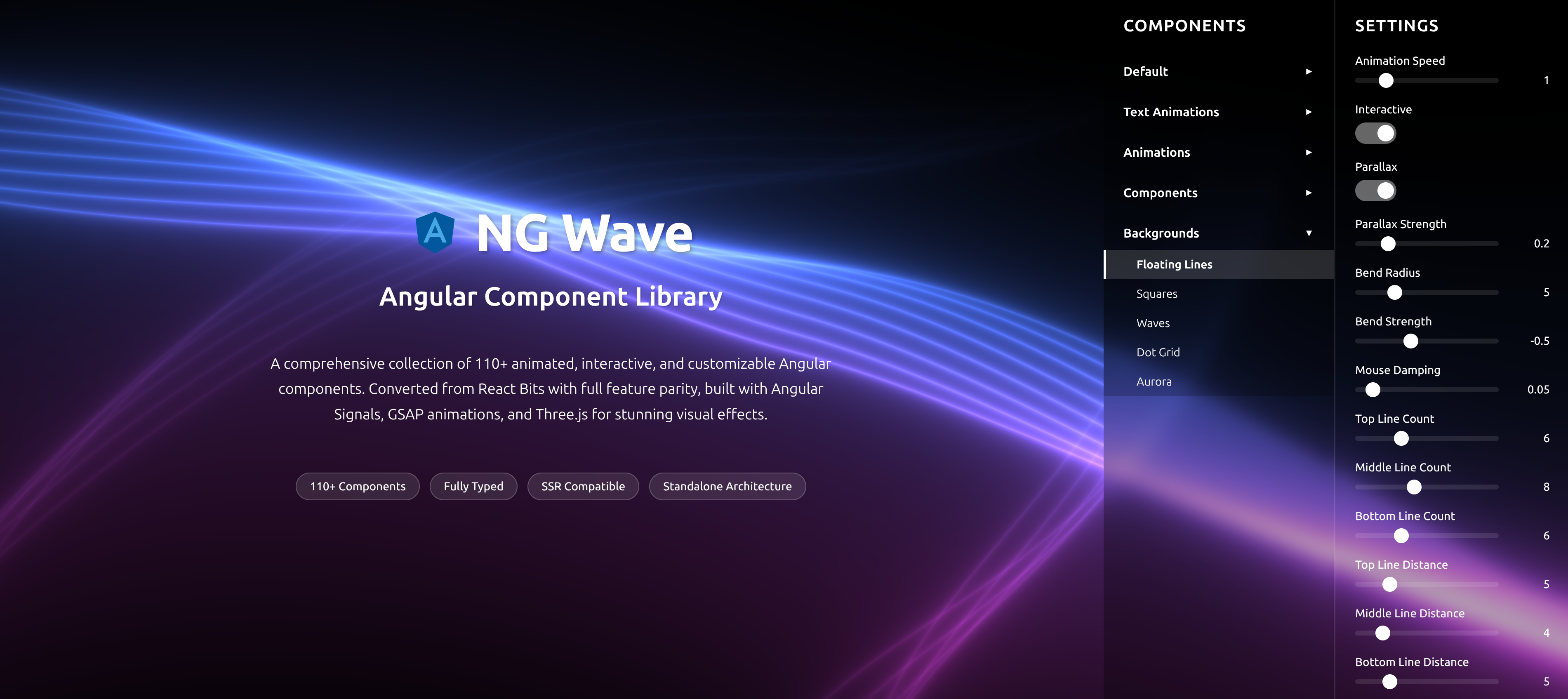
NG Wave
Angular Component Library
A comprehensive collection of 110+ animated, interactive, and customizable Angular components. Converted from React Bits with full feature parity, built with Angular Signals, GSAP animations, and Three.js for stunning visual effects.
Explore Components