Premium Motion in Angular 20+: Animation Timelines, Easing Curves, and prefers-reduced-motion That Respect Performance Budgets
The motion system I ship on enterprise dashboards: consistent timelines, brand-eased transitions, and reduced‑motion fallbacks—measured in CI, fast on low‑end devices, and accessible by default.
Premium motion is clarity delivered at speed: the right timeline, the right curve, and the right to opt out.Back to all posts
I’ve shipped motion systems into dashboards that handle millions of events a day—employee tracking for a global entertainment company, airport kiosks that can’t stutter, and advertising analytics where a jittery chart erodes trust. Premium motion isn’t about adding flair; it’s about clear state transitions that never get in the way of speed or accessibility.
This article shows how I implement animation timelines, easing, and prefers-reduced-motion fallbacks in Angular 20+ with Signals/SignalStore, PrimeNG, and a tokenized visual language. We’ll keep polish aligned with performance budgets, CI guardrails, and AA accessibility—something I insist on when you hire an Angular developer or bring me in as an Angular consultant.
A dashboard that feels premium because motion gets out of the way
As companies plan 2025 Angular roadmaps, a common brief lands in my inbox: “make it feel premium without slowing anything down.” That’s achievable when motion is a system—timelines, curves, and toggles—backed by metrics. In Angular 20+, Signals and a light SignalStore make the implementation predictable and testable.
A quick scene from production
In a telecom ads analytics platform, KPI tiles update every second via WebSockets. Early builds had tiles ‘pop’ and charts stutter. We replaced ad-hoc transitions with a system: timeboxed enter/exit, a shared easing curve, and reduced-motion behavior. The result: calmer perception, higher trust, and cleaner flame charts.
Real-time updates without jitter
Consistent easing across components
Respect user motion preferences
Why Angular motion design matters for enterprise dashboards
If the animation budget clashes with the performance budget, performance wins. The trick is designing motion that enhances clarity while staying within strict thresholds.
Clarity and brand, not decoration
Motion is there to explain state change: rows appear, filters apply, charts rebase. A consistent easing curve and timeline become subtle brand cues, just like color and typography.
Communicate state: selection, load, success, error
Reduce change blindness in live data contexts
Express brand via a consistent curve
Budgets and metrics
We enforce budgets in CI (Lighthouse), validate with Angular DevTools flame charts, and observe in GA4/Firebase. Performance is a feature; motion must respect it.
Micro-interactions ≤ 150ms
Navigation/overlay transitions 200–300ms
Target 60 fps; no long main-thread tasks (>50ms)
Establish a motion system: tokens, timelines, and easing curves
Below is a minimal SCSS token set with reduced-motion handling.
SCSS motion tokens
I encode durations and easings as tokens so Angular components, PrimeNG themes, and charts share the same source of truth.
Durations: fast/standard/slow
Easings: enter, exit, emphasized
Media-aware fallbacks
Timelines per interaction
Lists may stagger 20–30ms per item (cap at 6 for AA tolerance). Charts get a 120–200ms transition on data updates; on reduced motion, snap with crossfade only.
Enter/exit pairs
Staggered lists
Chart update phases
SCSS motion tokens with reduced motion
// tokens/_motion.scss
:root {
  /* Durations */
  --motion-fast: 120ms;
  --motion-standard: 200ms;
  --motion-slow: 280ms;
  --motion-stagger: 24ms;

  /* Easing (cubic-bezier) */
  --ease-enter: cubic-bezier(0.16, 1, 0.3, 1);      // Swift out
  --ease-exit: cubic-bezier(0.4, 0, 0.2, 1);        // Standard material-ish
  --ease-emph: cubic-bezier(0.2, 0.8, 0.2, 1);      // Emphasized
}

@media (prefers-reduced-motion: reduce) {
  :root {
    --motion-fast: 0ms;
    --motion-standard: 0ms;
    --motion-slow: 0ms;
    --motion-stagger: 0ms;
  }

  .reduced-motion * {
    animation-duration: 0ms !important;
    transition-duration: 0ms !important;
  }
}

.fade-in {
  transition: opacity var(--motion-standard) var(--ease-enter);
  will-change: opacity;
}

.slide-in {
  transition: transform var(--motion-standard) var(--ease-enter),
              opacity var(--motion-standard) var(--ease-enter);
  transform: translateY(8px);
  opacity: 0;
}
.slide-in.is-in {
  transform: translateY(0);
  opacity: 1;
}
Angular 20 implementation: Signals, SignalStore, and prefers-reduced-motion
// ui.store.ts
import { signalStore, withState, withMethods, withHooks } from '@ngrx/signals';

export type Density = 'comfortable' | 'compact';
interface UiState {
  reducedMotion: boolean | 'system';
  density: Density;
}

const initial: UiState = { reducedMotion: 'system', density: 'comfortable' };

export const UiStore = signalStore(
  { providedIn: 'root' },
  withState(initial),
  withMethods((store) => ({
    setReducedMotion(v: UiState['reducedMotion']) { store.setState({ ...store(), reducedMotion: v }); },
    setDensity(d: Density) { store.setState({ ...store(), density: d }); },
  })),
  withHooks({
    onInit(store) {
      // hydrate from localStorage
      const raw = localStorage.getItem('ui');
      if (raw) store.setState({ ...store(), ...JSON.parse(raw) });
      store.effect(() => localStorage.setItem('ui', JSON.stringify(store())));
    }
  })
);

// motion.directive.ts
import { Directive, HostBinding, inject, effect, signal } from '@angular/core';
import { UiStore } from './ui.store';

@Directive({ selector: '[appMotionRoot]' })
export class MotionRootDirective {
  private ui = inject(UiStore);
  private systemReduce = signal<boolean>(false);

  constructor() {
    const mq = window.matchMedia('(prefers-reduced-motion: reduce)');
    this.systemReduce.set(mq.matches);
    mq.addEventListener('change', e => this.systemReduce.set(e.matches));

    effect(() => {
      const pref = this.ui.reducedMotion();
      this.reducedMotion = pref === 'system' ? this.systemReduce() : pref;
      this.compact = this.ui.density() === 'compact';
    });
  }

  @HostBinding('class.reduced-motion') reducedMotion = false;
  @HostBinding('class.density-compact') compact = false;
}
<!-- app.component.html -->
<main appMotionRoot>
<!-- Your app -->
</main>SignalStore for UI preferences
Store user preferences in a tiny SignalStore to override system settings responsibly, which is crucial for accessibility and enterprise environments.
Reduced motion override
Density: comfortable/compact
Persist to localStorage
Directive to apply CSS classes
A directive keeps templates clean and works with SSR/Vite without client-side flicker by hydrating early.
HostBinding for .reduced-motion
.density-compact on root
Lightweight and SSR-safe
PrimeNG and Material: align animations to your tokens
// prime.config.ts
import { PrimeNGConfig } from 'primeng/api';
import { inject } from '@angular/core';
import { UiStore } from './ui.store';

export function setupPrimeNG() {
  const config = inject(PrimeNGConfig);
  const ui = inject(UiStore);
  const reduced = ui.reducedMotion() !== 'system' ? ui.reducedMotion() : window.matchMedia('(prefers-reduced-motion: reduce)').matches;

  config.ripple = !reduced; // disable if reduced motion
  config.zIndex = { modal: 1100, overlay: 1000, menu: 1000, tooltip: 1100 }; // typical
}
PrimeNG ripples and overlays
PrimeNG exposes global configs. Keep ripples snappy (120–160ms) and dialogs around 220–260ms. Respect reduced-motion by disabling ripple and shortening overlay transitions.
Configure ripple speed
Dialog/overlay transitions
Toast timings
Material baseline
Even if you use PrimeNG, you may keep Material utilities. Normalize their timings to your tokens for consistency.
SnackBar duration
MatTooltip show/hide delay
Color, typography, and density: the AngularUX visual language
// tokens/_theme.scss
:root {
  --color-sapphire-600: #1C3FAA;
  --color-teal-500:     #14B8A6;
  --color-slate-700:    #334155;
  --color-amber-400:    #F59E0B;
  --color-crimson-500:  #EF4444;

  --space-1: .25rem; --space-2: .5rem; --space-3: .75rem; --space-4: 1rem;
  --radius-2: 8px; --radius-3: 12px;
}

body { font-family: Inter, Roboto, system-ui, sans-serif; }

.density-compact {
  --space-2: .375rem;
  --space-3: .625rem;
}
Color palette
Motion should complement, not compete. Elevation and focus states use subtle 8–12px translate/opacity changes, staying within brand contrast rules.
Sapphire 600 #1C3FAA
Teal 500 #14B8A6
Slate 700 #334155
Amber 400 #F59E0B
Crimson 500 #EF4444
Type and density
Density toggles are class-based (.density-compact) to adjust spacing tokens while keeping legibility. Motion timings don’t change with density, but distances do—shorter travel in compact for perceived speed.
Inter/Roboto 1.25 modular scale
Comfortable vs compact
Touch targets ≥ 40px in compact
Apply motion to visualizations without jitter
// d3 update example
selection
  .transition()
  .duration(parseInt(getComputedStyle(document.documentElement).getPropertyValue('--motion-standard')))
  .ease(d3.easeCubicOut)
  .attr('transform', d => `translate(${x(d.key)}, ${y(d.value)})`)
  .style('opacity', 1);

// Highcharts
Highcharts.setOptions({
  plotOptions: { series: { animation: { duration: 180 } } }
});
D3 enter/update/exit
Animating y or height can trigger layout. Prefer translateY and opacity, or animate scales while the DOM remains stable.
Transform/opacity only
Short 120–160ms updates
Skip tween on reduced motion
Highcharts and Canvas/Three.js
We standardize chart transitions to 160–200ms. For heavy scenes, switch to Canvas or Three.js and cap frame work under 6–8ms.
Set global animation duration
Use requestAnimationFrame
Throttle live updates
Data virtualization and role-based dashboards
Virtual tables should not animate row mounts—only highlight changes. Role-based dashboards (ops vs exec) may use different motion density while sharing tokens.
No animation on virtual row recycle
Subtle highlight on selection
Per-role motion density
Measure and guard-rail motion in CI: Cypress, Lighthouse, Nx
# .github/workflows/ci.yml (excerpt)
name: ci
on: [push, pull_request]
jobs:
  test:
    runs-on: ubuntu-latest
    steps:
      - uses: actions/checkout@v4
      - uses: pnpm/action-setup@v4
      - run: pnpm install
      - run: npx nx run-many -t lint,test,build --parallel=3
      - name: Lighthouse CI
        run: |
          npx @lhci/cli autorun --upload.target=temporary-public-storage
# Cypress reduced-motion hint
CYPRESS_MOTION='reduce' pnpm cypress runReduced-motion test
Emulate reduced-motion and assert that critical elements transition instantly and PrimeNG ripple is disabled.
Assert no CSS animation
Ensure ripple off
Budgets and performance checks
We keep budgets in the repo and run Lighthouse in CI on Firebase previews. Fail fast is cheaper than rolling back production.
Lighthouse CI
Bundle budgets
FPS sanity on key flows
When to hire an Angular developer for legacy UX polish
If you need an Angular consultant or senior Angular engineer to stabilize your visual language and motion system, I’ve done it across kiosks, telematics dashboards, and analytics platforms.
Symptoms I fix
Legacy Angular/AngularJS apps accumulate ad-hoc animations. I replace one-offs with a tokenized system, align libraries, and wire CI gates.
Jittery list updates
Inconsistent timings
A11y complaints about motion
Expected timeline
With Nx and feature flags, we pilot on a few surfaces (nav, dialogs, a chart) and expand. Zero-downtime with Firebase canaries and rollback plans.
Audit in 3–5 days
Pilot in 1–2 weeks
Rollout in phases
Concise takeaways and next steps
- Motion is a system: tokens, timelines, easing, and preferences.
- Respect prefers-reduced-motion and provide a user override via SignalStore.
- Keep animations transform/opacity only, ≤ 200ms, and CI-measured.
- Align PrimeNG/Material and chart libraries to the same tokens.
- Use density and type scales to preserve clarity at any speed.
Ready to discuss your Angular roadmap, or need help to make motion feel premium without breaking performance? Let’s review your build.
Key takeaways
- Define motion tokens (durations, delays, easings) and reuse across Angular, PrimeNG, and charts for consistency.
- Detect prefers-reduced-motion and provide zero- or low-motion alternatives with a user override stored in SignalStore.
- Use performance budgets, FPS checks, and CI gates (Lighthouse, Cypress) to ensure motion never regresses UX.
- Animate transform/opacity only; avoid layout thrash. Keep micro-interactions under 150ms, navigations 200–300ms.
- Integrate motion with density and typography scales so compact views remain legible and performant.
- Instrument with Angular DevTools and GA4 to correlate motion with engagement, errors, and Core Web Vitals.
Implementation checklist
- Inventory all animated surfaces (nav, modals, tables, charts, toasts).
- Create SCSS motion tokens: durations, delays, easings, and scales (fast/standard/slow).
- Wire a SignalStore for user overrides (reduced motion, compact density).
- Implement @media (prefers-reduced-motion) fallbacks and class-based overrides.
- Constrain animations to transform/opacity; test 60 fps on low-end devices.
- Add CI gates: Lighthouse budgets, Cypress reduced-motion tests, and bundle size checks.
- Tune PrimeNG/Material animation configs to your tokens.
- Standardize chart transitions (D3/Highcharts/Canvas) to use the same durations and easings.
- Log motion preferences and animation errors to Firebase/GA4 for observability.
- Document the system with usage guidelines and code examples in your design system.
Questions we hear from teams
- What’s a reasonable cost and timeline to hire an Angular developer for motion and UX polish?
- Typical engagements run 2–6 weeks depending on scope. An audit with pilot components usually fits in 1–2 weeks. Pricing varies by complexity and team needs; I’m a remote Angular consultant and can scope a fixed-price audit within 48 hours.
- How do you ensure animations don’t hurt performance?
- I constrain to transform/opacity, set strict duration budgets, and instrument with Angular DevTools and Lighthouse in CI. We run Firebase preview checks and GA4 telemetry to validate FPS and user impact before rollout.
- How is prefers-reduced-motion handled in Angular apps?
- Use @media queries for CSS fallbacks and a small SignalStore to manage a user override. Add a root class like .reduced-motion, disable PrimeNG ripples, and shorten overlays. Test in Cypress with mocked media queries.
- Can you align D3/Highcharts animations with the app’s motion tokens?
- Yes. Read durations from CSS variables, set chart library defaults to those values, and skip tweens when reduced-motion is on. For heavy scenes, prefer Canvas/Three.js and cap per-frame work.
- What’s included in a typical motion system deliverable?
- SCSS tokens for motion/color/spacing, a UiStore with preferences, directives for class toggles, PrimeNG/Material configuration, chart presets, CI checks (Lighthouse/Cypress), and documentation in your Nx repo’s design system.
Ready to level up your Angular experience?
Let AngularUX review your Signals roadmap, design system, or SSR deployment plan.
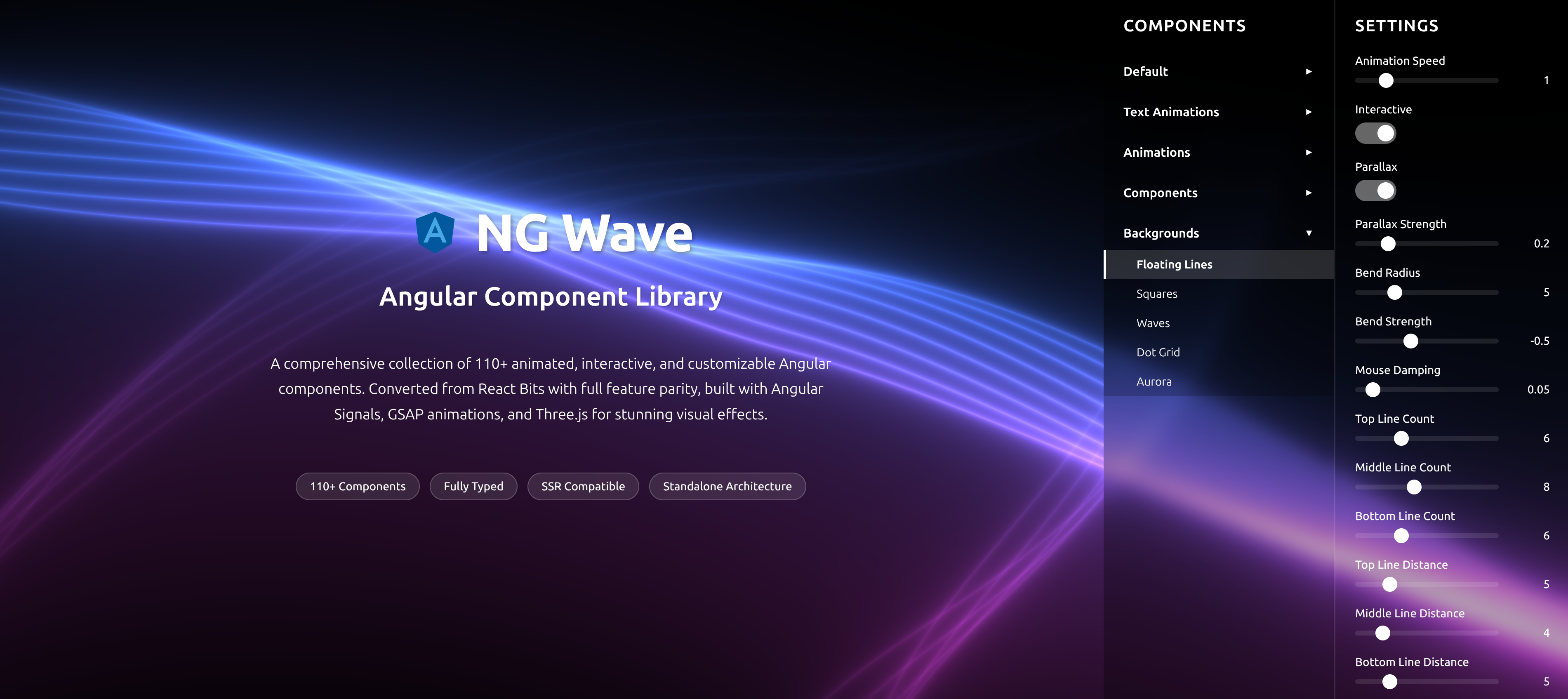
NG Wave
Angular Component Library
A comprehensive collection of 110+ animated, interactive, and customizable Angular components. Converted from React Bits with full feature parity, built with Angular Signals, GSAP animations, and Three.js for stunning visual effects.
Explore Components