Premium Motion in Angular 20+: Timeline Choreography, Easing Tokens, and prefers-reduced-motion Fallbacks That Respect Performance
Animation that feels intentional, inclusive, and fast—backed by tokens, Signals, and CI guardrails.
Premium motion is the quiet engineer: it orients, never distracts, and respects user preferences.Back to all posts
I’ve shipped motion in places where it can’t be cute—it has to be honest. a global entertainment company employee tooling that needs fast orientation; United’s airport kiosks where vestibular issues and offline flows are real; Charter’s ad dashboards where 60fps matters during busy hours. Premium motion is the quiet engineer that guides attention without stealing it.
As companies plan 2025 Angular roadmaps, your animation system needs the same rigor as your design tokens. Below is how I build timeline choreography, easing tokens, and prefers-reduced-motion fallbacks in Angular 20+ with Signals, PrimeNG, Nx, and Firebase—polish that coexists with performance budgets.
When Motion Feels Cheap: The Dashboard Jitters Story
Cheap motion is inconsistent motion—mixed easings, long fades, and layout-affecting transitions that jitter under load. The cure is a motion system, not one-off CSS.
Real-world snapshots
The fix was systemic: unify easing, reduce durations, and choreograph enter/exit with staggers. Motion stopped drawing attention to itself and started reinforcing information hierarchy.
a global entertainment company: bulk approvals UI jittered on filter change; users lost context.
United kiosks: parallax and long fades triggered nausea for some travelers.
Charter: overlay panels eased differently than cards—felt inconsistent.
Why Animation Timelines and Easing Matter in Angular 20+
If you’re shipping role-based, multi-tenant dashboards, motion is part of the visual language—just like typography and color. It needs tokens, docs, and guardrails.
What the team gets
On real-time dashboards (D3/Highcharts, WebSocket updates), timelines prevent data thrash from feeling chaotic. Motion becomes a compression layer for change—especially with role-based variants where different personas see different density and module stacks.
Orientation: enter/exit timelines tell the brain what changed.
Hierarchy: faster, shorter easing for minor UI; longer, emphasized for modal/alerts.
Performance: transform/opacity keep frames smooth even with real-time data.
Build a Motion System with Tokens, Signals, and PrimeNG
Define the contract first: durations, easings, and naming that maps to intent (fast, standard, slow, emphasized). Then connect those tokens to Angular runtime via Signals and to PrimeNG overlays.
Motion tokens in SCSS
Use CSS variables for runtime flexibility and Storybook controls.
Signals-driven motion preferences
Detect prefers-reduced-motion once, expose as a signal, and wire to components and third‑party libs.
PrimeNG ripple and overlay integration
Disable ripple and reduce overlay animations when reduced motion is requested.
SCSS Motion Tokens and Density-Aware Durations
:root {
  /* Durations */
  --motion-fast: 120ms;
  --motion-standard: 200ms;
  --motion-slow: 320ms;
  --motion-emph: 480ms;

  /* Easings */
  --ease-standard: cubic-bezier(.2, 0, 0, .9);
  --ease-out: cubic-bezier(0, 0, .2, 1);
  --ease-in: cubic-bezier(.4, 0, 1, 1);
  --ease-emph: cubic-bezier(.2, .7, 0, 1);
}

/* Density modifier */
[data-density="compact"] {
  --motion-fast: 100ms;
  --motion-standard: 170ms;
  --motion-slow: 260ms;
}

/***** AngularUX color palette hooks *****/
:root {
  --ux-surface: #0f1221;
  --ux-elev-1: #161a2e;
  --ux-primary: #6c8cff;
  --ux-accent:  #00d3a7;
}

.card {
  background: var(--ux-elev-1);
  color: #fff;
  transition: transform var(--motion-standard) var(--ease-out),
              box-shadow var(--motion-standard) var(--ease-out);
  will-change: transform;
}
.card:hover { transform: translateY(-2px); }
Tokens with density scaling
Map motion to density so the UI feels cohesive across compact/comfortable modes.
Compact UIs feel faster: shorten durations by ~10-15%.
Respect color and typography tokens; keep focus rings instant.
prefers-reduced-motion in Angular: CSS and Runtime Fallbacks
@media (prefers-reduced-motion: reduce) {
  :root {
    --motion-fast: 0ms;
    --motion-standard: 0ms;
    --motion-slow: 0ms;
    --motion-emph: 0ms;
  }
  .parallax, .bg-video { display: none !important; }
}
// motion-prefs.service.ts (Angular 20+, Signals)
import { Injectable, effect, signal } from '@angular/core';
@Injectable({ providedIn: 'root' })
export class MotionPrefsService {
private mq = matchMedia('(prefers-reduced-motion: reduce)');
readonly reduced = signal(this.mq.matches);
constructor() {
const onChange = (e: MediaQueryListEvent) => this.reduced.set(e.matches);
this.mq.addEventListener('change', onChange);
}
}// app.component.ts
import { Component, inject, Signal } from '@angular/core';
import { MotionPrefsService } from './motion-prefs.service';
import { PrimeNGConfig } from 'primeng/api';
@Component({ selector: 'app-root', template: '<router-outlet />' })
export class AppComponent {
private motion = inject(MotionPrefsService);
private pConfig = inject(PrimeNGConfig);
constructor() {
// Toggle ripple globally
this.motion.reduced.subscribe((isReduced) => {
this.pConfig.ripple = !isReduced;
document.body.classList.toggle('reduced-motion', isReduced);
});
}
}CSS baseline
Set durations to 0ms.
Remove parallax, heavy shadows, and background videos.
Signals-based preference service
Expose a signal for components and libs.
Apply a body class for pure CSS toggles.
PrimeNG & charts integration
Turn off ripple via PrimeNGConfig.
Disable Highcharts/D3 transitions when reduced.
Choreography: Enter/Exit, Stagger, and Parent-Child Timelines
// motion-tokens.ts
export const MOTION = {
  fast: 120,
  standard: 200,
  slow: 320,
  emph: 480,
  ease: {
    standard: 'cubic-bezier(.2, 0, 0, .9)',
    out: 'cubic-bezier(0, 0, .2, 1)',
    in: 'cubic-bezier(.4, 0, 1, 1)'
  }
};

// list.animations.ts
import { trigger, transition, style, animate, query, stagger } from '@angular/animations';

export const listStagger = trigger('listStagger', [
  transition(':enter', [
    query(':enter', [
      style({ opacity: 0, transform: 'translateY(8px)' }),
      stagger(40, [
        animate(`${MOTION.standard}ms ${MOTION.ease.out}`,
          style({ opacity: 1, transform: 'none' }))
      ])
    ], { optional: true })
  ]),
  transition(':leave', [
    query(':leave', [
      stagger(-20, [
        animate(`${MOTION.fast}ms ${MOTION.ease.in}`,
          style({ opacity: 0, transform: 'translateY(8px)' }))
      ])
    ], { optional: true })
  ])
]);<ul [@listStagger]>
<li *ngFor="let item of items">{{ item.label }}</li>
</ul>Angular animations with shared tokens
Use accelerate-in for exit, decelerate-out for enter.
Keep delays short (20–40ms) for lists.
Avoid layout jank
Animate transform/opacity, not height/width/margins.
Reserve space to avoid CLS.
Data Visualization: Animations that Feel Premium, Not Gimmicky
// highcharts-options.ts
import { MOTION } from './motion-tokens';
import * as Highcharts from 'highcharts';

export function makeChartOptions(reduced: boolean): Highcharts.Options {
  return {
    chart: { animation: !reduced },
    plotOptions: {
      series: {
        animation: reduced ? false : { duration: MOTION.standard },
        turboThreshold: 0
      }
    }
  };
}
// d3-transitions.ts
import { select, easeCubicOut, easeCubicIn } from 'd3';
import { MOTION } from './motion-tokens';
export function renderBars(svg: SVGSVGElement, data: any[], reduced: boolean) {
const t = reduced ? 0 : MOTION.standard;
const g = select(svg).select('g#bars');
const bars = g.selectAll('rect').data(data, (d: any) => d.id);
bars.enter()
.append('rect')
.attr('opacity', 0)
.attr('y', d => d.y)
.attr('height', d => d.h)
.attr('x', d => d.x)
.attr('width', d => d.w)
.transition().duration(t).ease(easeCubicOut)
.attr('opacity', 1);
bars.exit()
.transition().duration(t).ease(easeCubicIn)
.attr('opacity', 0)
.remove();
}Highcharts/Angular
Respect reduced motion by disabling animation.
Shorten add/remove transitions to keep context.
D3 transitions
Use easeCubicOut for enter; easeCubicIn for exit.
Batch joins; never animate 100k rows—animate aggregates.
Performance Budgets: transform-only and CI Guardrails
/* Avoid animating layout-affecting properties */
.nav-drawer {
  transform: translateX(-100%);
  transition: transform var(--motion-standard) var(--ease-out);
}
.nav-drawer--open { transform: none; }
# .github/workflows/ci.yml (Nx + Lighthouse)
- name: Lighthouse budget
run: npx lhci autorun --config=./lighthouserc.json// Firebase Performance: measure motion blocking
const start = performance.now();
const off = () => {
const dur = performance.now() - start;
// @ts-ignore trace API
const trace = (window as any).firebase.performance().trace('anim_blocking');
trace.putMetric('duration_ms', Math.round(dur));
trace.stop();
};
document.addEventListener('animationend', off, { once: true });Style discipline
Transform/opacity only; avoid filter/box-shadow during motion.
Reserve layout space; prevent CLS.
Measure and enforce
Lighthouse budgets in CI.
Firebase custom traces for nav-to-stable and anim-blocking time.
Accessibility, Typography, Density, and the AngularUX Palette
Accessibility isn’t a feature flag—it’s the default. We never animate focus, we limit color shifts, and we preserve system preferences at the token layer. Typography scale and density controls apply corresponding duration tweaks so the interface feels coherent across roles and tenants.
AA first
Focus rings never animated.
Color transitions stay within AA contrast.
Typography + density
AngularUX’s palette (primary #6c8cff, accent #00d3a7) works well with subtle elevation and transform. Keep hover the only color change; use transform for movement.
Compact density uses shorter durations.
Large-display dashboards can stretch to 240–280ms for readability.
When to Hire an Angular Developer for Legacy Rescue
If your app jitters, I can help unify motion, eliminate layout thrash, and wire telemetry so design and engineering agree on what “premium” means in numbers.
Bring in an Angular consultant when
I’ve stabilized chaotic codebases at a global entertainment company, a broadcast media network, and Charter by centralizing motion tokens, aligning Angular animations, and fixing SSR hydration flashes that made motion feel broken.
Animations cause CLS or flicker on route changes.
PrimeNG overlays feel inconsistent across pages.
Charts and tables animate heavy datasets and stall rendering.
Reduced-motion isn’t respected in modals/overlays/viz.
How an Angular Consultant Approaches Motion Migration
Motion migration is quick ROI: 1–2 weeks for tokens + pref hooks, 2–4 for choreography and CI guardrails depending on surface area.
Step-by-step
On United’s kiosks we used Docker-based hardware simulation for scanners/printers, then verified motion with offline scenarios—ensuring no animation depended on network timing. Same rigor works for enterprise dashboards.
Audit: DevTools frames, Angular DevTools, GA4 funnels.
Tokenize: durations/easing in SCSS + TS constants.
Implement: Signals prefs, PrimeNG hooks, chart toggles.
Guard: Lighthouse budgets, Cypress reduced-motion spec.
Concise Takeaways
- Motion is a system: tokens, timelines, and telemetry.
- prefers-reduced-motion is non-negotiable—CSS and runtime.
- Keep to transform/opacity and short durations (120–200ms) for most UI.
- Integrate PrimeNG, D3/Highcharts, and data virtualization with the same motion contract.
- Measure polish: Firebase traces, Lighthouse budgets, and Angular DevTools render counts.
Key takeaways
- Design motion as a system: duration/ease tokens + timeline patterns (enter/exit/stagger).
- Respect prefers-reduced-motion in CSS and runtime (disable ripple/charts/transforms).
- Use transform/opacity-only animations; avoid layout thrash to preserve 60fps.
- Plug motion into telemetry: measure nav-to-stable and animation-blocking time with Firebase.
- Scale polish with PrimeNG, Highcharts/D3, and Signals without breaking performance budgets.
Implementation checklist
- Define motion tokens: durations (120/200/320/480ms) and standard/in/out/emphasized easing.
- Implement a Signals-based MotionPrefs service and a directive/class hook.
- Honor prefers-reduced-motion: set durations to 0ms, disable ripple/parallax/chart transitions.
- Choreograph sequences: enter/exit, stagger, parent-child handoffs with Angular animations.
- Integrate with PrimeNG overlays and Highcharts/D3 transitions using tokens.
- Guard with CI: Lighthouse budgets, Cypress reduced-motion spec, and Firebase custom traces.
Questions we hear from teams
- How much does it cost to hire an Angular developer for a motion system?
- Most teams land between 2–6 weeks depending on scope: tokens + reduced-motion (1–2 weeks), choreography + PrimeNG/charts integration (1–3 weeks), and CI guardrails (1 week). Fixed-scope assessments are available after a 45‑minute discovery call.
- What does prefers-reduced-motion support require in Angular?
- Two layers: CSS media query to zero-out durations and a Signals-based runtime to disable ripple, chart transitions, and non-essential transforms. Add a body class for pure CSS toggles and ensure focus states remain instant.
- Will animations hurt performance budgets?
- Not if you stick to transform/opacity with short durations, avoid layout-affecting properties, and test with Lighthouse + DevTools. In practice, motion can improve perceived performance by clarifying changes and reducing cognitive load.
- How long does an Angular motion migration take?
- Tokens and reduced-motion hooks ship in 1–2 weeks. Complex timeline choreography across overlays, lists, and route transitions typically adds 1–3 weeks. I align this with Nx CI and Firebase metrics to prove impact.
- What’s included in a typical engagement?
- Audit, motion tokens, Signals preference service, PrimeNG/charts integration, example timelines, CI guardrails (Lighthouse budgets, Cypress spec), and telemetry via Firebase Performance or GA4 to quantify before/after. Documentation and handoff included.
Ready to level up your Angular experience?
Let AngularUX review your Signals roadmap, design system, or SSR deployment plan.
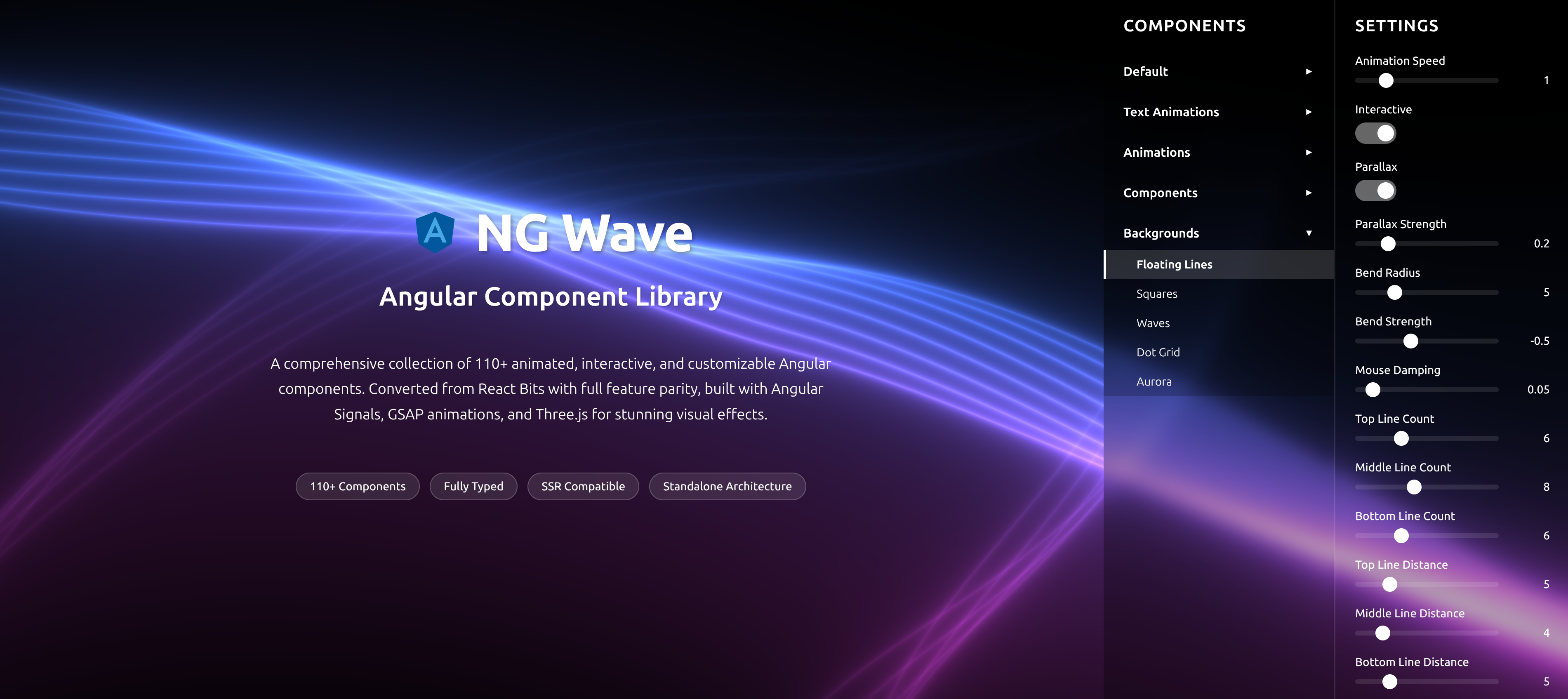
NG Wave
Angular Component Library
A comprehensive collection of 110+ animated, interactive, and customizable Angular components. Converted from React Bits with full feature parity, built with Angular Signals, GSAP animations, and Three.js for stunning visual effects.
Explore Components